AI Compliance —
ISO 42001: The Complete Guide to AI Management System Certification
ISO 42001 is the global standard for AI management systems. Learn what it requires, how it maps to ISO 27001, and how to certify your AI systems
Jon Ozdoruk
AI Regulatory Compliance
Share this article


ISO 42001: AI Management System Certification
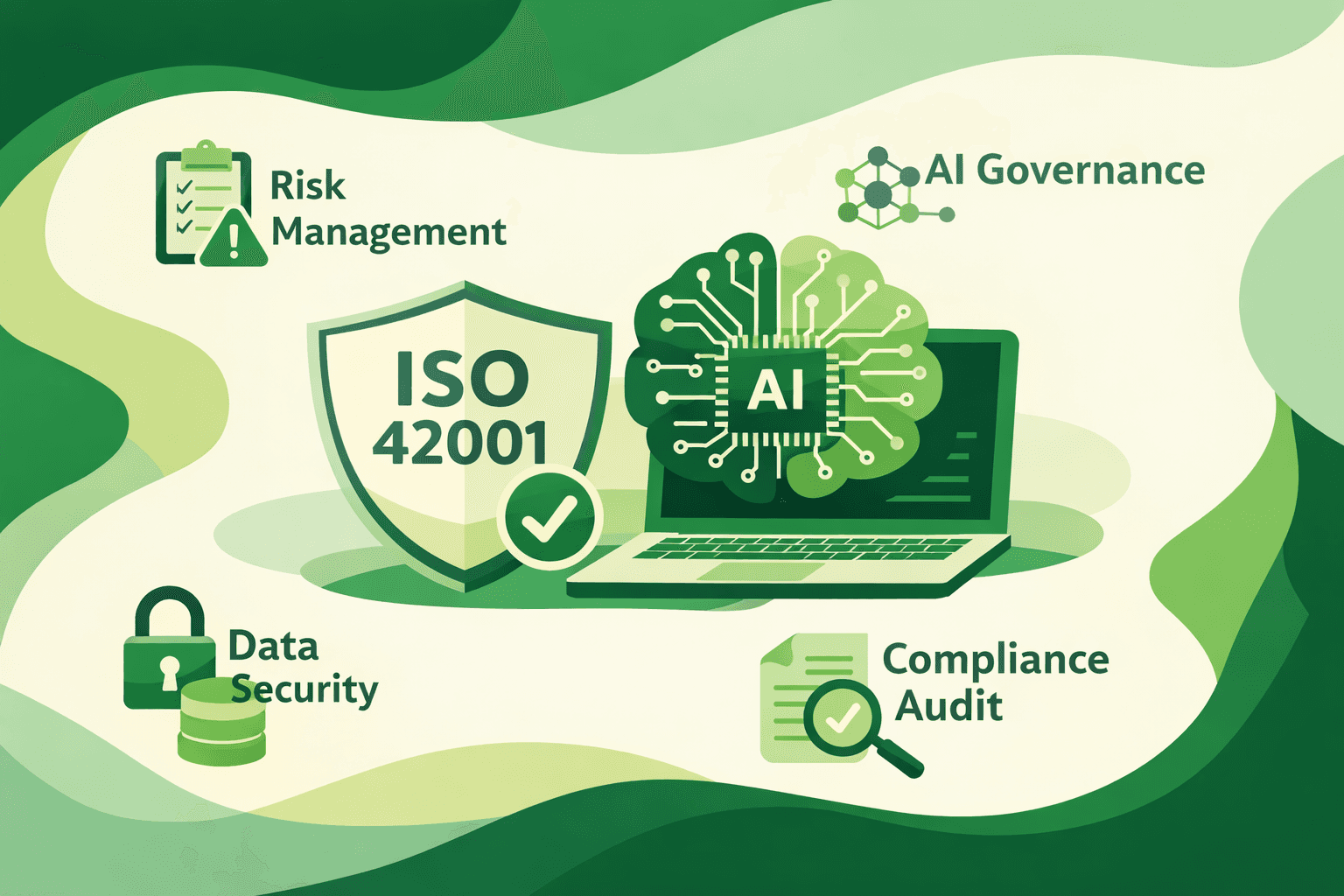
ISO 42001 is the first internationally recognized standard for Artificial Intelligence Management Systems — published in December 2023 and already the fastest-growing certification request among AI companies, SaaS platforms, and enterprises deploying AI at scale. If your organization builds AI products, integrates large language models into customer-facing workflows, or uses AI systems in consequential decision-making, ISO 42001 is the framework that gives customers, regulators, and enterprise buyers documented confidence that your AI is governed responsibly. This guide explains exactly what ISO 42001 requires, how it maps to ISO 27001 and the EU AI Act, and the implementation roadmap for organizations certifying in 2026.
What ISO 42001 Is and Why It Exists
Every major AI deployment now faces the same question from enterprise buyers, boards, and regulators: how do we know this AI system is being governed responsibly? Until December 2023, there was no internationally recognized standard that answered that question with the same authority that ISO 27001 brings to information security.
ISO 42001 fills that gap. Published by the International Organization for Standardization, it establishes requirements for an Artificial Intelligence Management System — a structured, documented, and auditable framework for managing the development, deployment, and ongoing oversight of AI systems across an organization.
The standard was designed with a specific recognition built in: AI introduces risks that existing management system standards do not fully address. The opacity of machine learning models, the potential for algorithmic bias, the difficulty of explaining AI-generated decisions, the shifting nature of AI system behavior over time — these are governance challenges that ISO 27001's information security controls were not designed to handle. ISO 42001 addresses them directly.
Who Needs ISO 42001
ISO 42001 is relevant to any organization that develops, provides, or uses AI systems in a meaningful capacity. In practice, the organizations with the most urgent need fall into four categories.
AI product companies building software that incorporates machine learning, generative AI, or automated decision-making are facing increasing customer due diligence requests that specifically ask about AI governance frameworks. ISO 42001 certification is becoming the standard response to those requests, just as ISO 27001 was to information security questionnaires a decade ago.
Enterprises deploying AI at scale — financial services firms using AI for credit decisions, healthcare organizations using AI for clinical support, HR platforms using AI for recruitment — are subject to regulatory scrutiny that requires demonstrable governance. ISO 42001 provides the audit trail.
Government and defense contractors increasingly face procurement requirements that demand evidence of responsible AI practices. ISO 42001 certification is emerging as a qualifying criterion for public-sector AI procurement across the EU, the UK, and Singapore.
Companies navigating EU AI Act obligations will find that ISO 42001 provides substantial coverage for the governance requirements imposed on high-risk AI system providers. While ISO 42001 certification does not automatically satisfy EU AI Act obligations, the overlap is significant enough that organizations building an ISO 42001-compliant AI management system will be well positioned for regulatory conformity assessments.
The Core Requirements of ISO 42001
ISO 42001 follows the High Level Structure used by all modern ISO management system standards — the same architecture as ISO 27001, ISO 9001, and ISO 14001. This means organizations already certified to ISO 27001 will find the structural logic familiar. The specific requirements, however, are unique to AI.
Organizational Context and AI Policy
ISO 42001 requires organizations to define their organizational context for AI — understanding the internal and external factors that shape how AI is developed and used, identifying the interested parties whose needs and expectations matter, and defining the scope of the AI management system.
This culminates in a formal AI policy: a documented statement of the organization's commitment to responsible AI, aligned with its strategic objectives and covering the principles of fairness, transparency, accountability, safety, and privacy that should govern AI across the organization.
The AI policy is not a marketing document. It is an operational commitment that the rest of the management system is built to implement and demonstrate.
AI Risk Assessment and Treatment
The heart of ISO 42001's requirements is a systematic process for identifying, assessing, and treating risks specific to AI systems. This goes beyond the information security risk assessment familiar from ISO 27001. AI-specific risks include model bias and discriminatory outputs; lack of explainability in decision-making; failures in data quality and representativeness; model drift over time; adversarial attacks and prompt injection; privacy risks from training data; and the potential for AI systems to cause physical, psychological, financial, or societal harm.
For each AI system in scope, organizations must conduct a documented risk assessment that considers the context of use, the potential impact on affected individuals and communities, the likelihood of harm, and the controls in place to mitigate identified risks.
The risk treatment plan documents how identified risks are addressed through technical controls, process controls, policy constraints on use cases, human oversight mechanisms, or acceptance with documented rationale.
AI Objectives and Planning
ISO 42001 requires organizations to establish measurable AI objectives — specific, trackable targets for responsible AI performance that are consistent with the AI policy and regularly reviewed. These might include bias-metric thresholds for specific models, explainability coverage targets, incident-response time objectives, or training completion rates for AI governance programs.
The planning process connects objectives to the resources, responsibilities, timelines, and evaluation methods needed to achieve them. This is what turns a policy statement into an operating program.
Operational Controls for AI Systems
The operational requirements of ISO 42001 cover the full AI lifecycle — from initial concept and data sourcing through model development, testing, deployment, monitoring, and decommissioning.
Key operational controls include documented data governance requirements covering the sourcing, quality assessment, and bias evaluation of training data; model development standards covering validation, testing against defined performance and fairness metrics, and documentation of model architecture and limitations; deployment controls covering human oversight mechanisms, monitoring configurations, and escalation procedures; and post-deployment monitoring covering ongoing performance assessment, bias monitoring, incident detection, and model update procedures.
These controls are where ISO 42001 does the most work. They translate the governance principles in the AI policy into the documented practices that auditors can verify, and customers can rely on.
Impact Assessment
One of ISO 42001's most distinctive requirements is the AI impact assessment — a structured evaluation of the potential impacts of an AI system on individuals, groups, and society, conducted before deployment and whenever significant changes are made.
The impact assessment considers the context and purpose of the AI system, the population it affects, the potential for discriminatory or harmful outputs, the availability of human review and redress mechanisms, and the proportionality of the AI system's use to its intended benefit. For high-impact applications — credit scoring, hiring, healthcare triage, criminal justice — the assessment is a substantial exercise requiring cross-functional input and documented sign-off.
This requirement maps directly to the EU AI Act's fundamental rights impact assessment obligation for high-risk AI systems, making ISO 42001 a natural foundation for EU AI Act compliance work.
Internal Audit and Management Review
Like all ISO management system standards, ISO 42001 requires a program of internal audits to verify that the AI management system is implemented effectively and that controls are operating as intended. Internal auditors need to understand both the management system requirements and the technical realities of AI systems — a skills combination that most organizations will need to build deliberately.
Management review requires senior leadership to regularly assess the performance of the AI management system, review audit findings, evaluate the continued appropriateness of the AI policy, and make resource allocation decisions to support the system's objectives.
ISO 42001 vs ISO 27001: How They Relate
For organizations already holding ISO 27001 certification, the most common question about ISO 42001 is whether it replaces, extends, or duplicates their existing certification. The answer is that it extends — and the integration is more natural than it might initially appear.
ISO 27001 governs information security across an organization's information assets. It addresses confidentiality, integrity, and availability of information. When AI systems are deployed, ISO 27001's controls provide important foundational protection — securing training data, protecting model infrastructure, managing access controls for AI platforms, and addressing the security of AI-generated outputs.
What ISO 27001 does not address is the AI-specific governance dimension: the fairness of model outputs, the explainability of AI decisions, the evaluation of bias in training data, the impact assessment on affected populations, or the oversight mechanisms needed for autonomous AI systems. These are the gaps ISO 42001 fills.
In structural terms, an organization implementing both standards will find substantial overlap in its management system infrastructure — context analysis, risk assessment processes, documentation requirements, internal audit programs, management review, and continual improvement cycles all follow the same High-Level Structure. The ISO 42001 implementation effort for an existing ISO 27001 organization is meaningfully smaller than a standalone implementation, as the infrastructure already exists.
The practical integration approach is to extend the existing ISMS scope to incorporate AI-specific controls and processes, add AI risk assessment as a specialized track within the existing risk management process, and integrate AI objectives and performance monitoring into existing management review cycles.
ISO 42001 and the EU AI Act: The Overlap
The EU AI Act and ISO 42001 were developed in parallel, with awareness of each other, and their alignment is substantial — though not complete.
For organizations building or deploying high-risk AI systems under the EU AI Act, the conformity assessment process requires documentation of risk management systems, data governance practices, technical documentation of AI systems, transparency and human oversight mechanisms, and accuracy and robustness testing. ISO 42001's requirements cover all of these areas directly.
ISO 42001 certification does not automatically satisfy EU AI Act conformity assessment obligations — the Act requires engagement with designated notified bodies for certain high-risk categories. However, organizations with a functioning ISO 42001 AI management system will enter the conformity assessment process with the documentation, processes, and governance infrastructure required by the assessment, significantly reducing both the effort and the risk of nonconformity findings.
For organizations building their EU AI Act compliance program, implementing ISO 42001 first is the most efficient path — it lays the governance foundation that both the standard and the regulation require, rather than developing them in parallel.
The ISO 42001 Implementation Roadmap
Organizations implementing ISO 42001 in 2026 should plan for a structured program across three phases.
Phase 1 — Foundation (Weeks 1 to 6)
The foundation phase establishes the organizational context for the AI management system, defines the scope, and conducts the initial gap analysis against ISO 42001 requirements. For organizations with existing ISO 27001 programs, this phase assesses what management system infrastructure can be leveraged and what AI-specific elements need to be built.
Key deliverables include the AI management system scope statement, the AI policy, the initial AI system inventory covering all AI systems within scope, and the gap analysis report identifying the specific controls and processes that need to be developed.
Phase 2 — Build (Weeks 7 to 18)
The build phase implements the specific requirements of ISO 42001. This is the most resource-intensive phase and includes developing the AI risk assessment methodology and conducting initial assessments for all in-scope AI systems, building the data governance framework covering training data quality, bias evaluation, and data sourcing standards, implementing impact assessment processes and conducting initial assessments for high-impact AI systems, establishing operational controls for AI development, testing, deployment, and monitoring, and developing the internal audit program and competency framework.
Phase 3 — Audit and Certification (Weeks 19 to 26)
The certification phase begins with an internal audit to verify that the AI management system is implemented effectively and that all required controls are operating. Findings from the internal audit feed into a management review and a corrective action process before external certification.
External certification involves a Stage 1 audit — a documentation review conducted by an accredited certification body — followed by a Stage 2 audit that verifies implementation in practice. Certification is issued when the auditor confirms conformance to ISO 42001 requirements, typically accompanied by a list of minor observations and opportunities for improvement.
The Business Case for ISO 42001 Certification
The argument for ISO 42001 certification is not purely defensive. Organizations that certify early in their market's adoption curve gain a meaningful competitive advantage that compounds over time.
Enterprise procurement processes in financial services, healthcare, and government are already beginning to include AI governance questions in vendor security questionnaires. ISO 42001 certification provides a single, internationally recognized answer to those questions — just as ISO 27001 transformed the enterprise sales process for SaaS companies a decade ago.
For AI product companies in regulated industries, certification also accelerates sales cycles by reducing customers' due diligence burden. A customer who would otherwise spend six weeks reviewing your AI governance documentation can instead rely on a certification from an accredited body — and close the contract faster.
Research from Microsoft's 2025 Responsible AI Transparency Report found that organizations with mature responsible AI programs reported improvements in customer trust, brand reputation, and enterprise sales confidence. ISO 42001 provides the documented, auditable evidence of that maturity.
How DSALTA Supports ISO 42001 Implementation
DSALTA's AI compliance platform is built for exactly the cross-framework complexity that ISO 42001 introduces for organizations already managing ISO 27001, SOC 2, or HIPAA programs.
With DSALTA, organizations implementing ISO 42001 can leverage their existing compliance infrastructure — risk assessment workflows, documentation management, evidence collection, and audit programs — and extend them to cover ISO 42001's AI-specific requirements without rebuilding from scratch. DSALTA's framework library includes the AI policy templates, risk assessment methodologies, impact assessment frameworks, and operational control documentation required by the standard.
For organizations pursuing both ISO 42001 and EU AI Act compliance simultaneously, DSALTA's cross-framework mapping identifies where a single control satisfies both requirements — eliminating duplicate work and accelerating the path to certification.
Key Takeaways
ISO 42001 is the international standard for AI management systems and the emerging benchmark for demonstrable AI governance among enterprise AI companies. Organizations building AI products, deploying AI in regulated industries, or navigating EU AI Act obligations will find ISO 42001 to be the most efficient path to the governance infrastructure required by all three scenarios.
For organizations with existing ISO 27001 programs, implementation effort is meaningfully reduced by the shared management system architecture. The competitive advantage of early certification — in enterprise sales cycles, procurement qualification, and regulatory positioning — rewards organizations that move in 2026 rather than waiting for the market to mandate it.
Frequently Asked Questions
What is ISO 42001? ISO 42001 is the international standard for Artificial Intelligence Management Systems, published in December 2023. It specifies requirements for establishing, implementing, maintaining, and continually improving an AI management system — a structured framework for the responsible development, deployment, and oversight of AI systems.
Who should get ISO 42001 certified? Any organization that develops AI products, deploys AI in consequential decision-making, or provides AI-powered services to enterprise or regulated-industry customers should consider ISO 42001 certification. It is particularly valuable for organizations that already hold ISO 27001 certification and are expanding into AI.
How does ISO 42001 relate to ISO 27001? ISO 27001 covers information security management. ISO 42001 extends governance specifically to AI systems — covering fairness, explainability, bias evaluation, impact assessment, and AI-specific risk management that ISO 27001 was not designed to address. The two standards share a common High-Level Structure, making integrated implementation more efficient.
Does ISO 42001 certification satisfy EU AI Act requirements? ISO 42001 certification provides substantial coverage of the EU AI Act's governance obligations, but does not automatically satisfy the Act's conformity assessment requirements for high-risk AI systems. Organizations implementing ISO 42001 will enter EU AI Act conformity assessment with the documentation and governance infrastructure required for the assessment.
How long does ISO 42001 certification take? For organizations with existing ISO 27001 programs, ISO 42001 certification typically takes six to nine months from gap analysis to certification. Organizations implementing from scratch should plan for 9 to 12 months, depending on the complexity and the number of AI systems in scope.
How does DSALTA help with ISO 42001 implementation? DSALTA provides the policy templates, risk assessment frameworks, impact assessment tools, and evidence collection automation needed to build an ISO 42001-compliant AI management system. For organizations already using DSALTA for ISO 27001, extending coverage to ISO 42001 leverages existing compliance infrastructure with targeted AI-specific additions.
DSALTA is an AI compliance software company helping organizations build audit-ready AI governance programs for ISO 42001, ISO 27001, SOC 2, HIPAA, GDPR, and the EU AI Act. Learn more at dsalta.com.


Explore more AI Compliance articles
Stop losing deals to compliance.
Get compliant. Keep building.
Join 100s of startups who got audit-ready in days, not months.