AI Compliance —
AI revolutionizing - SOC2 Compliance
See how AI is revolutionizing SOC 2 compliance in 2025. Discover tools, trends, and best practices that save time and cost.
John Ozdemir
SOC 2 & AI
Share this article


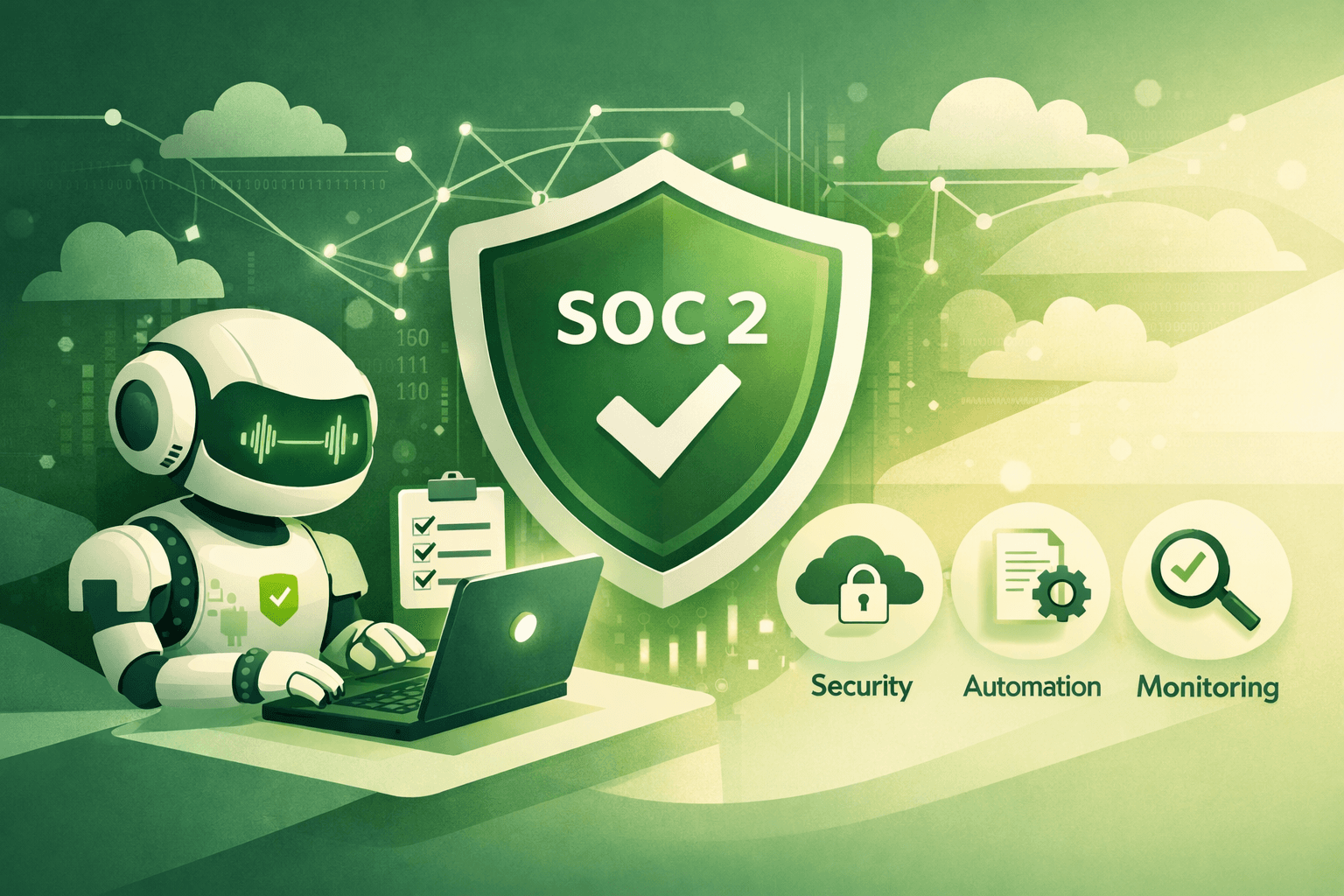
How AI and Automation Are Changing the Game
SOC 2 compliance establishes trust by demonstrating to customers and partners that your business maintains data security through proper care and integrity, as well as robust protective measures. The compliance world is advancing rapidly as we approach 2025. Organizations today face heightened risks and stringent regulations, alongside continuous cyber threats leveraging advanced technologies. The compliance framework for SOC 2 has undergone a complete transformation through the implementation of AI and automation systems. The article explores how new tools both simplify SOC 2 standards and redefine "compliance ready" in the evolving standards landscape.
The Evolving SOC 2 Landscape in 2025
The SOC 2 framework originated primarily for tech and cloud companies. The framework emerged more than ten years ago to serve the on-premises infrastructure and technology environments of the 1990s and 2000s. Every organization that manages customer data, including health, financial, and technology businesses, must meet these standards today.
Why the leap? Organizations now operate with cloud-first systems and multi-cloud networks, and complex AI-driven processes have become standard practice. The attack surface has ballooned just as fast.
The practice of compliance extends beyond annual audits in current times. The system demands ongoing monitoring and continuous control, together with modern security measures. The SOC 2 framework now extends its coverage to standard IT environments, AI-enabled systems, global data centers, and multi-cloud deployments. The elevated risks align with the growing opportunities in the current situation.

Emerging Regulatory and Technical Standards
Organizations are balancing more than just SOC 2 in 2025. New frameworks are joining the fray. Examples include NIST's updated risk frameworks, ISO 42001 for AI management, and cloud-focused standards such as CSA STAR and ISO 27017. These modifications affect how organizations prepare and what is required for SOC 2.
Criteria for Trust Service (TSC): The core criteria of security, availability, confidentiality, processing integrity, and privacy remain in place, but the "security" criterion takes center stage.
Policy Alignment: In addition to SOC 2, modern policies must also comply with GDPR, HIPAA, and an expanding patchwork of international privacy regulations.
Constant Observation: Evidence gathering and control testing are now conducted continuously rather than once a year, in line with the expectation of always-on compliance.
Industry-Specific Pressures and Expanded Threat Landscape
There are hurdles in every industry. Access controls and detailed reporting are essential for finance. Healthcare must protect sensitive patient data while complying with regulatory requirements. Keeping sprawling cloud systems secure and proving compliance to global customers is a challenge for tech giants.
The old security models are fading away. Even within their own networks, organizations are moving toward a "trust no one, verify everything" mentality.
With more partners and cloud vendors in the mix, the risk is no longer just internal.
Attackers use generative AI to create smart phishing, malware, and deepfake attacks. A few years ago, compliance meant blocking threats that didn't even exist.
AI and Automation Are Changing the Game in SOC 2 Compliance
Keeping up with compliance today isn’t about piling on more work—it’s about working smarter. That’s where AI and automation are stepping in. What once took weeks of manual effort can now be handled in minutes using the right tools.
Real-Time Monitoring That Never Sleeps
Gone are the days of rushing to pull together evidence right before a SOC 2 audit. AI-powered systems now track your infrastructure 24/7, catching risks and policy violations the moment they happen.
Always Active: Automated tools continuously collect evidence from your cloud, apps, and servers.
Instant Notifications: Teams get real-time alerts the second something goes off track.
Live Compliance Dashboards: Leaders can see the compliance status at a glance—no more guesswork or outdated reports.
This not only saves hours of manual checking but also ensures that nothing slips through the cracks.
Smarter Risk Management with AI
AI does more than just monitor systems—it helps prevent problems before they happen.
Predictive Risk Detection: Machine learning scans your system’s data to identify patterns that might signal future issues.
Automated Response Playbooks: When a threat pops up, AI can take action right away—blocking access, flagging incidents, or notifying the right people.
Vendor Risk Scoring: AI can even evaluate third-party vendors, ranking them based on their security and compliance performance.
Instead of reacting after the fact, teams can shift their focus to stopping threats before they start.
Effortless Audit Prep with Automation
Documentation has always been one of the most time-consuming parts of SOC 2 compliance. Now, smart automation handles much of it for you.
Automatic Evidence Collection: Scripts pull logs and data straight from cloud platforms and servers.
Organized Reports for Auditors: Everything gets tagged and filed properly, so audit review times drop significantly.
Ongoing Audit Readiness: With systems that update automatically, your business stays ready for review at any time—not just once a year.
This makes scaling compliance easier, especially for fast-growing companies that can’t afford to slow down.
Conclusion
SOC 2 in 2025 isn’t just about ticking boxes anymore. Thanks to advances in AI and automation, businesses can stay ahead of threats, prove their trustworthiness, and breeze through audits with far less manual work.
At DSALTA, we believe compliance should be a strength—not a struggle. That’s why we created the first open-source compliance framework, built to simplify complex audits and help teams move faster with confidence.
The future of compliance is already here—and with DSALTA, it’s smarter, simpler, and finally within reach for everyone.


Explore more AI Compliance articles
Stop losing deals to compliance.
Get compliant. Keep building.
Join 100s of startups who got audit-ready in days, not months.