AI Compliance —
AI Compliance Automation: Build Your Foundation Fast
AI compliance automation lets SaaS teams complete gap analysis, generate policies, map controls, and go audit-ready in 7 days, what used to take 6 months manually.
Jon Ozdoruk
Share this article


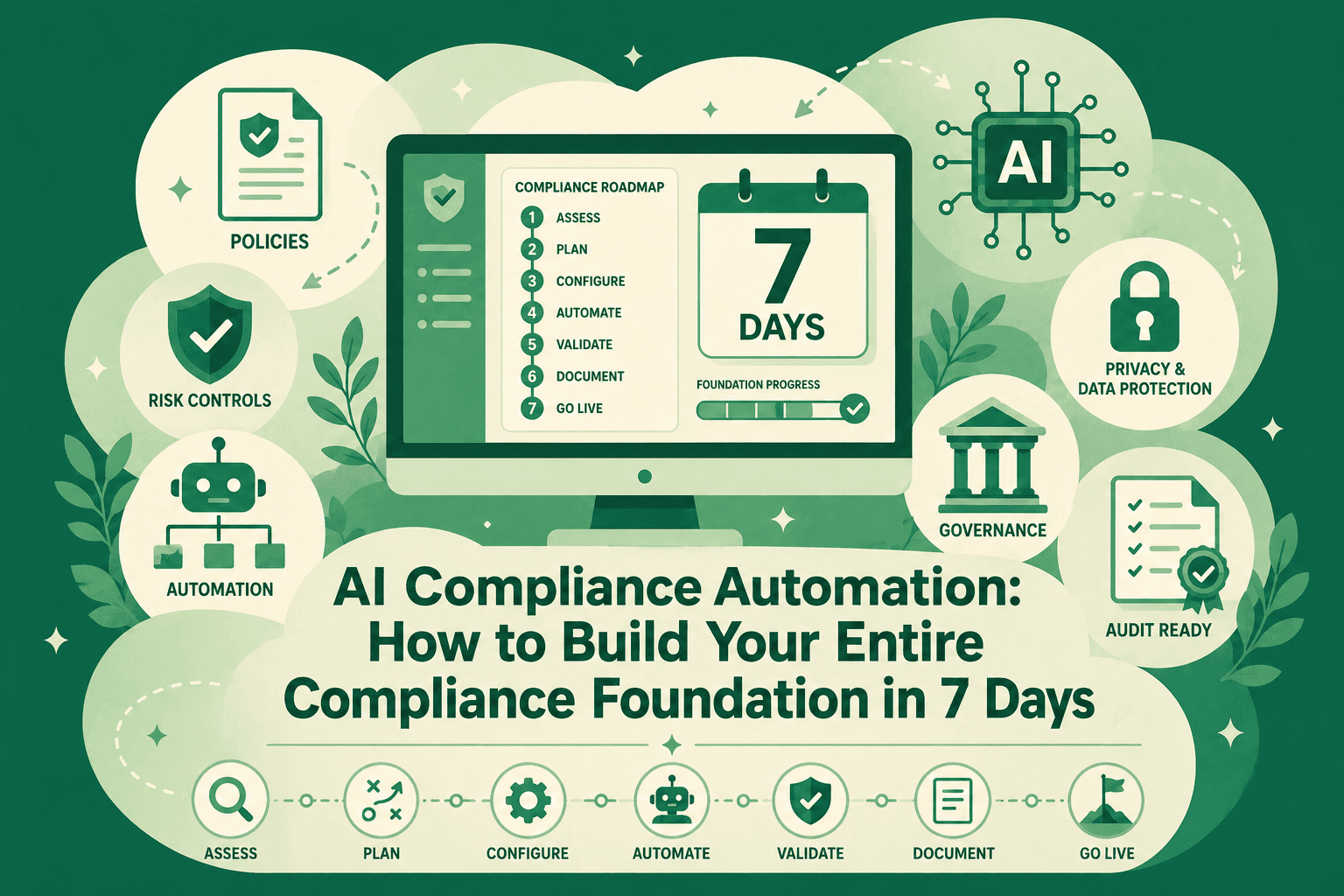
Six months. That's how long it used to take to get your compliance infrastructure off the ground — before you even started the clock on your audit observation period.
Six months of policy writing. Six months of spreadsheet-based gap tracking. Six months of manually chasing engineers for evidence, building control matrices in Excel, and scheduling back-to-back interviews with every team that touches your systems.
That era is over.
AI compliance automation platforms have compressed the foundation-building phase from 6 months to 7 days. Not the full certification — the observation period is what it is, and no tool changes that. But the gap analysis, policy generation, control mapping, evidence workflow setup, and continuous monitoring infrastructure that used to eat 80% of your compliance budget? AI handles that now, and it handles it in a week.
This guide walks you through exactly how: what AI compliance automation actually does, what a realistic 7-day compliance sprint looks like step by step, and what to look for in an automated compliance platform before you buy.
What Is AI Compliance Automation?
AI compliance automation is the use of artificial intelligence — including large language models, machine learning, and intelligent agents — to replace manual work in the compliance lifecycle. It spans five core functions:
1. Automated Gap Analysis. Instead of a consultant spending three weeks interviewing your team and manually checking controls against framework requirements, an AI compliance platform integrates with your existing infrastructure (AWS, Azure, GCP, GitHub, Okta, Jira, HR systems) and produces a gap report in hours. It automatically maps your current security controls against SOC 2, ISO 27001, HIPAA, GDPR, PCI DSS, or CMMC requirements, flags what's missing, and prioritizes remediation by risk impact.
2. AI-Generated Policies Compliance policies — your information security policy, access control policy, incident response plan, business continuity plan, vendor management policy, and more — used to require a lawyer or compliance consultant and weeks of drafting and review cycles. AI compliance platforms generate a complete, framework-aligned policy library from your business context in hours. You review, customize, and approve. The drafting work is done.
3. Automated Control Mapping If you're pursuing multiple frameworks (SOC 2 and ISO 27001, for instance), a single control — say, your MFA policy — may satisfy requirements across 8–12 different framework criteria. Doing this mapping manually in a spreadsheet is error-prone and time-consuming. AI does it automatically, showing you exactly which controls satisfy which requirements across every framework you're working toward — and which gaps remain.
4. Continuous Evidence Collection. Traditional compliance evidence collection involves manually capturing screenshots, exporting logs, and organizing artifacts into audit folders whenever an auditor needs proof. AI compliance platforms integrate with your tools and automatically collect evidence continuously. When your auditor asks for access control logs from the past 90 days, they're already there, organized and tagged.
5. Real-Time Risk Monitoring AI compliance platforms monitor your environment continuously, flagging control drift in real time. When a new IAM user gets created without MFA, when a public S3 bucket appears, when a vendor's security posture degrades — your compliance dashboard surfaces it immediately, before it becomes an audit finding.
Why the "7-Day Foundation" Is Now Real
The bottleneck in traditional compliance wasn't knowledge — it was labor. A compliance consultant had to manually inventory your systems, read through your existing documentation, cross-reference framework requirements, write policies from scratch, and build evidence workflows in spreadsheets. That's not intellectually hard. It's just slow and expensive.
AI replaces the slow parts while keeping human judgment in the loop for the decisions that actually require it.
Here's the honest breakdown of what AI can do in 7 days that used to take 6 months:
Task | Manual Timeline | AI-Automated Timeline |
|---|---|---|
Infrastructure discovery and inventory | 2–3 weeks | 2–4 hours |
Gap analysis against SOC 2 / ISO 27001 | 3–4 weeks | 4–8 hours |
Policy library generation (15–25 policies) | 6–10 weeks | 1–2 days |
Control mapping to framework criteria | 2–3 weeks | Automated (continuous) |
Evidence collection workflow setup | 2–4 weeks | 1–2 days |
Risk register population | 2–3 weeks | 4–8 hours |
Vendor assessment questionnaire setup | 1–2 weeks | Hours |
Continuous monitoring configuration | 2–4 weeks | 1 day |
Total foundation-building phase | 4–6 months | 5–7 days |
What you still need time for: the observation period (6–12 months for SOC 2 Type 2), auditor-facing evidence review, and any complex remediation work that requires engineering changes. AI doesn't shortcut those. But it eliminates the 4–6 months of prep work that precedes them.
The 7-Day AI Compliance Sprint: Day by Day
Here is what a focused 7-day compliance foundation build looks like using a modern AI compliance automation platform.
Day 1: Connect, Discover, and Scope
What happens: You connect your cloud infrastructure (AWS, Azure, GCP), identity provider (Okta, Azure AD, Google Workspace), code repositories (GitHub, GitLab), project management tools (Jira, Linear), and HR system to the compliance platform via native integrations or APIs.
The AI runs an automated discovery scan: it inventories every asset, user, permission, configuration, and data flow that's relevant to your compliance scope.
What you get at end of Day 1:
Complete asset inventory
System boundary definition (what's in scope for your compliance program)
Initial data classification map showing where sensitive data lives
A preliminary list of integrations to complete or configurations to review
Time investment: 2–4 hours of your team's time (mostly IT/DevOps connecting integrations).
Day 2: AI Gap Analysis
What happens: The platform runs your discovered infrastructure and configurations against your target framework(s) — SOC 2, ISO 27001, HIPAA, GDPR, or a combination. It produces a gap report: every control requirement, whether your current environment satisfies it, and the evidence basis for that conclusion.
This is the work that used to take a consultant three weeks. The AI does it overnight after Day 1's discovery.
What you get at the end of Day 2:
Full gap analysis report against your chosen framework(s)
Controls categorized as: Satisfied, Partially Satisfied, Not Satisfied
Risk-prioritized remediation list (high/medium/low impact gaps)
Estimated remediation effort for each gap
Quick-win list: gaps closeable within the 7-day sprint
Time investment: 2–3 hours reviewing the gap report with your team and making scoping decisions.
Day 3: Policy Library Generation
What happens: Based on your business context (industry, company size, tech stack, data types handled) and the gap analysis, the AI generates a complete, framework-aligned policy library. For SOC 2, this typically means 18–25 policies. For ISO 27001, it's 20–30 policies. For dual compliance, the platform generates unified policies that satisfy both simultaneously.
Policies generated typically include: Information Security Policy, Access Control Policy, Acceptable Use Policy, Change Management Policy, Incident Response Plan, Business Continuity and Disaster Recovery Plan, Vendor Management Policy, Data Classification Policy, Encryption Policy, Password Policy, Physical Security Policy, Risk Management Policy, and more.
What you get at the end of Day 3:
Complete policy library, customized to your business
Framework alignment annotation on each policy (which criteria each policy satisfies)
Owner assignments for each policy
Review workflow initiated with relevant stakeholders
Time investment: 3–5 hours reviewing and customizing policies. Most teams assign one policy owner per domain to review and approve their area.
Day 4: Control Mapping and Evidence Framework Setup
What happens: The platform maps your policies, configurations, and technical controls to specific framework criteria — automatically. For every SOC 2 criterion or ISO 27001 Annex A control, you see exactly which of your controls satisfies it and what evidence proves it.
Simultaneously, the platform sets up automated evidence collection: defining what evidence is required for each control, where it lives (which integration it pulls from), and how frequently it's collected.
What you get at the end of Day 4:
Complete control-to-framework mapping matrix
Evidence collection workflows run automatically for every mapped control
Control ownership assignments (who's responsible for each control)
Initial evidence artifacts have already been collected from your integrated systems
Time investment: 2–3 hours reviewing control assignments and evidence mappings with your team.
Day 5: Risk Register and Vendor Assessment Setup
What happens: The AI populates your risk register based on the gap analysis results, the asset inventory, and industry threat intelligence. Each risk gets an initial likelihood and impact scoring, mapped to the controls that mitigate it.
The platform also sets up your vendor risk management workflow by importing your current vendor list, generating assessment questionnaires, and configuring automated monitoring of your critical vendors' security posture.
What you get at the end of Day 5:
Populated risk register (typically 40–80 risks for a mid-size SaaS company)
Risk treatment decisions initiated (accept, mitigate, transfer, avoid)
Vendor inventory and tiering completed
Vendor questionnaires dispatched to critical vendors
Time investment: 2–4 hours with your risk owner and vendor management team.
Day 6: Remediation Planning and Quick-Win Execution
What happens: Your team focuses on the quick-win gap remediation items identified on Day 2. These are typically configuration changes (enabling MFA enforcement, fixing S3 bucket permissions, activating CloudTrail logging) that can be completed without significant engineering effort.
The platform tracks each remediation in real time — as you close a gap, the compliance dashboard updates immediately, moving that control from "Not Satisfied" to "Satisfied" and automatically capturing the evidence.
What you get at the end of Day 6:
20–40% of identified gaps closed (depending on your starting maturity)
Formal POA&M (Plan of Action and Milestones) generated for remaining gaps
Remediation tasks assigned and tracked in your project management tool
Updated compliance posture score reflecting Day 6 progress
Time investment: 4–6 hours across the IT, DevOps, and security teams.
Day 7: Continuous Monitoring Live, Compliance Dashboard Complete
What happens: Continuous monitoring goes live. The platform is now monitoring your environment in real time — flagging control drift, new risks, changes in vendor posture, and policy violations as they occur.
You conduct a full review of the compliance dashboard: your current posture score, outstanding gaps with owners and timelines, evidence collection status, and the audit readiness trajectory. You're now operating a compliance program, not building one.
What you get at the end of Day 7:
Live compliance dashboard with real-time posture score
Automated alerts for control drift and new risks
Audit readiness timeline based on the current gap closure rate
Full documentation trail for Day 1–7 activities (already organized as audit evidence)
Compliance program handed off to ongoing ownership
Time investment: 3–4 hours for final review, stakeholder briefing, and ongoing cadence setup.
What AI Compliance Automation Cannot Do in 7 Days (Be Honest About This)
Credibility matters. Here is what no AI compliance platform can shortcut, regardless of what vendors claim:
The SOC 2 Type 2 observation period. SOC 2 Type 2 requires your controls to operate effectively over a minimum 6-month observation period (most auditors prefer 12 months). That clock starts on Day 1 of your observation window — your 7-day sprint starts it sooner, but it doesn't change the duration. Anyone claiming AI can get you a SOC 2 Type 2 certification in 7 days is lying.
Complex engineering remediation. If your gap analysis reveals that you don't have encryption at rest, or you need to rebuild your access control architecture, or you need to implement FIPS-validated cryptography — those are engineering projects that take weeks to months, regardless of your compliance tooling.
Auditor relationship and fieldwork. Your auditor still needs to assess your controls, review evidence, conduct interviews, and issue their report. A well-organized compliance platform makes this faster, but it doesn't eliminate the auditor's work.
Human judgment on risk decisions. AI can populate your risk register and score your risks. A human still needs to make the business decision on risk acceptance, treatment approach, and residual risk tolerance. Don't outsource that judgment.
What the 7-day sprint delivers is the infrastructure — the foundation that makes everything else faster, cheaper, and better organized. The certification timeline compresses significantly (companies with AI-automated compliance foundations typically achieve SOC 2 Type 2 40–50% faster than manual programs), but the clock is still real.
What to Look for in an AI Compliance Automation Platform
Not all compliance automation platforms are equal. Here are the capabilities that separate platforms that genuinely accelerate your program from ones that just digitize your spreadsheets:
Native integrations with your actual stack. The platform needs pre-built integrations with your cloud provider, identity provider, code repositories, and HR system. If the integrations don't exist and you're building custom API connections, you've eliminated most of the time savings.
Multi-framework support with automatic cross-mapping. If you're going to need SOC 2 and ISO 27001 (or HIPAA and SOC 2, or CMMC and ISO 27001), the platform needs to automatically map controls across frameworks. Building that matrix manually in a single-framework tool defeats the purpose.
AI policy generation that's actually customizable. Generic policy templates you download and edit in Word are not AI compliance automation. The platform should generate policies from your specific business context and allow structured, tracked editing with version control.
Continuous evidence collection, not manual uploads. If the platform requires your team to manually upload evidence artifacts, it's not genuinely automated. Evidence should be pulled automatically from your integrated systems on a defined schedule.
Real-time control monitoring with drift detection. Compliance is not a point-in-time state — it's continuous. The platform needs to alert you when controls fail, not just when you check the dashboard.
Auditor-ready evidence export. When your auditor starts fieldwork, they need to access organized, labeled evidence efficiently. The platform should produce clean, auditor-formatted evidence packages, not a bulk data dump.
AI Compliance Automation vs Manual Compliance: True Cost Comparison
Dimension | Manual Compliance | AI-Automated Compliance |
|---|---|---|
Foundation build time | 4–6 months | 5–7 days |
Policy library creation | $15,000–$40,000 (consultant) | Included in the platform |
Gap analysis | $10,000–$25,000 (consultant) | Included in the platform |
Annual evidence collection labor | 400–800 hours/year | 40–80 hours/year |
Control drift detection | Reactive (audit findings) | Real-time alerts |
Multi-framework cost | 2x–3x multiplier | Marginal additional cost |
Audit preparation time | 6–8 weeks | 1–2 weeks |
First-year total compliance cost | $80,000–$250,000 | $25,000–$80,000 |
Time to audit-ready | 6–12 months | 6–8 weeks (post-sprint) |
The ROI on AI compliance automation is not subtle. For a 50-person SaaS company pursuing SOC 2 Type 2 for the first time, the platform pays for itself in the first year on labor savings alone — before you account for the faster deal velocity that an earlier certification enables.
Frequently Asked Questions
Can you really achieve compliance in 7 days? The 7-day sprint builds your compliance foundation — gap analysis, policy library, control mapping, evidence workflows, risk register, and continuous monitoring. It does not achieve certification. SOC 2 Type 2 still requires a minimum 6-month observation period; ISO 27001 still requires a Stage 1 and Stage 2 audit. The change is that with AI automation, your foundation is complete in days rather than months, so your observation period starts sooner and your audit prep is dramatically faster.
What compliance frameworks do AI platforms support? Leading AI compliance platforms support SOC 2, ISO 27001, HIPAA, GDPR, PCI DSS, CMMC 2.0, NIST CSF, FedRAMP, and often several others. The key capability to evaluate is automatic cross-framework control mapping — whether the platform shows you how a single control satisfies requirements across multiple frameworks simultaneously.
How does AI generate compliance policies? AI compliance platforms generate policies using large language models trained on compliance frameworks, informed by your specific business context (industry, company size, data types processed, technical stack, geographic scope). The output is a customized draft policy, not a generic template. You review, edit, and approve — the AI handles the initial drafting.
Is AI-automated compliance accepted by auditors? Yes. Auditors assess your controls, not your tooling. A SOC 2 auditor doesn't care whether your evidence was collected manually or automatically — they care whether the evidence demonstrates your controls were operating effectively during the observation period. Well-organized, automatically collected evidence typically makes audits faster, not more contentious.
What's the difference between a compliance automation platform and a GRC tool? Traditional GRC (Governance, Risk, and Compliance) tools are primarily documentation and workflow management systems — they help you organize compliance work but don't automate the underlying analysis or evidence collection. AI compliance automation platforms actively work: they discover gaps, generate policies, collect evidence, monitor controls, and score your posture. The distinction is between a filing system and an intelligent assistant.
How long does SOC 2 compliance automation actually take? With a strong AI compliance platform, the foundation phase takes 7–10 days. The observation period (6–12 months) is unchanged. Audit prep compresses from 6–8 weeks to 1–2 weeks. Total time from start to SOC 2 Type 2 report: approximately 7–10 months, compared to 12–18 months with a manual program.
Your 7-Day Compliance Sprint Starts When You Decide It Does
The manual compliance era ran on a simple premise: compliance is hard, slow, and expensive, and there's nothing you can do about it. That premise is broken.
AI compliance automation hasn't made compliance effortless — you still need to make real security decisions, fix real gaps, and satisfy a real auditor. What it has done is eliminate the months of low-value, high-labor work that used to precede all of that.
Your gap analysis is done in hours, not weeks. Your policies are drafted in days, not months. Your evidence is collected automatically, not chased manually. Your control drift is caught in real time, not discovered by your auditor.
The companies that recognize this shift earliest are the ones that close enterprise deals 6 months ahead of their competitors — because they reached audit-ready status 6 months sooner.
Your 7-day compliance foundation sprint doesn't require a compliance consultant. It doesn't require a six-figure budget. It requires picking the right platform and committing a week of focused attention.
That week is worth it.
See how Dsalta's AI compliance engine runs your gap analysis, generates your policies, and maps your controls in hours — not months. Start your compliance sprint →


Explore more AI Compliance articles
Stop losing deals to compliance.
Get compliant. Keep building.
Join 100s of startups who got audit-ready in days, not months.