AI Compliance —
HIPAA for AI Copilots: Chatbots in Healthcare Workflows
AI chatbots and copilots in clinical workflows create PHI risks most HIPAA programs aren't ready for. Learn the safeguards and vendor checks required.
Dogan Akbulut
HIPAA & Healthcare AI
Share this article


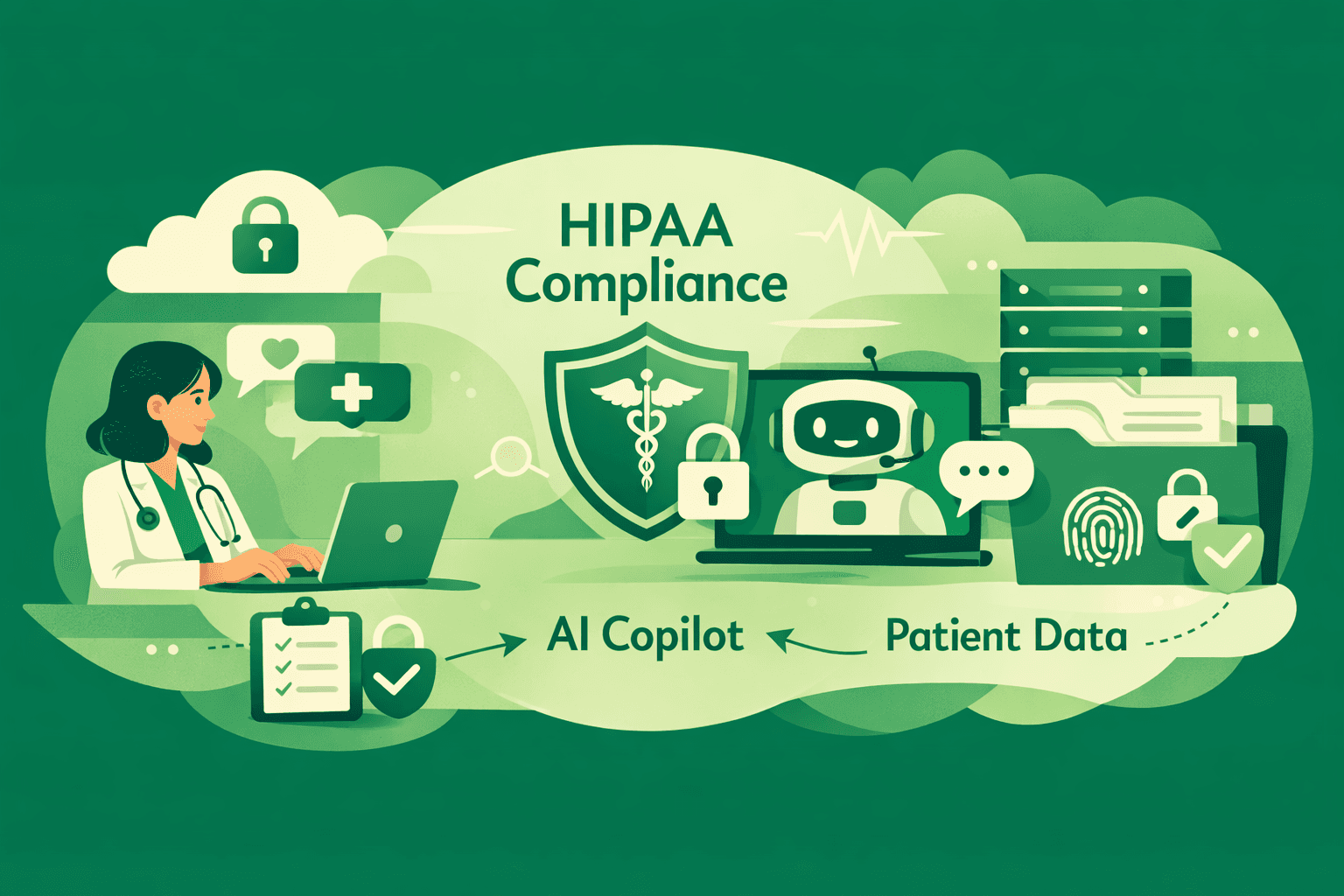
Introduction: The AI Copilot is Now in the Exam Room
A clinician pulls up a patient record and asks an AI assistant to summarize the last six months of visit notes. A patient sends a message through a hospital portal chatbot about medication side effects. An autonomous agent triages incoming lab results and drafts follow-up care plans before a physician ever logs in.
These scenarios are no longer hypothetical. AI copilots, chatbots, and autonomous agents are being embedded directly into EHRs, patient portals, revenue cycle platforms, and clinical decision support tools at a pace that is outrunning most organizations' compliance programs.
And that creates a serious problem.
The Health Insurance Portability and Accountability Act was written decades before large language models existed. The Privacy Rule, Security Rule, and Breach Notification Rule were designed for databases, fax machines, and email servers — not for systems that ingest, reason over, and generate content from protected health information in real time. When an AI copilot enters a clinical workflow, it doesn't just touch PHI. It processes it, stores it, transmits it, and sometimes hallucinates conclusions about it.
This blog breaks down exactly where PHI is at risk when AI agents enter healthcare workflows, what HIPAA requires in response, how to evaluate an AI vendor's compliance posture, and how continuous monitoring can prevent the kind of PHI breach that ends careers and costs millions.
Part 1: Where PHI Actually Flows When AI Enters the Clinical Workflow
Most healthcare organizations think about PHI flow in familiar terms: data at rest in a database, data in transit over a network. AI copilots create a third category that compliance teams are often unprepared for — data in inference.
Here is a map of where PHI flows when an AI assistant is embedded in a clinical setting:
The Prompt Layer
When a clinician types a query into an AI assistant — "What were the patient's last three A1C readings?" or "Draft a prior authorization letter for this patient's MRI" — that query often contains or implies PHI. The patient's name, date of birth, diagnosis code, or record number may be embedded in the prompt text itself. Many organizations assume prompts are ephemeral. In most commercial AI systems, they are not. Prompts are logged, stored for abuse detection, used to improve the model, or retained for audit purposes. Every one of those use cases is a HIPAA concern.
The Context Window
Modern AI assistants operate with large context windows, meaning they retain a substantial amount of information in active memory during a session. When a clinical AI copilot is given access to a patient's full medical record to generate a care summary, that entire record — diagnoses, medications, lab results, visit history — is available within the model's context window during inference. If the underlying infrastructure logs context windows (and many do, by default), PHI is now sitting in a log file somewhere outside the EHR's security perimeter.
Retrieval-Augmented Generation (RAG) Pipelines
Many enterprise AI copilots use RAG architectures, in which the model retrieves relevant documents from a vector database at query time rather than relying solely on its training data. In a healthcare setting, this means patient records, clinical notes, and care protocols are being chunked, embedded, and stored in a vector database that is often separate from the core EHR. That vector database is a new PHI repository — and it is frequently overlooked in risk assessments.
Model Fine-Tuning
Some health systems are fine-tuning general-purpose language models on their own clinical data to improve performance on domain-specific tasks. Fine-tuning on de-identified data is common. Fine-tuning on data that has not been properly de-identified per HIPAA's Safe Harbor or Expert Determination methods is a direct Privacy Rule violation — and it happens more often than organizations realize.
Output and Downstream Transmission
When an AI copilot generates a patient summary, a draft clinical note, or an automated care message, that output often contains PHI. If that output is sent to a third-party analytics platform, a CRM, or a communication tool that is not covered by a Business Associate Agreement, the organization has just transmitted PHI to an unauthorized recipient.
Agentic Workflows
This is the frontier that is moving fastest and creating the greatest compliance exposure. Autonomous agents — AI systems that can take actions, not just answer questions — can schedule appointments, send patient messages, order labs, update records, and initiate referrals. Each action an agent takes on behalf of a provider or patient creates a new PHI transaction. Traditional HIPAA logging frameworks were designed around human users taking actions. Tracking, auditing, and attributing actions taken by AI agents requires a fundamentally different approach.
Part 2: What HIPAA Actually Requires When AI Handles PHI
There is no HIPAA rule specifically for AI copilots. What exists is a framework that was written broadly enough to apply to new technologies — if organizations are willing to apply it rigorously. Here is what the rules actually demand in an AI context.
Business Associate Agreements Are Non-Negotiable
Any vendor whose AI product creates, receives, maintains, or transmits PHI on behalf of a covered entity is a Business Associate under HIPAA. This is not ambiguous. If an AI copilot vendor ingests patient data to generate clinical summaries, that vendor is a Business Associate, full stop. A BAA must be executed before PHI is shared with that vendor's systems.
The problem is that many healthcare organizations are deploying AI tools at the department level — clinical informatics teams, nursing administrators, revenue cycle managers — without routing procurement through compliance or legal. The AI tool gets integrated, patient data flows in, and nobody has signed a BAA because nobody knew to ask for one.
What a BAA with an AI vendor must address goes beyond the standard template. It needs to specify how the vendor handles prompt data, whether the vendor uses customer data to train or fine-tune models, what the data retention policy is for context logs and inference outputs, where data is processed, and what the vendor's breach notification timeline is.
The Minimum Necessary Standard Applies to AI
The Privacy Rule's minimum necessary standard requires that access to PHI be limited to the minimum amount needed to accomplish the intended purpose. When an AI copilot is given broad, standing access to a patient's entire medical history to answer a question about their current medications, that likely violates the minimum necessary standard. AI systems that pull entire records into their context window when only a subset of that record is relevant to the task are creating Privacy Rule exposure that most organizations have not evaluated.
Access Controls Must Cover AI Systems
The Security Rule's Technical Safeguards require that organizations implement technical policies and procedures to allow access only to authorized persons or software programs. An AI copilot is a software program. It must be in scope for access control policies. This means role-based access controls should govern what data an AI agent can query, read, write, or transmit. An AI assistant used by front-desk staff for scheduling should not have the same access to clinical records as one used by attending physicians for care planning.
Audit controls — HIPAA's requirement that organizations implement hardware, software, and procedural mechanisms to record and examine activity in information systems containing PHI — must extend to AI actions. If an AI agent updates a record, sends a message, or retrieves a document, that action needs to be logged with sufficient detail to reconstruct what happened, when, and in response to what query.
Data Integrity Must Be Maintained
AI systems can hallucinate. In healthcare, a hallucination is not just an inconvenience — it is a patient safety risk and a potential data integrity violation. If an AI copilot generates a clinical note containing fabricated medication dosages or incorrect allergy information and that note is incorporated into the patient's record, the organization has a data integrity problem that the Security Rule's integrity controls are designed to prevent. Organizations using generative AI in documentation workflows need human review checkpoints specifically designed to catch AI-generated errors before they become part of the permanent record.
The Breach Notification Rule Applies to AI-Related Incidents
If an AI vendor suffers a breach that exposes PHI processed through their platform, the covered entity has 60 days from discovery to notify affected individuals, HHS, and in some cases the media. The breach notification obligation does not disappear because the breach occurred at a vendor rather than in the covered entity's own systems. Organizations need to ensure their BAAs specify discovery timelines and that vendor incident response plans are reviewed as part of AI procurement.
Part 3: How to Validate an AI Vendor's HIPAA Compliance Posture
Not all AI vendors are created equal when it comes to HIPAA compliance. The following framework gives healthcare organizations a structured way to evaluate an AI copilot vendor before PHI is ever shared.
Start with the BAA before the demo.
Many AI vendors will offer a BAA only after a contract is signed. This is backwards. Compliance review of the BAA should be part of the procurement process, not an afterthought. If a vendor is unwilling to provide a BAA at all — some major AI platform providers take this position — they cannot be used with PHI. End of discussion.
Ask About Model Training Policies
Ask the vendor directly: Does your company use customer data to train or improve your models? What is the opt-out mechanism? How is training data segregated between customers? Many general-purpose AI platforms include model training as a default data use in their terms of service. Healthcare organizations often assume enterprise contracts automatically exclude this. They often do not.
Request a Data Flow Diagram
Ask the vendor to produce a data flow diagram showing exactly where PHI goes from the moment it enters their system until it is deleted. This diagram should include prompt storage, inference infrastructure, logging systems, RAG databases, fine-tuning pipelines, and any subprocessors. If a vendor cannot or will not produce this diagram, that is itself a significant compliance signal.
Review Their Subprocessor List
AI systems are almost never built entirely by a single vendor. They rely on cloud infrastructure providers, logging services, model hosting platforms, and third-party APIs. Each of those subprocessors may come into contact with PHI. Ask the vendor for their full list of subprocessors and whether each is covered by a BAA.
Ask for Their SOC 2 Type II Report
A SOC 2 Type II report provides third-party audited evidence that a vendor's security controls were operating effectively over a defined period. For healthcare AI vendors, you want to see a SOC 2 report that covers security, availability, and confidentiality trust service criteria. A vendor with only a SOC 2 Type I report — which covers design adequacy at a single point in time, not operational effectiveness over time — provides significantly weaker assurance.
Evaluate Their Incident Response Capabilities
Ask the vendor how they detect unauthorized access to PHI within their systems. Ask for their mean time to detection and mean time to notification. Ask whether they have ever had a security incident involving customer data and, if so, what happened. A vendor who cannot answer these questions with specificity is not ready to be a Business Associate.Learn more about effective third-party risk management.
Assess Their AI-Specific Security Controls
Beyond standard security controls, AI systems require specific protections. Prompt injection — where malicious input manipulates an AI agent into taking unauthorized actions — is a real attack vector. Model inversion attacks — where an adversary extracts training data from a model — are an emerging threat in healthcare AI. Ask vendors which specific controls they have implemented to defend against these AI-native attack vectors.
Part 4: How Automation and Continuous Monitoring Reduce AI-Related PHI Risk
The challenge with AI copilots in healthcare is that the risk surface is not static. New PHI flows emerge every time a new integration is added, a new agent capability is enabled, or a new clinical workflow is automated. Point-in-time compliance reviews — the annual risk assessment, the quarterly vendor review — are not sufficient to manage this kind of dynamic risk.
Continuous monitoring is the only defensible approach for organizations that are seriously deploying AI in clinical workflows.
Real-Time PHI Detection in AI Outputs
Organizations should implement data loss prevention controls that monitor AI-generated outputs for PHI patterns — names, dates of birth, Social Security numbers, diagnosis codes — before those outputs are transmitted to downstream systems. This is particularly important for agentic workflows in which AI systems send messages or update records autonomously.
Automated BAA Tracking
As AI vendor relationships expand and evolve, BAA management becomes a significant operational challenge. Automated compliance platforms can track BAA status, expiration dates, and scope limitations for every vendor in the AI stack. When a vendor adds a new subprocessor or changes their data processing terms, automated tracking systems can flag the change for compliance review rather than relying on manual monitoring of vendor communications.
Continuous Control Monitoring for AI Systems
Traditional HIPAA compliance monitoring focuses on EHR access logs, workforce training records, and policy attestations. Organizations using AI copilots need to extend continuous control monitoring to AI-specific controls: prompt logging configurations, RAG database access controls, AI agent action audit trails, and model access permissions. Automated compliance platforms can run continuous checks against these controls and alert compliance teams when a configuration drifts out of the required state.
Automated Risk Assessments That Reflect AI Changes
HIPAA's Security Rule requires covered entities to conduct periodic technical and non-technical evaluations when environmental or operational changes affect the security of PHI. Deploying a new AI copilot, adding a new agent capability, or connecting a new data source to an existing AI system all qualify as such changes. Organizations that have integrated compliance automation into their change management workflows can trigger AI-specific risk assessment workflows automatically when these changes occur, rather than discovering the risk exposure months later.
Vendor Risk Monitoring for AI Business Associates
A vendor's compliance posture at the time of BAA execution is not the same as it is six months later. AI vendors in particular are moving fast — adding features, changing infrastructure providers, updating data retention policies, and deploying new model versions. Continuous vendor risk monitoring programs can track changes in a vendor's security posture over time and alert organizations when their AI Business Associates introduce new risk factors.
Part 5: The Regulatory Horizon — What's Coming for Healthcare AI Compliance
HIPAA is not standing still in response to AI. The HHS Office for Civil Rights has signaled increased attention to AI-related PHI risks, and healthcare organizations should expect regulatory guidance to become more specific regarding AI copilot requirements over the next two to three years.
The EU AI Act, which took effect in 2024, classifies AI systems used in clinical decision support as high-risk AI systems subject to stringent requirements around transparency, data governance, human oversight, and auditability. US healthcare organizations with international operations or that use AI vendors based in the EU are already within the scope of these requirements.
The FTC has been active in enforcement actions related to health data and AI, particularly around consumer-facing health apps and chatbots. While the FTC's authority over covered entities is limited by HIPAA preemption, its enforcement actions signal the direction of regulatory expectations around AI and health data more broadly.
State-level health data privacy laws — particularly in states like Washington, Nevada, and Connecticut — are expanding protections for consumer health data in ways that sometimes go beyond HIPAA's scope. Healthcare organizations using AI copilots with consumer-facing features need to track state law developments alongside federal HIPAA requirements.
Conclusion: Compliance Is Now a System Design Problem
The entry of AI copilots into healthcare workflows is not a future event to prepare for. It is happening now, in most health systems, often faster than compliance programs can respond. The organizations that will navigate this transition successfully are those that treat HIPAA compliance not as a documentation exercise but as a system-design discipline.
That means building PHI protection into AI architectures from the beginning — not retrofitting compliance onto systems that were deployed without it. It means demanding the same rigor from AI vendors that you would demand from any other Business Associate. It means monitoring AI systems continuously rather than auditing them periodically. And it means investing in the automation infrastructure that makes continuous compliance operationally feasible at the pace AI is moving.
The risk of getting this wrong is not abstract. A PHI breach involving an AI system is not just a regulatory exposure — it is a patient safety event, a trust crisis, and in the era of HHS enforcement activity, a potential eight-figure financial liability.
The organizations that build AI compliance programs as sophisticated as the AI systems they deploy will be the ones that earn and keep the trust of their patients, regulators, and markets.
dsalta.com helps healthcare organizations and the vendors who serve them build continuous, automated compliance programs for HIPAA, SOC 2, ISO 27001, and the frameworks that govern AI in regulated environments. Learn more at dsalta.com.


Explore more AI Compliance articles
Stop losing deals to compliance.
Get compliant. Keep building.
Join 100s of startups who got audit-ready in days, not months.