AI Compliance —
ISO 27001 for AI Startups - LLMs, Agents, and Sensitive Training Data
How AI startups can scope and implement ISO 27001 for LLMs, autonomous agents, and sensitive training data — without the overhead of a traditional ISMS.
Deepika
Future of AI Compliance
Share this article


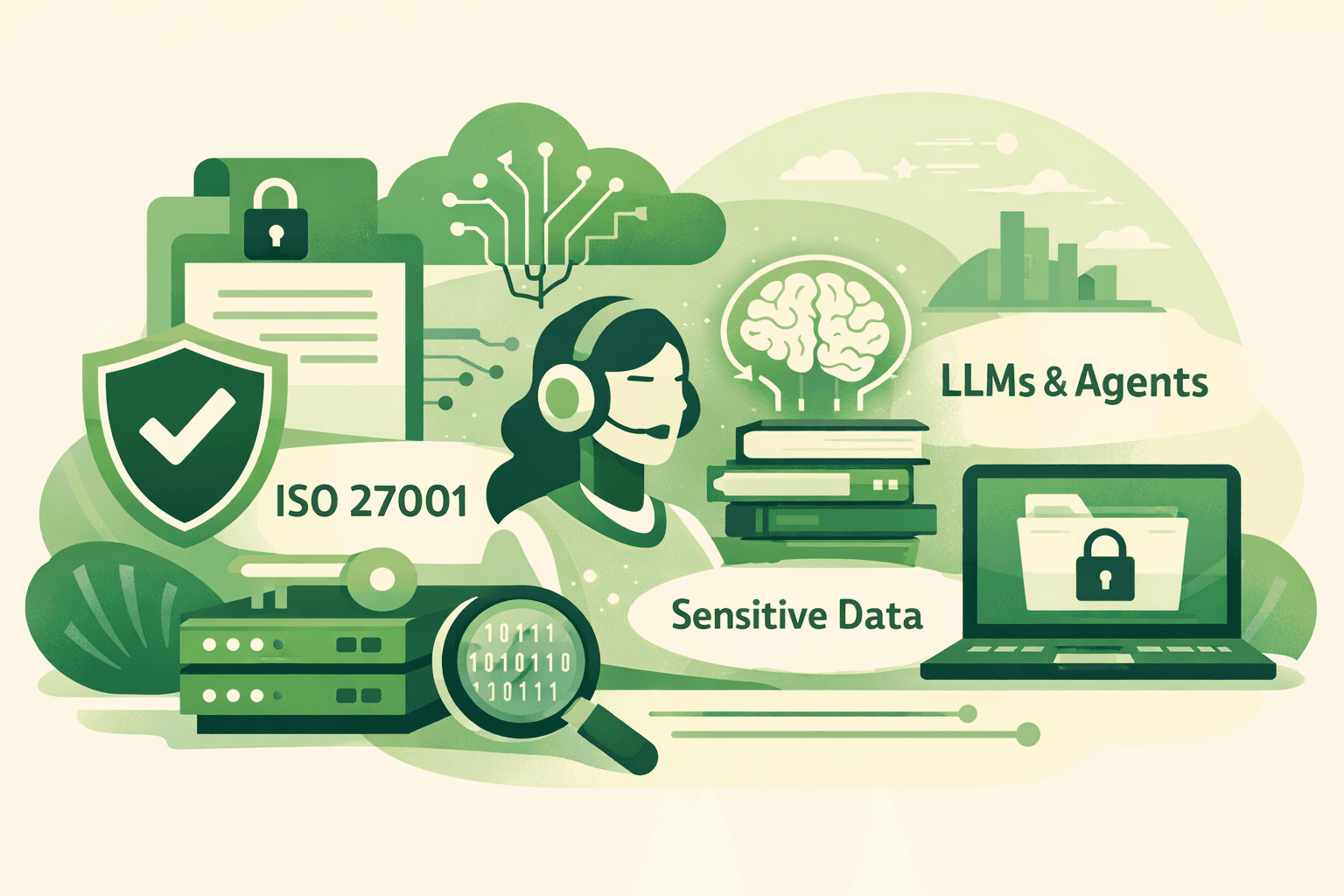
If you're building a company on large language models, autonomous agents, or proprietary training data, enterprise customers love what you're building. Their security and procurement teams, however, have questions. Chief among them: "Do you have ISO 27001?"
The problem is that most ISO 27001 guidance was written for SaaS companies with fairly predictable attack surfaces — databases, APIs, cloud infrastructure. AI startups have all of that, plus a layer of risk that traditional frameworks weren't designed to address: training datasets that may contain sensitive personal data, LLM prompt logs that capture confidential user inputs, model outputs that can be manipulated or leaked, and agentic systems with broad access to external services.
This guide is for founders, CTOs, and security leads at AI companies who want to pursue ISO 27001 certification without applying a decade-old compliance framework to a next-generation technology stack.
Why ISO 27001 Hits Differently for AI Companies
Generic ISO 27001 resources tell you to document your asset inventory, define your scope, and implement controls from Annex A. That advice isn't wrong — but it dramatically undersells the challenge for AI startups. Here's what makes AI companies structurally different.
Your most sensitive assets aren't in a database. Training data often lives in object storage, data lakes, or third-party annotation platforms. It may be copied, versioned, and shared across teams without a formal data classification process. If that training data includes PII, protected health information, or proprietary customer content, you face a serious information security risk that most asset inventories overlook.
Your logs are a liability. Every time a user interacts with your LLM, that interaction is typically logged for debugging, fine-tuning, or safety monitoring. Those logs can contain passwords typed into prompts, confidential business details, medical information, and more. Prompt logs are one of the most underprotected assets in the AI industry right now.
Your models are intellectual property. The trained weights of your model represent months of compute investment and proprietary data curation. Unauthorized access to those weights isn't just a business risk — it's an information security incident. Most AI companies have no formal controls around model weight access, versioning, or exfiltration prevention.
Agents operate with delegated authority. An AI agent that can browse the web, write code, send emails, or call external APIs operates with a level of access that your ISMS needs to explicitly account for. Traditional access control frameworks assume a human is making decisions. Agents don't fit neatly into that model.
These aren't hypothetical risks. They are active attack vectors that an ISO 27001 auditor — or a savvy enterprise security team — will ask about directly.
Step 1: Define Your ISMS Scope With AI in Mind
The first formal step in ISO 27001 is defining the scope of your Information Security Management System. For a generic SaaS company, this means the cloud infrastructure that runs the product, the people who access it, and the processes surrounding it. For an AI company, your scope statement needs to explicitly address four additional areas.
Training data pipelines. Where does your training data come from? How is it ingested, stored, transformed, and used? Who has access at each stage? If you're using third-party annotation services, labeling platforms, or external datasets, those vendor relationships belong in scope — or you need a documented rationale for excluding them.
Model development environments. Jupyter notebooks, ML experiment-tracking tools such as MLflow or Weights & Biases, and GPU clusters used for training are all in scope. These environments are frequently deprioritized in security programs because they're seen as development rather than production — but they often contain the most sensitive data in your entire organization.
Prompt and inference logs. If you log user interactions, those logs are an information asset with a defined risk profile. Your ISMS scope needs to include wherever those logs are stored, who can access them, and how long they're retained.
Agentic systems and integrations. If your AI agents have OAuth connections to third-party services, can make API calls, or operate in automated pipelines with external data sources, the boundaries of those integrations need to be clearly reflected in your scope documentation.
A well-scoped ISMS for an AI startup will look more complex than a typical SaaS ISMS. That's appropriate. Trying to minimize scope to make certification easier will either fail audit scrutiny or leave your real risks completely unmanaged.
Step 2: Build a Risk Register That Reflects AI-Specific Threats
ISO 27001 is fundamentally a risk-based framework. Clause 6.1 requires you to identify, assess, and treat information security risks. Most risk register templates were designed for conventional IT environments. Here are the AI-specific risks every startup in this space needs to include.
Training data poisoning. An adversary who can influence what data enters your training pipeline can subtly corrupt your model's behavior. This is particularly relevant if you use user-generated content, web-scraped data, or third-party annotation services. Your risk register should document this threat and your mitigating controls — data validation, source integrity checks, and provenance tracking.
Prompt injection. If users can influence the instructions your model receives — directly or indirectly through data it processes — they may manipulate model behavior, extract system prompts, or access unauthorized information. This is one of the most active exploit categories in deployed LLM systems today.
Model exfiltration. An attacker with sufficient API access can reconstruct model behavior, extract training data through carefully crafted queries, or clone your model weights through model-stealing attacks. Access controls and rate limiting are partial mitigations, but they need to be explicit in your risk treatment plan.
Sensitive data in prompts. Enterprise users will paste confidential information into prompts. Your risk register should treat prompt log storage and access as a high-risk asset requiring specific controls around retention, encryption, and access restriction.
Unintended data memorization. LLMs trained on data containing PII or confidential information can sometimes reproduce that information when prompted in specific ways. This is a training process risk with direct compliance implications under GDPR, HIPAA, and similar regulations.
Agent over-permission. AI agents that accumulate broad permissions across integrated services create a large blast radius if compromised. Least-privilege principles apply to agents just as they do to human users, but implementing them requires deliberate architectural decisions that must be documented.
For each risk, document the likelihood, the potential impact, your risk tolerance, and your treatment approach — whether through controls, acceptance, insurance transfer, or architectural avoidance.
Step 3: Map AI Risks to ISO 27001 Annex A Controls
Annex A of ISO 27001 (2022 version) provides 93 controls organized into four categories: Organizational, People, Physical, and Technological. Here's how the most relevant controls apply to AI-specific risks.
A.5.12 – Classification of Information. Explicitly apply a classification scheme to your AI assets. Training datasets, model weights, inference logs, and fine-tuning data should each have defined classification levels. A training dataset containing PII carries an entirely different risk profile from a dataset of synthetic benchmark data. Your classification policy must reflect this distinction in writing.
A.5.23 – Information Security for Use of Cloud Services. Most AI companies rely heavily on cloud infrastructure for compute, storage, and managed endpoints. This control requires documented security requirements for cloud services and a clear understanding of the shared responsibility model. For AI specifically, pay close attention to data residency requirements if your training data is subject to GDPR or sector-specific regulations.
A.8.2 – Privileged Access Rights. Least privilege for human users is standard practice. Apply the same discipline to service accounts and API keys used by AI systems. An LLM agent shouldn't have production database write access unless the specific use case absolutely requires it. Document the access rights assigned to each agent persona and review them on a defined schedule.
A.8.10 – Deletion of Information. In AI systems, deletion is more complex than it sounds. Removing a record from a database is straightforward. Removing its influence from a trained model is not. Document your approach to handling deletion requests — whether through model retraining, fine-tuning on corrected data, or other techniques — and be candid in your ISMS documentation about current limitations.Understanding data security compliance controls across healthcare and finance</a> can provide valuable context for implementing masking in sensitive AI applications."
A.8.11 – Data Masking. Implement masking or anonymization techniques in training pipelines where PII is present. Document the specific techniques used — tokenization, k-anonymization, differential privacy, synthetic data generation — and their known limitations. Auditors will want to see that you've thought carefully about this rather than simply asserting your data is "anonymized."
A.8.16 – Monitoring Activities. Monitoring for anomalous behavior in AI systems requires approaches beyond standard SIEM alerting. Log model inputs and outputs at the inference layer. Set thresholds for unusual query patterns that may indicate prompt-injection attempts or model-extraction activity. Integrate these signals into your broader security monitoring process.
A.8.28 – Secure Coding. Extend your secure development practices to ML code. Dependency scanning for ML frameworks — PyTorch, TensorFlow, Hugging Face transformers — is critical. This ecosystem moves fast and has had significant supply chain vulnerabilities. Treat model serving code with the same security scrutiny as your application code.
Step 4: Document Controls in a Way That Survives Audit
ISO 27001 certification isn't just about having good security — it's about demonstrating it. Documentation is the mechanism by which you prove to an auditor that your controls are real, consistently applied, and proportionate to your risk profile.
Evidence for ML-specific controls is non-standard. An auditor knows what an access control review looks like for a SaaS application. They may be less clear on what evidence to expect for training data integrity verification or model output monitoring. You'll need to produce evidence and explain its significance. Create runbooks and control descriptions that bridge the gap between ML engineering practice and information security language — don't assume the auditor will make that translation themselves.
Document your model governance process. When you train or fine-tune a model, who approves that the training data meets your security and privacy requirements? Who reviews the model before it's promoted to production? What's the rollback procedure if a deployed model exhibits unexpected behavior? These governance decisions belong in your ISMS documentation, and right now, most AI startups have no written record of them. A detailed ISO 27001 implementation guide can help you structure this documentation effectively.
Create an AI-specific asset inventory. Your information asset register needs to include: training datasets (with source, classification, and owner), model versions (with training run metadata and access controls), prompt log stores, fine-tuning datasets, and evaluation benchmarks. Many AI companies can enumerate their AWS infrastructure in precise detail but lack a systematic inventory of their ML assets. That gap will surface in an audit.
Version control your ISMS documentation. Your risk register, Statement of Applicability, policies, and procedures should be version-controlled just like your code. Git-based documentation workflows are perfectly acceptable and, in fact, superior to shared drives for audit traceability. The ability to show an auditor a clear history of policy changes and approvals is a meaningful indicator of a mature ISMS.
Step 5: Leverage Automation to Maintain Your ISMS Continuously
Achieving ISO 27001 certification is a milestone. Maintaining it — through surveillance audits and the ongoing demands of a fast-moving AI startup — is the long-term challenge. AI compliance automation platforms significantly reduce that burden in four specific areas.
Continuous control monitoring replaces the pre-audit scramble for evidence with a steady stream of collected and stored control evidence — access reviews, vulnerability scans, configuration compliance checks — so you're always audit-ready rather than periodically audit-ready.
Vendor risk management is particularly valuable for AI companies, which typically have complex vendor ecosystems that include cloud providers, annotation platforms, model API providers, and open-source dependencies. Automated tools can continuously monitor the security posture of these third parties, flagging changes that affect your risk profile before they become audit findings.
Policy management and training tracking addresses the ISO 27001 requirement that relevant personnel are aware of and trained on your information security policies. Automated platforms manage policy distribution, track acknowledgment, and provide evidence of training completion without the manual follow-up that consumes security team bandwidth.
Infrastructure drift detection is especially critical in AI environments where the infrastructure changes constantly. A new GPU cluster, a new cloud storage bucket for a training run, a new third-party API integration — these are routine occurrences that can inadvertently expand your attack surface. Automated configuration monitoring detects these changes before they lead to audit gaps or security incidents. AI-powered compliance automation can transform your approach from reactive evidence gathering to proactive continuous monitoring.
The goal isn't to automate away the judgment and governance that make an ISMS effective. It's to eliminate the manual busywork that consumes time without adding proportional security value.
The Business Case: Why This Matters Now
There's a pragmatic argument for ISO 27001 that goes beyond security hygiene.
Enterprise procurement processes for AI vendors are becoming significantly more rigorous. Security questionnaires that used to ask only about SOC 2 are now asking about AI governance policies, training data provenance, and controls around LLM outputs. ISO 27001 certification — scoped to include your AI development and deployment environment — provides a credible, internationally recognized answer to those questions. This is particularly important for companies pursuing both SOC 2 and ISO 27001 compliance to meet diverse customer requirements
For AI companies operating in regulated industries — healthcare, financial services, legal, government — certification is increasingly a prerequisite rather than a differentiator. HIPAA-covered entities procuring AI tools need confidence that you handle protected health information appropriately across your entire stack, including training pipelines and inference logs. ISO 27001 creates the documented, auditable framework that supports that trust.
And for AI companies with European customers or EU AI Act exposure, ISO 27001 provides foundational controls that align directly with the Act's technical documentation and risk management requirements for providers of high-risk AI systems. Building a compliant ISMS now reduces your regulatory surface area considerably as that framework matures.
A Practical Roadmap to Certification
For an AI startup approaching this for the first time, here's a realistic sequencing toward certification.
In the first two months, focus on scope definition and gap assessment. Define your ISMS scope, explicitly including AI assets. Build your AI-specific asset inventory. Identify your top risks and conduct a gap assessment against ISO 27001:2022 requirements. In months three and four, develop or update your information security policies to address AI-specific scenarios, document your risk register and Statement of Applicability, and establish your model governance process in writing. Months five and six are for control implementation — access reviews, vulnerability management, incident response planning, and AI-specific controls related to training data, prompt logs, and agent permissions. Months seven and eight are internal audit and management review: identify remaining gaps and close them before external scrutiny. Months nine through twelve bring you to the certification audit itself, with Stage 1 documentation review followed by Stage 2 implementation assessment.
This is an aggressive but achievable timeline for a startup with a focused effort and appropriate tooling. Companies that attempt this entirely manually will find the middle months extremely painful. Compliance automation platforms materially compress that timeline.
Conclusion
ISO 27001 was designed to be adaptable to organizations of any type and any technology stack. But that adaptability requires you to do the interpretive work — to look at a control designed for a financial services firm in 2013 and determine what it means for a company training and deploying large language models today.
The core logic of ISO 27001 — identify your risks, implement proportionate controls, document everything, and review continuously — is exactly the right mental model for securing AI systems. AI introduces new risk categories, new assets, and new attack vectors, but it doesn't change the fundamentals of what good information security governance looks like.
Build your ISMS to reflect your actual technology stack. Document your AI-specific risks explicitly. Implement controls that address the realities of training data, inference systems, and agentic architectures. And invest in automation that lets you maintain that posture continuously, not just in the weeks before an audit.
Your customers are asking. Your auditors are preparing. The framework is ready.
Dsalta helps AI startups and fast-growing SaaS companies achieve and maintain ISO 27001 certification through AI-powered compliance automation. Ready to start your ISO 27001 journey? Book a demo to see how we can cut your time to certification in half.


Explore more AI Compliance articles
Stop losing deals to compliance.
Get compliant. Keep building.
Join 100s of startups who got audit-ready in days, not months.