AI Compliance —
AIUC-1: The Compliance Framework Built for the Age of AI
SOC 2 solved SaaS trust but was never built for AI agents. AIUC-1 is the world's first compliance standard for AI — here's what it covers and why it matters.
Jon Ozdoruk
Future of AI Compliance
Share this article


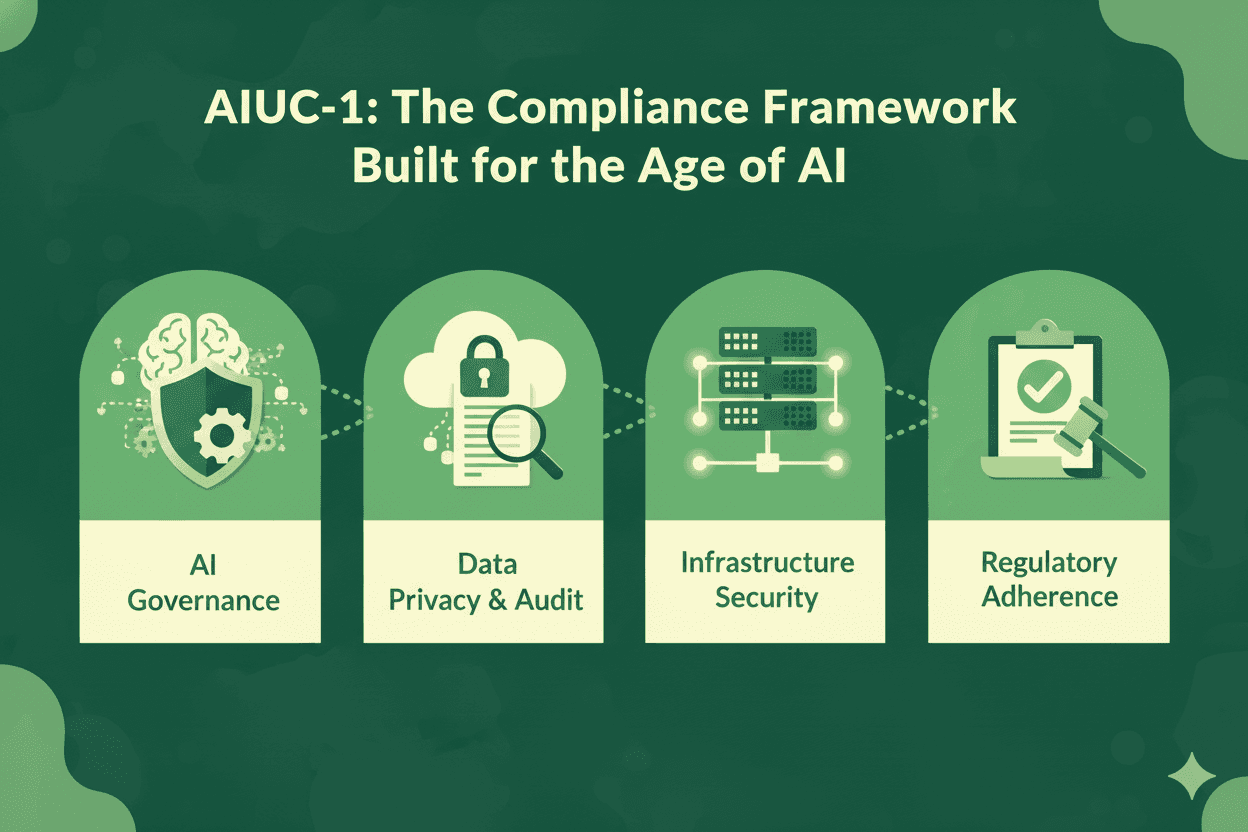
SOC 2 built SaaS trust.
Meet the framework built to do the same for AI.
AIUC-1 is the world's first compliance standard for AI agents, and if you are shipping AI into enterprise, it is the framework your buyers will start asking about next.
When businesses first began outsourcing critical operations to cloud vendors in the early 2000s, enterprise procurement teams faced a fundamental problem: how do you trust a vendor you cannot see inside? You cannot audit every piece of infrastructure. You cannot run security tests on someone else's stack. You need a proxy for trusting something independent, credible, and consistent.
SOC 2 solved that problem. It created a common standard, required independent auditors, and gave enterprise buyers a trusted signal they could act on without needing an in-house security team to verify it. It unlocked an entire generation of SaaS deals. Companies that had it won enterprise contracts. Companies that didn't stall in procurement.
Twenty years later, the same problem has arrived for AI, and existing frameworks are not equipped to solve it.
Companies are now shipping AI agents that make autonomous decisions, generate customer-facing outputs, process sensitive data, and interact with enterprise systems in ways no human team can fully supervise in real time. The compliance frameworks that enterprise buyers rely on, SOC 2, ISO 27001, HIPAA, and GDPR, were designed before any of this existed. They can tell a buyer whether your infrastructure is secure. They cannot tell them whether your AI will hallucinate a critical recommendation, leak PII into a response, execute an action nobody authorized, or produce an output that creates legal liability.
That is the trust gap AIUC-1 was built to close.
What is AIUC-1?
AIUC-1 is the world's first compliance standard designed specifically for AI agents. It works similarly to SOC 2 in that independent third-party auditors assess controls against a defined framework and issue a certificate that enterprise buyers can rely on. The difference is in scope: AIUC-1 addresses AI agent risks that SOC 2 was never designed to evaluate.
The standard was developed by the AIUC-1 Consortium, a body comprising AI vendors, security practitioners, and enterprise buyers, which identified the specific controls required for AI systems to be trustworthy in commercial deployments. Unlike SOC 2, which conducts a single annual audit, AIUC-1 requires ongoing compliance: technical controls must be tested at least quarterly, and the certificate must be renewed annually, or it lapses entirely.
This makes AIUC-1 a forward-looking standard rather than a backward-looking attestation. SOC 2 tells you what happened over the past year. AIUC-1 tells you which safeguards are currently in place.
The certification ecosystem is also beginning to mature. Schellman became the first authorized AIUC-1 auditor in 2026, adding third-party audit infrastructure around AIUC's technical evaluations and certification process.
The six pillars of AIUC-1
The framework is built around six domains, each mapped to the specific ways AI systems can fail, cause harm, or erode enterprise trust:
Pillar A
Data & Privacy
Input and output data policies, PII leakage prevention, IP protection, cross-customer data exposure controls
Pillar B
Security
Adversarial robustness testing, prompt injection detection, real-time input filtering, unauthorized agent action prevention
Pillar C
Safety
Pre-deployment testing, harmful output prevention, high-risk output flagging for human review, and real-time AI risk monitoring
Pillar D
Reliability
Hallucination prevention and third-party testing, safe tool call enforcement, and output accuracy controls
Pillar E
Accountability
AI failure plans for breaches and harmful outputs, activity logging, vendor due diligence, and regulatory compliance documentation
Pillar F
Society
Prevention of AI cyber misuse, controls against catastrophic misuse, and broader societal harm mitigation
Together, these six domains cover the full lifecycle of an AI agent deployment — from how data enters the system, to what the model does with it, to how failures are detected, documented, and remediated. No existing certification standard covers this ground.
What SOC 2 got right — and where it ends
SOC 2 became the enterprise default because it solved the right three problems: independent validation that procurement teams could rely on, a common language that removed friction from security reviews, and concrete coverage of the controls that actually blocked deals. AIUC-1 keeps every one of those principles. What changes is the scope.
SOC 2 Type II vs. AIUC-1 — side by side
SOC 2 Type II | AIUC-1 | |
|---|---|---|
Designed for | SaaS infrastructure and data handling | AI agents and autonomous systems |
Test cadence | Defined historical review period, backward-looking assessment | Quarterly minimum, forward-looking, continuous validity requirement |
Hallucination risk | Not covered: No concept of model output accuracy | Covered Pillar D — Reliability, with third-party testing |
Prompt injection | Not covered. Predates the attack surface entirely | Covered Pillar B — Security, real-time input filtering |
Autonomous actions | Not covered. Assumes human-in-the-loop at all times | CoveredAgent action controls and access enforcement |
PII via AI output | Not covered: Covers data storage, not model responses | Covered Pillar A — Data & Privacy, output data policy |
AI failure plans | Not covered | Required plans for breaches, harmful outputs, and hallucinations |
Certification output | Attestation report, renewed annually | Audit report + certificate, renewed annually with quarterly testing |
The critical difference: SOC 2 tells an enterprise buyer your infrastructure was secure over a defined historical review period. AIUC-1 tells them your AI is actively governed, tested against real-world attack vectors, and held accountable on an ongoing basis, not just when an auditor visits.
How AIUC-1 compares to other AI governance frameworks
AIUC-1 is not the only framework addressing AI risk, but it is the only one structured as a certifiable standard with third-party auditors, a formal certificate, and a defined renewal process. Here is how it sits alongside the others:
AI governance frameworks — scope comparison
Framework | Type | What it covers |
|---|---|---|
AIUC-1 | Certifiable standard | Full AI agent lifecycle — security, safety, reliability, privacy, accountability, society. Independent auditors. Quarterly testing. |
NIST AI RMF | Voluntary framework | AI risk identification, measurement, and management guidance. No certification. No auditors. |
ISO 42001 | Certifiable standard | AI management systems governance. Process-focused. Does not test specific AI outputs or behaviors. |
EU AI Act | Regulation | Risk classification and prohibited uses for AI systems in the EU. Compliance required for high-risk AI. Not a certification. |
OWASP Top 10 for LLMs | Guidance | Identifies the top 10 security risks in LLM applications. No certification or audit path. |
Why your enterprise buyers will ask about this next
AIUC-1 is not yet a regulation. But enterprise procurement does not wait for mandates. The companies that requested SOC 2 reports in 2012 did so years before any regulation required them. They did it because it answered a real question: Can we trust this vendor's security posture without auditing it ourselves?
The same dynamic is playing out now for AI. Enterprise security teams are already building AI-specific vendor questionnaires. Legal teams are asking about model governance and output accountability. Procurement teams at financial institutions, healthcare companies, and public-sector buyers are adding AI risk to their standard review templates — and few established certification standards directly address this agent-specific risk layer.
If you are shipping an AI agent into a regulated enterprise, expect a governance question in the next security review that your SOC 2 report cannot answer
If you are in a sales cycle with a financial institution or healthcare buyer, AI risk is already entering their vendor questionnaire templates in 2026
If your competitors achieve AIUC-1 certification before you, they will use it to differentiate in exactly the deals you are trying to close
If you wait for AIUC-1 to become a requirement before preparing, you will be six months behind the companies that treated it as an opportunity
SOC 2 did not become mandatory because a law was passed. It became mandatory because enterprise buyers demanded it, and vendors with it won deals that those without it lost. AIUC-1 is on the same trajectory, moving faster, in a market where AI trust failures are front-page news every week.
The result: a new trust layer for the AI era
SOC 2 provided the SaaS generation with a standard that enabled enterprise adoption. It worked because it kept the three things that matter: independent validation, a common language, and coverage of what buyers actually care about. AIUC-1 is built on those same foundations and adds the scope that AI demands.
For AI vendors, AIUC-1 is a concrete way to prove your AI systems are safe, reliable, and accountable, and to stop losing procurement cycles to a question your SOC 2 report was never designed to answer. A certificate puts the focus back on building great technology instead of spending months on security reviews.
For enterprise buyers, AIUC-1 provides a more standardized way to evaluate AI agent risk. Not by asking whether the vendor's infrastructure is secured, but whether the AI operating inside that infrastructure is actively governed, tested, and held to a standard that an independent third party has verified.
The trust gap between enterprises and the AI systems being deployed inside them is real. AIUC-1 is the standard built to close it — and the companies that move early will be the ones that enterprise buyers learn to trust first.
What AIUC-1 does not replace
AIUC-1 does not replace SOC 2, ISO 27001, ISO 42001, GDPR, or sector-specific regulatory obligations. It is best understood as an additional layer of assurance for AI agent behavior, especially where autonomous actions, model outputs, tool use, prompt injection, and AI-specific safety controls pose risks that fall outside the scope of traditional security frameworks.
DSALTA is the only GRC platform built to deliver AIUC-1 certification today. Whether you're starting from scratch or already have SOC 2 and ISO 27001 in place, we map your existing controls to AIUC-1 so you don't build compliance twice.
Book your demo with us now.


Explore more AI Compliance articles
Stop losing deals to compliance.
Get compliant. Keep building.
Join 100s of startups who got audit-ready in days, not months.