AI Compliance —
NIST CSF 2.0 Explained: A Complete Implementation Guide for SaaS
A complete NIST CSF 2.0 guide for SaaS companies — covering the six functions including the new Govern, Tiers, Profiles, and how CSF 2.0 maps to ISO 27001 and SOC 2.
Jon Ozdoruk
AI Regulatory Compliance
Share this article


Every SaaS company eventually faces the same moment. An enterprise prospect sends over a security questionnaire. A cyber insurance underwriter asks for evidence of a formal security program. A potential partner in financial services or healthcare requests documentation of how you manage cybersecurity risk. And somewhere in that questionnaire, that underwriting form, or that due diligence request, there is a reference to the NIST Cybersecurity Framework.
For many SaaS founders and engineering-led security teams, the NIST Cybersecurity Framework sits in an awkward middle ground — more structured than ad-hoc security practices, less prescriptive than ISO 27001, and less auditable than SOC 2. What it actually is and what implementing it properly looks like for a SaaS or cloud company are less well understood than its reputation suggests.
The National Institute of Standards and Technology released version 2.0 of the Cybersecurity Framework in February 2024. It was the first major revision since the framework's original publication in 2014. The update introduced a sixth core function, significantly expanded guidance on supply chain risk, and reframed the framework to be explicitly applicable to organizations of any size and sector — not only critical infrastructure operators, which had been the original target audience.
This guide explains what NIST CSF 2.0 is, how its six core functions work in practice, what Tiers and Profiles mean and why they matter, how to implement the framework for a SaaS or cloud company, and how CSF 2.0 maps to ISO 27001 and SOC 2 for organizations navigating multiple frameworks simultaneously.
What NIST CSF 2.0 Actually Is
The NIST Cybersecurity Framework is voluntary. It is not a law, it does not carry regulatory penalties for non-compliance, and it does not result in a third-party certification the way ISO 27001 does. What it provides is a structured, flexible, and widely recognized vocabulary and approach for managing cybersecurity risk that organizations can adopt, adapt, and use as the foundation for more formal security commitments.
Its voluntary nature has not limited its adoption. The framework is referenced in US federal cybersecurity executive orders, cited in guidance from the Securities and Exchange Commission on cybersecurity risk disclosures, used by the Department of Defense as a baseline for contractor security expectations, incorporated into cyber insurance underwriting criteria, and required or strongly recommended by enterprise procurement teams across financial services, healthcare, and government contracting.
Version 2.0 introduced three changes that are significant for SaaS companies. First, it introduced the Govern function as a sixth core function, elevating organizational governance and accountability for cybersecurity to the same structural level as technical functions like Detect and Respond. Second, it substantially expanded guidance on cybersecurity supply chain risk management, recognizing that modern organizations' security posture is inseparable from the security of their vendors, suppliers, and technology providers. Third, it explicitly repositioned the framework as applicable to all organizations regardless of size, sector, or existing cybersecurity maturity — removing the implicit assumption that it was primarily a tool for large critical infrastructure operators.
For SaaS companies, this means that CSF 2.0 is now a more directly applicable and more commercially relevant framework than its predecessor. Enterprise buyers who ask about your CSF alignment are asking a question with a defined answer. Cyber insurers that reference the NIST CSF in their questionnaires are working with a framework that includes specific, implementable requirements. The question is no longer whether to engage with NIST CSF but how to implement it in a way that is both operationally meaningful and demonstrable to external stakeholders.
The Six Core Functions of NIST CSF 2.0
The CSF 2.0 Core is organized around six functions that together describe a complete approach to cybersecurity risk management. Each function contains categories and subcategories that provide increasingly specific guidance on what implementation looks like. The six functions are Govern, Identify, Protect, Detect, Respond, and Recover.
Govern: The New Foundation
Govern is the function added in version 2.0 and is the most significant structural change in the update. It addresses the organizational context, strategy, roles, policies, and oversight mechanisms that make the other five functions operate effectively. Without a functioning governance structure, the technical activities of Identify, Protect, Detect, Respond, and Recover are disconnected from the organizational decisions that determine whether cybersecurity is treated as a strategic priority or an afterthought.
GV.OC — Organisational Context requires that the organisation understands its mission, the environment in which it operates, its cybersecurity risk appetite, and the stakeholders who have a legitimate interest in how it manages cybersecurity risk. For a SaaS company, this means articulating — formally and documentably — who your customers are, what data you hold on their behalf, what your obligations to them are in the event of a security incident, and how much cybersecurity risk your organization is prepared to accept in pursuit of its business objectives. Risk appetite is not a philosophical statement. It is a documented position that informs every subsequent security decision.
GV.RM — Risk Management Strategy requires a defined, documented approach to managing cybersecurity risk. This means establishing how risks are identified, assessed, prioritized, and treated — the methodology, not just the outcomes. It requires that the risk management approach be communicated across the organization and reviewed and updated as the organization's threat landscape and business context evolve.
GV.RR — Roles, Responsibilities, and Authorities requires that cybersecurity roles and responsibilities are clearly defined and that appropriate authority is assigned to the individuals and teams responsible for security outcomes. For a SaaS company, this means knowing — and documenting — who owns security, who approves security investments, who is responsible for incident response, and who has the authority to make risk acceptance decisions. Ambiguity about who owns security is one of the most consistent predictors of organizational-level security failure.
GV.PO — Policy requires that cybersecurity policies be established, communicated, and enforced. Policies must reflect the organization's risk management strategy and must be specific enough to guide operational decisions. A policy that says "we take security seriously" is not a policy. A policy that defines what constitutes acceptable use of cloud services, how access credentials must be managed, and what must happen when a potential security incident is detected.
GV.OV — Oversight requires that senior leadership maintain active visibility into the organization's cybersecurity risk posture and that cybersecurity considerations are integrated into business decision-making. For SaaS companies, this means that the executive team receives regular, meaningful reporting on security metrics — not just incident counts but risk posture trends, control effectiveness, and emerging threats — and that cybersecurity considerations are part of product, infrastructure, and commercial decision discussions rather than addressed separately after decisions are made.
GV.SC — Cybersecurity Supply Chain Risk Management is the subcategory most significantly expanded in version 2.0. It requires the organization to identify, assess, and manage cybersecurity risks arising from its relationships with suppliers, vendors, and technology providers. For a SaaS company that relies on cloud infrastructure, third-party APIs, open-source software, and SaaS tools across its product and operations stack, supply chain risk management is not a peripheral concern. It is central to the organization's security posture. GV.SC requires documented vendor security assessment processes, supplier contractual requirements, and ongoing monitoring of third-party security posture.
Identify: Knowing What You Are Protecting
The Identify function focuses on understanding the assets, data, systems, and capabilities that must be protected, and the risks to those assets that must be managed. You cannot protect what you do not know exists, and you cannot prioritize risk management without understanding what is at risk.
ID.AM — Asset Management requires a current, accurate inventory of all assets — hardware, software, data, and services — that are relevant to the organization's cybersecurity risk profile. For SaaS companies, this includes cloud infrastructure components, software dependencies, data stores, APIs and integration points, employee devices, and the third-party services that process or have access to sensitive data. Asset inventories are consistently among the most underdeveloped capabilities in early-stage SaaS security programs. The common failure mode is maintaining a partial inventory — capturing production servers and databases while omitting development environments, CI/CD pipeline components, and the growing stack of SaaS tools used across the business.
ID.RA — Risk Assessment requires systematic identification and evaluation of cybersecurity risks to the organization's assets and operations. This is not a one-time exercise. Risk assessments must be conducted on a defined schedule, triggered by significant environmental changes, and updated when new threat intelligence indicates a change in the risk profile. For SaaS companies, risk assessment must account for cloud infrastructure risks, application-layer vulnerabilities, supply chain risks, and the increasingly sophisticated threat actors targeting the software supply chain.
ID.IM — Improvement is a category added in version 2.0 that formalizes the feedback loop between security operations, risk assessments, and program improvement. Lessons learned from incidents, near-misses, and vulnerability discoveries must be fed back into the security program rather than addressed in isolation.
Protect: Implementing Safeguards
The Protect function addresses the safeguards and controls that limit the impact of a cybersecurity event. It covers the technical and operational measures that prevent unauthorized access, limit the blast radius of incidents, and maintain the functionality of critical services under adverse conditions.
PR.AA — Identity Management, Authentication, and Access Control requires that access to assets be managed on the principle of least privilege — users, systems, and services should have only the access necessary for their functions. For SaaS companies, this means robust identity and access management across production systems, strict controls over privileged access, multi-factor authentication for all systems handling sensitive data, and regular access reviews that revoke permissions when no longer required. Access control failures are the leading cause of data breaches in cloud environments, and the gap between what organizations document as their access control policy and what is actually enforced in their cloud infrastructure is frequently significant.
PR.AT — Awareness and Training requires that personnel understand their cybersecurity responsibilities and have the knowledge necessary to fulfill them. Security awareness training conducted once during onboarding and never revisited does not meet this requirement. Effective awareness training is role-specific, regularly updated to reflect current threats, and accompanied by mechanisms — phishing simulations, security champions programs, incident drills — that reinforce learning through practice.
PR.DS — Data Security requires that data is protected throughout its lifecycle — in transit, at rest, and during processing. For SaaS companies handling customer data, this means encryption standards that meet or exceed industry expectations, data classification that determines handling requirements for different categories of information, and data retention and disposal policies that are documented, enforced, and auditable.
PR.PS — Platform Security addresses the security of the technology platforms on which the organization operates — the configuration of cloud services, the hardening of systems, the management of software vulnerabilities, and the security of the software development lifecycle. For SaaS companies, platform security is where the gap between security policy and operational reality is most commonly found. Configuration drift, unpatched dependencies, overly permissive cloud service configurations, and inadequate separation between production and development environments are recurring findings.
PR.IR — Technology Infrastructure Resilience requires that infrastructure be designed and managed to withstand cybersecurity events and maintain operational continuity. This includes redundancy, backup, and recovery capabilities that are documented, regularly tested, and appropriately sized to meet the organization's recovery time and recovery point objectives.
Detect: Finding Problems Early
The Detect function addresses the capabilities that allow an organization to identify cybersecurity events in a timely manner. The earlier an event is detected, the lower its impact. The consistent finding in post-incident analysis is that the gap between the initial compromise and its detection — the dwell time — is where the most significant damage accumulates.
DE.CM — Continuous Monitoring requires ongoing monitoring of networks, systems, user activity, and the external environment for indicators of cybersecurity events. For SaaS companies operating in cloud environments, continuous monitoring means centralized logging, security information and event management capabilities, anomaly detection, and defined thresholds that trigger alerts and investigation. The most common monitoring gap in SaaS security programs is not the absence of logs but the absence of a defined process for reviewing them. Logs that are collected but never reviewed provide no detection capability.
DE.AE — Adverse Event Analysis requires analyzing potential cybersecurity events to understand their nature, scope, and impact before determining a response. Not every alert is an incident. Effective adverse event analysis means having defined escalation criteria, the expertise to distinguish true positives from false positives, and documented procedures that ensure consistent handling of potential events, regardless of who is on duty when they occur.
Respond: Acting When Something Goes Wrong
The Respond function addresses what the organization does when a cybersecurity incident occurs. A security program that invests heavily in prevention and detection but lacks a defined response capability will consistently be slower, more disorganized, and more costly in its incident response than one that has prepared for incidents as planned operational scenarios rather than unexpected emergencies.
RS.MA — Incident Management requires documented incident response procedures that define roles, responsibilities, escalation paths, communication protocols, and decision criteria. These procedures must be tested — through tabletop exercises, simulation drills, or actual incident rehearsals — to ensure that they are operationally realistic and that the people responsible for executing them have practiced doing so.
RS.CO — Incident Response Reporting and Communication requires that internal and external communications during and after an incident are managed according to defined procedures. For SaaS companies, this means knowing in advance who must be notified if customer data is involved in an incident, what your contractual and legal notification obligations are, and who has the authority to communicate externally on behalf of the organization during an active incident.
RS.AN — Incident Analysis and RS.MI — Incident Mitigation addresses the technical and operational work of containing and understanding an incident. Containment, eradication, and recovery must follow defined procedures rather than improvised responses, and the analysis of each incident must produce documented lessons learned that feed back into the Govern and Identify functions.
Recover: Returning to Normal
The Recover function addresses the restoration of capabilities and services following a cybersecurity incident. Recovery planning is among the most consistently neglected aspects of security programs in SaaS companies, where the focus tends to be on prevention and detection rather than on what happens when those controls fail.
RC.RP — Incident Recovery Plan Execution requires that recovery plans exist, are tested, and are executed in a structured way following an incident. Recovery plans must define the sequence of restoration activities, the criteria for determining when systems are sufficiently restored to resume normal operations, and the communication requirements during the recovery process.
RC.CO — Incident Recovery Communication requires that stakeholders — internal teams, customers, partners, and, where applicable, regulators — are kept informed during the recovery process. Transparency during recovery is one of the factors most consistently associated with stronger customer relationships following security incidents. Organizations that communicate proactively and honestly during recovery consistently fare better in customer retention and reputational terms than those that communicate minimally or reactively.
Tiers: Understanding Your Maturity Level
CSF 2.0 defines four Tiers that describe the degree to which an organization's cybersecurity risk management practices are formalized, integrated into broader organizational processes, and informed by external threat intelligence.
Tier 1 — Partial describes an organization where cybersecurity risk management is ad hoc, reactive, and not formalized. Practices exist at the individual level rather than the organizational level. There is limited awareness of cybersecurity risk at the senior leadership level and limited coordination between security and other organizational functions.
Tier 2 — Risk Informed describes an organization where cybersecurity risk management practices exist and are understood by relevant personnel, but are not consistently applied across the organization. Senior leadership is aware of cybersecurity risk but may not have formal processes for managing it. Supply chain risks are acknowledged, but management is inconsistent.
Tier 3 — Repeatable describes an organization where cybersecurity risk management practices are formally documented, consistently applied, and regularly reviewed and updated. Senior leadership actively manages cybersecurity risk as part of broader organizational risk management. Supply chain risk management is formalized and applied to significant supplier relationships.
Tier 4 — Adaptive describes an organization where cybersecurity risk management is fully integrated into organizational decision-making, continuously improved based on lessons learned and threat intelligence, and informed by a deep understanding of the threat landscape. Supply chain risk management is comprehensive and proactive.
For most SaaS companies at Series A through Series C, the realistic and appropriate target is Tier 3. Tier 4 is achievable and appropriate for organizations with mature security programs and significant resources dedicated to security operations, but Tier 3 is the level at which enterprise buyers and cyber insurers typically consider a security program well-managed. The Tier progression is not a compliance checkbox — it is a directional indicator of program maturity that informs investment decisions and helps organizations articulate their security posture to external stakeholders.
Profiles: Mapping the Framework to Your Context
A CSF Profile is a prioritized, context-specific selection of the framework's categories and subcategories that reflects an organization's current security practices, its target state, and the gaps between them. Profiles translate the generic framework into an organization-specific implementation roadmap.
A Current Profile describes where the organization is today — which categories and subcategories are being addressed, to what degree, and with what effectiveness. Building a Current Profile requires an honest assessment of existing security practices against the framework's requirements.
A Target Profile describes where the organization wants to be — the categories and subcategories it intends to address, to what degree, and within what timeframe. Target Profile selection is driven by the organization's risk tolerance, regulatory requirements, customer expectations, and available resources.
The gap between the Current Profile and the Target Profile is the implementation roadmap. It identifies which capabilities need to be built or improved, in what order of priority, and with what investment. The Profile mechanism is what makes CSF 2.0 a practical planning tool rather than an abstract framework. It converts the framework's comprehensive requirements into a manageable, prioritized action plan that is specific to the organization's context rather than generic.
NIST provides online tools and reference profiles that organizations can use as starting points for Profile development, including sector-specific profiles for healthcare, financial services, and technology that reflect the particular risk context of each sector.
How NIST CSF 2.0 Maps to ISO 27001
For organizations that hold or are pursuing ISO 27001 certification, understanding how CSF 2.0 maps to the standard prevents duplication of effort and enables existing ISO 27001 work to directly support CSF alignment.
The mapping is substantial. ISO 27001's ISMS structure — the context, leadership, planning, support, operation, performance evaluation, and improvement clauses — maps closely to the CSF's Govern function. The risk assessment and risk treatment processes required by ISO 27001, Clause 6, map to the CSF's Identify function, particularly ID.RA. The Annex A controls cover the technical and operational safeguards that correspond to the Protect function. The monitoring and measurement requirements in ISO 27001, Clause 9, map to the Detect function.
The primary gap between ISO 27001 and CSF 2.0 is in the Respond and Recover functions. ISO 27001 addresses incident management through Annex A controls A.5.24 through A.5.28, but the CSF's Respond and Recover functions provide more detailed and operationally specific guidance on incident response planning, communication, and recovery than ISO 27001 requires. Organizations holding ISO 27001 certification who want to demonstrate CSF alignment should focus their gap assessment on the Respond and Recover functions and on the supply chain risk management requirements of GV.SC.
NIST publishes an informative reference that maps CSF 2.0 categories and subcategories to ISO 27001:2022 controls, which provides a structured basis for gap assessment for organizations subject to both frameworks.
How NIST CSF 2.0 Maps to SOC 2
SOC 2's Trust Services Criteria map to the CSF at the control level rather than the function level, but the alignment is strong across the Security criterion (CC6 through CC9) and the Availability criterion.
The Common Criteria for logical and physical access controls, system operations, and change management align with the CSF's Protect and Detect functions. The availability criteria related to system monitoring, incident response, and recovery correspond to the Detect, Respond, and Recover functions.
The CSF adds governance and supply chain risk dimensions that SOC 2 addresses less explicitly. SOC 2 requires vendor management controls under CC9.2, but the CSF's GV. The SC subcategory provides significantly more detailed guidance on managing supply chain risk. Organizations that implement CSF GV.SC rigorously will find that it strengthens their SOC 2 posture around vendor management while also addressing the broader supply chain risk expectations of enterprise buyers and cyber insurers.
Building a NIST CSF 2.0 Implementation for Your SaaS Company
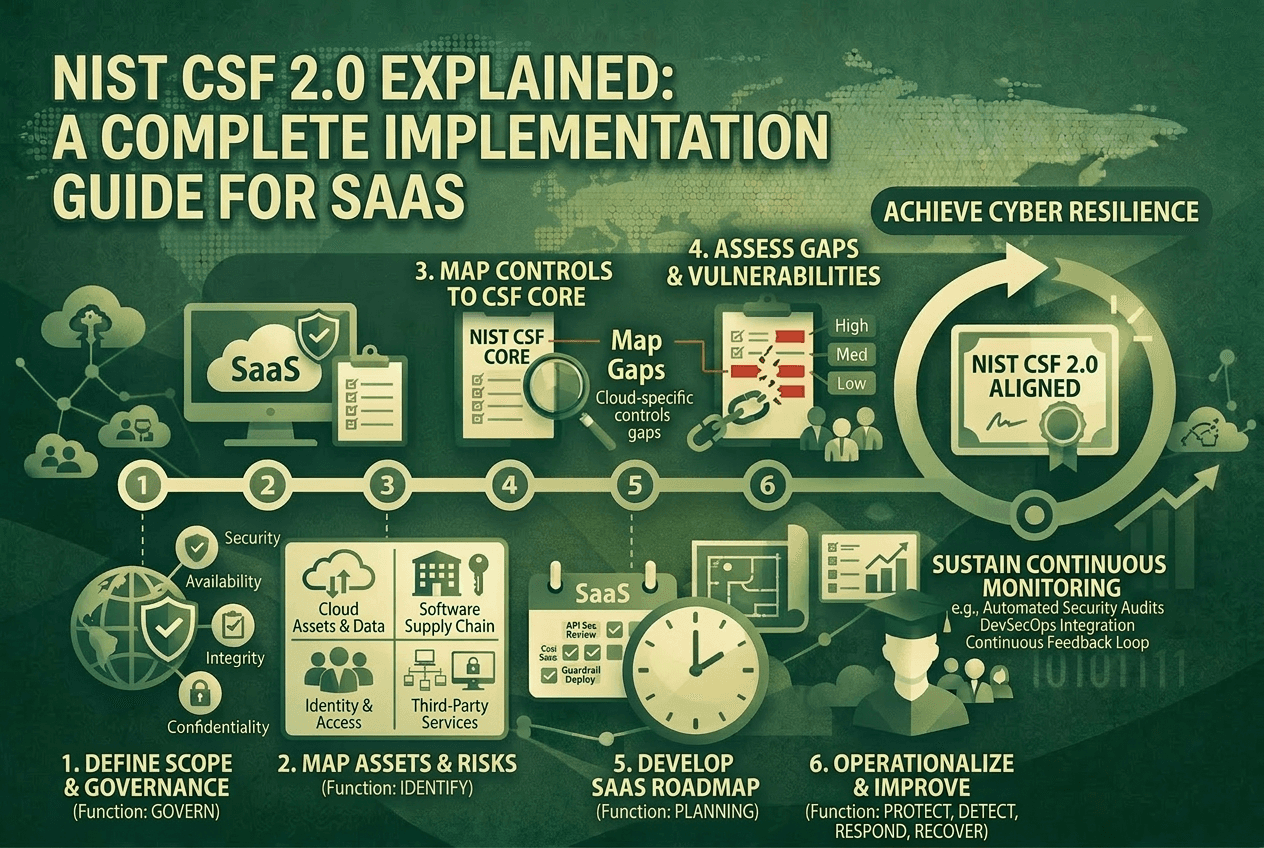
A CSF 2.0 implementation for a SaaS company follows a defined sequence regardless of the organization's size or existing security maturity.
Start by scoping and building a Current Profile. Before deciding what to implement, understand where you are. Work through the six functions and their categories, assess your current practices honestly against each subcategory, and document the result as your Current Profile. Be specific — a subcategory is not addressed because a policy document mentions it. It is addressed because there is an operational process, documented procedure, or technical control in place that implements it, and you can produce evidence that it operates as described.
Define your Target Profile based on your risk context. Your Target Profile should be driven by your customers' expectations, your regulatory environment, your insurance requirements, and your organization's risk appetite. For most enterprise-facing SaaS companies, Tier 3 across all six functions is the appropriate target. For companies in regulated industries or those with government customers, certain subcategories within the Govern and Identify functions may require Tier 4 maturity.
Prioritize your gap remediation. The gap between your Current Profile and Target Profile is your implementation roadmap. Prioritize based on risk — address gaps in the categories that correspond to your highest-risk areas first. For most SaaS companies, the highest-priority gaps are in GV.SC (supply chain risk management), PR.AA (access control and identity management), DE.CM (continuous monitoring) and RS.MA (incident response planning).
Build the Govern foundation before addressing technical controls. The most common implementation failure in CSF programs is to focus on technical controls — logging, encryption, access management — while neglecting the governance foundation that makes those controls sustainable. Policies that are not enforced, risk assessments that are not acted upon, and roles that are assigned on paper but not exercised in practice do not constitute a governance capability. Build the governance infrastructure first, and the implementation of technical controls becomes significantly more effective.
Document everything in your Profile. The CSF Profile is the primary artifact that demonstrates CSF alignment to external stakeholders. It should be complete, current, and specific enough that a reviewer — a customer's security team, a cyber insurance underwriter, or an internal auditor — can understand your security posture, the gaps you have identified, and the remediation activities in progress or planned. Vague descriptions of security practices are not a Profile. Specific, evidence-based assessments against defined subcategories are.
Review and update on a defined schedule. CSF alignment is not a point-in-time achievement. The framework expects organizations to continuously improve their cybersecurity posture and to review and update their Profiles as their environment, threat landscape, and business context evolve. Build a review cadence into your security program — quarterly for high-priority gaps and annually for the full Profile — and treat the review as a governance activity with executive visibility rather than a technical exercise.
The NIST Cybersecurity Framework 2.0 is the most widely adopted voluntary cybersecurity framework in the world and the framework against which an increasing proportion of enterprise buyer security reviews, cyber insurance applications, and regulatory examinations are conducted. Implementing it rigorously — not as a documentation exercise but as an operational security program — is the difference between a security posture that holds up under scrutiny and one that creates risk and friction at exactly the moments that matter most to your business.
dsalta helps SaaS and cloud companies implement NIST CSF 2.0, build and maintain their Current and Target Profiles, and demonstrate alignment with cybersecurity frameworks to enterprise buyers, auditors, and cyber insurers.


Explore more AI Compliance articles
Stop losing deals to compliance.
Get compliant. Keep building.
Join 100s of startups who got audit-ready in days, not months.