Preparation —
Conducting an ISO 27001 Risk Assessment
ISO 27001 risk assessment identifies, evaluates risks, maps controls, and documents the Statement of Applicability (SoA)
Share this article


A robust risk assessment is at the heart of ISO 27001 compliance. It informs how your Information Security Management System (ISMS) is structured, which controls you implement, and how you prioritize improvements across your organization.
Defining Your Risk Assessment Methodology
Begin by defining a risk assessment methodology appropriate to your organization's size, industry, and complexity. This typically includes four key phases: risk identification, analysis, evaluation, and treatment. Your methodology should align with ISO 27001 requirements and be documented as part of your compliance framework.
Many organizations struggle with choosing between qualitative and quantitative approaches. For most startups and mid-sized companies, a qualitative or semi-quantitative method provides the right balance of rigor and practicality.
Identifying Assets, Threats, and Vulnerabilities
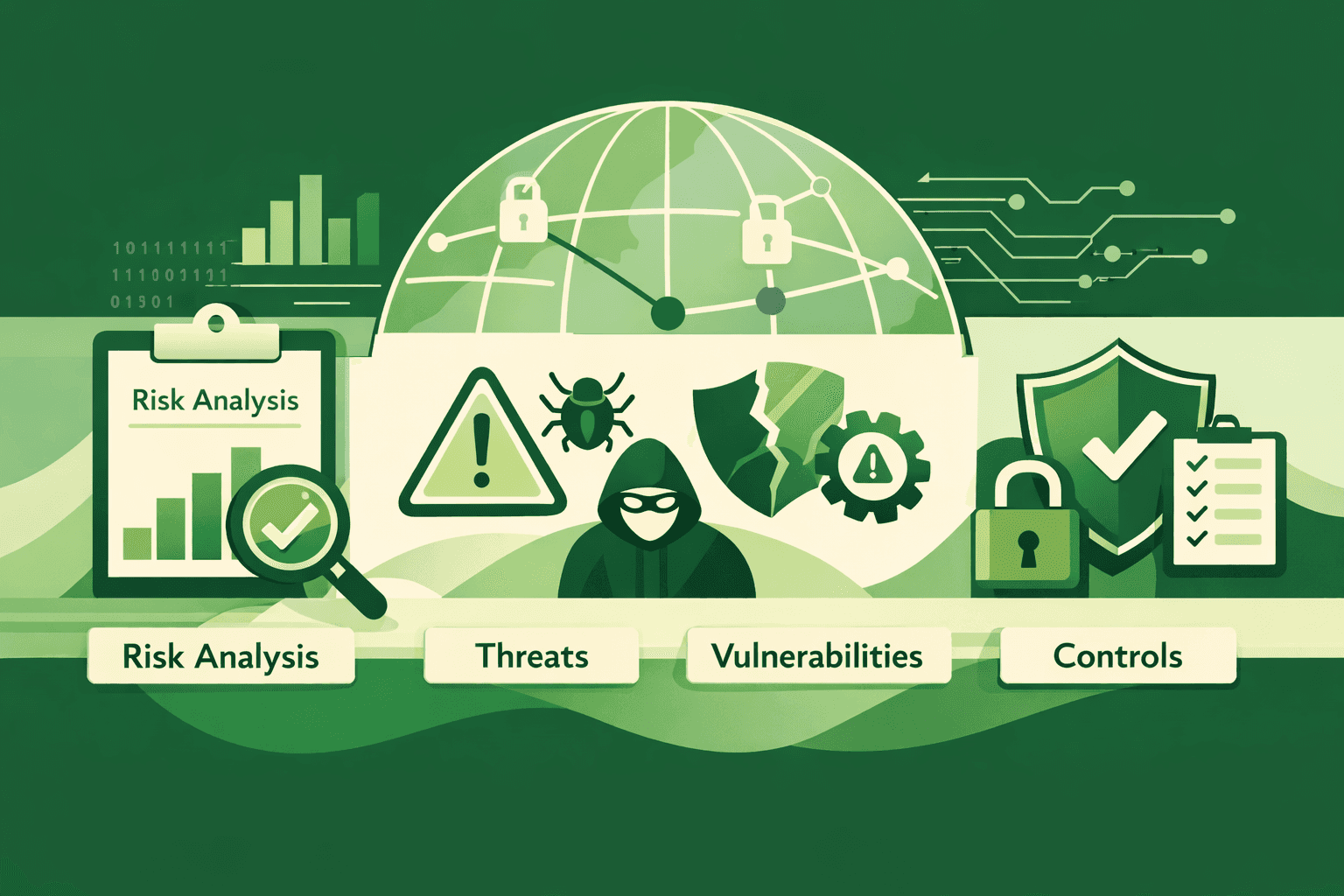
The foundation of any risk assessment is a comprehensive asset inventory. Identify all information assets, including data, systems, personnel, and facilities, that support your business operations.
For each asset, document:
Threats: What could go wrong? (e.g., cyberattacks, insider threats, natural disasters)
Vulnerabilities: What weaknesses could threats exploit? (e.g., unpatched software, weak access controls)
Potential impacts: What would happen if the threat materialized? (e.g., data breach, service disruption, regulatory fines)
This systematic approach ensures nothing falls through the cracks and provides the basis for prioritization. Organizations preparing for ISO 27001 certification must demonstrate thoroughness in this phase.
Assessing Likelihood and Impact
Once risks are identified, assess both the likelihood of occurrence and the impact on your organization. This dual assessment allows you to prioritize your mitigation efforts effectively.
Create a risk matrix that plots likelihood against impact to categorize risks as:
Critical: Immediate action required
High: Priority treatment needed
Medium: Monitor and plan mitigation
Low: Accept or apply minimal controls
This prioritization is essential for resource allocation and demonstrates to auditors that you're taking a risk-based approach to security, a core principle of ISO 27001.
Documenting Your Risk Treatment Plan
Once risks are evaluated, document a comprehensive risk treatment plan. This plan should map specific controls—many from ISO 27001 Annex A to the risks they address.
For each risk, you'll need to decide on one of four treatment options:
Modify: Implement controls to reduce the risk
Retain: Accept the risk as-is (with justification)
Avoid: Eliminate the activity that creates the risk
Share: Transfer risk through insurance or outsourcing
Your treatment plan becomes a living document that guides ISO 27001 implementation and provides clear evidence during audits.
Creating the Statement of Applicability (SoA)
The Statement of Applicability (SoA) is one of the most critical documents in your ISO 27001 compliance program. It provides a formal record of which controls from Annex A are implemented, which are excluded, and most importantly, the justification for these decisions.
For each of the 93 Annex A controls, your SoA should indicate:
Whether it's applicable to your organization
Implementation status (planned, in progress, or implemented)
Justification for exclusions
How it addresses specific risks from your assessment
The SoA bridges your risk assessment to your actual security posture and serves as a roadmap for maintaining ISO 27001 compliance year-round.
Streamlining Risk Assessment with Automation
Manual risk assessments are time-consuming and prone to inconsistency. Modern ISO 27001 compliance automation tools can dramatically accelerate this process while improving accuracy.
DSALTA's AI-powered platform automates risk identification, maps controls to frameworks, and maintains your SoA in real time, reducing what traditionally takes months to weeks. Learn more about how to conduct an ISO 27001 risk assessment with automation.
Ready to streamline your ISO 27001 risk assessment? Book a demo to see how DSALTA can help you achieve certification faster.
Frequently Asked Questions (FAQs)
What is the role of risk assessment in ISO 27001?
Risk assessment is the foundation of ISO 27001 because it shapes your ISMS, determines which controls you need, and helps you prioritize improvements.What are the main phases of an ISO 27001 risk assessment?
The main phases are risk identification, analysis, evaluation, and treatment.What is the first step in a risk assessment?
The first step is building a complete asset inventory that includes data, systems, personnel, and facilities.What should be identified for each asset?
You should identify threats, vulnerabilities, and potential impacts for each asset.How are risks prioritized in ISO 27001?
Risks are usually ranked by likelihood and impact, often using a risk matrix.What do risk ratings like critical, high, medium, and low mean?
Critical risks need immediate action, high risks need priority treatment, medium risks should be monitored and planned for, and low risks may be accepted or treated minimally.What are the risk treatment options in ISO 27001?
The four options are modify, retain, avoid, and share.


In the Spotlight

Start your ISO 27001 compliance journey with DSALTA's complete checklist.
ISO® 27001 is the international gold standard for information security management systems (ISMS). Certification shows your organization can manage sensitive information securely and reliably.
Although ISO 27001 looks challenging, DSALTA®’s automation makes it easier: mapping risks, collecting evidence, and monitoring controls in real time. This checklist gives you a clear step- by-step roadmap.
Read more about ISO 27001 certificate with DSALTA.
Stop losing deals to compliance.
Get compliant. Keep building.
Join 100s of startups who got audit-ready in days, not months.