Rules & Requirements —
Understanding the ISO 27001 ISMS
An ISMS is a dynamic system managing info security risks via policies, controls, and monitoring, enabling compliance.
Share this article


An Information Security Management System — ISMS — is the structured framework of policies, processes, controls, roles, and responsibilities that an organization uses to identify, manage, and continuously improve its approach to information security risk. Under ISO 27001, the ISMS is not a document you produce for an auditor it is the operating system your entire security program runs on. Every control, every policy, every risk decision in an ISO 27001 program exists within the ISMS, and certification is essentially the external validation that your ISMS is designed correctly and functioning as intended. This guide explains exactly what an ISMS is, what ISO 27001 requires it to contain, and how organizations build one that works in practice rather than just on paper.
What Is an Information Security Management System?
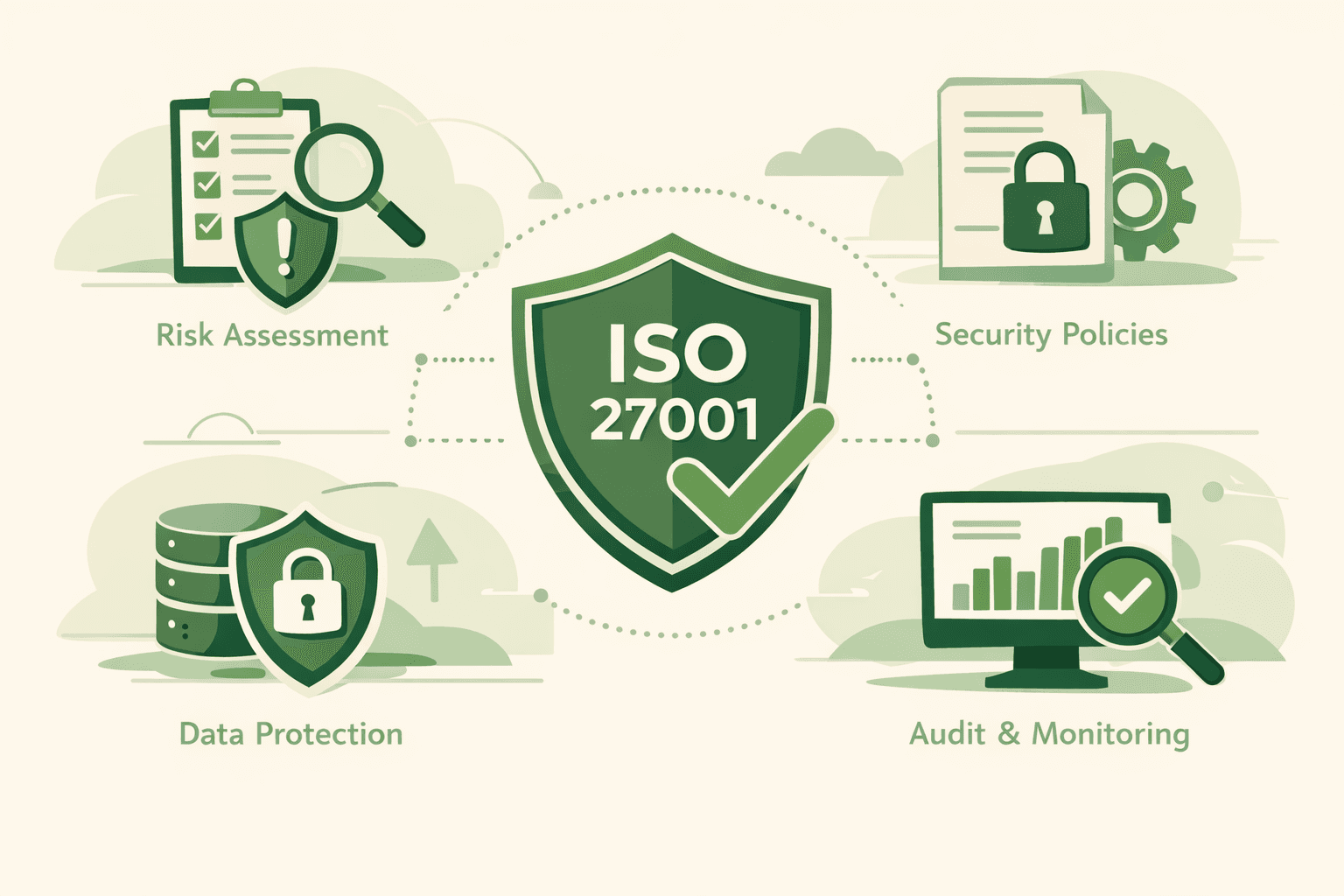
An Information Security Management System is a systematic, risk-based approach to managing sensitive information across an organization. The key word is systematic — an ISMS is not a collection of individual security measures or a one-time audit exercise. It is an integrated management system that connects your organization's security objectives, risk environment, controls, and governance structure into a coherent, auditable whole.
ISO 27001 defines the requirements for establishing, implementing, maintaining, and continually improving an ISMS. An organization that achieves ISO 27001 certification has demonstrated to an independent auditor that its ISMS meets those requirements — that information security risks are being identified and managed systematically, that controls are operating effectively, and that the organization has the governance structure and processes in place to keep improving over time.
What distinguishes an ISMS from a simpler security program is its scope and its dynamism. An ISMS covers the full lifecycle of information security management — from initial risk identification through control implementation, ongoing monitoring, incident response, and management review. And it is explicitly designed to evolve as the organization's threat landscape, business operations, and regulatory environment change.
What an ISMS Is Not
Understanding what an ISMS is not is just as important as understanding what it is — because the most common ISMS implementation failures come from misunderstanding its nature.
An ISMS is not a document. Organizations sometimes treat ISO 27001 certification as a documentation exercise — producing the required policies and procedures for an auditor, then filing them away. This produces a certification that fails to survive the first annual surveillance audit and delivers no actual security improvement. A functioning ISMS is an operating practice, not a filing cabinet.
An ISMS is not a technology platform. Security tools — SIEM, vulnerability scanners, endpoint detection, and access management platforms — are components that support an ISMS. They are not the ISMS itself. An organization with sophisticated security tooling but lacking a governance structure, a defined risk management process, and management oversight does not have an ISMS.
An ISMS is not static. ISO 27001 explicitly requires continual improvement. An ISMS that was certified three years ago and has not been reviewed, updated, or measured since is not compliant — regardless of what the certificate on the wall says.
The Core Components of an ISO 27001 ISMS
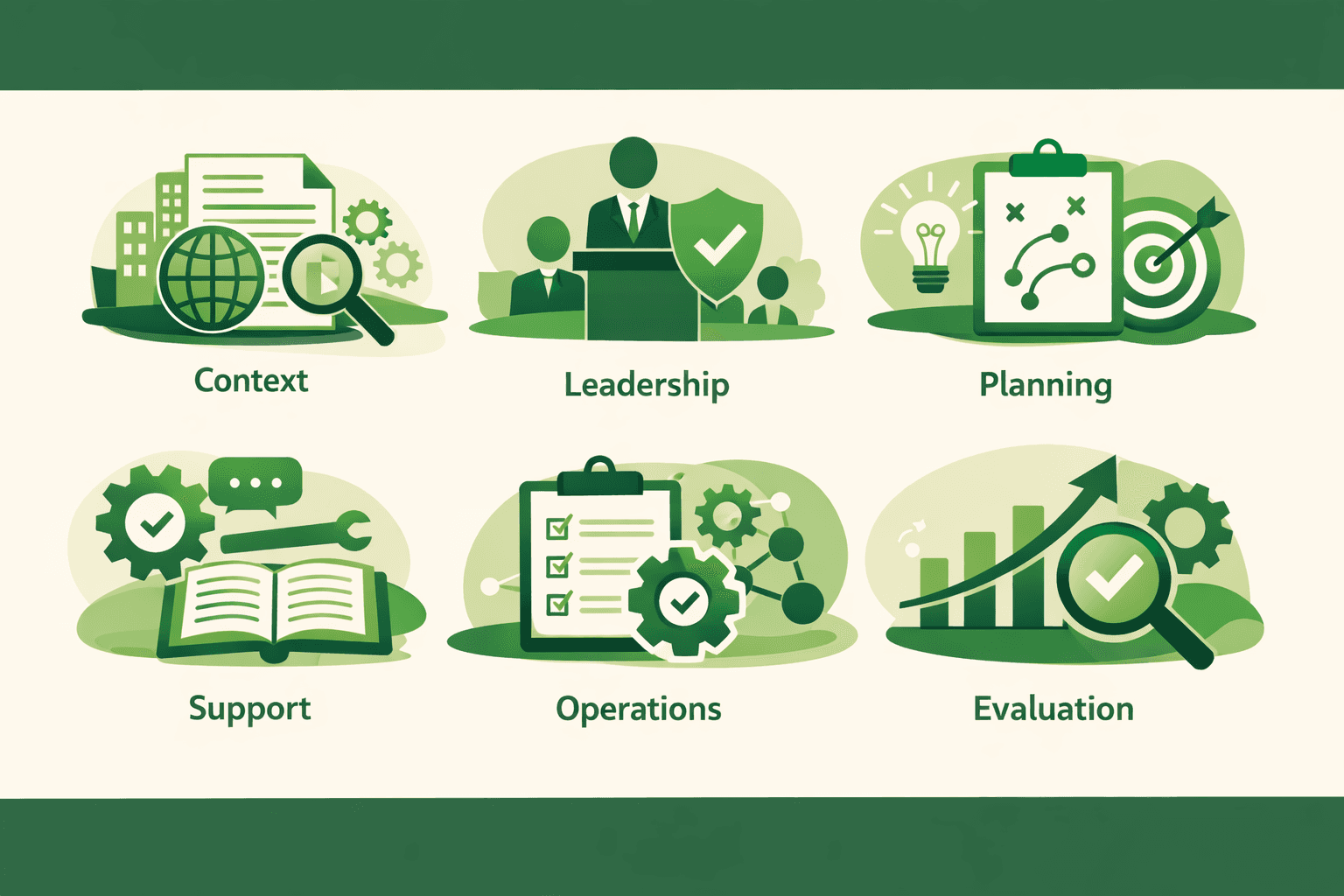
ISO 27001 specifies what an ISMS must contain through its clause structure. Understanding these components is the foundation for building one that will pass certification and deliver real security value.
Organizational Context and Scope
Before implementing any controls, ISO 27001 requires organizations to define the context in which the ISMS operates. This means understanding the internal and external factors that affect information security — business objectives, regulatory requirements, contractual obligations, the competitive landscape, and the organization's own capabilities and constraints.
From this context analysis, the organization defines the scope of the ISMS: which parts of the organization, locations, systems, and information assets fall within the ISMS boundary. Scope definition is one of the most consequential decisions in an ISO 27001 program — too narrow and the certification carries limited commercial credibility, too broad and the implementation burden becomes unmanageable for the first attempt.
Most organizations certifying for the first time define a scope that covers their core product infrastructure, the teams that build and operate it, and the information assets most relevant to their customer relationships. The scope can be expanded in subsequent certification cycles.
Information Security Policy
The Information Security Policy is the top-level document that establishes the organization's commitment to information security, defines the ISMS objectives, and provides the governance framework within which all other policies and procedures operate.
The policy must be approved by top management — ISO 27001 makes it explicit that senior leadership accountability is not optional — and communicated to all workforce members and relevant interested parties. It should be brief, clear, and aligned with the organization's strategic objectives. A policy that no one has read and no one refers to in practice is not fulfilling its ISO 27001 function.
Risk Assessment and Treatment
Risk assessment is the engine of the ISMS. ISO 27001 does not prescribe a specific risk assessment methodology, but it requires that the methodology be documented, applied consistently, and capable of producing comparable, reproducible results.
The risk assessment process identifies information assets within the ISMS scope, identifies the threats and vulnerabilities that could compromise those assets, assesses the likelihood and potential impact of each identified risk given existing controls, and produces a risk register that documents the organization's risk landscape at a point in time.
The risk treatment process documents how each identified risk will be addressed — by implementing controls from ISO 27001's Annex A control set, by applying other controls appropriate to the risk, by accepting the risk with a documented rationale, or by avoiding the risk by discontinuing the activity that creates it. Every risk treatment decision must be documented, and the resulting risk treatment plan becomes the basis for the Statement of Applicability.
Statement of Applicability
The Statement of Applicability is one of ISO 27001's most distinctive requirements and one of the documents auditors review most carefully. It lists all 93 controls in ISO 27001's Annex A, states whether each control is applicable to the organization, and for applicable controls, provides evidence that the control has been implemented.
For controls that are not applicable, the SoA must provide a documented justification. "We don't have physical offices" is a legitimate justification for excluding certain physical security controls. "This control is too difficult to implement" is not.
The SoA connects the risk treatment plan to the control set, demonstrating that control selection decisions were risk-driven rather than arbitrary.
Annex A Controls
ISO 27001's Annex A contains 93 controls organized across four themes: Organizational controls, People controls, Physical controls, and Technological controls. These represent the control baseline from which organizations select the specific measures appropriate to their risk treatment decisions.
Organizational controls cover areas including information security policies, roles and responsibilities, threat intelligence, information security in supplier relationships, and incident management. People controls address workforce screening, terms and conditions of employment, security awareness and training, and disciplinary processes. Physical controls cover physical security perimeters, clear desk and clear screen policies, and equipment security. Technological controls address user endpoint devices, privileged access rights, information access restriction, encryption, logging, network security, and secure development.
Not every organization implements every control — selection is driven by the risk assessment and documented in the SoA. But the selection must be defensible, and the implemented controls must be operating effectively, not just documented as existing.
Internal Audit
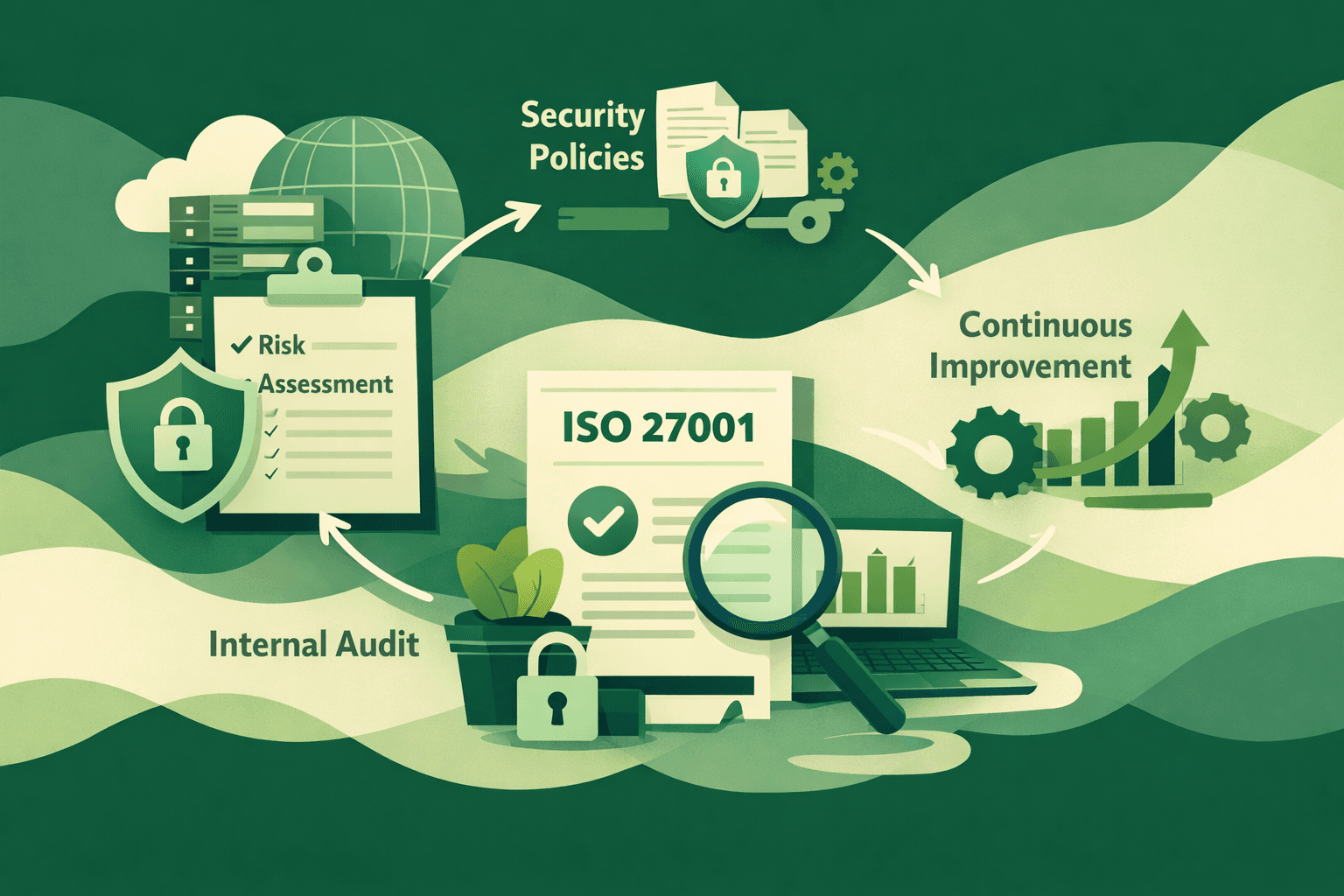
ISO 27001 requires a program of internal audits to verify that the ISMS is implemented correctly and operating effectively. Internal audits are not the same as management review — they are a systematic, documented evaluation of ISMS conformance conducted by individuals who are independent of the areas being audited.
Internal auditors need to understand both the ISO 27001 requirements and the operational realities of the systems and processes they are auditing. A well-conducted internal audit identifies genuine gaps before an external certification auditor does — and demonstrates to external auditors that the organization has a mature approach to ISMS governance.
Audit findings must be documented, tracked through to resolution, and presented at management review. An organization that conducts internal audits, finds issues, and does nothing about them is in a worse position at certification than one that never audited at all.
Management Review
ISO 27001 requires senior management to conduct formal reviews of the ISMS at planned intervals — at a minimum annually for most organizations. Management review assesses the continued suitability, adequacy, and effectiveness of the ISMS, reviews audit findings and risk assessment results, evaluates security incidents and near-misses, considers changes in the internal and external context that affect the ISMS, and makes resource allocation decisions to support ISMS objectives.
Management review is where ISO 27001's requirement for top management accountability becomes most visible to auditors. Minutes of management review meetings, documented decisions, and evidence that findings were acted upon are standard audit evidence requests.
Continual Improvement
ISO 27001's continual improvement requirement means the ISMS must have a documented process for identifying, implementing, and tracking improvements over time. Nonconformities — instances where the ISMS fails to meet its own requirements or ISO 27001's requirements — must be documented, root-caused, and remediated, with evidence that the remediation was effective.
The continual improvement cycle is what distinguishes a certification-grade ISMS from a compliance exercise. Organizations that genuinely use their ISMS to drive security improvement — updating risk assessments in response to new threats, revising controls when monitoring reveals gaps, adjusting scope as the business grows — produce the kind of audit evidence that leads to clean certifications and genuine security maturity.
Why the ISMS Is Central to ISO 27001 — Not Just a Component of It
Some organizations approach ISO 27001 by treating the ISMS as a single element of the certification, alongside the Annex A controls. This misunderstands the structure of the standard. The ISMS is not a component of ISO 27001 certification — it is the entire framework within which certification exists.
The Annex A controls are selected and implemented within the ISMS. The risk assessment process is part of the ISMS. The internal audit program is part of the ISMS program. The management review is an ISMS review. Every requirement of ISO 27001 concerns how the ISMS is established, maintained, and improved.
This is why organizations that implement a set of security controls without building the governance structure around them — the documented risk management process, the management review cadence, the internal audit program, the policy framework cannot achieve ISO 27001 certification, regardless of how strong their technical security posture is. Certification assesses the management system, not just the controls.
The Business Value of a Well-Implemented ISMS
The case for ISO 27001 certification is well-established in enterprise sales and procurement contexts. But the business value of the ISMS itself, the management system behind the certification, extends beyond the certificate.
A functioning ISMS provides a governance structure for security decision-making that scales with organizational growth. Security decisions made informally at ten employees break down at one hundred. An ISMS provides the documented processes, defined responsibilities, and management oversight that enable consistent security decision-making as teams grow and organizational complexity increases.
An ISMS also provides the foundation for efficient multi-framework compliance. Organizations managing SOC 2, PCI DSS, HIPAA, and GDPR alongside ISO 27001 find that the ISMS's risk management process, documentation standards, and control framework provide significant coverage across all of these frameworks. Controls implemented for ISO 27001 frequently satisfy requirements under SOC 2's Common Criteria, HIPAA's Security Rule, and PCI DSS's control requirements — reducing the overall compliance burden compared to running parallel programs for each framework.
Finally, a well-implemented ISMS builds demonstrable trust with customers, partners, and regulators in a way that security claims alone cannot. The ISO 27001 certification is externally validated evidence that your information security management system has been assessed by an independent, accredited body and found to meet an internationally recognized standard. In enterprise procurement, that evidence accelerates sales cycles and reduces due diligence friction in ways that are directly measurable in revenue impact.
How DSALTA Supports ISO 27001 ISMS Implementation
DSALTA's AI compliance platform is built to support the full ISO 27001 ISMS lifecycle from initial scope definition and risk assessment through control implementation, evidence collection, internal audit, and certification readiness.
For organizations implementing an ISMS for the first time, DSALTA provides the risk assessment methodology, policy templates calibrated to ISO 27001's requirements, the Statement of Applicability framework, and automated evidence collection that integrates with your existing cloud and engineering infrastructure. For organizations managing ISO 27001 alongside SOC 2, HIPAA, or GDPR, DSALTA's cross-framework architecture maps overlapping controls so a single implementation satisfies multiple framework requirements simultaneously.
Frequently Asked Questions
What is an ISMS under ISO 27001? An Information Security Management System is the structured framework of policies, processes, controls, roles, and responsibilities through which an organization manages information security risk. ISO 27001 specifies the requirements for establishing, implementing, maintaining, and continually improving an ISMS.
What must an ISO 27001 ISMS include? An ISO 27001 ISMS must include a defined scope, an information security policy approved by top management, a documented risk assessment and treatment process, a Statement of Applicability covering all 93 Annex A controls, implemented security controls aligned to risk treatment decisions, an internal audit program, management review processes, and a continual improvement mechanism.
How long does it take to implement an ISMS? For most organizations implementing ISO 27001 for the first time, ISMS implementation and initial certification take 6 to 12 months, depending on organizational complexity, ISMS scope, and the maturity of existing security controls. Organizations using compliance automation platforms typically complete implementation faster than those relying on manual processes.
Is an ISMS the same as an information security policy? No. An information security policy is one component of an ISMS — the top-level document that establishes the organization's commitment to security and governance framework. The ISMS is the entire management system within which the policy, risk management process, controls, audit program, and continual improvement cycle all operate.
Can a small company implement an ISO 27001 ISMS? Yes. ISO 27001 is designed to be scalable and applicable to organizations of any size. A small company's ISMS will be simpler in scope and structure than a large enterprise's, but the core requirements — risk assessment, control implementation, management review, internal audit, and continual improvement — apply regardless of organizational size.
How does DSALTA help with ISO 27001 ISMS implementation? DSALTA provides the risk assessment framework, policy templates, Statement of Applicability tooling, automated evidence collection, and audit readiness tracking needed to implement a certification-grade ISO 27001 ISMS. For organizations already managing other compliance frameworks, DSALTA maps overlapping controls to reduce duplicate implementation effort.
DSALTA is an AI compliance software company helping organizations build and maintain ISO 27001, SOC 2, HIPAA, GDPR, and AI governance programs. Learn more at dsalta.com.
Frequently Asked Questions (FAQs)
What is an ISMS under ISO 27001?
An Information Security Management System is the structured framework of policies, processes, controls, roles, and responsibilities an organization uses to manage information security risk.What does ISO 27001 require an ISMS to do?
It must be established, implemented, maintained, and continually improved.Is an ISMS just a document?
No. It is an operating system for security management, not a filing cabinet of policies.Is an ISMS the same as security tools?
No. Tools support the ISMS, but the ISMS also needs governance, risk management, and management oversight.What are the core components of an ISO 27001 ISMS?
They include scope and context, the information security policy, risk assessment and treatment, the Statement of Applicability, Annex A controls, internal audit, management review, and continual improvement.What is the role of scope in an ISMS?
Scope defines which business units, systems, locations, and information assets are covered.What is the information security policy?
It is the top-level document that sets the organization’s commitment to security and its governance framework.


In the Spotlight

Start your ISO 27001 compliance journey with DSALTA's complete checklist.
ISO® 27001 is the international gold standard for information security management systems (ISMS). Certification shows your organization can manage sensitive information securely and reliably.
Although ISO 27001 looks challenging, DSALTA®’s automation makes it easier: mapping risks, collecting evidence, and monitoring controls in real time. This checklist gives you a clear step- by-step roadmap.
Read more about ISO 27001 certificate with DSALTA.
Stop losing deals to compliance.
Get compliant. Keep building.
Join 100s of startups who got audit-ready in days, not months.