Audit Process —
ISO 27001 Certification: A Step-by-Step Guide
ISO 27001 certification steps: gap analysis, set up ISMS, perform internal audits, and complete management review.
Share this article


ISO 27001 Certification: A Step-by-Step Guide
The certification process has eight distinct steps, and the order matters — skipping or compressing steps (especially gap analysis and remediation) is the most common reason organizations hit unexpected delays at Stage 1 or Stage 2. Here's what each step actually involves.
1. Gap Analysis
Before building anything, assess your current security posture against ISO 27001's requirements — Clauses 4-10 and the 93 Annex A controls. This identifies what already exists, what's partially in place, and what needs to be built from scratch. Organizations that skip this step often duplicate work later, building controls that don't map cleanly to what the standard actually requires.
2. ISMS Development
This is the largest step, covering four distinct pieces of work:
Scope definition — what's in and out of the ISMS, per Clause 4
Risk assessment — identifying, analyzing, and treating risk, producing the Statement of Applicability
Control implementation — putting the controls the SoA identifies into actual operation, with evidence collection designed in from the start
Documentation — policies, procedures, and records that satisfy Clause 7.5's documented information requirements
Conducting an ISO 27001 Risk Assessment and Building ISO 27001 Policies with Templates cover the two most failure-prone pieces of this step in depth.
3. Internal Audit
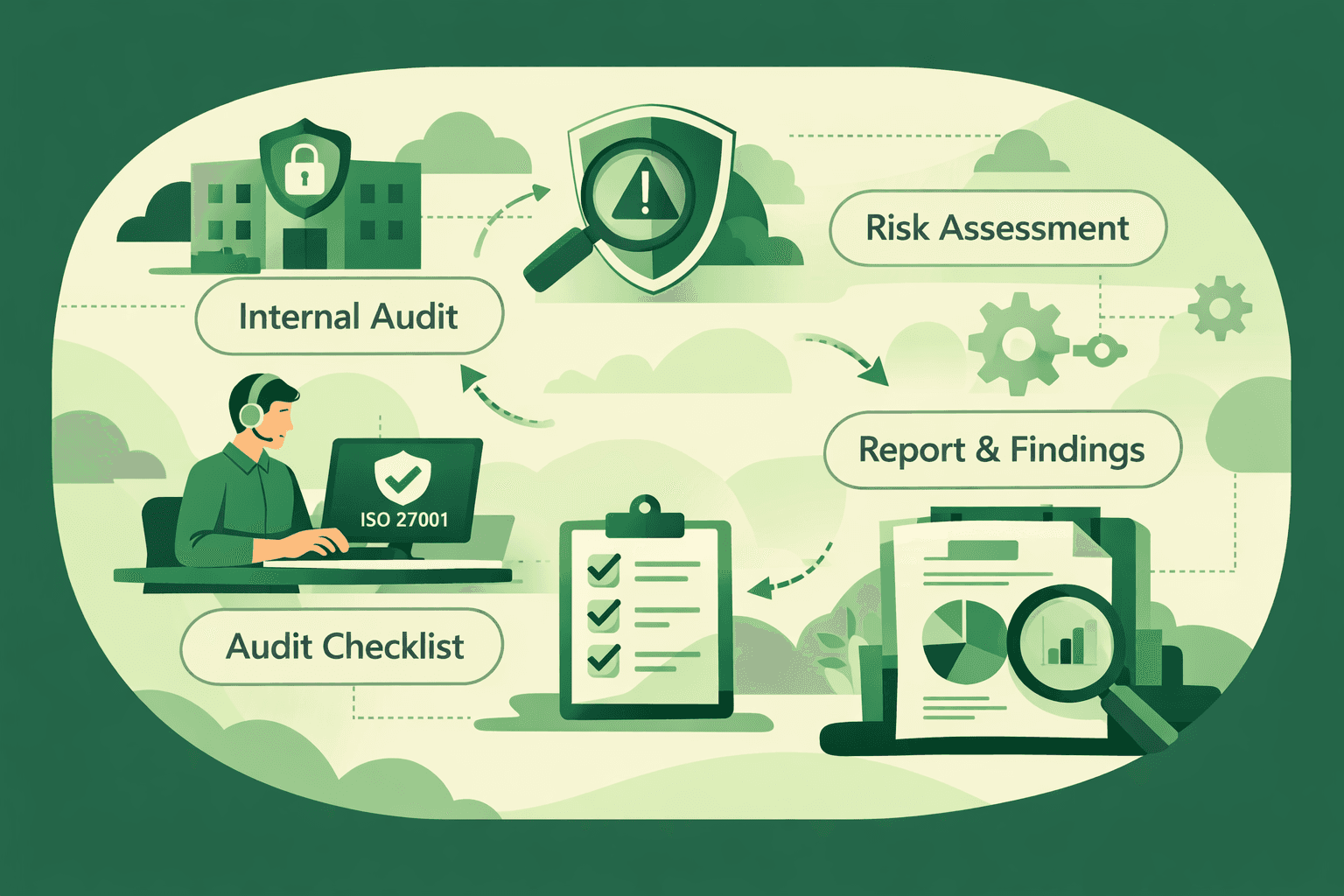
Before any external auditor sees the ISMS, an independent internal audit checks whether it actually works — not just whether it's documented. This step exists specifically to catch gaps while they're still cheap to fix, rather than during a paid certification audit. Running an ISO 27001 Internal Audit covers building an audit plan and selecting independent auditors.
4. Management Review
Leadership formally reviews the ISMS's performance — audit results, risk status, corrective actions — and makes an explicit decision that the organization is ready to pursue certification. This step is often treated as a formality; auditors check for it specifically because a rushed or undocumented management review is itself a Clause 9.3 nonconformity.
5. Stage 1 Audit
The certification body reviews documentation: scope statement, policies, SoA, risk treatment plan. This is a readiness check, not a full evaluation — it confirms the ISMS is documented coherently enough to proceed to Stage 2. Most Stage 1 findings are documentation gaps: missing SoA justifications, inconsistencies between the scope statement and what's actually been risk-assessed.
6. Remediation
If Stage 1 surfaces findings, they get fixed before Stage 2 is scheduled. This step is frequently underestimated in project timelines — organizations that budget zero time for remediation between stages are the ones most likely to face delays. Building a remediation buffer into the certification timeline from the start is more realistic than assuming Stage 1 will pass cleanly.
7. Stage 2 Audit
The full evaluation: auditors test whether implemented controls actually operate as documented, sampling real evidence and interviewing control owners. This is where the gap between "looks compliant on paper" and "is actually compliant in practice" gets tested directly. Passing Stage 2 requires operational evidence behind every control marked as implemented in the SoA — not just the control's existence.
8. Certification Issuance
After passing Stage 2, the certification body issues the ISO 27001 certificate, valid for three years. Certification isn't the end of the work: annual surveillance audits in years one and two check whether the ISMS has kept pace with the organization, and a full recertification audit happens in year three. Understanding ISO 27001 Certification Validity covers what those ongoing audits require.
Aligning with Other Frameworks
If your organization is also pursuing SOC 2, HIPAA, PCI DSS, or GDPR, several of the eight steps above overlap substantially with what those frameworks require — particularly risk assessment, access control documentation, and incident response procedures. Sequencing ISO 27001's ISMS development to also satisfy these adjacent frameworks, rather than building separate parallel efforts, typically saves significant duplicated work.
For cost and timeline expectations across all eight steps, see Estimating ISO 27001 Certification Costs and How Long Does ISO 27001 Certification Take?
Frequently Asked Questions (FAQs)
What are the 8 steps of ISO 27001 certification?
The eight steps are gap analysis, ISMS development, internal audit, management review, Stage 1 audit, remediation, Stage 2 audit, and certification issuance.Why is gap analysis the first step?
Because it shows what already exists, what is partially in place, and what still needs to be built before certification work begins.What happens during ISMS development?
You define scope, complete the risk assessment, implement applicable controls, and create the required policies, procedures, and records.Why is internal audit required before certification?
It checks whether the ISMS actually works in practice and helps catch issues before the external audit.What is management review in ISO 27001?
It is a formal leadership review of ISMS performance, audit results, risk status, and corrective actions before moving toward certification.What is Stage 1 of the certification audit?
Stage 1 is a documentation and readiness review to make sure the ISMS is coherent enough to proceed.What is Stage 2 of the certification audit?
Stage 2 is the full audit where auditors test whether controls are operating as documented and backed by real evidence.


In the Spotlight

Start your ISO 27001 compliance journey with DSALTA's complete checklist.
ISO® 27001 is the international gold standard for information security management systems (ISMS). Certification shows your organization can manage sensitive information securely and reliably.
Although ISO 27001 looks challenging, DSALTA®’s automation makes it easier: mapping risks, collecting evidence, and monitoring controls in real time. This checklist gives you a clear step- by-step roadmap.
Read more about ISO 27001 certificate with DSALTA.
Stop losing deals to compliance.
Get compliant. Keep building.
Join 100s of startups who got audit-ready in days, not months.