SOC 2 —
SOC 2 vs ISO 27001: Map Controls & Avoid Double Work
Learn how to map SOC 2 and ISO 27001 controls efficiently. Save time, reduce costs, and maintain dual compliance with our practical framework guide.
Jon Ozdoruk
Multi-Framework Strategy
Share this article


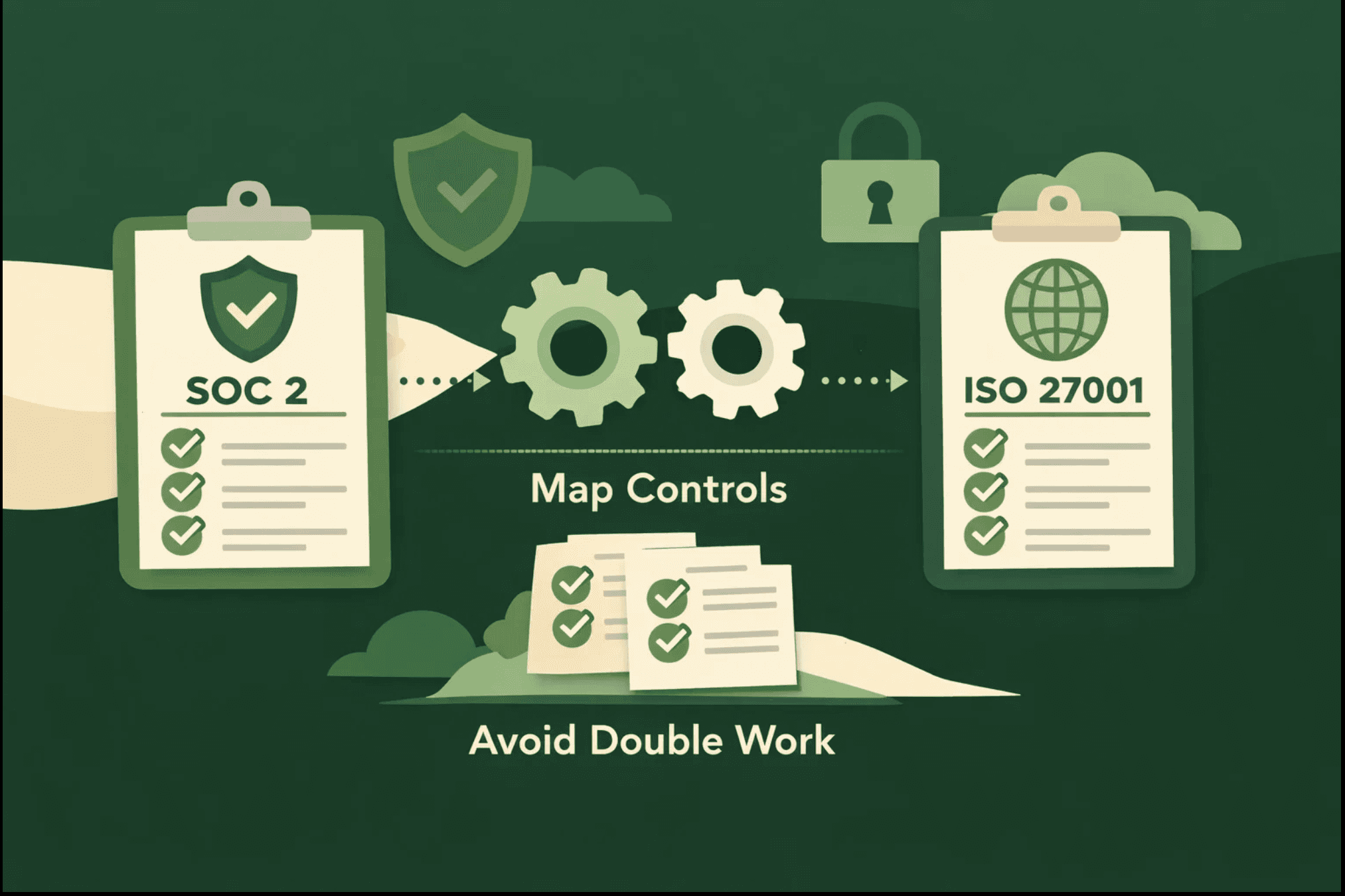
How to Map Controls Between SOC 2 and ISO 27001 and Avoid Double Work
As your startup scales, customers in different markets start asking for different compliance certifications. US enterprise clients want SOC 2. European partners demand ISO 27001. Suddenly, you're facing what feels like double the compliance work.
But here's the good news: you don't have to build two separate programs from scratch. SOC 2 and ISO 27001 share significant overlap in their security controls, and with smart mapping, you can maintain both certifications without doubling your workload.
Why Founders Face This Dual Compliance Challenge
Most startups start with SOC 2 because it's what American customers demand. Then international expansion hits, and ISO 27001 becomes non-negotiable for European or global enterprise deals.
The common mistake? Treating these as completely separate frameworks and building parallel compliance programs. This leads to:
Duplicate documentation across two systems
Conflicting policies that confuse your team
Wasted audit fees for covering the same controls twice
Compliance fatigue that slows down your actual security improvements
Understanding the Overlap Between SOC 2 and ISO 27001
While SOC 2 and ISO 27001 come from different origins, they're both fundamentally about information security management. Here's what they have in common:
Shared Security Objectives
Both frameworks require you to:
Implement access controls to protect sensitive data
Establish risk assessment processes
Create incident response procedures
Maintain security awareness training
Document change management processes
Conduct regular security monitoring
The key difference isn't what you do, but how you document and demonstrate it.
How to Map SOC 2 Trust Service Criteria to ISO 27001 Controls
The most efficient approach is to create a control mapping matrix that shows how your existing controls satisfy both frameworks simultaneously.
Start With Your Common Criteria (CC) Controls
SOC 2's Common Criteria section maps almost directly to ISO 27001's Annex A controls:
Access Control Example:
SOC 2 CC6.1 (logical and physical access controls) aligns with ISO 27001 A.9.1 (access control policy)
Your single access control policy can satisfy both requirements
Risk Assessment Example:
SOC 2 CC3.1 (entity identifies risks) maps to ISO 27001 A.8.1 (information security risk assessment)
One comprehensive risk register works for both audits
Additional Criteria Mapping Strategy
For SOC 2's additional criteria (Availability, Confidentiality, Processing Integrity, Privacy), identify which ISO 27001 controls already address these concerns:
Availability requirements overlap with ISO 27001 A.17 (business continuity)
Confidentiality controls mirror ISO 27001 A.8.2 (information classification)
Privacy considerations connect to ISO 27001 A.18 (compliance with legal requirements)
Practical Steps to Implement Dual Compliance
Create a Unified Control Framework
Instead of maintaining separate control libraries, build one master framework that references both standards:
Control ID: AC-001
Control Name: User Access Management
SOC 2 Mapping: CC6.1, CC6.2
ISO 27001 Mapping: A.9.1.1, A.9.2.1
Implementation: A single procedure document that covers both requirements
Write Dual-Purpose Policies
When drafting policies, include references to both frameworks. For example, your Information Security Policy should cite:
SOC 2 Common Criteria requirements
ISO 27001 Clause 5 leadership requirements
This way, one document serves both audit purposes.
Leverage a Single Evidence Repository
Store all your compliance evidence in one centralized location with tags for both frameworks. When auditors request access logs, you pull the same evidence file regardless of the certification they're auditing.
Schedule Coordinated Audits
Work with auditors who understand both frameworks. Some firms can conduct SOC 2 and ISO 27001 audits simultaneously or in close succession, reviewing the same controls once instead of twice.
Where the Frameworks Diverge (And How to Handle It)
While overlap is substantial, some differences require specific attention:
Documentation Style
ISO 27001 requires a formal Information Security Management System (ISMS) with mandatory documented procedures
SOC 2 is more flexible about documentation format, but emphasizes operational effectiveness
Solution: Create formal ISO procedures that also serve as your SOC 2 evidence of implementation.
Scope Definition
ISO 27001 uses a Statement of Applicability to define which controls apply
SOC 2 focuses on trust service criteria relevant to your system description
Solution: Ensure your system description and ISMS scope align, making it clear what's in and out of scope for both.
Management Review
ISO 27001 mandates formal management review meetings with specific agenda items
SOC 2 requires oversight, but witha less prescriptive format
Solution: Design management reviews that meet ISO 27001's strict requirements, thereby automatically satisfying SOC 2 requirements.
Tools and Templates to Simplify Dual Compliance
Managing both certifications becomes exponentially easier with the right infrastructure:
Governance, Risk, and Compliance (GRC) Platforms
Modern GRC tools like DSALTA can maintain unified control libraries with built-in multi-framework mapping. This eliminates manual spreadsheet management and ensures nothing falls through the cracks.
Automated Evidence Collection
Instead of scrambling before audits, implement continuous evidence collection that automatically tags artifacts for both SOC 2 and ISO 27001 requirements.
Gap Analysis Templates
Use control mapping templates to identify exactly where you need additional work for the second certification versus where your existing controls already comply.
Timeline and Cost Considerations
If you already have SOC 2, adding ISO 27001 typically requires:
Time Investment:
2-3 months for gap analysis and additional documentation
1-2 months for the implementation of missing controls
1 month for certification audit preparation
Cost Savings:
40-60% less effort than building ISO 27001 from scratch
Reduced audit fees through coordinated assessments
Lower ongoing maintenance with unified processes
Common Pitfalls to Avoid
Treating Them as Completely Separate
The biggest mistake is maintaining two parallel compliance programs. This creates confusion, increases costs, and makes both certifications harder to maintain.
Neglecting the Statement of Applicability
ISO 27001 requires you to justify why controls are excluded. Make sure your SoA clearly documents how SOC 2 controls satisfy ISO requirements or why certain ISO controls aren't applicable to your scope.
Forgetting Continuous Improvement
Both frameworks expect ongoing enhancement, not just check-the-box compliance. Your unified approach should include regular reviews and updates that benefit both certifications.
Getting Started: Your Action Plan
Ready to pursue dual compliance efficiently? Here's your roadmap:
Conduct a control mapping exercise comparing your current SOC 2 controls to ISO 27001 Annex A
Identify gaps where additional ISO controls are needed
Redesign documentation to reference both frameworks
Implement missing controls, focusing on areas where ISO 27001 is more stringent
Select an experienced auditor familiar with both standards
Schedule your ISO 27001 certification strategically around your SOC 2 audit cycle
Why Dual Compliance Is Worth the Effort
Maintaining both SOC 2 and ISO 27001 certifications opens doors globally. You'll be able to:
Win enterprise deals in both the US and international markets
Demonstrate security maturity to investors and partners
Streamline vendor assessments by providing universally recognized certifications
Build a stronger security program by incorporating best practices from both frameworks
The key is to approach this strategically, with proper control mapping, rather than treating each certification as a separate mountain to climb.
Ready to simplify your dual compliance journey? DSALTA's AI-powered compliance platform automatically maps controls across SOC 2, ISO 27001, and other frameworks, helping you maintain multiple certifications without the administrative burden. Learn how we can help your startup scale compliance efficiently.
People Also Ask
What is the difference between SOC 2 and ISO 27001?
SOC 2 is a US-based auditing standard focused on service organizations' security controls, while ISO 27001 is an international standard for information security management systems. SOC 2 emphasizes operational effectiveness, while ISO 27001 requires formal documentation and continuous improvement processes.
Can you have both SOC 2 and ISO 27001 certification?
Yes, many organizations maintain both certifications simultaneously. The frameworks share 60-70% control overlap, making dual compliance more efficient than pursuing each separately.
How long does it take to get ISO 27001 if you already have SOC 2?
Typically, 4-6 months, which is 40-50% faster than obtaining ISO 27001 from scratch, since many controls are already in place for SOC 2 compliance.
Which is harder, SOC 2 or ISO 27001?
ISO 27001 generally requires more formal documentation and prescriptive processes, while SOC 2 offers more flexibility. However, difficulty depends on your organization's existing security maturity and documentation practices.

Explore more SOC 2 articles
Stop losing deals to compliance.
Get compliant. Keep building.
Join 100s of startups who got audit-ready in days, not months.