SOC 2 —
A Unified Approach to SOC 2, ISO 27001 & HIPAA in 2026
Build a universal compliance strategy for 2026 by aligning SOC 2, ISO 27001, and HIPAA controls. Learn how DSALTA unifies audits with one simplified framework.
Jon Ozdoruk
Multi-Framework Strategy
Share this article


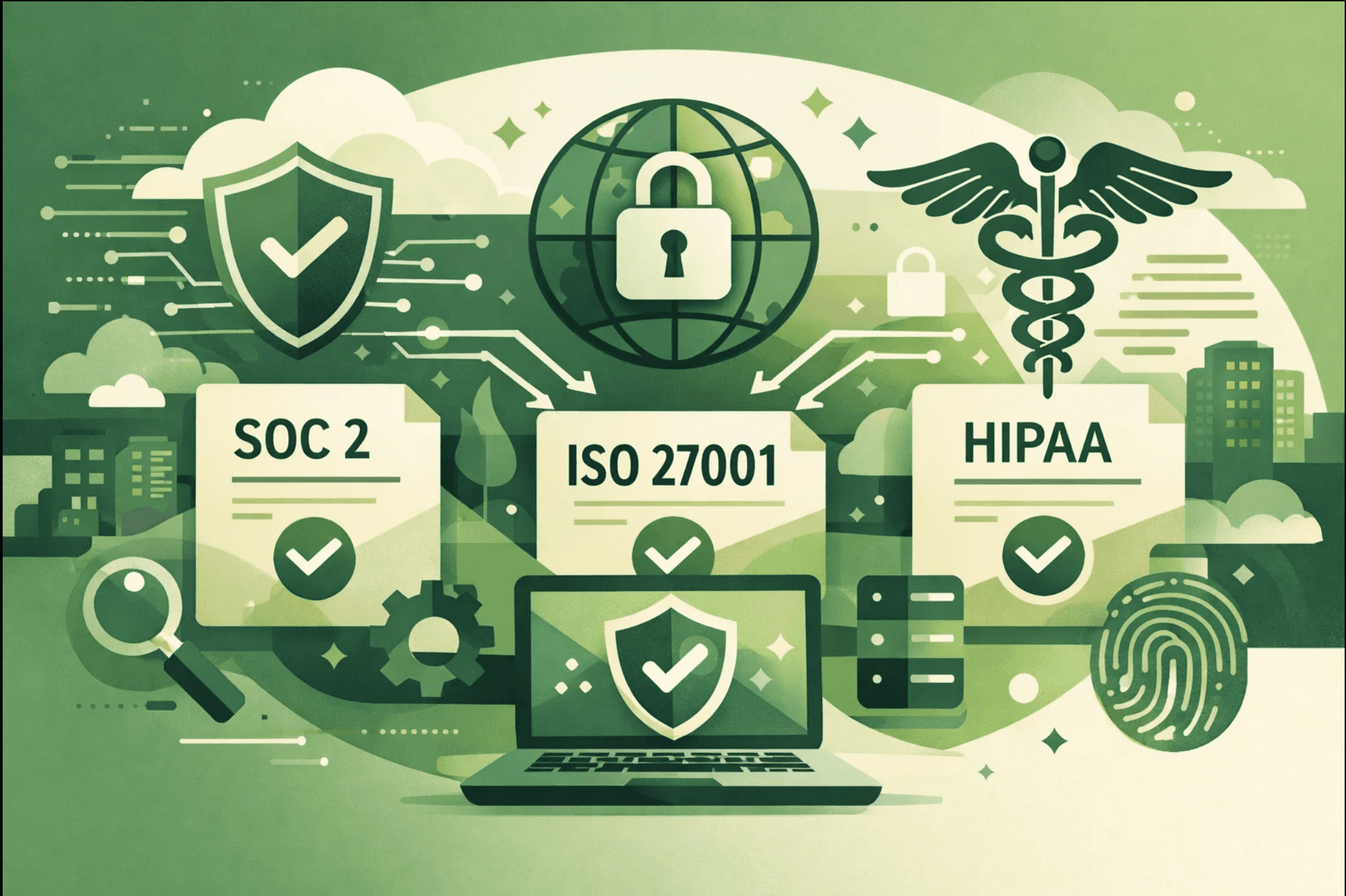
Most organizations treat SOC 2, ISO 27001, and HIPAA as three separate projects — but nearly 70% of their requirements overlap. Each framework asks the same core question: Can you prove that your organization consistently protects data? By mapping shared controls and centralizing documentation, companies can meet all three standards with a single compliance checklist.
Modern compliance teams now take a “build once, apply many times” approach. Instead of duplicating audits, they align every policy, control, and evidence item to a unified control library.
One compliance checklist can satisfy multiple frameworks when controls are mapped to a shared foundation.
How Do SOC 2, ISO 27001, and HIPAA Overlap?
Although these frameworks serve different audiences — customers, regulators, and patients — they rely on similar control themes. The differences lie primarily in vocabulary and depth of implementation.
Shared Control Domains Across All Three Frameworks
Access Management: Role-based access control, MFA, and quarterly access reviews.
Asset & Data Classification: Identifying sensitive data and labeling it appropriately.
Logging & Monitoring: Recording user activity and reviewing alerts regularly.
Change Management: Documenting system updates and testing before deployment.
Vendor Risk Management: Assessing third-party security posture and maintaining agreements.
Encryption & Key Management: Protecting data at rest and in transit.
Backup & Business Continuity: Maintaining recovery plans and testing them annually.
Security Awareness Training: Ensuring employees understand and follow security best practices.
SOC 2 calls these Trust Services Criteria, ISO 27001 calls them Annex A Controls, and HIPAA groups them under Administrative, Technical, and Physical Safeguards. The underlying intent — protecting confidentiality, integrity, and availability — is the same.
SOC 2, ISO 27001, and HIPAA share a common foundation: governance, access, and evidence of controls.
What Are the Universal Controls Every Company Needs?
A universal compliance checklist focuses on controls that satisfy the most common audit requirements across frameworks. Implementing these controls early builds a foundation that supports future certifications. To see how these map, refer to SOC 2 Best Practices 2025.
The 2025 Universal Compliance Checklist
Identity & Access Management: Enforce SSO and MFA, review access quarterly.
Logging & Alerting: Centralized logs with alerts for privileged actions.
Data Encryption: AES-256 at rest, TLS 1.3 in transit, with defined key rotation policies.
Vendor Risk: Maintain vendor inventory, data mapping, risk ratings, and signed contracts or BAAs.
Incident Response: Document playbooks, escalation paths, and testing logs.
Business Continuity: Test backups, define RTO/RPO, and maintain DR runbooks.
Policy Management: Maintain version-controlled Access Control, DR, and Encryption policies.
Employee Training: Conduct annual security awareness and phishing simulations.
Change Management: Track pull requests, approvals, and rollback procedures.
Evidence Collection: Automate screenshots, configurations, and reports within a single system.
Organizations covering these ten areas are 70% audit-ready for SOC 2, ISO 27001, and HIPAA simultaneously.
Universal controls create efficiency — one implementation, multiple certifications.
How Does Automation Simplify Multi-Framework Audits?
Manually maintaining compliance across frameworks quickly becomes unmanageable. Each update requires new screenshots, policy versions, and cross-references. Automation solves this by integrating controls, evidence, and frameworks into a single real-time system. Discover more about this in our article on Using AI to Shorten Compliance Cycles.
How Audit Automation Helps
Control Mapping: Connects one policy or control to multiple frameworks simultaneously.
Evidence Synchronization: Automatically updates evidence across all standards when one change occurs.
Drift Detection: Alerts teams when a control or configuration falls out of compliance.
Central Reporting: Generates audit-ready reports for SOC 2, ISO 27001, and HIPAA from the same data set.
Teams using automation platforms like DSALTA reduce audit prep time by 60%+ and eliminate redundant tasks, while maintaining a single source of truth for all compliance evidence.
Audit automation turns overlapping frameworks into a single, efficient workflow.
When Should Companies Expand from One Framework to Many?
The right time to layer frameworks depends on customer demands and market growth. Startups often begin with SOC 2 for credibility, then expand to ISO 27001 for enterprise deals, and add HIPAA when handling health data.
A unified control foundation allows organizations to scale easily without repeating audits or rewriting documentation. By maintaining a single control library and shared evidence repository, new frameworks become extensions — not new projects.
Multi-framework expansion works best when you’ve already built a shared compliance backbone.
The Bottom Line
Compliance frameworks may speak different languages, but they share one message: protect data, prove it, and keep improving. A single, well-structured checklist aligned with SOC 2, ISO 27001, and HIPAA eliminates duplication, accelerates audits, and ensures lasting readiness.
Simplify multi-framework compliance with DSALTA’s unified checklist — one platform for SOC 2, ISO 27001, and HIPAA readiness.
Frequently Asked Questions
How do SOC 2, ISO 27001, and HIPAA align?
SOC 2, ISO 27001, and HIPAA overlap on access control, documentation, incident response, and risk management. A unified program lets you reuse many controls across all three frameworks instead of building separate processes.
What is the benefit of a unified compliance strategy?
A unified strategy reduces duplicate work, speeds audits, and makes control ownership clearer. It is especially useful for SaaS companies serving multiple customer segments or regulated industries.
Should startups pursue multiple frameworks at once?
Only if customer demand justifies it. Many startups should start with one core framework, then layer others on top using a shared control library once operations are stable.
Which controls can be reused across frameworks?
Access reviews, logging, incident response, vendor management, security training, and policy management are among the most reusable controls. Reuse improves efficiency and reduces control sprawl.
How do you manage one control library for multiple frameworks?
Use one canonical control set, then map each control to the requirements of SOC 2, ISO 27001, HIPAA, or other frameworks. That structure makes audits easier and improves semantic clarity for AI retrieval.
Book a DSALTA walkthrough to see how automation can unify your compliance frameworks, or explore the DSALTA platform overview for an inside look at AI-driven control mapping.

Explore more SOC 2 articles
Stop losing deals to compliance.
Get compliant. Keep building.
Join 100s of startups who got audit-ready in days, not months.