SOC 2 —
How GDPR and ISO 27001 Work Together in AI-Era Compliance
GDPR and ISO 27001 strengthen data protection and AI compliance. Discover how DSALTA helps organisations align both frameworks for maximum regulatory coverage.
John Ozdemir
GDPR & ISO 27001 with AI
Share this article


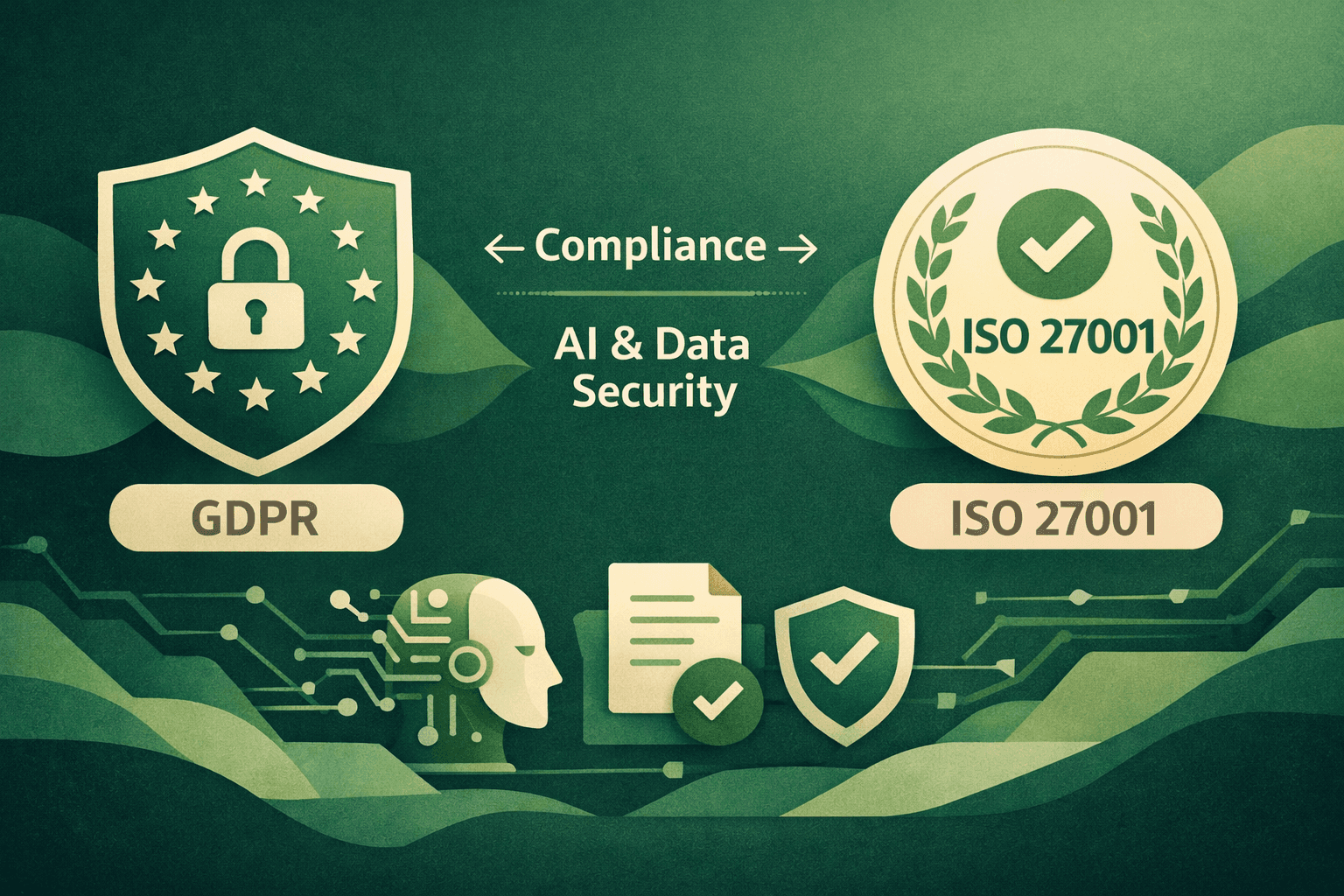
GDPR and ISO 27001 are complementary frameworks. GDPR sets the legal requirements for personal data protection, while ISO 27001 provides the structured information security management system (ISMS) to meet them. Together, they form a powerful compliance foundation, especially critical for organisations deploying AI systems.
As regulatory scrutiny intensifies around AI, data privacy, and cybersecurity, organisations can no longer treat compliance frameworks in isolation. GDPR compliance and ISO 27001 certification are two of the most critical pillars of modern information governance, and the good news is that they are designed to reinforce each other.
At DSALTA, we help organisations navigate the intersection of data privacy law and information security standards, particularly in environments where artificial intelligence is reshaping how data is collected, processed, and used. In this guide, we break down exactly how GDPR and ISO 27001 work together, where they overlap, and how a dual-framework approach can accelerate your compliance journey.
What Is GDPR and What Does It Require?
The General Data Protection Regulation (GDPR) is the European Union's landmark data privacy law, effective since May 2018. It applies to any organisation that processes the personal data of EU/EEA residents, regardless of where the organisation is based.
GDPR establishes strict obligations regarding the collection, storage, processing, and protection of personal data. Key requirements include:
A lawful basis for all data processing activities
Transparent privacy notices and data subject rights (access, erasure, portability)
Data minimisation and purpose limitation principles
Implementation of appropriate technical and organisational security measures (Article 32)
Mandatory data breach notification within 72 hours
Data Protection Impact Assessments (DPIAs) for high-risk processing activities
Appointment of a Data Protection Officer (DPO) in certain cases
Critically, GDPR does not prescribe how security must be implemented — it focuses on outcomes. This is where ISO 27001 becomes essential.
What Is ISO 27001 and How Does It Work?
ISO/IEC 27001 is the internationally recognised standard for Information Security Management Systems (ISMS). It provides a systematic, risk-based framework for managing sensitive company and customer information, ensuring it remains secure, available, and confidential.
ISO 27001 is built around a Plan-Do-Check-Act (PDCA) cycle and includes 93 controls in Annex A (updated in ISO 27001:2022) covering:
Organisational controls (policies, risk management, supplier relationships)
People controls (training, background checks, remote working)
Physical controls (access control, equipment security)
Technological controls (encryption, malware protection, access management)
Unlike GDPR, ISO 27001 is a voluntary standard — but achieving certification demonstrates to customers, regulators, and partners that your organisation takes information security seriously and has the processes to back it up.
The Key Overlaps: Where GDPR and ISO 27001 Align
The most powerful argument for a dual-framework approach is the significant overlap between the two. Implementing ISO 27001 doesn't just improve your security posture — it directly addresses multiple GDPR obligations.
Compliance Area | GDPR Requirement | ISO 27001 Control |
|---|---|---|
Risk Management | Article 32 – Security of processing | Clause 6.1 / Annex A 5.7 |
Incident Response | Articles 33 & 34 – Breach notification | Annex A 5.24–5.26 |
Access Control | Data minimisation (Article 5) | Annex A 5.15–5.18 |
Supplier Security | Article 28 – Processor contracts | Annex A 5.19–5.22 |
Business Continuity | Article 32(1)(c) – Availability | Annex A 5.29–5.30 |
Security Training | Article 32(4) – Staff awareness | Annex A 6.3 |
Encryption | Article 32(1)(a) – Pseudonymisation | Annex A 8.24 |
This alignment means organisations that have already invested in ISO 27001 certification have a head start on demonstrating GDPR compliance — and vice versa.
How ISO 27001 Helps You Meet GDPR's Article 32 Requirements
Article 32 of GDPR requires organisations to implement "appropriate technical and organisational measures" to ensure a level of security appropriate to the risk. This is one of the most challenging requirements for organisations to demonstrate to regulators, because GDPR intentionally avoids specifying what "appropriate" means.
ISO 27001 fills this gap perfectly. By achieving and maintaining ISO 27001 certification, organisations can demonstrate to the ICO (or any EU supervisory authority) that they have:
Conducted a systematic information security risk assessment
Implemented a comprehensive set of security controls
Established processes for continuous monitoring and improvement
Subjected their security practices to an independent third-party audit
In the event of a GDPR investigation or data breach, ISO 27001 certification is one of the strongest pieces of evidence an organisation can present to show it had appropriate safeguards in place.
GDPR and ISO 27001 in the Age of AI: Why Both Frameworks Matter More Than Ever
The rise of AI systems introduces new compliance complexities, making the combination of GDPR/ISO 27001 more important than ever. AI systems often process vast amounts of personal data, make automated decisions that affect individuals, and introduce novel security risks across all areas where the two frameworks intersect.
AI and GDPR: Key Considerations
Article 22: Individuals have the right not to be subject to solely automated decision-making with significant effects
DPIAs are typically required before deploying high-risk AI systems
AI training data must comply with purpose limitation and data minimisation principles
Transparency obligations apply to AI-driven processing activities
AI and ISO 27001: Key Considerations
ISO 27001:2022 introduces new controls relevant to AI, including threat intelligence (5.7) and secure development (8.25–8.28)
AI model security — protecting against adversarial attacks and data poisoning — falls within the ISMS scope
Third-party AI vendors must be assessed under Annex A supplier security controls
Cloud and AI infrastructure security is addressed through Annex A 8.x technology controls
At DSALTA, we work with organisations to map their AI systems against both GDPR obligations and ISO 27001 controls — ensuring that AI deployment doesn't create compliance gaps or security blind spots.
A Practical Roadmap: Implementing GDPR and ISO 27001 Together
For organisations looking to align GDPR compliance with ISO 27001 certification, a phased approach is typically most effective. Here is the roadmap DSALTA recommends:
Phase 1 – Gap Analysis: Assess your current data processing activities against GDPR requirements and your information security posture against ISO 27001 controls. Identify overlapping gaps to maximise efficiency.
Phase 2 – Risk Assessment: Conduct a unified information security and data protection risk assessment. ISO 27001's risk assessment methodology (Clause 6.1) can be adapted to capture GDPR-specific risks related to personal data.
Phase 3 – Policy Development: Create an integrated suite of policies that satisfy both frameworks — including an Information Security Policy, Data Protection Policy, Acceptable Use Policy, and Incident Response Plan.
Phase 4 – Technical Controls: Implement the technical measures required by both frameworks: encryption, access controls, logging, monitoring, and backup systems.
Phase 5 – Training & Awareness: Roll out staff training that covers both data protection responsibilities (GDPR) and information security awareness (ISO 27001 Annex A 6.3).
Phase 6 – Audit & Certification: Conduct internal audits aligned to both frameworks, remediate findings, and proceed to ISO 27001 certification. Use the audit evidence to also demonstrate GDPR compliance readiness.
Phase 7 – Continual Improvement: Both GDPR and ISO 27001 require ongoing review and improvement. Establish a management review cycle that addresses both frameworks simultaneously.
Common Questions About GDPR and ISO 27001 Alignment
Does ISO 27001 certification mean you are GDPR compliant?
Not automatically. ISO 27001 certification demonstrates strong information security management, which supports GDPR compliance — but GDPR also has specific legal obligations (such as establishing a lawful basis for processing, managing data subject rights, and breach notification) that go beyond what ISO 27001 covers on its own. You need both.
Do you need ISO 27001 to be GDPR compliant?
No, GDPR does not mandate ISO 27001 certification. However, implementing ISO 27001 is widely recognised as one of the most effective ways to demonstrate compliance with GDPR's Article 32 security requirements. For organisations handling significant volumes of personal data, it is strongly recommended.
How much does dual-compliance with the framework cost?
Costs vary significantly based on organisation size, complexity, and existing maturity. However, pursuing both frameworks simultaneously rather than sequentially typically reduces total cost and effort by 30–40%, as many activities (risk assessments, policy development, training, internal audits) serve both frameworks.
How DSALTA Helps You Align GDPR and ISO 27001
DSALTA is an AI compliance company specialising in helping organisations navigate complex, overlapping regulatory frameworks. Our integrated approach to GDPR and ISO 27001 compliance ensures you build a single, coherent compliance programme rather than two separate, duplicative workstreams.
Whether you are starting from scratch or looking to strengthen an existing compliance programme, DSALTA provides the expertise and tools to build a robust, audit-ready foundation.
Conclusion: A Unified Approach to Data Protection and Security
GDPR and ISO 27001 are not competing frameworks; they are complementary partners in a comprehensive compliance strategy. GDPR defines the outcomes you must achieve in data protection; ISO 27001 provides the structured system to achieve them.
For organisations in the AI era, where data flows are more complex, risks are greater, and regulatory expectations are higher than ever, a dual-framework approach is not just best practice, it is essential.
DSALTA is here to help you build that foundation. Contact our team today to discover how we can streamline your path to both GDPR compliance and ISO 27001 certification.

Explore more SOC 2 articles
Stop losing deals to compliance.
Get compliant. Keep building.
Join 100s of startups who got audit-ready in days, not months.