Rules & Requirements —
Seven Core GDPR Data Privacy Principles
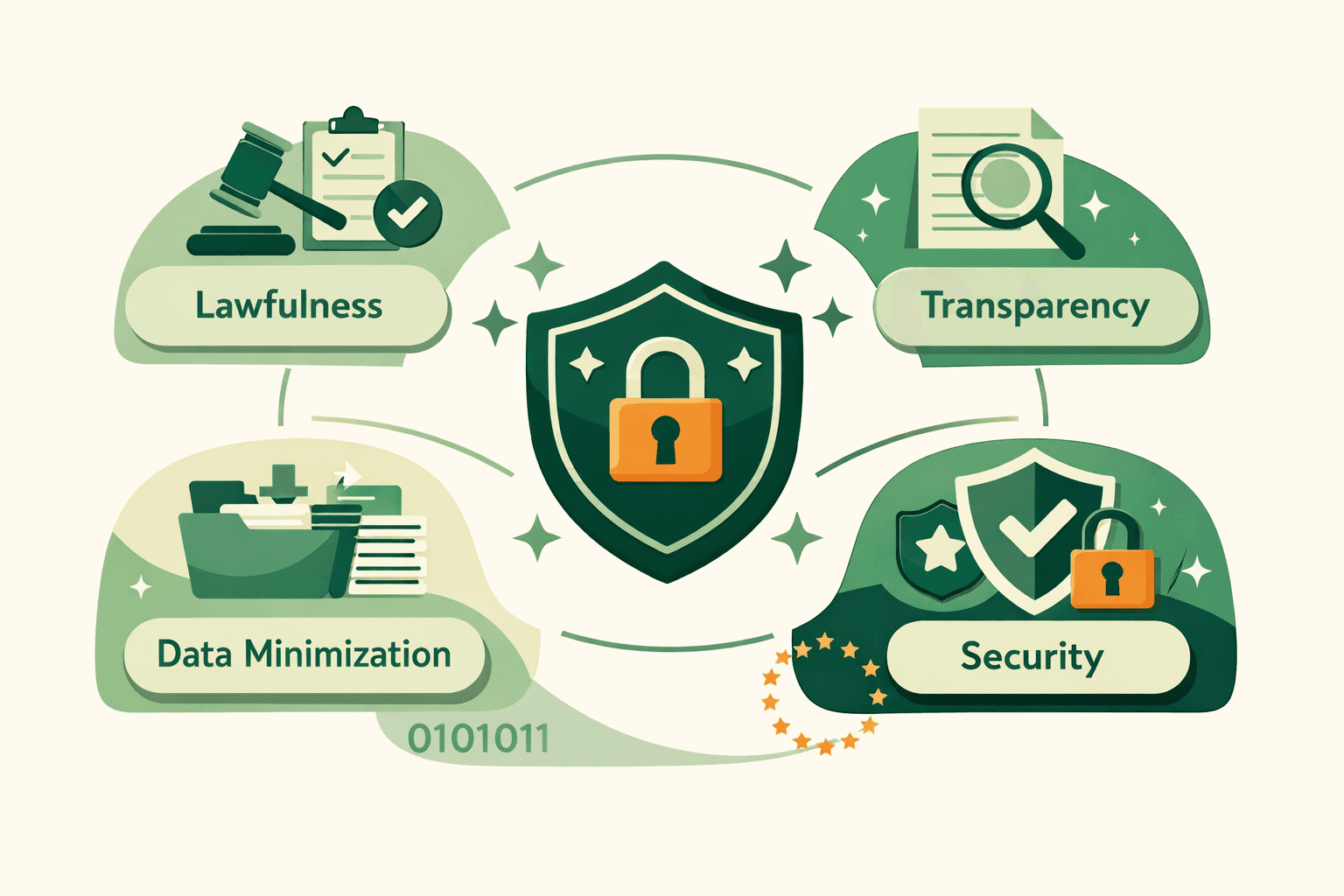
GDPR’s core principles—lawfulness, purpose, minimization, accuracy, security—guide ethical, transparent data use.
Share this article


The 7 GDPR Principles, Explained Simply
If you remember nothing else about GDPR, remember this: everything in the regulation traces back to seven principles in Article 5. Every other rule — consent, breach notification, data subject rights — exists to support one of these seven. And here's the part that gets glossed over a lot: breaking one of these isn't a minor slip. Article 83(5)(a) puts violations of these core principles in GDPR's highest fine tier — the same tier as violating someone's basic data rights.
1. Lawfulness, Fairness, and Transparency
You need a real legal reason to process someone's data, you can't be sneaky about how you collect it, and people need to actually understand what's happening to their information.
The "fairness" part trips people up the most. It's not just about telling the truth — it's about not designing your UI to manipulate people into oversharing. If you're offering a "basic" vs. "premium" option and the basic one quietly collects way more data than it needs to, just to nudge people toward premium, that's a fairness problem even if every word on the page is technically accurate.
2. Purpose Limitation
Whatever you collect data for, that's what you can use it for. If someone gives you their email to get a newsletter, you can't quietly start using that same email for a totally unrelated ad campaign without telling them. There's an exception for research, archiving, and statistics — that kind of reuse generally doesn't count as incompatible.
3. Data Minimization
Only collect what you actually need. Not what might be useful someday — what you need right now for the purpose you've already stated. A newsletter signup that asks for someone's home address is a data minimization problem, full stop, because a home address has nothing to do with sending an email.
4. Accuracy
Keep the data correct and current, and fix it quickly when it's wrong — especially if someone tells you it's wrong. This isn't just a compliance checkbox. Bad data leads to bad decisions, and sometimes real harm to the person it's about.
5. Storage Limitation
Don't keep data forever just because deleting it feels like a hassle. You need to know how long you're allowed to hold onto something based on why you collected it, and you need an actual retention schedule, not "we'll get to it eventually."
6. Integrity and Confidentiality (Security)
This is the principle that ties GDPR to actual security practice. You need real technical and organizational safeguards — encryption, access controls, the works — to protect data from being lost, stolen, or messed with. This is also exactly where GDPR overlaps with frameworks like ISO 27001 and SOC 2, which exist to prove this kind of security is actually in place.
7. Accountability
This is the principle that ties all the others together, and it's the one most people underestimate. It's not enough to follow the first six — you have to be able to prove it. Records of processing activities, documented policies, risk assessments, audit trails. If a regulator asks how you're complying, "we just do" isn't an answer. You need paperwork that backs it up.
Why These Seven Actually Matter, Practically
These aren't abstract values sitting at the top of a legal document for show. They get checked, literally, every time you build something new. Launching an app? You're supposed to think through data minimization and security before you write a line of code — that's GDPR's "privacy by design" requirement, and it's built directly on these seven principles.
Getting any one of these wrong tends to create a domino effect. Collect more data than you need (minimization), and now you're storing things you don't have a real purpose for (purpose limitation), which means you probably don't have solid documentation justifying why you're holding onto it (accountability). The principles aren't separate boxes to check — they reinforce each other.
Where This Connects to Other Frameworks
If you're also working on ISO 27001 or SOC 2, the security and accountability principles above map closely to what both frameworks already ask for — risk-based controls, documented evidence, ongoing review. Building your GDPR program around these seven principles from the start tends to make the other two frameworks easier to layer on top, instead of starting from scratch each time.
FAQs
What are the 7 GDPR principles? The seven principles under Article 5 are: lawfulness, fairness, and transparency; purpose limitation; data minimization; accuracy; storage limitation; integrity and confidentiality (security); and accountability. Every other GDPR rule — consent, breach notification, data subject rights — exists to support one of these seven.
What does "fairness" actually mean under GDPR, beyond just telling the truth? Fairness goes beyond factual accuracy — it also covers whether a company's design manipulates people into oversharing. For example, if a "basic" plan quietly collects more data than necessary just to nudge users toward a "premium" option, that's a fairness violation even if every statement on the page is technically true.
What is purpose limitation under GDPR? Purpose limitation means data can only be used for the reason it was originally collected. If someone provides their email for a newsletter, that email can't quietly be repurposed for an unrelated ad campaign without informing them. Exceptions exist for research, archiving, and statistical purposes.
What counts as a data minimization violation? Data minimization means only collecting what's genuinely needed for the stated purpose — not what might be useful later. A newsletter signup form asking for someone's home address is a clear example, since a home address has no bearing on sending an email newsletter.
Why is "accountability" considered the most underestimated GDPR principle? Accountability requires organizations to prove compliance, not just practice it. Records of processing activities, documented policies, risk assessments, and audit trails are all required — telling a regulator "we just do" isn't sufficient without paperwork backing it up.
How severe are fines for violating GDPR's core principles? Violations of Article 5's core principles fall into GDPR's highest fine tier under Article 83(5)(a) — the same tier as violating someone's basic data subject rights, with fines reaching up to €20 million or 4% of global annual turnover.
How do the seven GDPR principles connect to each other in practice? They reinforce one another rather than functioning as separate checkboxes. For example, collecting more data than necessary (violating minimization) often means storing data without a real justified purpose (violating purpose limitation), which typically means there's no solid documentation explaining why it's being retained (violating accountability).
How do the GDPR principles relate to "privacy by design"? Privacy by design is built directly on these seven principles — particularly data minimization and security. It requires organizations to think through these principles during the planning stage of a new product or feature, before any code is written, rather than retrofitting compliance after launch.
What's the difference between storage limitation and data minimization? Data minimization is about not collecting more than you need upfront. Storage limitation is about not keeping data longer than necessary once you have it — requiring an actual retention schedule tied to why the data was collected, rather than holding onto it indefinitely by default.
Which GDPR principle overlaps most with security frameworks like ISO 27001 and SOC 2? Integrity and confidentiality (the security principle) overlaps most directly, since it requires real technical and organizational safeguards like encryption and access controls — the same kind of controls ISO 27001 and SOC 2 are designed to verify are in place.




In the Spotlight

Start your GDPR compliance journey with DSALTA's complete checklist.
The General Data Protection Regulation (GDPR) is Europe’s core privacy law, shaping how organizations collect, process, and protect the personal data of EU residents. Non-compliance can result in heavy fines, reputational damage, and loss of customer trust.
GDPR can feel complicated with its broad scope and strict requirements, but DSALTA® makes it manageable. With automated evidence collection, continuous monitoring, and AI- driven risk insights, you can maintain compliance without drowning in manual work. Use this checklist to guide your GDPR journey.
Read more about GDPR compliance with DSALTA.
Stop losing deals to compliance.
Get compliant. Keep building.
Join 100s of startups who got audit-ready in days, not months.