SOC 2 —
How to Identify and Close SOC 2 Compliance Gaps
Learn how to identify and close SOC 2 compliance gaps. DSALTA helps AI-driven teams achieve readiness faster with step-by-step gap assessments.
Jon Ozdoruk
Getting Started with SOC 2
Share this article


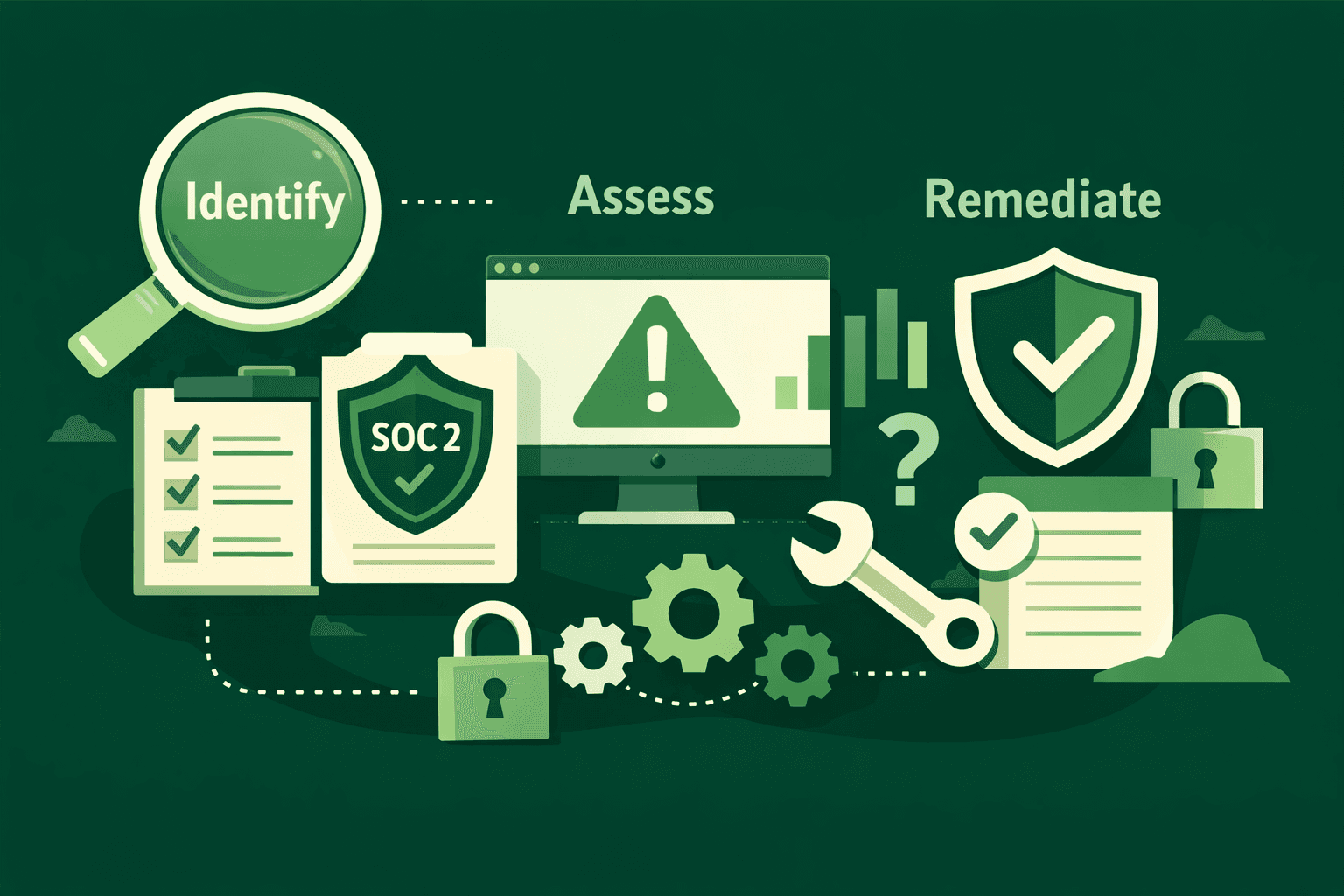
Identifying and closing SOC 2 compliance gaps requires a structured gap assessment against the AICPA's Trust Services Criteria (TSC), followed by a prioritized remediation roadmap. Organizations that complete a thorough SOC 2 gap analysis before their formal audit reduce audit failures by up to 60% and significantly shorten time-to-certification.
Whether you're preparing for your first SOC 2 audit or tightening controls ahead of a renewal, this guide walks you through every phase — from scoping your environment to remediating findings and sustaining compliance over time. At DSALTA, we specialize in helping AI-driven businesses build audit-ready compliance programs from the ground up.
What Are SOC 2 Compliance Gaps?
SOC 2 compliance gaps are areas where your organization's current security controls, policies, or procedures fall short of the requirements set by the American Institute of Certified Public Accountants (AICPA) under their Trust Services Criteria (TSC).
These gaps can appear across five TSC categories:
Security (CC) — The foundational category required for all SOC 2 audits
Availability (A) — Ensuring systems are available as committed
Processing Integrity (PI) — System processing is complete and accurate
Confidentiality (C) — Information designated as confidential is protected
Privacy (P) — Personal information is collected, used, and retained appropriately
A gap exists any time there is a mismatch between what the criteria require and what your organization currently does. Left unaddressed, compliance gaps become audit findings — and audit findings can delay certification, damage customer trust, and create real security vulnerabilities.
Step 1: Define Your SOC 2 Scope
Before you can identify gaps, you need to know what you're measuring against. Scoping is the most consequential decision in your SOC 2 journey.
What to Include in Scope
In-scope services: The specific product or service being audited (e.g., your SaaS platform, data processing pipeline, or AI inference environment)
Infrastructure components: Cloud environments (AWS, Azure, GCP), data centers, and any supporting infrastructure
Personnel: Teams with access to in-scope systems — engineering, DevOps, IT, and security
Third-party vendors: Subservice organizations that handle data on your behalf (e.g., cloud providers, payroll processors)
Choosing SOC 2 Type I vs. Type II
SOC 2 Type I evaluates whether your controls are designed appropriately at a single point in time
SOC 2 Type II evaluates whether those controls operated effectively over a period (typically 6–12 months)
Most enterprise customers require SOC 2 Type II. If you're starting from scratch, a Type I can serve as an intermediate milestone while you build your evidence library for Type II.
For AI companies, scope creep is one of the biggest audit risks. Your AI training pipelines, inference APIs, and data annotation workflows may all need to be evaluated.
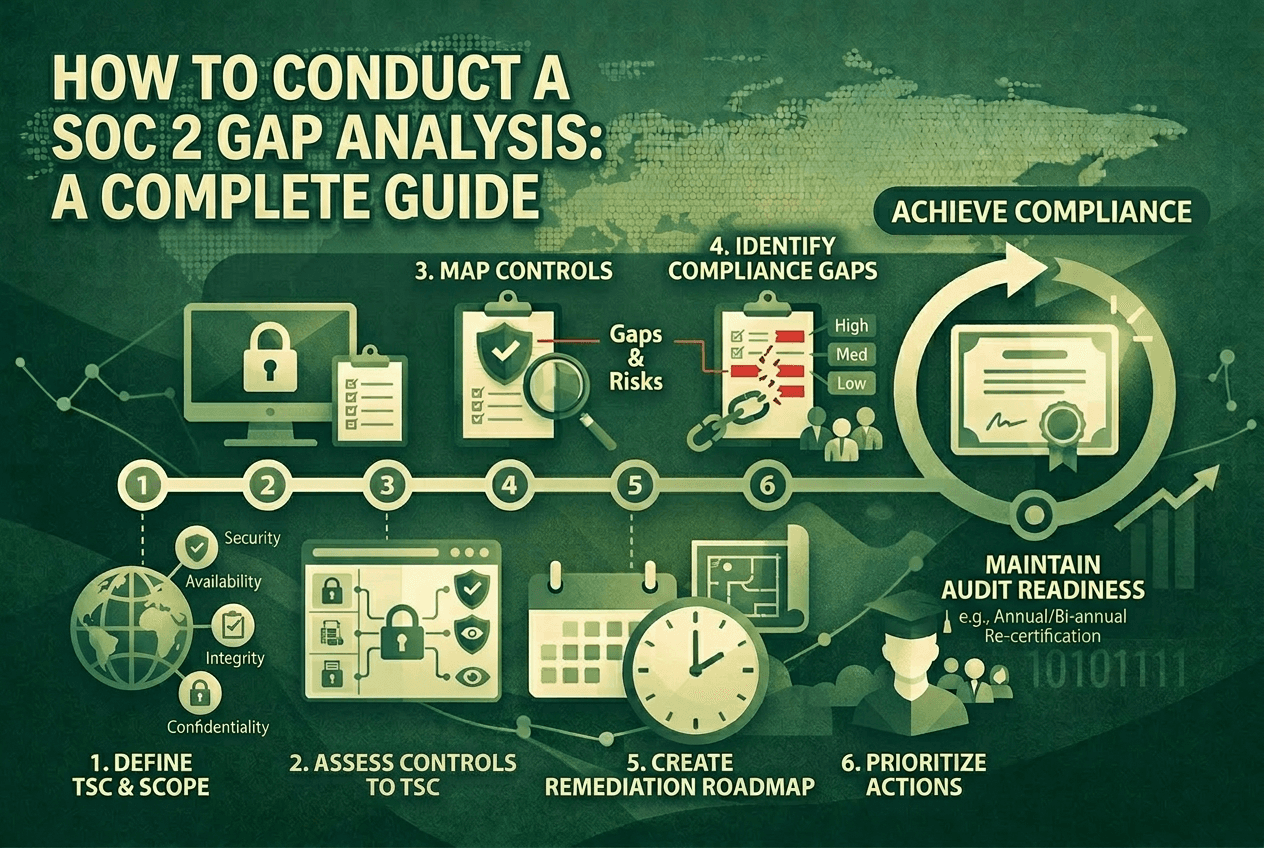
Step 2: Conduct a Formal SOC 2 Gap Assessment
A SOC 2 gap assessment is a systematic evaluation of your existing controls against each applicable Trust Services Criterion. This is the engine of your entire compliance program.
How to Perform a SOC 2 Gap Assessment
1. Map Controls to Trust Services Criteria: Create a control inventory that lists every security measure you currently have in place. For each control, map it to the specific TSC criteria it satisfies. Use the AICPA's Common Criteria (CC1 through CC9) as your framework.
2. Gather Evidence of Current State. For each mapped control, collect evidence of implementation: policy documents, system configuration screenshots, access control logs, vendor contracts, and training completion records.
3. Identify Gaps by Criterion: Compare your current evidence against what each criterion requires. A gap exists when a required control is missing, not formally documented, not consistently implemented, or lacks sufficient evidence for an auditor to test.
4. Score and Prioritize Each Gap Score each finding on likelihood of audit failure and implementation complexity. Prioritize high-likelihood, low-complexity gaps first — these are your quick wins that demonstrate immediate progress.
Most Common SOC 2 Compliance Gaps by Category
Security (CC) — Most Frequently Cited:
No formal risk assessment process
Missing or outdated vendor risk management program
Insufficient access review cadence (quarterly is the standard)
Lack of multi-factor authentication (MFA) enforcement
No documented incident response plan
Availability Gaps:
Undocumented uptime SLAs and monitoring thresholds
Missing disaster recovery (DR) or business continuity plans
No formal capacity management process
Confidentiality Gaps:
Unclassified data inventory — no formal data classification policy
Encryption is not enforced at rest or in transit for sensitive data
No data retention and disposal procedures
Step 3: Build a Remediation Roadmap
Identifying gaps is only half the battle. A structured remediation roadmap ensures gaps are closed systematically — and that closure is documented in a way auditors can verify.
The 90-Day SOC 2 Remediation Sprint
Days 1–30: Foundation
Finalize scope documentation
Draft or update your Information Security Policy
Implement MFA across all in-scope systems
Stand up a formal risk register
Days 31–60: Controls Implementation
Complete vendor risk assessments for all subservice organizations
Implement access review procedures and conduct the first review cycle
Deploy logging and monitoring on in-scope infrastructure
Establish formal employee security awareness training
Days 61–90: Evidence Collection & Testing
Begin collecting continuous evidence (screenshots, exports, signed records)
Conduct internal tabletop exercises for incident response
Perform vulnerability scans and document remediation
Engage an external auditor for a pre-audit readiness review
Your remediation roadmap should align with best practices for comprehensive SOC 2 compliance documentation.
Policy vs. Process vs. Technical Controls
Remediation gaps fall into three categories, each requiring a different response:
Policy Gap Example: No formal data classification policy. Fix: Draft, approve, and publish policy
Process Gap Example: Access reviews not performed. Fix: Define cadence, assign an owner, and conduct the first cycle
Technical Gap Example: MFA not enforced. Fix: Configure IdP, enforce policy, document exceptions
Step 4: Implement Continuous Monitoring
SOC 2 Type II audits cover a period of time, which means gaps that reopen after remediation are just as damaging as gaps that were never closed. Continuous monitoring is what separates organizations that pass their audit from those that struggle.
Key Continuous Monitoring Practices
Automated Evidence Collection Manual evidence gathering is error-prone and time-consuming. Modern compliance platforms automate evidence collection directly from your cloud environments, eliminating the need for screenshot marathons at audit time.
Alerting on Control Failures: Configure alerts for control deviations before auditors find them: a user provisioned without completing security training, a critical system not covered by backup policy, or a vulnerability scan not completed on schedule.
Quarterly Access Reviews: Access reviews are one of the most frequently tested SOC 2 controls. Establish a documented, repeatable quarterly process — and keep the evidence: approval records, role change logs, and deprovisioning confirmations.
Vendor Risk Re-assessments: Your third-party vendors change over time. Establish annual (or trigger-based) reassessments of your subservice organizations, particularly for any vendor with access to sensitive customer data.
Step 5: Prepare for Your SOC 2 Audit
With gaps closed and controls operating for your audit period, the final step is formal audit preparation.
Selecting an Auditor
Choose a CPA firm with demonstrated experience in your industry vertical. For AI and SaaS companies, look for auditors familiar with cloud-native infrastructure (AWS, GCP, Azure), AI/ML development pipelines, and multi-tenant architectures.
What Auditors Test
SOC 2 auditors use four testing methods for each criterion in scope:
Inquiry — Interviews with control owners confirming they understand their responsibilities
Inspection — Review of policy documents, configurations, and records
Observation — Direct review of processes as they are performed
Re-performance — The auditor independently executes a control to verify results match the evidence
Building Your Evidence Package
Organize evidence by criterion in a shared repository. For each control, include: the policy or procedure document (with effective date and approval signature), implementation evidence (configuration export or screenshot), and operational evidence showing the control ran at least once per testing period.
SOC 2 Gap Assessment Checklist
Use this checklist to evaluate your SOC 2 readiness before engaging an auditor.
Scope & Documentation
☐ Audit scope formally defined and approved
☐ System Description drafted
☐ Information Security Policy in place and approved
Access & Identity
☐ MFA enforced on all in-scope systems
☐ Role-based access control (RBAC) implemented
☐ Quarterly access reviews documented
Risk & Vendor Management
☐ Formal risk assessment completed within the past year
☐ Risk register maintained and regularly updated
☐ Vendor risk assessments completed for all subservice organizations
Monitoring & Incident Response
☐ Centralized logging enabled for in-scope infrastructure
☐ Incident response plan documented and tested
☐ Vulnerability management program in place
Data Protection
☐ Data classification policy implemented
☐ Encryption enforced at rest and in transit
☐ Data retention and disposal procedures documented
How DSALTA Accelerates SOC 2 Compliance
DSALTA is purpose-built for AI companies navigating the complexity of modern compliance frameworks. Our platform:
Automates gap assessment against SOC 2, ISO 27001, HIPAA, and other frameworks simultaneously
Maps AI-specific risks to standard compliance controls — so your LLM pipelines, training data, and model outputs are covered
Generates audit-ready evidence continuously, eliminating last-minute scrambles
Provides a prioritized remediation roadmap so your team knows exactly what to fix — and in what order
Organizations using DSALTA reduce their average time-to-SOC 2-certification by 40% compared to manual compliance programs.
Ready to identify your SOC 2 compliance gaps? Start your free DSALTA gap assessment →
Frequently Asked Questions
How long does a SOC 2 gap assessment take? A comprehensive SOC 2 gap assessment typically takes two to four weeks for a mid-sized organization, depending on the complexity of your environment and the number of TSC categories in scope. AI-powered tools like DSALTA can compress this timeline significantly by automating control mapping and evidence review.
What is the difference between a SOC 2 gap assessment and a readiness assessment? These terms are often used interchangeably. A gap assessment focuses on identifying where your controls fall short. A readiness assessment is broader — it includes the gap analysis plus a formal opinion on whether you are ready to engage an auditor for a Type I or Type II report.
Can I do a SOC 2 gap assessment myself? Yes — especially with a structured framework. However, independent gap assessments often miss nuanced interpretations of criteria or underestimate the evidence requirements. Engaging a qualified compliance partner or using an automated platform like DSALTA significantly reduces the risk of surprises during the formal audit.
How much does it cost to close SOC 2 compliance gaps? Remediation costs vary widely. Policy and process gaps are relatively inexpensive to close — often requiring only internal time. Technical gaps may require tooling investment. The average first-year cost of SOC 2 compliance for a SaaS company ranges from $30,000 to $100,000, depending on the starting maturity of your security program.
How often do SOC 2 compliance gaps reopen? More often than organizations expect. Personnel changes, new product features, infrastructure migrations, and vendor changes all introduce new gaps. This is why continuous monitoring — not just point-in-time assessments — is essential for maintaining SOC 2 compliance year over year.
For a complete SOC 2 compliance checklist tailored to different business stages, see our comprehensive guide.
Summary: Your SOC 2 Gap Closure Roadmap
Define your scope — know exactly what's being audited
Conduct a gap assessment — map controls to TSC criteria, collect evidence, identify shortfalls
Build a remediation roadmap — prioritize by risk and complexity, sprint to closure
Implement continuous monitoring — automate evidence collection and alerting
Prepare for audit — organize evidence, select your auditor, and complete a readiness review
The organizations that achieve SOC 2 certification fastest — and with the fewest findings — are those that treat compliance as a continuous program, not a one-time event.
DSALTA makes this possible for AI companies. Our platform brings together gap assessment, automated evidence collection, and AI-native control mapping in one place — so you can focus on building your product while we handle the compliance complexity.
Schedule a demo with DSALTA →

Explore more SOC 2 articles
Stop losing deals to compliance.
Get compliant. Keep building.
Join 100s of startups who got audit-ready in days, not months.