SOC 2 —
SOC 2 Readiness Checklist 2026: Guide for SaaS Startups
Get your 2026 SOC 2 readiness checklist for startups. Learn how to prepare for a SOC 2 audit, identify required artifacts, and get compliant quickly.
Jon Ozdoruk
Getting Started with SOC 2
Share this article


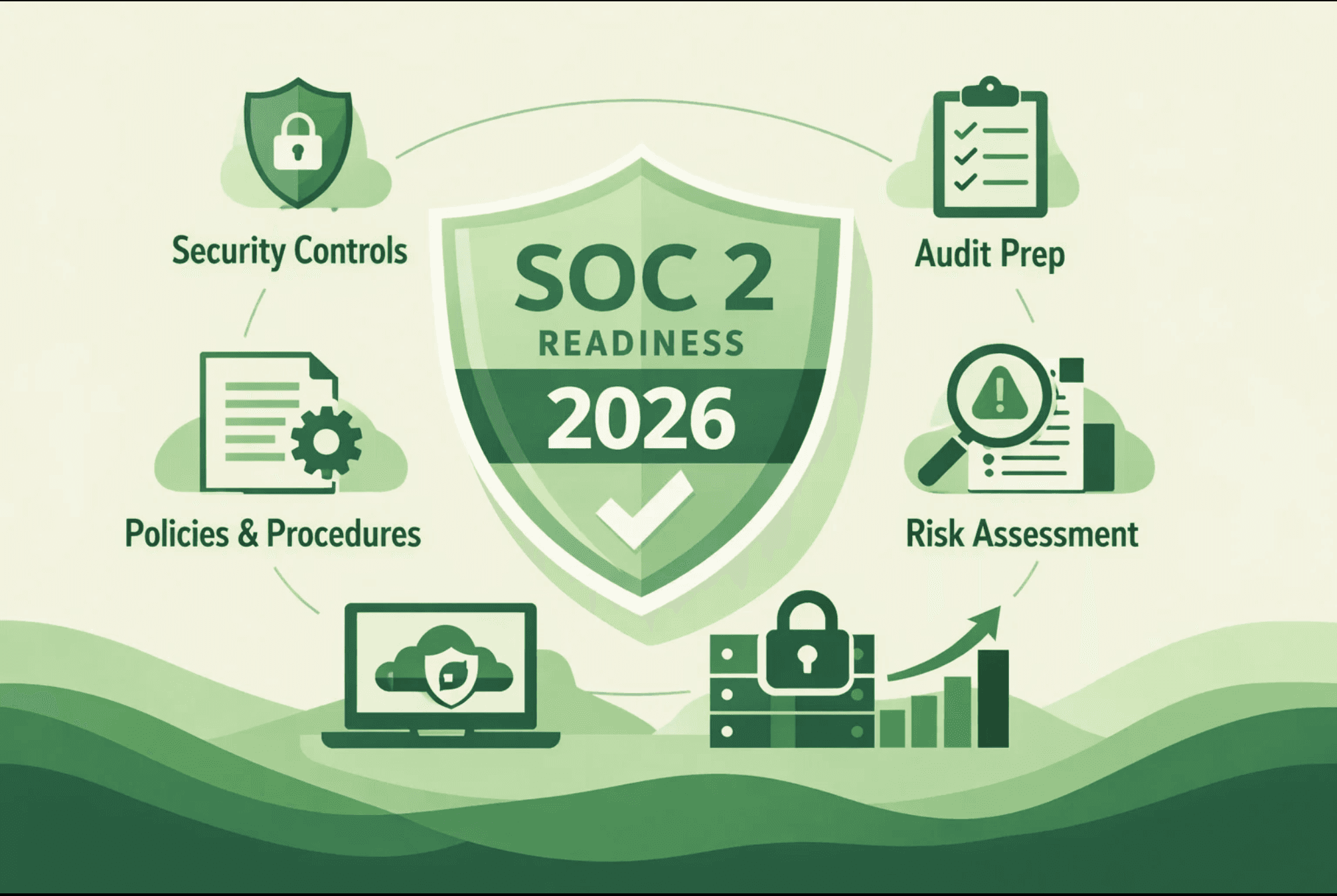
Introduction: Why SOC 2 Becomes Every Startup's Make-or-Break Moment
You've built an incredible product. Your early customers love it. Then you get the meeting with your first enterprise prospect—the deal that could transform your business. The conversation goes perfectly until the procurement team asks one question:
"Do you have SOC 2?"
Suddenly, a compliance framework you barely understood last week becomes the blocker between you and revenue growth. Your team scrambles to understand what SOC 2 even means. You're overwhelmed by cryptic control requirements, evidence requests, and audit timelines that feel impossibly long.
This is the moment every SaaS startup faces. The question is whether you'll spend 6-12 months struggling through manual compliance or use a strategic, efficient approach to achieve SOC 2 compliance in weeks rather than months.
Most early-stage teams don't fail SOC 2 because they're fundamentally insecure. They fail because they don't know where to start, confuse frameworks with individual controls, get lost in spreadsheets and policy templates, and try to achieve perfection rather than focus on audit readiness.
This SOC 2 readiness checklist for startups breaks down compliance into a practical roadmap for small teams with limited resources. You don't need perfection—you need readiness.
If you want a quick starting point for the basics: What is SOC 2?
Understanding What SOC 2 Actually Tests
The Trust Services Criteria Explained
SOC 2 is not a simple compliance checklist. It's a trust report that evaluates how your systems protect customer data based on the Trust Services Criteria developed by the AICPA.
Security (mandatory for all SOC 2 audits) addresses who can access your systems, how access is controlled and monitored, whether authentication is appropriately strong, and how you detect and respond to security incidents.
Availability evaluates whether customers can rely on system uptime, how you monitor performance and capacity, what backup and recovery capabilities exist, and how you handle incidents affecting availability.
Confidentiality examines whether sensitive records are appropriately restricted, how you classify and protect confidential information, what controls prevent unauthorized disclosure, and how you manage confidential data throughout its lifecycle.
Processing Integrity verifies that systems produce accurate, complete, and timely outputs, how you detect and correct processing errors, whether data transformations maintain integrity, and how you validate system processing.
Privacy addresses how personal information is collected, used, retained, disclosed, and disposed of according to your privacy notice and applicable regulations.
Helpful internal reference if you want to link deeper on the criteria: Trust Services Criteria
The Critical Startup Decision
For startups preparing for a SOC 2 audit efficiently, start with Security only. Trying to implement all five criteria simultaneously is how teams burn out before reaching the audit.
Most enterprise customers accept a Security-only SOC 2 Type 1 as proof that you take data protection seriously. You can continually expand the scope to additional criteria once you've achieved initial certification and built sustainable compliance processes.
If you want a clean “why this matters” link here: Why is SOC 2 important
Defining Your SOC 2 Scope
Why Scope Determines Audit Difficulty
SOC 2 is not company-wide compliance—it's system-specific. The most important early decision you'll make is defining precisely which systems fall within your SOC 2 scope.
Your goal is to answer one question: Which systems create, process, store, or transmit customer data?
If you want a supporting link that helps people scope correctly: Defining your SOC 2 audit scope
Typical Startup SOC 2 Scope
Production application infrastructure including your application backend, production databases, API servers, and customer-facing services must be in scope. This is the core of what customers trust you to protect.
Cloud infrastructure encompasses your AWS, Google Cloud, or Azure environments that host production workloads, including compute instances, storage services, networking components, and managed services that process customer data.
Authentication and access systems include single sign-on solutions, identity providers, multi-factor authentication systems, and privileged access management tools controlling production access.
CI/CD pipelines that deploy code to production environments typically fall within scope because they represent a critical security boundary for production systems.
Customer support tools like Intercom, Zendesk, or custom support applications that access customer data must be included in scope and adequately controlled.
What to Exclude From Scope
Marketing and sales tools that don't touch customer data can typically be excluded. Your CRM might be in scope if it contains customer system access logs, but general prospect data usually isn't.
Finance and accounting software processing invoices and financial records typically falls outside the SOC 2 scope unless it also handles customer payment data.
Internal collaboration tools like company wikis, project management systems, and general Slack channels can be excluded if they don't contain customer data or production access credentials.
Development and staging environments that don't connect to production systems or contain real customer data are typically out of scope. This significantly reduces audit burden.
Strategic scope definition can reduce your audit burden by 40-50% while still satisfying customer requirements. Start focused and expand scope intentionally based on business needs.
Your Startup SOC 2 Readiness Checklist
This is the minimum viable checklist that actually moves you toward getting SOC 2 compliant without over-engineering controls your startup doesn't need yet.
If you want to add a lightweight internal link before the checklist: SOC 2 compliance requirements
Access Control Requirements
Multi-factor authentication must be enabled for all production systems, cloud infrastructure consoles, code repositories, and customer data access tools. Password-only authentication is insufficient for SOC 2.
Role-based access control limits what each user can do based on their job function. Developers shouldn't have production database admin rights unless specifically required. Support staff shouldn't access infrastructure consoles.
Quarterly access reviews verify that user permissions remain appropriate. Document who performed the review, what was reviewed, what changes were made, and when the review occurred. Export evidence from your identity provider.
Offboarding procedures must remove access immediately upon employees' departure. Create a documented checklist showing system access removal, credential rotation where necessary, and confirmation of completion.
Privileged access management applies additional controls to administrator accounts, including separate admin credentials from regular accounts, approval workflows for privileged actions, and enhanced logging of admin activities.
Logging and Monitoring Requirements
Centralized logging aggregates security-relevant logs from all in-scope systems. AWS CloudTrail, Google Cloud Logging, Azure Monitor, or third-party SIEM solutions satisfy this requirement.
Security event monitoring detects suspicious activities, including failed authentication attempts, privilege escalations, unusual data access patterns, and configuration changes to production systems.
Log retention must preserve logs for at least 90 days; 180 days is safer, and many startups choose 1 year. Document your retention policy and ensure automated enforcement.
Alerting on critical events sends notifications when security-relevant activities occur. Admin actions in production, failed login patterns, and infrastructure changes should trigger alerts to your security team.
Change Management Requirements
Code review before deployment ensures that at least one other developer reviews code changes before they reach production. GitHub pull requests with approvals provide clear evidence.
Version-controlled infrastructure manages infrastructure as code through Terraform, CloudFormation, or similar tools, with all changes committed to repositories and reviewed before application.
Testing procedures verify that changes work as intended before production deployment. Document your testing approach and maintain evidence of test execution.
Rollback capabilities allow rapid reversion if changes cause problems. Document procedures and periodically test rollback processes.
Change documentation links for every production change to a ticket, a pull request, and an approval trail. Auditors will sample recent changes and expect this documentation.
Vendor Risk Management Requirements
Vendor inventory lists all third-party services with access to customer data or production systems. Include cloud providers, monitoring services, customer support tools, and any SaaS applications in scope.
Security documentation collection gathers SOC 2 reports, ISO 27001 certificates, or security questionnaire responses from critical vendors. Focus on vendors that process or store customer data.
Risk classification assigns risk tiers (critical, high, medium, low) based on data access, system criticality, and vendor maturity. Critical vendors need annual reviews; lower-risk vendors can be reviewed less frequently.
Vendor review process documents how you assess new vendors and monitor existing vendors. Even a simple procedure satisfies this requirement if consistently followed.
If you want a relevant DSALTA internal link for this section: Vendor Risk Management
Required Policies and Procedures
Information Security Policy serves as your overarching security governance document, defining roles, responsibilities, and your security program structure.
Access Control Policy documents how you manage user access, including provisioning, reviews, MFA requirements, and termination procedures.
Incident Response Policy defines how you detect, respond to, and recover from security incidents, including communication protocols and escalation paths.
Change Management Policy establishes procedures for making changes to production systems, including approval requirements, testing, and documentation.
Vendor Risk Management Policy explains how you assess and monitor third-party vendors handling customer data.
These don't need to be elaborate. Clear, concise policies that your team actually follows beat lengthy documents that gather dust.
A strong “policy + procedure” internal link that fits here: Crafting SOC 2 policies and procedures
Gathering Audit Evidence Continuously
The Biggest Mistake Startups Make
Founders think evidence is created during the audit. This is wrong and guarantees a stressful audit experience.
Evidence is created daily through normal operations: Git pull requests showing code reviews, access review exports from your identity provider, incident response documentation from actual incidents, vendor assessment records from security reviews, and system logs capturing security-relevant events.
If you're scrambling during audit week to gather evidence, you've already created unnecessary risk and stress.
This is a good place for a dedicated internal link: Mastering SOC 2 compliance documentation
Building Your Evidence Collection System
Organize evidence by control rather than by date. Create folders or tags for Access Control, Change Management, Monitoring, Incident Response, and Vendor Risk with evidence filed appropriately.
Automate evidence capture wherever possible screenshot manual processes only when necessary. Export data directly from systems for access reviews, log retention, backup success, and configuration snapshots.
Document as you go rather than retrospectively. When you conduct an access review, export results immediately. When an incident occurs, document the response while it's fresh.
Use consistent naming conventions for evidence files, including control reference, evidence type, and date. This makes the auditor review efficient and demonstrates operational maturity.
This is where compliance automation tools like DSALTA remove 70% of manual work by automatically tracking artifacts instead of founders babysitting spreadsheets.
Understanding SOC 2 Report Types
Type 1 vs Type 2: What's the Difference?
SOC 2 Type 1 evaluates whether your controls are appropriately designed at a single point in time. Auditors verify controls exist, are documented, and are theoretically sufficient to meet the Trust Services Criteria.
SOC 2 Type 2 evaluates whether your controls operated effectively over a period of time, typically 3-12 months. Auditors test that controls functioned consistently throughout the observation period.
The Startup Strategy
Your first milestone should be SOC 2 Type 1 in 8-12 weeks. This enables sales conversations with enterprise prospects who need proof that you take security seriously.
Type 1 doesn't require months of operational evidence—just properly implemented controls and point-in-time proof they work. This gets you in the door with enterprise customers faster.
Plan for Type 2 once your sales pipeline demands it. Most enterprise customers eventually want Type 2, but accepting Type 1 initially while you complete the observation period is standard
Preparing Your Systems for Audit
Beyond Documentation: System Reality
Most startups pass documentation reviews but fail when auditors test actual system configurations. Before engaging auditors, verify these are truly implemented:
Access controls must enforce SSO across production tools, prohibit shared accounts in production environments, document quarterly access reviews with evidence, and remove access immediately for terminated employees with proof.
Logging and monitoring require centralized log aggregation from all in-scope systems, logs for authentication, authorization, admin actions, and critical system events, 90-180-day retention actually configured and enforced, and working alerts for security-relevant events.
Backup and recovery needs daily automated backups of production data, tested restoration with documented results, secure backup storage with encryption and access controls, and documented recovery time objectives.
Change management must demonstrate that every production change has a linked ticket, pull request approval trail, testing evidence where appropriate, and deployment documentation.
If it's not logged, approved, or reviewable—it doesn't exist to an auditor.
A clean internal link to reinforce this: Preparing for your SOC 2 audit
Running a Readiness Assessment
Test Before the Real Audit
Before engaging external auditors, simulate the audit internally to identify gaps while you can still fix them.
Access control verification: Can you produce access review evidence in under 10 minutes? Export your current user list from Okta, Azure AD, or AWS IAM. If this takes manual effort, streamline the process now.
Log availability check: Can you show the last 90 days of authentication logs instantly? Query your SIEM or cloud logging service. If logs aren't centralized, fix this before the audit.
Incident traceability test: Can you trace an end-to-end production incident, showing detection, response, resolution, and lessons learned? If not, document your next incident thoroughly.
Change management verification: Pull up your last 10 production changes. Does each have a ticket, code review, and deployment record? Missing any of these signals indicates process gaps.
Vendor documentation check: Can you quickly locate SOC 2 reports or security documentation for your critical vendors? If you're searching for emails, organize this into a vendor risk repository.
If the answers are no, fix the issues now—not during the audit, when pressure is highest.
If you want a strong “pre-audit” internal article link: Pre-audit survival guide
Choosing the Right Auditor
Not all audit firms are startup-friendly. Auditor selection significantly impacts your experience, timeline, and costs.
Look for SaaS experience with firms that understand cloud-native architectures, DevOps practices, and modern technology stacks. Enterprise-focused auditors may not understand startup operations.
Evaluate communication style through initial consultations. Do they explain requirements clearly? Are they responsive? Do they understand your stage and constraints?
Check transparency around testing approach and expectations. Good auditors explain precisely what they'll test and what evidence they need before starting.
Compare pricing structures, including base fees, per-control costs, and whether they charge for remediation findings. Get detailed quotes covering your specific scope.
Ask for references from similar-stage companies. Talk to other startups about their audit experience with firms you're considering.
This choice can save weeks of back-and-forth and tens of thousands of dollars.
If you want a supporting link that fits here: Who conducts SOC 2
Surviving the Type 2 Observation Period
If you're pursuing SOC 2 Type 2, the testing period is when many startups slip up. For 3-12 months, you must maintain consistent control operation.
Maintain schedule discipline for quarterly access reviews, regular vulnerability scans, monthly backup tests, and vendor assessments. Set calendar reminders and treat these as non-negotiable.
Document everything, including minor security incidents, even if they don't represent breaches. Auditors want to see you detect, respond to, and learn from issues.
Monitor control health to ensure controls don't silently break. If logging stops working or alerting fails, you create audit gaps even if you fix the issue quickly.
Track changes to your environment. Adding new systems, vendors, or data flows during the observation period may require updating your system description and controls.
Prepare for sampling by maintaining evidence continuously. Auditors will sample activities throughout the period, so evidence must exist for the entire window.
SOC 2 Type 2 isn't a sprint—it's building operational discipline that becomes part of how your team works.
A great internal anchor for “continuous” operations: Staying continuously SOC 2 compliant
Common Startup Pitfalls to Avoid
Doing everything manually creates an unsustainable burden. Your team can't maintain evidence collection over the long term if it requires constant manual effort. Automate evidence capture from your existing tools.
Losing evidence in Slack threads, email, or local drives guarantees scrambling during an audit. Organize evidence systematically from day one.
Forgetting access reviews breaks compliance quickly. Set reminders, assign ownership, and treat quarterly reviews as seriously as customer commitments.
Treating vendor risk as a checkbox exercise leads to missing vendor documentation during an audit. Build a simple vendor risk program early and maintain it.
Waiting until the last week to gather proof creates unnecessary stress and risk. Evidence collection must be continuous, not crisis-driven.
These aren't technical problems—they're workflow problems that process improvements solve.
If you want a “mistakes/pitfalls” internal link here: Avoiding common SOC 2 audit pitfalls
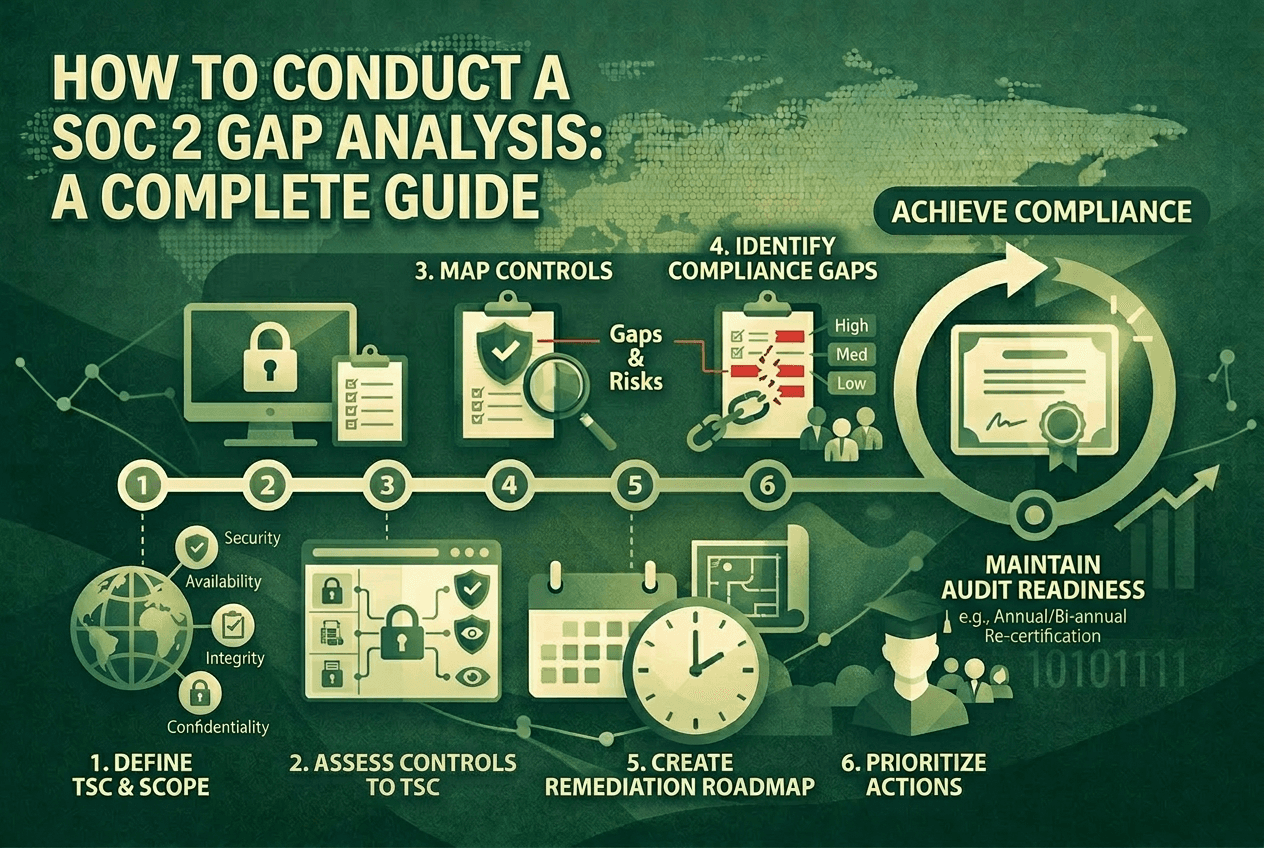
The Roadmap: From Zero to Audit-Ready
Week 1-2: Foundation
Define the SOC 2 scope precisely. Create your system description. Identify which Trust Services Criteria you'll pursue initially (start with Security only).
Week 3-4: Gap Assessment
Compare your current state against the SOC 2 readiness checklist. Identify missing controls and prioritize based on audit impact.
Week 5-8: Control Implementation
Remediate identified gaps focusing on access controls, logging and monitoring, change management, and vendor risk. Create required policies.
Week 9-10: Evidence Collection
Set up automated evidence collection from integrated tools. Organize existing evidence by control area. Create templates for manual documentation.
Week 11-12: Readiness Validation
Run an internal readiness assessment. Fix remaining gaps. Engage the auditor and schedule the kickoff.
Week 13-16: Type 1 Audit
Provide evidence to the auditor. Respond to questions and requests. Receive and address any findings. Obtain the final SOC 2 Type 1 report.
This timeline assumes focused effort and good project management. It's achievable for startups with basic security hygiene already in place.
How DSALTA Accelerates SOC 2 Readiness
The traditional approach to how to prepare for SOC 2 audit involves months of manual work, expensive consultants, and constant evidence gathering. DSALTA changes this equation through intelligent automation.
Automated control mapping analyzes your technology stack and shows exactly which SOC 2 controls apply to your environment. No more guessing which requirements matter.
Continuous evidence collection integrates with your existing tools—AWS, Okta, GitHub, and more—to capture proof that your controls work automatically. Evidence collection happens in the background without manual effort.
Policy generation creates customized policies based on your actual operations rather than generic templates that don't fit your business.
Gap tracking shows precisely what you need to fix with clear remediation guidance and implementation examples.
Cross-framework support is helpful when you need to meet SOC 2, ISO 27001, GDPR, or HIPAA requirements. Explore resources at:
What traditionally takes 6-12 months happens in weeks with DSALTA's AI-powered approach. Book a demo.
Conclusion: Making SOC 2 Achievable for Startups
Founders don't fail SOC 2 because it's fundamentally too difficult. They fail because they try to bolt compliance on rather than building it into how they already work.
SOC 2 readiness isn't about perfection—it's about repeatability. When compliance becomes part of daily operations rather than a separate initiative, audits stop feeling like mountains and become routine checkpoints.
This SOC 2 readiness checklist for startups provides the practical roadmap you need. Start with a clear scope definition, implement minimum viable controls that actually work, gather evidence continuously as you operate, and pursue Type 1 first to enable enterprise sales quickly.
The startups winning enterprise deals in 2025 aren't those with the most significant compliance budgets. They're those using innovative strategies and modern tools to achieve how to get SOC 2 compliant at startup speed and startup scale.
You've built an incredible product. Don't let compliance become the barrier between you and the customers who need what you've created.

Explore more SOC 2 articles
Stop losing deals to compliance.
Get compliant. Keep building.
Join 100s of startups who got audit-ready in days, not months.