SOC 2 —
SOC 2 Type 1 vs Type 2: Timelines, Cost & What Buyers Expect
SOC 2 Type 1 vs Type 2 explained: timelines, costs, and what enterprise buyers expect. Learn which report your startup needs and how to plan your compliance roadmap.
Deepika
Controls & Technical Implementation
Share this article


Understanding SOC 2: Why It Matters for Your Startup in 2026
If you're a founder or security lead at a B2B SaaS company, you've likely heard "We need to see your SOC 2 report" during a sales conversation. But here's the confusing part: there are two types of SOC 2 reports, and choosing the wrong one could delay deals or waste resources.
SOC 2 Type 1 and SOC 2 Type 2 reports both attest to your company's commitment to security, but they serve different purposes and entail distinct timelines and costs. This guide breaks down everything you need to know to make the right choice for your business stage.
What Is SOC 2?
SOC 2 (System and Organization Controls 2) is an auditing framework developed by the AICPA that evaluates how companies handle customer data based on five Trust Service Criteria:
Security (required for all audits)
Availability
Processing Integrity
Confidentiality
Privacy
When you complete a SOC 2 audit, you receive a report that customers can review to verify your security controls meet industry standards.
SOC 2 Type 1 vs Type 2: The Core Differences
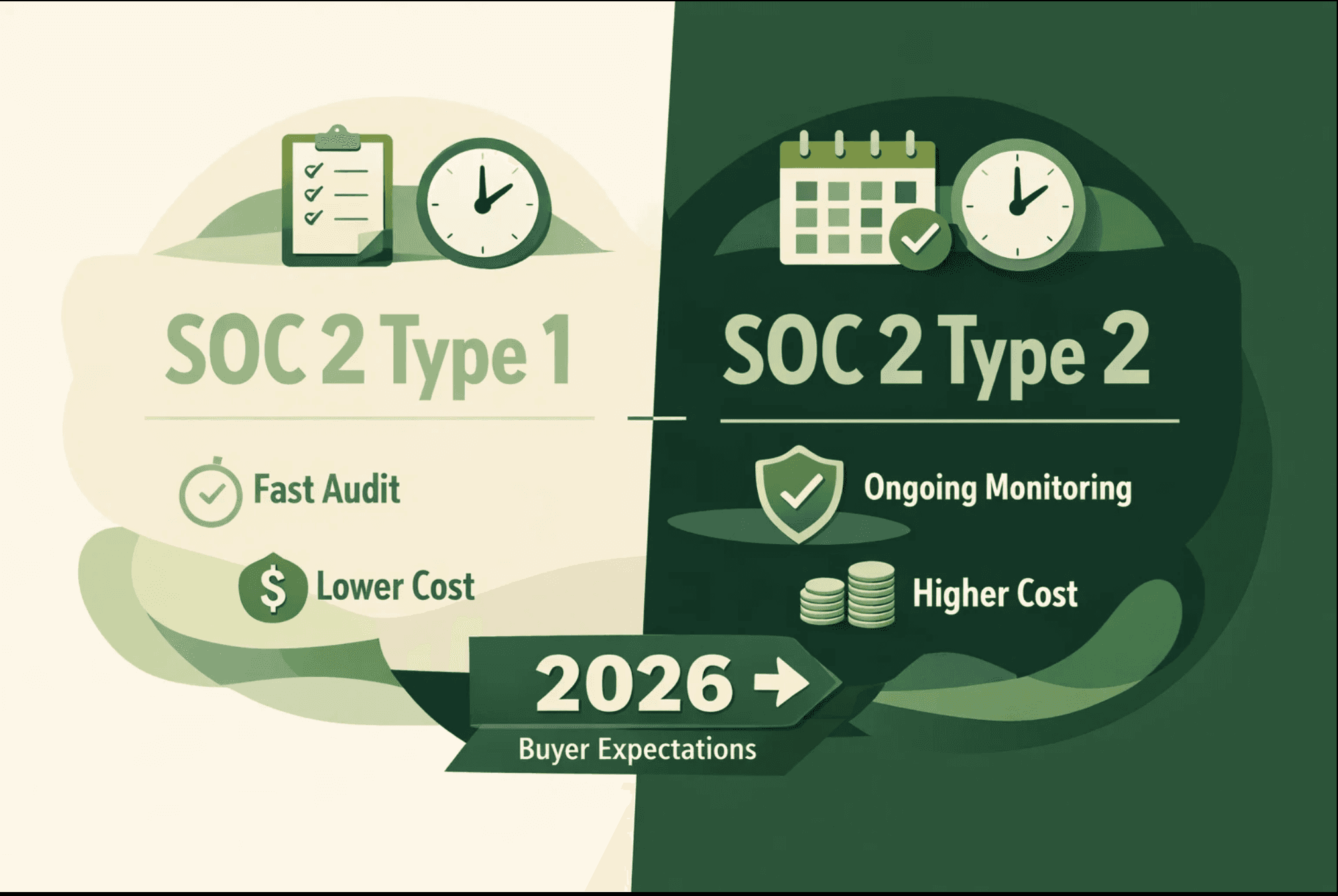
SOC 2 Type 1: Point-in-Time Assessment
A SOC 2 Type 1 report evaluates whether your security controls are properly designed at a specific moment in time. Think of it as a snapshot.
What auditors check:
Are your policies and procedures documented?
Do your controls address relevant security risks?
Are your systems configured correctly on the audit date?
Evidence period: Single day or brief window
What it proves: Your controls exist and are designed appropriately
SOC 2 Type 2: Operating Effectiveness Over Time
A SOC 2 Type 2 report goes further by testing whether your controls operate effectively over a sustained period, typically 3-12 months.
What auditors check:
Are controls functioning as intended consistently?
Do you have evidence of ongoing monitoring and enforcement?
Have there been security incidents or control failures?
Evidence period: Minimum 3 months, typically 6-12 months
What it proves: Your controls work consistently in practice, not just on paper
SOC 2 Audit Timeline: How Long Does Each Type Take?
Type 1 Timeline
Total time: 3-6 months from start to finish
Readiness phase: 2-3 months (implement controls, gather documentation)
Audit execution: 3-6 weeks (auditor review and testing)
Report issuance: 1-2 weeks
For startups with existing security practices, this timeline can be compressed to 8-12 weeks.
Type 2 Timeline
Total time: 6-12 months from start to finish
Readiness phase: 2-4 months (implement and document controls)
Observation period: 3-12 months (controls must operate continuously)
Audit execution: 6-8 weeks (auditor testing and validation)
Report issuance: 2-3 weeks
The observation period is the key differentiator—you must demonstrate consistent control operation over time.
SOC 2 Audit Cost: What to Expect
Type 1 Cost Range
Typical investment: $15,000-$50,000
Cost breakdown:
Auditor fees: $10,000-$30,000
Compliance automation tools: $2,000-$10,000 annually
Internal labor and remediation: $3,000-$10,000
Smaller startups with simpler infrastructures typically fall on the lower end, while companies with complex environments or multiple Trust Service Criteria pay more. .
Type 2 Cost Range
Typical investment: $30,000-$100,000+
Cost breakdown:
Auditor fees: $20,000-$60,000
Compliance automation tools: $5,000-$20,000 annually
Internal labor and ongoing monitoring: $5,000-$20,000
Remediation and improvements: Variable
The extended observation period requires ongoing evidence collection and monitoring, which increases both auditor hours and internal effort.
Hidden Costs to Consider
Both audit types include additional expenses that many founders overlook:
Penetration testing (often required): $5,000-$25,000
Vendor security assessments: Time-intensive internal work
Tool implementations: SSO, encryption, logging solutions
Policy development and training: Internal or consultant hours
When Buyers Expect Type 1 vs Type 2 in 2026
Type 1 Is Acceptable For:
Early-stage enterprise prospects exploring new vendors
Mid-market deals with lower compliance requirements
Initial security validation before larger commitments
Proof of concept or pilot programs
Type 1 shows you're serious about security and can be a foot in the door for startups still building their compliance program.
Type 2 Is Required For:
Enterprise contracts over $100K annually
Highly regulated industries (healthcare, finance, government)
Companies handling sensitive customer data at scale
Renewals and expansions with existing enterprise customers
In 2026, most enterprise security questionnaires explicitly request SOC 2 Type 2. If you're targeting Fortune 500 companies or regulated industries, Type 2 is non-negotiable.
People Also Ask: Common SOC 2 Questions
Can I go directly to Type 2 without Type 1?
Yes. While many companies start with Type 1 for faster time-to-market, you can skip directly to Type 2 if you have sufficient time and resources. This approach makes sense if your sales pipeline is 9+ months out.
How often do I need to renew my SOC 2 report?
SOC 2 reports are typically valid for 12 months. Most companies undergo annual audits to maintain their current compliance status and meet ongoing customer requirements.
What happens if my controls fail during a Type 2 audit?
Control failures don't automatically disqualify you. Auditors document exceptions and your remediation efforts. However, significant failures may result in qualified opinions that concern buyers.
Do I need both Type 1 and Type 2?
Not simultaneously. Type 1 serves as a stepping stone. Once you achieve Type 2, you won't maintain separate Type 1 reports—Type 2 supersedes them.
Your SOC 2 Compliance Roadmap: From Zero to Type 2
Stage 1: Foundation (Months 0-3)
Goal: Build security fundamentals
Implement essential security controls (MFA, encryption, access management)
Document security policies and procedures. Use our guide to crafting SOC 2 policies and procedures with ready-to-use templates.
Select a compliance automation platform
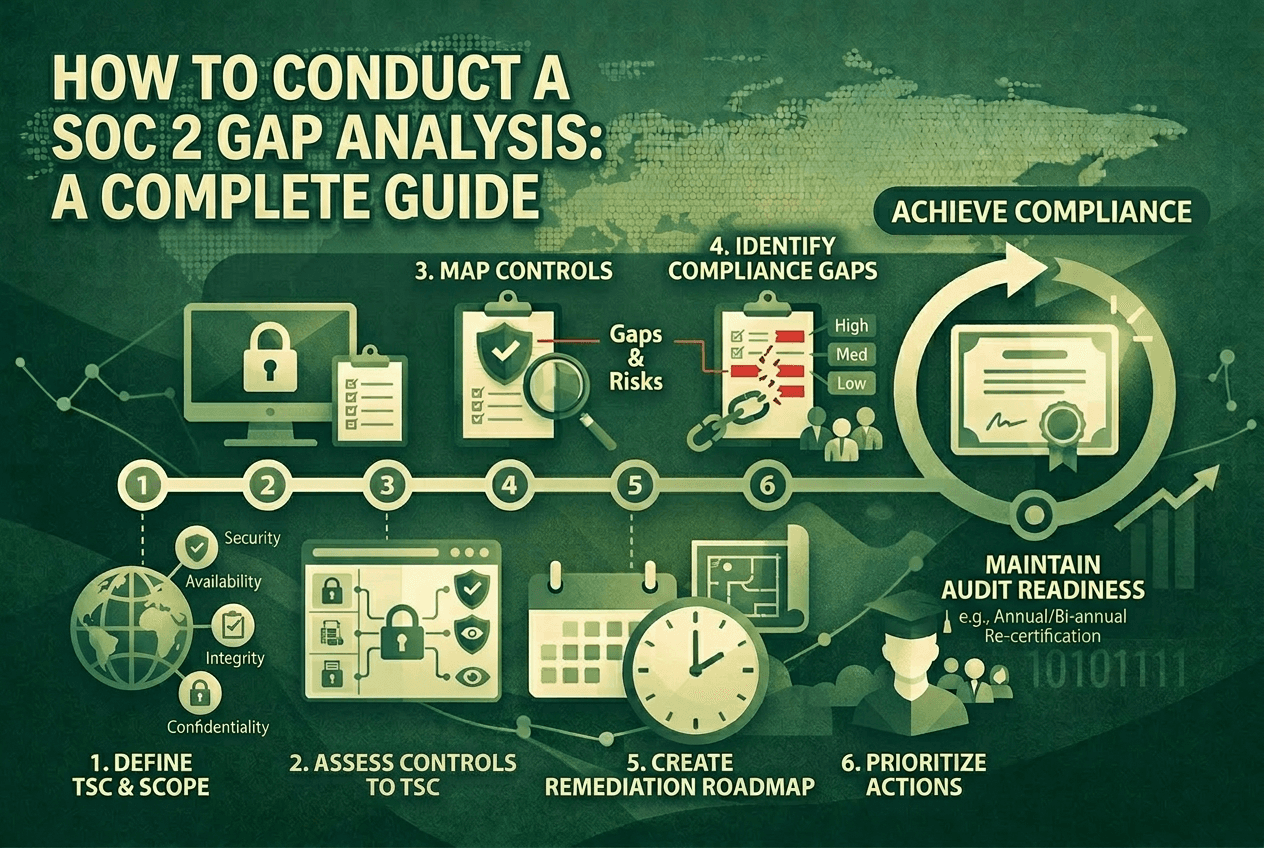
Identify gaps through a readiness assessment
Stage 2: Type 1 Achievement (Months 3-6)
Goal: Prove your controls are designed correctly
Remediate identified gaps from the readiness phase
Gather point-in-time evidence for all controls
Complete Type 1 audit with your chosen auditor
Begin using the report in mid-market sales cycles
Stage 3: Observation Period (Months 6-12)
Goal: Demonstrate consistent control operation
Maintain continuous evidence collection
Conduct quarterly internal reviews
Monitor and document security incidents or exceptions
Prepare for Type 2 audit testing
Stage 4: Type 2 Achievement (Months 12-15)
Goal: Unlock enterprise opportunities
Complete Type 2 audit covering 6-12 month observation
Update sales materials and RFP responses
Leverage report for enterprise deal acceleration
Plan for annual renewal cycle
When to Start with Type 1
Type 1 makes strategic sense when:
You need a compliance win within 3-6 months to close pending deals
Your infrastructure is still maturing and not ready for extended observation
You're testing the market for enterprise demand before major compliance investment
Internal resources are limited, and you need a phased approach
Practical example: A Series A SaaS company facing its first enterprise RFP can achieve Type 1 in 4-5 months, win the initial deal, then work toward Type 2 during the first year of service delivery.
When Enterprise Deals Demand Type 2
You should prioritize Type 2 when:
Your sales pipeline includes contracts over $100K ARR
Target customers operate in regulated industries (healthcare, financial services)
Security questionnaires explicitly require operating effectiveness evidence
You're ready to invest in long-term enterprise scalability
Practical example: A Series B company targeting healthcare systems should plan for Type 2 from the start, as HIPAA-regulated buyers rarely accept point-in-time assessments.
Choosing the Right Auditor
Whether pursuing Type 1 or Type 2, auditor selection impacts timeline, cost, and customer perception. Discover who conducts SOC 2 audits and how to evaluate qualified firms for your needs
Key selection criteria:
Industry experience with companies of your size and sector
Brand recognition among your target customers (Big 4 vs specialized firms)
Service quality and responsiveness during the process
Pricing transparency with clear scope definitions
Get quotes from at least three firms and ask for client references in your industry.
Common Pitfalls to Avoid
Starting Too Late
The biggest mistake is beginning SOC 2 preparation when a deal is already in legal review. Start your compliance journey 6-12 months before you expect enterprise requirements.
Underestimating Internal Effort
Even with consultants and tools, SOC 2 requires significant time from internal stakeholders. Engineering, IT, HR, and legal teams all play roles in evidence collection.
Neglecting Ongoing Maintenance
Achieving SOC 2 is just the beginning. Continuous compliance requires sustained effort, monitoring, and annual re-audits. Budget accordingly.
Choosing Type Based Solely on Cost
While Type 1 is cheaper initially, if your buyers require Type 2 within 6 months, you'll pay for two audits instead of one. Align your choice with actual customer requirements.
Making Your Decision: Type 1 or Type 2?
Ask yourself these questions:
What do my current and target customers require? Review actual RFPs and security questionnaires.
What's my timeline to revenue impact? Can I wait 12 months, or do I need wins in 6?
How mature are my security controls? Are they ready for extended observation?
Download our SOC 2 readiness checklist to assess your current compliance gaps before starting.
What's my total compliance budget? Can I afford to do this twice, or should I go straight to Type 2?
What industries am I targeting? Regulated sectors almost always require Type 2.
For most early-stage startups, Type 1 provides the fastest path to initial enterprise credibility, while Type 2 becomes essential for scaling into large enterprise accounts.
The Bottom Line
SOC 2 Type 1 and Type 2 aren't competing options—they're sequential stages in your compliance maturity journey. Type 1 validates your security design and opens doors to mid-market opportunities. Type 2 proves operational excellence and unlocks enterprise revenue at scale.
The right choice depends on where you are today and where your business is headed. Start with an honest assessment of your customer requirements, internal readiness, and growth timeline.
Ready to start your SOC 2 journey? DSALTA helps startups navigate compliance from initial assessment through annual audits, leveraging automation, expert guidance, and proven frameworks to accelerate timelines and reduce costs.

Explore more SOC 2 articles
Stop losing deals to compliance.
Get compliant. Keep building.
Join 100s of startups who got audit-ready in days, not months.