SOC 2 —
SOC 2 Type 2 Audit Readiness: Get Compliant Faster
AI-powered SOC 2 Type 2 compliance tools automate evidence collection, reduce audit prep time, and ensure continuous audit readiness.
Dogan Akbulut
Getting Started with SOC 2
Share this article


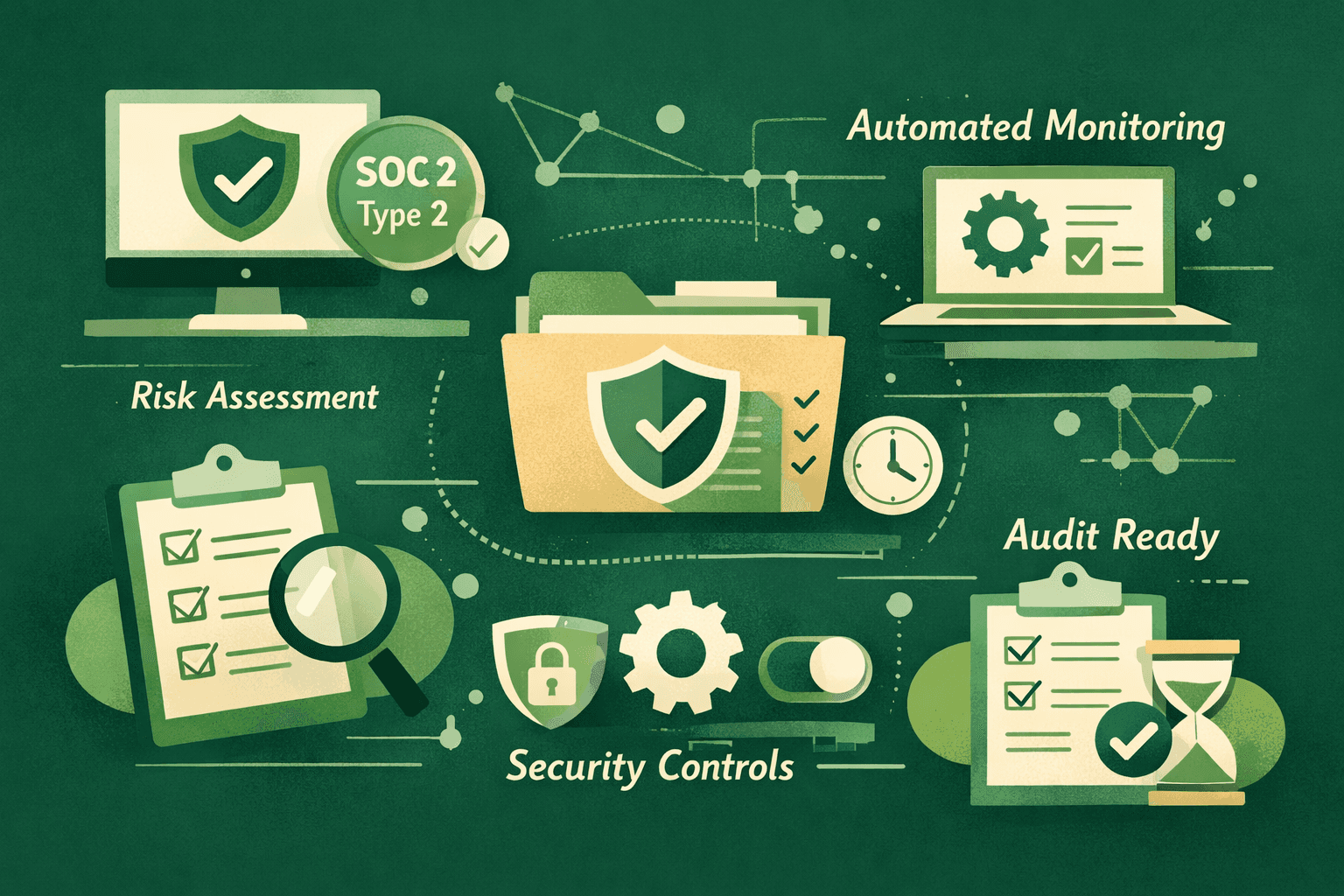
If you've been through a SOC 2 Type 2 audit the traditional way — spreadsheets, frantic evidence collection, late-night Slack messages to engineers — you already know the pain. It's slow, expensive, and exhausting. But something has changed. AI-powered compliance platforms are rewriting the rules, and teams that once spent six to twelve months preparing for a Type 2 audit are now doing it in weeks.
This guide breaks down exactly what that looks like, why it matters, and how your team can take advantage of it.
What Is SOC 2 Type 2, and Why Does It Still Matter So Much?
SOC 2 is a security framework developed by the American Institute of Certified Public Accountants (AICPA). For a complete breakdown of what SOC 2 entails, see our 2025 SOC 2 compliance guide. It evaluates how a company manages customer data based on five Trust Services Criteria: Security, Availability, Processing Integrity, Confidentiality, and Privacy.
A Type 1 report is a point-in-time snapshot — it says your controls exist on a given day. A Type 2 report is something far more demanding. It evaluates whether those controls actually operated effectively over a defined period, typically three to twelve months.
For SaaS companies, healthcare platforms, fintech startups, and any business handling sensitive customer data, SOC 2 Type 2 is increasingly non-negotiable. Enterprise buyers ask for it before signing. Learn how to automate security questionnaires to close deals faster. Security questionnaires reference it. And in competitive deals, not having it can cost you the contract.
The challenge has always been the operational burden. Collecting evidence continuously, mapping controls to the Trust Services Criteria, managing vendor risk, tracking policy compliance across a growing team — it adds up fast.
That's exactly where AI changes the game. Discover how AI automates SOC 2 and HIPAA compliance
The Traditional SOC 2 Type 2 Process: Where the Pain Lives
Before diving into what AI does differently, it helps to understand why the traditional path is so difficult.
Evidence collection is relentless. SOC 2 Type 2 auditors don't just want to see that you have an access control policy. They want logs showing who accessed what system, when, and whether those access rights were reviewed on schedule. Multiply that across dozens of controls over a twelve-month period, and you're talking about hundreds of pieces of evidence, manually exported from tools that don't talk to each other.
Gaps are discovered too late. In a traditional compliance program, teams often don't know there's a control failure until the auditor finds it. A missing log rotation policy, an unreviewed vendor, a lapsed security training completion — these things slip through without continuous monitoring.
Audits disrupt engineering. When audit season arrives, security and compliance teams flood engineers and IT staff with requests. "Can you pull the access logs for this system?" "When was the last time you reviewed these permissions?" It interrupts real work and creates resentment across the organization.
Documentation falls behind. Policies get written, then forgotten. Procedures get documented once and never updated. By the time an audit arrives, what's written down and what the team actually does have drifted apart in ways that are embarrassing at best and damaging at worst.
How AI Is Transforming the SOC 2 Type 2 Audit Cycle
AI-powered compliance platforms don't just digitize the manual process. They fundamentally rethink it. Here's how.
1. Continuous, Automated Evidence Collection
The biggest shift AI brings to SOC 2 Type 2 is moving from periodic evidence collection to continuous, automated monitoring.
Modern platforms integrate directly with the tools your team already uses — AWS, Azure, Google Cloud, GitHub, Okta, Jira, Slack, and dozens more. Instead of manually exporting logs at audit time, the platform pulls and organizes evidence in real time, every day.
When an auditor asks for twelve months of access control logs, you don't spend a week collecting them. See our SOC 2 audit evidence and artifacts collection checklist for a list of what auditors typically request. You export them from a dashboard in minutes.
This matters because SOC 2 Type 2 is fundamentally a test of operational consistency. You can't fake twelve months of good behavior in the final weeks before an audit. With continuous collection, the evidence builds itself.
2. AI-Driven Control Mapping and Gap Analysis
One of the most time-consuming parts of SOC 2 preparation is mapping your existing controls to the Trust Services Criteria. Which of your current policies satisfies CC6.1? What evidence covers CC7.2? Our SOC 2 control mapping guide explains how to map controls to the Trust Services Criteria. For teams without a dedicated compliance expert, this mapping work is opaque and error-prone.
AI handles this by analyzing your existing environment — your tools, policies, configurations, and workflows — and automatically mapping what you have to the relevant SOC 2 controls. More importantly, it identifies what's missing.
Instead of discovering gaps when an auditor flags them, you see them in real time on a compliance dashboard. A control is failing. Here's why. Here's what you need to fix it. That shift from reactive to proactive is enormous.
3. Intelligent Policy Management
SOC 2 Type 2 requires that your policies are not only written but also actively maintained and acknowledged by your team. AI-powered platforms can draft policies tailored to your specific environment, track employee acknowledgments, and alert you when policies need review or update.
This removes one of the biggest administrative burdens compliance teams face: keeping documentation aligned with how the organization actually operates. When your infrastructure changes, when you add new vendors, when you hire new employees, the platform flags which documentation needs updating and, in many cases, automatically drafts the updates.
4. Automated Vendor and Third-Party Risk Management
Auditors scrutinize your vendor relationships because your compliance posture is only as strong as the third parties with access to your systems and data. For growing companies with dozens of SaaS tools and cloud providers, managing vendor risk manually is almost impossible.
AI changes this by continuously monitoring vendors, automating security questionnaire workflows, scoring vendor risk, and surfacing issues before they become audit findings. For a comprehensive approach, read our guide to mastering third-party risk management. If a vendor's security posture changes — a new vulnerability, a lapsed certification — you know immediately rather than at audit time.
5. Audit-Ready Reporting at Any Moment
Perhaps the most tangible benefit for compliance teams is always being audit-ready. Instead of a frantic preparation sprint before the auditor arrives, AI-powered platforms maintain a continuous state of readiness.
At any time, you can generate a report showing your current compliance posture, evidence coverage for each control, outstanding gaps, and remediation timelines. When the auditor does arrive, the process is a review rather than a scramble.
What the Timeline Looks Like With AI
Traditional SOC 2 Type 2 timelines vary, but six to twelve months for the observation period alone is standard, with additional months spent on preparation before that. Total time from starting the process to receiving a clean report can easily exceed eighteen months for first-timers.
AI-powered platforms compress this significantly by eliminating the manual work that dominates traditional timelines.
Teams using modern compliance automation commonly achieve:
Initial environment assessment and control mapping in days rather than weeks
Policy documentation is completed in days rather than months
Continuous evidence collection that begins immediately and never stops
Audit observation periods that start sooner because controls are implemented and monitored faster
Evidence packages are assembled in hours rather than weeks when the auditor requests them
The observation period itself cannot be shortened — auditors require a minimum window, typically three to twelve months, depending on the scope and your auditor's requirements. But everything surrounding that window compresses dramatically.
The Cost Case for AI-Powered SOC 2 Type 2
Compliance has always been viewed as a cost center. AI-powered platforms challenge that framing.
Consider what the traditional approach costs. A compliance consultant or virtual CISO engagement for SOC 2 preparation can range from $30,000 to $100,000 or more, depending on the scope. Internal engineering time spent on evidence collection and remediation is rarely tracked, yet it often represents the highest hidden cost. Audit fees from a CPA firm typically run $15,000 to $50,000 for a Type 2 report.
AI platforms significantly reduce consulting dependency, compress engineering time, and help you arrive at the auditor in a cleaner shape, keeping audit fees lower and reducing the back-and-forth that extends timelines.
More importantly, SOC 2 Type 2 is a revenue enabler. Deals that require it close faster when you have it. Explore how security became a revenue driver in 2025 through compliance automation. Enterprise sales cycles shorten when you can hand a prospect a current SOC 2 report rather than promising one in six months. The investment in compliance automation pays back in deals that don't slip.
Key Features to Look for in an AI-Powered SOC 2 Platform
If you're evaluating platforms to support your SOC 2 Type 2 program, here's what to prioritize.
Breadth of integrations. The platform's value is directly tied to how many of your existing tools it can connect with. Look for native integrations with your cloud infrastructure, identity provider, version control, ticketing system, and HR platform.
Continuous monitoring, not point-in-time checks. Some platforms run scans on a schedule. The best ones monitor continuously and alert you to failures in real time.
Automated evidence collection. The platform should pull evidence automatically rather than requiring you to upload it manually. This is the difference between reducing audit burden and just organizing the manual process.
Multi-framework support. Most growing companies eventually need more than just SOC 2. Learn about a unified approach to SOC 2, ISO 27001, and HIPAA in 2025. A platform that supports ISO 27001, HIPAA, GDPR, and PCI DSS alongside SOC 2 means you can build once and get credit across multiple frameworks.
Clear audit trail and auditor access. Look for platforms that provide your auditor with direct, controlled access to evidence, rather than forcing you to export and email large file packages.
Policy management and employee workflows. Compliance is a team sport. The platform should handle policy distribution, acknowledgment tracking, integration with security training, and background check workflows.
Common Misconceptions About AI Compliance Automation
"AI replaces the auditor." It doesn't, and it shouldn't. The SOC 2 Type 2 report is issued by an independent CPA firm, and that independence is what gives the report its credibility with your customers. AI accelerates your preparation and ongoing compliance posture. The auditor still performs their independent assessment.
"Automation means we don't need a compliance lead." Automation reduces the operational burden, but someone still needs to own the compliance program, make decisions about risk acceptance, manage auditor relationships, and drive remediation when gaps surface. AI makes that person dramatically more effective. It doesn't eliminate the need for them.
"Once we have SOC 2 Type 2, we're done." SOC 2 Type 2 reports typically cover a twelve-month observation period, and most customers expect annual renewal. Compliance is a continuous practice, not a one-time achievement. AI platforms shine here because they keep you in a continuous state of readiness rather than treating compliance as a cyclical sprint.
Getting Started: A Practical Path to AI-Powered SOC 2 Type 2
If you're starting fresh or looking to modernize an existing compliance program, here's a practical approach.
Start with a scope decision. Determine which systems, products, and data flows fall within your SOC 2 boundary. A narrower scope is faster and cheaper. Expand over time as your program matures.
Connect your environment. Integrate your compliance platform with your cloud infrastructure, identity provider, and key tools. This is the foundation that makes automation possible.
Complete your control gap assessment. Let the platform analyze your environment against the SOC 2 Trust Services Criteria and surface what's missing. Prioritize remediation based on risk and audit likelihood.
Get your policies in order. Use the platform's policy library to implement or update your information security policies. Distribute them to your team and track acknowledgments.
Begin your observation period. Once your controls are operating, your observation period clock starts. Continuous monitoring means evidence is building every day.
Engage your auditor. Bring in a CPA firm to conduct the Type 2 audit. With your evidence organized and controls monitored continuously, the process is far smoother than the traditional approach.
The Bottom Line
SOC 2 Type 2 used to be something only well-resourced companies with dedicated compliance teams could pursue efficiently. AI-powered compliance platforms have changed that. What once required months of manual work, expensive consultants, and engineering disruption can now be accomplished faster, with higher-quality evidence, and with less organizational pain.
The companies winning enterprise deals in 2026 are the ones that treat compliance not as an annual fire drill but as a continuous, automated practice. AI makes that possible for teams of any size.
If your SOC 2 Type 2 program is still running on spreadsheets and shared folders, the gap between you and your competitors is growing. The good news is that closing it has never been more accessible.
Ready to see what AI-powered SOC 2 Type 2 compliance looks like in practice? Explore how Dsalta's compliance automation platform helps teams get audit-ready faster — without the manual chaos.

Explore more SOC 2 articles
Stop losing deals to compliance.
Get compliant. Keep building.
Join 100s of startups who got audit-ready in days, not months.