SOC 2 —
SOC 2 Background Check Requirements: What You Need to Know
Learn what SOC 2 background check requirements are, why they matter for compliance, and how your organization can meet them with confidence.
Jon Ozdoruk
Getting Started with SOC 2
Share this article


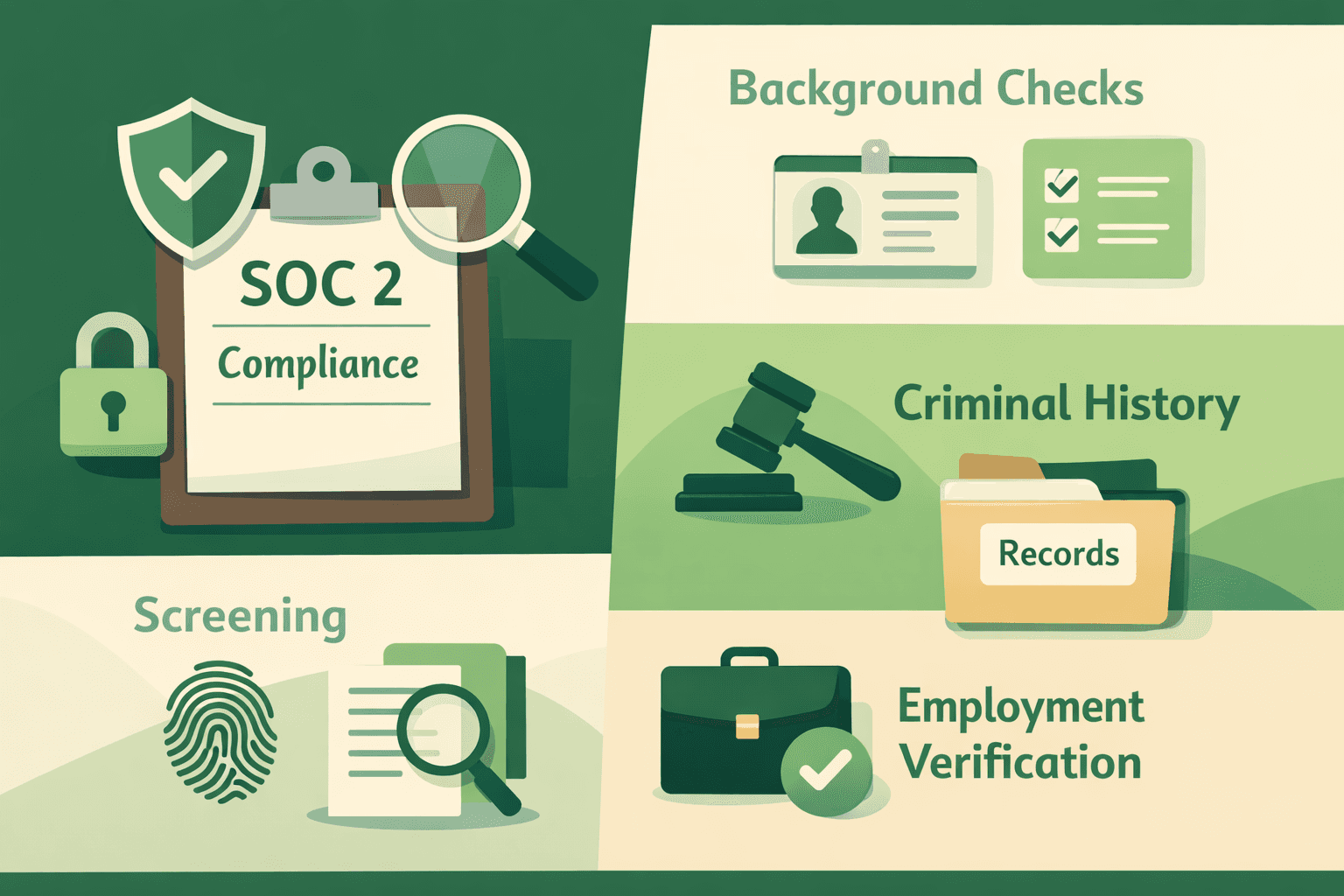
If your organization is pursuing SOC 2 compliance, background checks are not optional — they are a foundational requirement under the Trust Services Criteria. SOC 2 background check requirements mandate that companies screen employees and contractors who have access to sensitive customer data, ensuring that the humans inside your systems are as trustworthy as the systems themselves. This guide breaks down exactly what those requirements are, why they matter, and how to implement them correctly.
What Is SOC 2 and Why Do Background Checks Matter?
SOC 2, short for System and Organization Controls 2, is an auditing framework developed by the American Institute of Certified Public Accountants (AICPA). It is designed to help technology and cloud-based service providers demonstrate that they handle customer data securely and responsibly.
At the core of SOC 2 is a set of Trust Services Criteria (TSC) — Security, Availability, Processing Integrity, Confidentiality, and Privacy. Within these criteria, the people who access your systems are treated as a critical risk factor. No matter how airtight your technical controls are, an unvetted employee or contractor can undermine your organization's entire compliance posture.
This is why SOC 2 auditors look specifically at your personnel screening policies. Background checks serve as a direct control against insider threats, data breaches caused by negligence or malice, and reputational damage from hiring individuals with a history of fraud or misconduct.
What Are the SOC 2 Background Check Requirements?
SOC 2 does not prescribe a single rigid checklist for background checks. Instead, it requires organizations to demonstrate that reasonable, documented, and consistent personnel screening practices are in place. Here is what that typically includes:
Pre-Employment Background Screening
Before granting any employee or contractor access to systems that store or process customer data, organizations must conduct background checks. This typically covers:
Criminal history checks (federal, state, and sometimes international)
Identity verification
Employment history verification
Education and credential verification
Sex offender registry checks (where applicable and legally permitted)
Credit history checks (for roles involving financial data or systems)
The depth of the background check should be proportional to the level of access the individual will have. An engineer with root-level access to production databases requires more thorough screening than a marketing intern with no system access.
2. Background Check Policy Documentation
SOC 2 auditors will ask to see your written background check policy. This document must clearly outline:
Which roles require background checks
What types of checks are performed
Who is responsible for initiating and reviewing checks
How results are evaluated and what disqualifies a candidate
How results are stored securely and in compliance with applicable privacy laws
Without a documented policy, even if you conduct background checks informally, you will likely fail this control during a SOC 2 audit.
3. Consistent, Non-Discriminatory Application
SOC 2 requires that your background check process be applied consistently across comparable roles. Selective application of background checks — whether intentional or not — creates both a compliance gap and a legal liability. Your policy must be enforceable, repeatable, and applied equitably.
4. Contractor and Third-Party Vendor Screening
Many organizations overlook this, but SOC 2 extends personnel screening expectations to contractors, vendors, and third parties who access your systems. If an outside developer, consultant, or managed service provider has access to your environment, your background check requirements should apply to them as well — or you should have contractual assurances that they conduct equivalent screening.
5. Periodic Re-Screening (Recommended Best Practice)
While SOC 2 does not always mandate ongoing background checks after hire, auditors increasingly look favorably on organizations that re-screen employees in high-trust roles at regular intervals (typically every one to two years) or following significant changes in responsibilities.
Which SOC 2 Trust Services Criteria Cover Background Checks?
Background check requirements fall primarily under the Common Criteria (CC) section of SOC 2, specifically:
CC1.1 — COSO Principle 1: Commitment to Integrity and Ethical Values This criterion requires organizations to demonstrate they hire individuals aligned with the company's values and risk tolerance, which directly ties to pre-employment screening.
CC1.4 — Organizational Structure and Human Resources This criterion explicitly addresses the organization's commitment to attracting, developing, and retaining competent individuals, including verification of background and qualifications.
CC2.2 — Internal Communication Employees must understand their responsibilities, including those related to security and data handling, which requires them to be appropriately vetted in the first place.
Organizations seeking SOC 2 Type 2 certification (which covers controls over a period of time, typically 6–12 months) will need to show consistent application of their background check policy throughout the audit window, not just at a single point in time.
Why Are SOC 2 Background Check Requirements Important?
Protecting Customer Data from Insider Threats
The majority of data breaches involve some form of human error or malicious insider action. Background checks reduce the likelihood of hiring individuals with a demonstrated history of fraud, theft, or data-related misconduct. When your customers entrust you with their data, they expect that every person with access to that data has been appropriately vetted.
Meeting Enterprise Customer Expectations
Enterprise buyers increasingly require SOC 2 Type 2 certification as a baseline vendor requirement. Within those audits, background check controls are among the first things a security team or procurement officer will scrutinize. Weak or undocumented personnel screening policies can stall or kill enterprise sales cycles entirely.
Reducing Legal and Regulatory Exposure
Failing to screen personnel — especially those handling sensitive personal data — can expose organizations to significant legal risk under regulations such as GDPR, CCPA, and HIPAA. A well-documented SOC 2 background check program demonstrates due diligence that can serve as a meaningful defense in the event of a breach or investigation.
Building a Culture of Security and Accountability
Background check requirements are not just about catching bad actors. They communicate to your entire organization that security starts with the people you hire. This cultural signal reinforces other SOC 2 controls around access management, data handling, and incident response.
How to Implement SOC 2 Background Check Requirements at Your Organization
Getting your background check program audit-ready involves four key steps:
Step 1 — Define Scope: Identify all roles — employees, contractors, and vendors — that require access to systems in scope for SOC 2. Map access levels to screening depth.
Step 2 — Choose a Compliant Background Check Provider: Use an FCRA-compliant background check provider (in the US) or an equivalent legal framework in your jurisdiction. Ensure your provider can deliver results in a documented, auditable format.
Step 3 — Document Your Policy: Write a formal Background Check Policy that covers what is checked, when it is checked, how results are stored, and who is accountable. Have it reviewed by legal counsel familiar with employment law in your operating regions.
Step 4 — Integrate with Your HR and Onboarding Workflow: Background checks should be a mandatory gate in your hiring workflow — not an afterthought. Use your HR platform to enforce completion before granting system access.
Step 5 — Maintain Evidence for Auditors: Store completion records, policy versions, and any exception documentation in a secure, auditor-accessible location. Your SOC 2 auditor will want to sample this evidence.
How DSALTA Helps You Meet SOC 2 Background Check Requirements
At DSALTA, we specialize in AI-powered compliance solutions that take the complexity out of SOC 2 readiness. Our platform helps you:
Map your personnel screening controls to the SOC 2 Trust Services Criteria automatically
Generate audit-ready policy documentation tailored to your organization
Track background check completion status across your workforce and vendor ecosystem
Identify compliance gaps before your auditors do
Whether you are pursuing your first SOC 2 Type 1 report or maintaining a continuous SOC 2 Type 2 program, DSALTA gives your compliance team the tools and visibility they need to stay ahead.
Frequently Asked Questions About SOC 2 Background Check Requirements
Is a background check required for SOC 2?
Yes. While SOC 2 does not mandate a specific type of background check, it requires organizations to demonstrate that personnel screening controls are in place, documented, and consistently applied for individuals with access to in-scope systems.
Does SOC 2 require background checks for contractors?
Yes. SOC 2 extends personnel screening requirements to contractors and third-party vendors with access to systems and data in scope for the audit. Organizations should either conduct direct screening or obtain contractual confirmation of equivalent screening.
What is the difference between SOC 2 Type 1 and Type 2 for background checks?
SOC 2 Type 1 evaluates whether controls are designed appropriately at a single point in time. SOC 2 Type 2 evaluates whether those controls operated effectively over a defined period, typically 6–12 months. For background checks, Type 2 means you must show consistent application of your policy across all new hires and contractors throughout the audit window.
How long should background check records be retained?
Best practice is to retain background check records for the duration of employment and for a minimum of 3 to 7 years afterward, in line with applicable employment and privacy laws. Your legal team should confirm the specific requirements for your jurisdiction.
Final Thoughts
SOC 2 background check requirements exist for a simple reason: the security of your systems is only as strong as the people who operate them. A well-documented, consistently applied background check program is not just a box to check — it is a foundational investment in the trust your customers, partners, and auditors place in your organization.
If you are unsure whether your current personnel screening practices will hold up to SOC 2 scrutiny, DSALTA can help you find out — and fix what needs fixing before your audit begins.

Explore more SOC 2 articles
Stop losing deals to compliance.
Get compliant. Keep building.
Join 100s of startups who got audit-ready in days, not months.