SOC 2 —
SOC 2 for Fintech Companies: Audit Scope Guide
SOC 2 for fintech companies: scope your audit, meet financial services security requirements, and turn compliance into a commercial advantage.
Jon Ozdoruk
Getting Started with SOC 2
Share this article


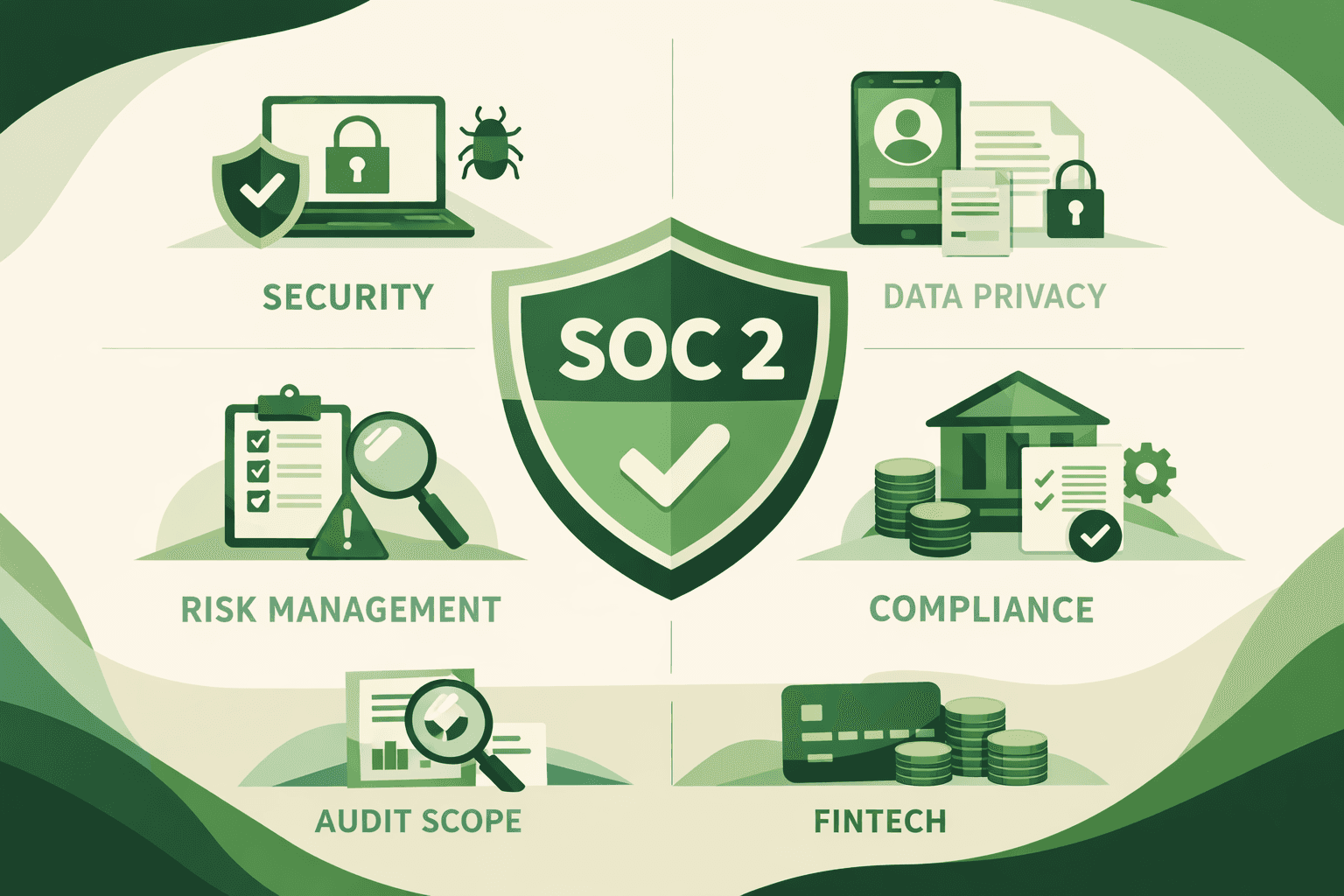
There is a moment that almost every fintech founder recognizes. You have spent months building the product, found early traction, and landed a meeting with a major bank, insurance carrier, or payments network. The conversation goes well. Then, a few days later, an email arrives from their vendor security team. Attached is a spreadsheet with 400 rows of security questions, and a note at the bottom: we also require a current SOC 2 Type II report before we can proceed with procurement.
For fintech companies, SOC 2 is rarely optional. It is the baseline security credential that financial institutions, enterprise buyers, and regulated organizations require before onboarding a technology vendor. The difference between fintech companies and generic SaaS companies pursuing SOC 2 is that fintech operates in a higher-stakes regulatory environment, handles more sensitive financial data, faces more sophisticated security questionnaires from buyers, and frequently needs to satisfy requirements from multiple frameworks simultaneously — SOC 2, PCI DSS, GDPR, and sometimes state-level financial regulations — within a single compliance program.
This guide covers what SOC 2 requires for fintech companies specifically, how to scope your audit for a financial services environment, what the Trust Services Criteria mean in the context of payments, lending, banking infrastructure, and financial data, and how to use your SOC 2 program to accelerate enterprise sales rather than just satisfy procurement checklists.
Why SOC 2 Is Non-Negotiable for Fintech
Financial institutions are among the most security-mature buyers in any market. Their own regulators, the OCC, FDIC, Federal Reserve, FCA, and DORA in Europe, hold them accountable for the security posture of the third-party vendors they rely on. When a bank onboards a fintech vendor, it is expanding its regulatory scope to encompass that vendor's security controls. The bank's auditors will eventually ask about it. The bank's regulators may review it. The bank's CISO is accountable for it.
This is why financial services security reviews are more rigorous than those in almost any other vertical. A generic SaaS company selling to mid-market businesses might get away with answering a security questionnaire by self-attestation for a year or two. A fintech company selling payment infrastructure to a regional bank, a lending API to a credit union, or a financial data platform to an asset manager will be asked for a SOC 2 report before the legal team even drafts a contract.
Beyond the immediate sales requirement, SOC 2 matters for fintech companies for three structural reasons. First, it signals security maturity to buyers who are legally required to perform vendor due diligence. Second, it provides a third-party-verified foundation for responding to the security questionnaires that consume significant sales and engineering time. Third, it creates a documented control environment that makes subsequent compliance certifications, such as ISO 27001, PCI DSS, SOC 1, or FedRAMP, significantly less costly to obtain, since the foundational work has already been completed.
Understanding SOC 2 in a Fintech Context
SOC 2 is a security attestation framework developed by the American Institute of Certified Public Accountants. It evaluates a service organization's controls against five Trust Services Criteria: Security, Availability, Processing Integrity, Confidentiality, and Privacy. Security is mandatory. The remaining four are optional and are selected based on what is relevant to your company's commitments to its customers.
For fintech companies, selecting Trust Services Criteria requires more deliberate thought than for a generic SaaS platform. The financial services context makes certain criteria almost universally relevant.
Security is mandatory for every SOC 2 program. It covers logical and physical access controls, system operations, change management, risk mitigation, and monitoring. For fintech, the Security criteria receive heightened scrutiny because financial data is a high-value target for attackers and because financial institution buyers have sophisticated security teams who will read your SOC 2 report closely.
Availability is highly relevant to fintech companies that provide infrastructure that other companies depend on for operational continuity. If your platform processes payments, provides banking APIs, or delivers financial data feeds that your customers' operations depend on, your buyers will want to know that your systems are available when needed. Availability commitments — uptime SLAs, disaster recovery procedures, business continuity plans — are evidenced under this criterion.
Processing Integrity is particularly important for fintech and is frequently overlooked by companies scoping their first SOC 2. Processing integrity addresses whether your system processes data completely, accurately, and validly in a timely manner. For a payments processor, a lending platform, or any fintech that performs calculations, transformations, or transactions on financial data, processing integrity is directly relevant to the commitments you make to customers. A payment that processes twice, a loan calculation that rounds incorrectly, or a financial data feed that delivers incomplete records are all processing integrity failures. Buyers in financial services will often specifically request that processing integrity be included in your SOC 2 scope.
Confidentiality covers how your organization protects information designated as confidential — typically customer data, contractual information, and proprietary business information. For fintech companies handling customer financial records, account data, transaction histories, or credit information, confidentiality controls are directly relevant and should be included in scope.
Privacy addresses the collection, use, retention, disclosure, and disposal of personal information in accordance with your privacy notice and applicable regulations. Fintech companies that collect personal financial information from consumers — account holders, loan applicants, cardholders — should consider whether the privacy criterion is appropriate for their scope, particularly if they are also navigating GDPR, CCPA, or GLBA requirements.
The most common scoping mistake fintech companies make is including only the Security criterion because it is mandatory and seems like the minimum viable SOC 2 program. For a generic SaaS company with no specific operational commitments to customers, Security-only may be appropriate. For a fintech company that makes commitments regarding uptime, data accuracy, and data confidentiality, a Security-only report may prompt buyers to ask why the other relevant criteria were excluded, which can slow or complicate the procurement review.
Scoping Your SOC 2 Audit for a Fintech Environment
Audit scope defines the boundaries of your SOC 2 program — which systems, services, processes, and data are covered by the controls you will evidence and attest to. Getting scope right is the most consequential decision in your SOC 2 program. A scope that is too narrow excludes the systems and processes your buyers care most about. A scope that is too broad creates an audit surface that is expensive to manage and difficult to maintain.
Define your in-scope services first. Your SOC 2 scope should map to the services you provide to customers and the commitments you make in your customer agreements. For a payments API company, the in-scope service is the payments-processing infrastructure — the API layer, the transaction-processing systems, the data storage and retrieval systems, and the operational processes that support them. For a financial data platform, the in-scope services are data ingestion, processing, storage, and delivery infrastructure.
Map your in-scope systems to your services. Once your in-scope services are defined, identify every system component that supports those services. This includes your production infrastructure (cloud provider, servers, databases, storage), your application layer, your network and security infrastructure, your identity and access management systems, your monitoring and alerting systems, and your data backup and recovery systems.
Identify your in-scope data. For fintech companies, in-scope data typically includes customer financial data processed or stored by your systems, authentication credentials and access data, transaction records, and any personal information covered by your privacy commitments. Data that flows through systems outside your direct control — particularly third-party payment networks, banking APIs, and financial data providers — needs to be addressed in your scope definition and in your vendor management program.
Address your cloud environment explicitly. Almost every fintech company runs on cloud infrastructure — AWS, GCP, or Azure. Your cloud provider has its own SOC 2 reports and other compliance certifications. Your SOC 2 scope includes the controls your organization is responsible for within that shared responsibility model. Your auditor will want to understand the boundary between what your cloud provider is responsible for and what your organization is responsible for, and will review your cloud provider's SOC 2 report as part of evaluating your vendor management controls.
Third-party integrations require particular attention in fintech. Fintech companies typically integrate with more third parties than generic SaaS companies — banking APIs, payment networks, credit bureaus, KYC providers, fraud detection services, and financial data providers. Each of these integrations represents a potential point of risk that your SOC 2 program must address. Your vendor management controls need to cover how you evaluate, onboard, and monitor these integrations. Your scope narrative needs to explain how third-party services outside your direct control are managed and what compensating controls are in place.
The Trust Services Criteria That Matter Most for Fintech
Within the Security criterion — which covers the Common Criteria applicable to all SOC 2 programs — several categories require particular depth and rigor for fintech companies due to the sensitivity of financial data and the sophistication of financial services buyers.
Logical and Physical Access Controls (CC6)
CC6 is the most scrutinized control category in any fintech SOC 2 program. It covers how your organization controls access to your systems, data, and infrastructure. For fintech, this means multi-factor authentication for all systems that process or store financial data, role-based access control with documented least-privilege principles, quarterly or more frequent access reviews that evidence that only authorized personnel retain appropriate access, privileged access management for production infrastructure, and documented procedures for revoking access promptly when employees leave or change roles.
Financial services buyers specifically look at how your organization manages access to production databases containing financial data, how access to customer account information is controlled and monitored, and whether your access control logs are sufficient to reconstruct what any individual user accessed and when. These are not abstract compliance requirements — they reflect the actual questions that bank security teams ask when reviewing your SOC 2 report.
Risk Assessment (CC3)
CC3 requires your organization to identify, analyze, and respond to risks that could affect its ability to meet its security commitments and system requirements. For fintech, your risk assessment must address the specific threat landscape of financial services — fraud, account takeover, payment interception, data exfiltration targeting financial records, and insider threat risks that are elevated in environments handling high-value financial data.
Your risk assessment should be annual at minimum and should be updated when significant changes occur — new product launches, new integrations with financial networks, significant changes to your infrastructure architecture, or material changes in the threat environment. A risk assessment last updated 18 months ago that does not reflect your current product or infrastructure will raise questions during an audit.
Change Management (CC8)
CC8 covers how your organization manages changes to infrastructure, data, and software to protect against unauthorized changes and mitigate the risk that changes will adversely affect security. In fintech, change-management rigor is heightened because changes to payment-processing logic, financial calculation engines, or data-handling procedures can have significant financial and regulatory consequences, as well as security implications.
Your change management controls should demonstrate that all production changes go through an approved process; that changes are tested in a non-production environment before deployment; that emergency changes have a documented expedited review process; that change records are maintained; and that unauthorized changes are detected through monitoring.
Vendor Management (CC9)
CC9 requires that your organization assess and manage the risks associated with vendors and business partners. For fintech companies with complex third-party ecosystems — banking APIs, payment networks, data providers, infrastructure vendors — vendor management is one of the most operationally intensive control categories in the SOC 2 program.
Your vendor management program should maintain a documented inventory of all vendors with access to in-scope systems or data, categorize vendors by risk level, require SOC 2 reports or equivalent security documentation from high-risk vendors, include contractual security requirements in vendor agreements, and have a process for monitoring vendor security posture on an ongoing basis.
Monitoring (CC7)
CC7 covers how your organization monitors its systems to detect security events, evaluates vulnerabilities, and responds to identified incidents. For fintech, monitoring requirements are elevated because financial systems are high-value targets and because financial institution buyers will expect evidence of mature security monitoring.
Your monitoring program should include continuous monitoring of production systems for security events, a defined process for evaluating the significance of detected events, an incident response plan that documents how security incidents are identified, contained, investigated, and resolved, and evidence that the incident response plan has been tested.
Navigating PCI DSS Alongside SOC 2
Fintech companies that handle payment card data — processing, transmitting, or storing cardholder data — are subject to PCI DSS in addition to SOC 2. Understanding how the two frameworks relate is essential to building an efficient compliance program that satisfies both without duplicating effort.
SOC 2 and PCI DSS overlap significantly but serve different purposes. SOC 2 is a general security attestation framework that you can customize to your commitments. PCI DSS is a prescriptive standard with specific mandatory requirements that apply to any organization that handles cardholder data. SOC 2 does not replace PCI DSS. If you are in scope for PCI DSS, you need both.
The good news is that the control overlap between SOC 2 and PCI DSS is substantial. Access controls, encryption, vulnerability management, logging and monitoring, change management, and incident response are all addressed by both frameworks. Building your controls to meet the more prescriptive PCI DSS requirements in these areas will generally also satisfy the equivalent SOC 2 criteria.
The areas where PCI DSS is more prescriptive than SOC 2 include network segmentation requirements (PCI DSS requires that cardholder data environments be segmented from other networks), specific encryption requirements for cardholder data at rest and in transit, quarterly vulnerability scanning by an Approved Scanning Vendor, and annual penetration testing. These PCI DSS-specific requirements should be incorporated into your SOC 2 evidence program so that the evidence you collect for PCI DSS compliance also supports your SOC 2 attestation.
The carve-out model is common and appropriate for many fintech companies. If your fintech product passes payment card data through a payment processor rather than storing or processing it directly, you may be able to limit your PCI DSS scope significantly by ensuring that cardholder data never touches your systems. The payment processor handles the PCI DSS obligations for the card data itself. Your SOC 2 scope in this model focuses on the security of your platform and the data you do handle, without the full weight of PCI DSS cardholder data environment requirements.
Understanding your PCI DSS scope — and being able to articulate it clearly to buyers — is part of the conversation in financial services security reviews. Enterprise buyers frequently ask fintech vendors not just whether they have SOC 2 but how their PCI DSS compliance is structured and what their cardholder data environment looks like.
What Financial Services Buyers Look for in Your SOC 2 Report
The SOC 2 report you receive from your auditor is a formal document with a defined structure. It contains the auditor's opinion, a description of your system, the trust services criteria being reported on, the controls you have implemented, the tests the auditor performed, and the results of those tests. Financial services buyers have sophisticated security teams who read SOC 2 reports closely, and understanding what they look for helps you build a SOC 2 program that performs well under scrutiny.
The scope section is the first thing a sophisticated buyer reads. They are looking for what is included and — more importantly — what is excluded. A scope that carves out significant portions of your infrastructure, limits coverage to a small subset of your systems, or excludes services relevant to the buyer's use case will prompt follow-up questions. A well-defined, appropriately comprehensive scope signals that your SOC 2 program genuinely covers the systems that matter.
Exceptions and qualified opinions are red flags. An unqualified SOC 2 opinion means the auditor found no material failures in your controls. A qualified opinion means the auditor identified one or more control failures significant enough to modify their opinion. Financial services buyers treat qualified opinions seriously — they indicate that controls did not operate effectively during the audit period. If your SOC 2 report contains exceptions, be prepared to explain what the control failure was, what the root cause was, what remediation was completed, and what evidence exists that the control is now operating effectively.
The description of controls and test results is where security teams spend most of their time. They are looking at whether your controls are genuinely designed to address the risks of your specific environment, whether the auditor's testing was rigorous, and whether the results demonstrate that the controls operated consistently throughout the audit period. Boilerplate controls that could apply to any company and clearly were not written to reflect your actual environment are a negative signal.
Subservice organizations — third-party vendors that are part of your system — are examined carefully. Your SOC 2 report will identify whether your program uses an inclusive or carve-out method for subservice organizations. Financial services buyers want to understand which critical vendors are carved out and what complementary user entity controls exist to address the risks those vendors introduce. If a critical financial data provider or banking API is carved out of your scope, buyers will want to understand how you assess and monitor that vendor's security posture.
Building Your SOC 2 Program for Long-Term Commercial Value
The fintech companies that derive the most commercial value from SOC 2 are not the ones that treat it as a minimum viable compliance exercise. They are the ones who build a genuinely rigorous program, maintain it continuously between audits, and make their security posture visible and accessible to buyers throughout the sales process.
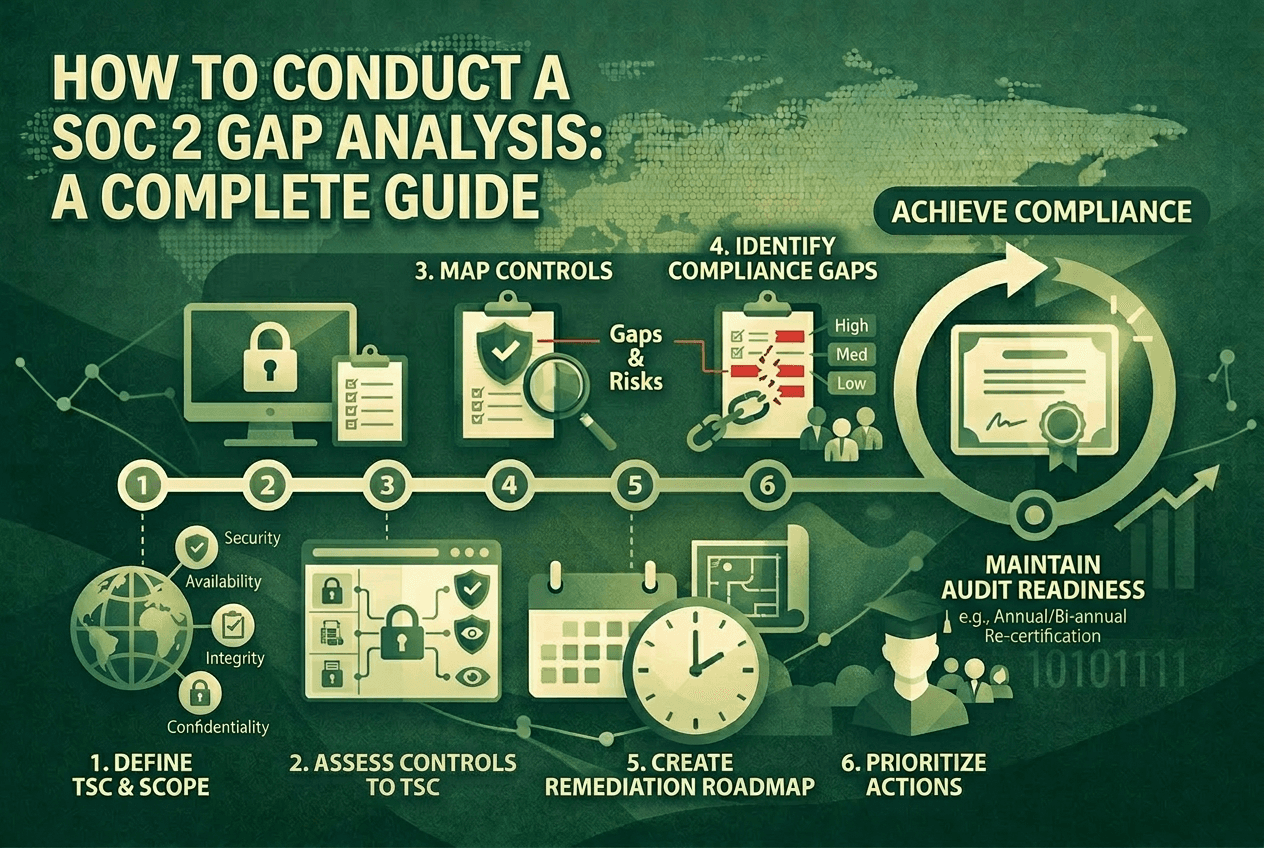
Start with a gap assessment before you begin your formal program. A gap assessment maps your current controls against the SOC 2 Trust Services Criteria you plan to include in scope. It identifies which controls you have, which controls you are missing, and what remediation work is required before you are ready for an audit. For fintech companies with more complex compliance requirements, a gap assessment also identifies where your existing PCI DSS or other compliance work can be leveraged to satisfy SOC 2 criteria, reducing duplicated effort.
Choose your audit period deliberately. SOC 2 Type II covers a defined audit period — typically six to twelve months. The controls you implement and the evidence you collect during that period will be tested by your auditor. Starting your audit period before your controls are fully implemented and operating consistently is a common mistake that results in control exceptions. Give yourself enough time after remediation to operate your controls consistently before the audit period begins.
Invest in your system description. The system description section of your SOC 2 report covers your company, services, infrastructure, and controls. Financial services buyers read this section to understand your environment. A well-written, accurate, specific system description that reflects your actual architecture signals professionalism and transparency. A generic, sparse description that could apply to any company is a missed opportunity.
Make continuous maintenance a designed operational process, not an audit scramble. SOC 2 Type II requires evidence that controls operated throughout the audit period — not just during an evidence collection sprint before the audit window opens. Access reviews need to happen quarterly. Risk assessments need to happen annually. Vendor security assessments need to be up to date. Employee security training needs to be completed and documented. Build these activities into your operational calendar rather than treating them as one-time compliance tasks.
Use your SOC 2 report actively in your sales process. Make your SOC 2 report available to prospects through a trust center or on request with a streamlined process. Proactively share it in enterprise sales conversations before buyers ask for it. Train your sales team on what the report covers and how to answer common security questions. The fintech companies that close enterprise deals fastest are the ones that make security review friction disappear rather than treating security as a late-stage sales blocker.
The Timeline and Cost Reality for Fintech Companies
Fintech founders frequently underestimate both the time and cost required to obtain a SOC 2 Type II report, particularly when starting from a low control-maturity baseline.
A realistic timeline from decision to the first SOC 2 Type II report is 12 to 18 months for a fintech company starting from scratch. This includes three to six months of remediation and control implementation, a six-to-twelve-month audit period during which evidence is collected, and two to three months for the audit itself and report issuance. Companies that have already implemented strong security practices for PCI DSS or other frameworks can often shorten this timeline by 3 to 6 months, as significant foundational work has already been completed.
SOC 2 Type I is available faster — typically six to nine months from decision — because it is a point-in-time assessment of control design rather than an assessment of control operation over time. Type I is useful for demonstrating progress to buyers who are willing to accept it as an interim credential while Type II is in progress. Most sophisticated financial services buyers will eventually require Type II, but Type I can unblock early enterprise conversations while the full program matures.
The total cost includes more than just the audit fee. The audit fee for a SOC 2 Type II from a reputable CPA firm typically ranges from $20,000 to $60,000, depending on company size, scope complexity, and the auditor. The higher cost for most fintech companies is the internal engineering and security time required to implement missing controls, build evidence collection processes, and maintain the program. A compliance automation platform significantly reduces this internal cost but adds its own subscription fee. Budget realistically for the total program cost, including internal time, platform costs, and audit fees across the full first year.
The fintech companies that struggle with SOC 2 are typically those that underestimated the ongoing operational commitment and treated it as a one-time certification exercise. The ones that succeed are those that build compliance into their operational model from the beginning — with clear ownership, defined processes, and the automation infrastructure to maintain evidence continuously rather than in last-minute audit sprints.
dsalta helps fintech companies build SOC 2 programs designed for the rigor of financial services security reviews — from initial gap assessment through continuous audit readiness and multi-framework compliance.

Explore more SOC 2 articles
Stop losing deals to compliance.
Get compliant. Keep building.
Join 100s of startups who got audit-ready in days, not months.