SOC 2 —
SOC 2 for Startups Raising Series A: The Complete Guide
Your Series A investor or enterprise customer just asked for SOC 2. Here's exactly what to do, how long it takes, what it costs, and how to get audit-ready fast.
Deepika
Getting Started with SOC 2
Share this article


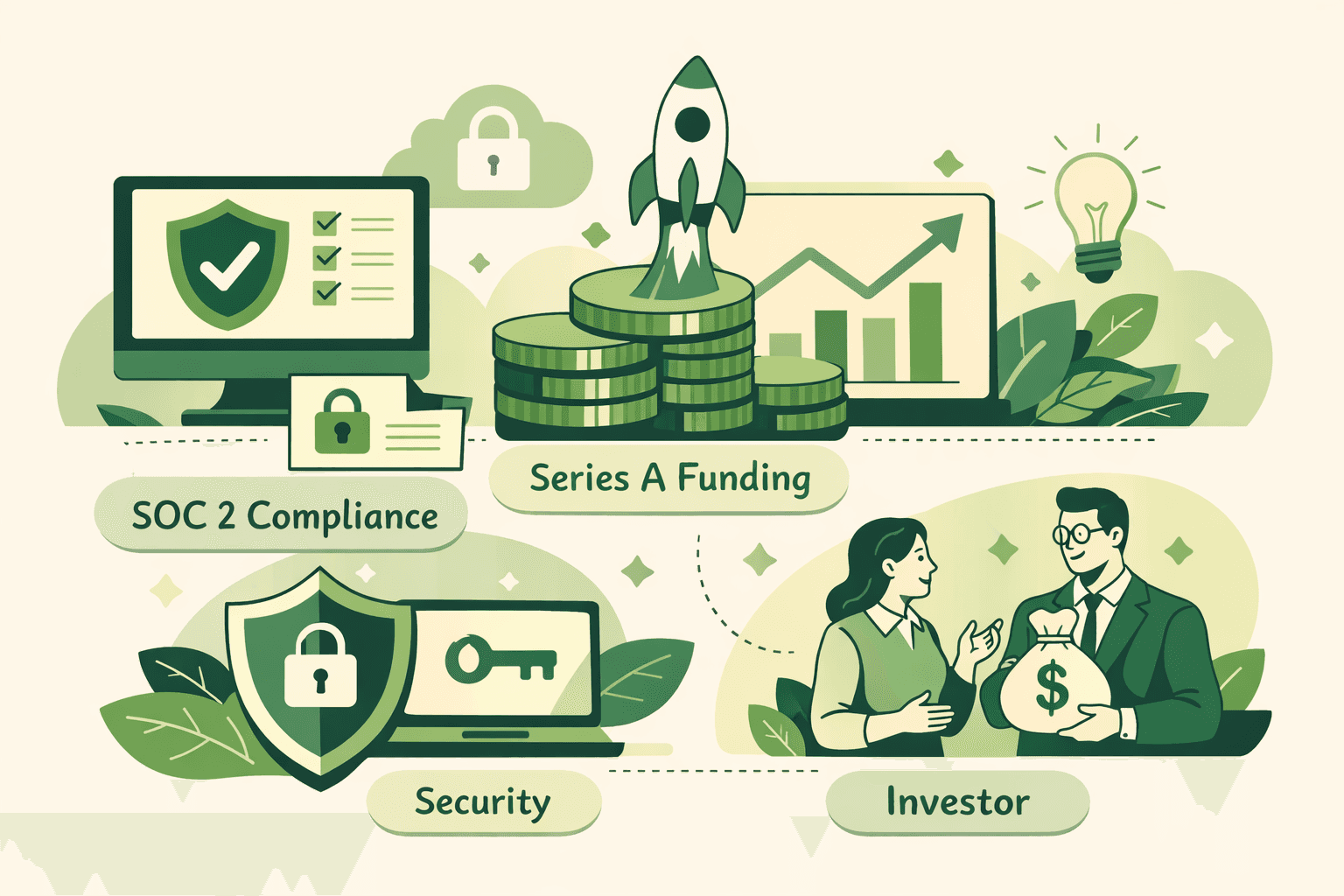
You are here because someone important — an enterprise prospect, a Series A investor, or a strategic partner — just asked for your SOC 2 report, and you do not have one. This happens to almost every B2B SaaS startup between seed and Series A, usually at the worst possible moment: mid-deal, on a timeline you did not choose. The good news is that SOC 2 Type I is achievable in 6 to 10 weeks for a well-prepared startup, and the process is far less disruptive than it sounds if you approach it correctly from the first week. This guide tells you exactly what SOC 2 is, why you are being asked for it right now, what Type I and Type II mean for your situation, what it will cost, and the fastest legitimate path from zero to certification.
Why You Are Being Asked for SOC 2 Right Now
Enterprise procurement teams and institutional investors operate under their own compliance obligations. When a company with a SOC 2 requirement buys software from a vendor that lacks one, it absorbs the vendor's security risk into its own compliance posture. Their auditors will flag that. Their CISO will flag that. Their procurement team has a checklist and SOC 2 is on it.
This is why the ask almost always arrives at the exact moment you are trying to close your most important deal or funding round. It is not a coincidence — it is the moment your prospect or investor decides you are serious enough to actually buy from or invest in. The SOC 2 request is a buying signal. It means you cleared the first cut. Now they need to know if you can clear the security bar.
The other reason this happens at Series A specifically is that institutional investors — particularly those with enterprise SaaS portfolio companies — have seen enough post-investment security incidents to know that a company without a security program is a liability. SOC 2 is not the only measure of security maturity, but it is the most widely recognized, and a clean SOC 2 report signals to a lead investor that your engineering and ops teams can operate with enterprise-grade discipline.
SOC 2 Type I vs Type II: Which One Do You Actually Need
This is the first decision you need to make, and it matters enormously for your timeline.
SOC 2 Type I is a point-in-time assessment. An independent auditor reviews your security controls as they exist on a specific date and issues an opinion on whether those controls are suitably designed to meet the relevant Trust Services Criteria. Type I does not require an observation period — once your controls are in place and documented, you can schedule the audit. For a well-prepared startup, Type I is achievable in 6 to 10 weeks.
SOC 2 Type II is an assessment over a defined observation period — typically 6 or 12 months. The auditor reviews whether your controls were not only suitably designed but also operating effectively throughout the entire period. Type II is the gold standard that most mature enterprise customers ultimately require, but it cannot be rushed because the observation period must elapse.
What this means for your immediate situation: If you need something fast to unblock a deal or satisfy an investor, SOC 2 Type I is the right first move. It is a credible, recognized report that demonstrates your controls are designed correctly and that you take security seriously. Most enterprise procurement teams will accept Type I to proceed with a contract, with the expectation that you will complete Type II within 12 months. Most Series A investors will accept Type I as evidence of security maturity.
If the party asking for SOC 2 specifically requires Type II and will not accept Type I, ask them how long they are willing to wait. If the answer is six months or more, you can start your observation period immediately and be on track. If they need it in 60 days, push back — no legitimate party expects a startup to produce a 12-month observation period report in 60 days, and any advisor telling you otherwise is not being straight with you.
The Five Trust Services Criteria — and Which Ones You Actually Need
SOC 2 is built around five Trust Services Criteria. You do not have to include all five in your audit scope — and for a startup at Series A, you almost certainly should not.
Security (CC) — also called the Common Criteria — covers logical and physical access controls, system monitoring, change management, risk assessment, and incident response. Security is the only mandatory criterion in every SOC 2 report. Every startup going through SOC 2 for the first time includes Security.
Availability (A) covers whether your system is available for operation and use as committed. Include this if your customers have uptime SLAs in their contracts or if availability is a core part of your product value proposition.
Confidentiality (C) covers whether information designated as confidential is protected as committed. Include this if you handle confidential business information — financial data, trade secrets, proprietary customer data beyond standard personal information.
Processing Integrity (PI) covers whether system processing is complete, accurate, timely, and authorized. Include this if your product performs financial transactions, data transformations, or any processing in which errors would have significant downstream consequences.
Privacy (P) covers the collection, use, retention, disclosure, and disposal of personal information. Include this if you handle significant volumes of personal information and privacy is a material concern for your customers.
For most B2B SaaS startups at Series A, the right initial scope is Security plus Availability. This covers 90 percent of what enterprise customers are asking for, keeps the audit scope manageable, and gives you a clean report fast. You can expand the scope to additional criteria in subsequent audits as your product and customer base mature.
What SOC 2 Actually Requires You to Have
The Common Criteria cover nine control categories. Here is what auditors will specifically look for in each one — and an honest assessment of where most early-stage startups have gaps.
CC1 — Control Environment
Auditors look for a demonstrated organizational commitment to security — a written information security policy, defined security roles and responsibilities, background checks for employees with access to production systems, and security awareness training. Most startups have informal versions of these, but lack the documentation auditors need to verify them.
CC2 — Communication and Information
Internal communication about security responsibilities and external communication with customers about security practices. This means your security page, privacy policy, and incident response communication procedures need to exist and be up to date.
CC3 — Risk Assessment
A documented process for identifying security risks to your systems and data, assessing their likelihood and impact, and deciding how to treat them. Most early-stage startups have never written a formal risk assessment. This is typically the most significant documentation gap.
CC4 — Monitoring Controls
Evidence that you monitor whether your controls are working. This includes vulnerability scanning, penetration testing, log monitoring, and periodic control reviews. If you have no monitoring tooling in place, this needs to be implemented and generating evidence before your audit date.
CC5 — Control Activities
The specific technical and operational controls you have implemented to address identified risks. Access controls, encryption, change management procedures, backup and recovery, and vendor management all live here.
CC6 — Logical and Physical Access Controls
How you manage who has access to what in your systems. Multi-factor authentication, role-based access control, access provisioning and deprovisioning processes, and periodic access reviews. This is where most startups have their most genuine gaps — informal access management that worked fine with ten employees breaks down with fifty.
CC7 — System Operations
How do you detect and respond to security events? Alerting configurations, incident response plan, and evidence that you have tested the plan. Most startups have alerting but lack a documented incident response plan and any evidence of testing it.
CC8 — Change Management
How code changes move from development to production. Peer review requirements, testing standards, deployment procedures, and separation of duties where applicable. Modern CI/CD pipelines with pull request reviews satisfy much of this — but they need to be documented.
CC9 — Risk Mitigation
How you manage risk through vendor oversight and other risk mitigation activities. Vendor security assessments and business continuity planning live here.
What SOC 2 Costs for a Series A Startup
The cost of SOC 2 has three components: readiness preparation, tooling, and the audit itself.
Readiness preparation is the work of documenting and implementing your controls before the audit. If you use a compliance platform like DSALTA, the platform guides you through this process with templates, automated evidence collection, and gap tracking. This is significantly faster and cheaper than hiring a consultant to do it manually — and produces better documentation.
Compliance tooling covers the monitoring and evidence-collection infrastructure you need to run continuously — including vulnerability scanning, log aggregation, endpoint detection, and background-check services. Budget $500 to $2,000 per month, depending on your stack size and tooling choices. Most of this infrastructure has security value beyond SOC 2, so it is not pure compliance spend.
The audit itself is conducted by an independent CPA firm with SOC 2 competency. For a Type I audit with Security scope, expect $15,000 to $30,000, depending on the firm and the complexity of your infrastructure. Type II audits run $20,000 to $50,000 at the same firms. Boutique audit firms that specialize in SaaS startups tend to be faster and more cost-effective than Big 4 firms for initial certifications — and the report carries equivalent weight with enterprise customers.
The total cost for a Series A startup doing SOC 2 Type I for the first time typically ranges from $25,000 to $50,000 all-in. That is a significant number, but measured against a single enterprise contract, it unblocks — or the credibility it builds in a funding round — the return calculation is usually straightforward.
The 8-Week SOC 2 Type I Roadmap for Startups
This is the fastest legitimate path from zero to Type I report for a startup with a reasonably modern cloud infrastructure.
Week 1 — Scope and Gap Analysis
Define your audit scope — which systems are in scope, which Trust Services Criteria you are pursuing, and who your auditor will be. Conduct a gap analysis against the Common Criteria to identify exactly what documentation and controls need to be built. If you are using a compliance platform, this process is guided and automatically produces a prioritized remediation checklist.
Do not skip the auditor selection step. Getting a commitment from your auditor in week one means they understand your timeline, can flag scope issues early, and will be ready to schedule when you are prepared. Audit firms with SaaS startup experience will give you honest feedback on your readiness timeline — listen to it.
Weeks 2 and 3 — Policy Documentation
Write the foundational security policies auditors will review. These include your Information Security Policy, Acceptable Use Policy, Access Control Policy, Incident Response Plan, Change Management Policy, Vendor Management Policy, and Business Continuity Plan. These documents do not need to be long — they need to be accurate, consistent with how you actually operate, and signed off by someone with authority.
Most startups underestimate how long this takes when starting from scratch. Templates from a compliance platform significantly accelerate this — your job becomes adapting them to your specific environment rather than writing from scratch.
Week 4 — Technical Control Implementation
Implement the technical controls you identified as gaps in week one. Common items that need to be addressed include enabling MFA across all production systems and admin accounts, configuring centralized log aggregation and alerting, implementing role-based access controls and access review processes, enabling encryption at rest and in transit where not already present, and configuring vulnerability scanning.
This is also the week to run your first vulnerability scan and address any critical or high findings before the audit. Auditors expect to see findings and remediation — a clean scan with no history is less credible than one showing issues identified and resolved.
Week 5 — Evidence Collection
Begin collecting the evidence that your auditor will review. Evidence includes screenshots of security configurations, exported access lists, training completion records, background check confirmations, vendor security assessment documentation, and change management logs. A compliance platform automates much of this collection — integrating directly with AWS, GCP, Azure, GitHub, Okta, and similar tools to pull evidence continuously rather than requiring manual export.
Week 6 — Penetration Test
Commission and complete an external penetration test. Most SOC 2 auditors expect to see penetration test results as supporting evidence for CC4.1 and CC7.x controls. For a startup-scale environment, a scoped web application and network penetration test from a qualified firm typically takes one to two weeks to complete and deliver a report. Schedule this early — good pen test firms book out.
Week 7 — Readiness Review
Conduct a formal internal readiness review — walk through every control in scope and verify that evidence exists, policies are signed, and configurations are correct. Address any remaining gaps. This is your dress rehearsal for the audit.
Week 8 — Stage 1 Audit
Your auditor conducts the Stage 1 documentation review — reviewing your policies, procedures, and control descriptions. They will issue a list of questions and requests for evidence. Respond promptly and completely. The Stage 2 fieldwork typically follows within one to two weeks of Stage 1 completion, after which the auditor issues a draft report for your review before issuing the final report.
The Three Mistakes Startups Make That Delay Their SOC 2
Waiting until a deal requires it. The worst time to start SOC 2 is under deal pressure. The best time was six months ago. The second-best time is now, before an enterprise customer puts it on the table as a condition of contract. Startups that complete SOC 2 proactively — before it is demanded — close enterprise deals faster because they can answer the security questionnaire before it becomes a procurement bottleneck.
Choosing the wrong auditor. Not all CPA firms with SOC 2 competency understand SaaS startup environments. An auditor who primarily works with large enterprises will apply expectations that make no sense for a 20-person startup — and the engagement will be slow, expensive, and frustrating. Choose a firm that regularly works with early-stage SaaS companies and can tell you their average time to report for a startup at your stage.
Treating it as a one-time project. SOC 2 Type I is a milestone, not a destination. Enterprise customers who accept Type I in year one will expect Type II in year two. And the controls you implement for SOC 2 — access management, monitoring, incident response, vendor oversight — only provide real security value if they continue to operate after the audit closes. Build the program to run continuously from day one.
What to Tell Your Investor or Enterprise Customer Right Now
If you are in the middle of a deal and someone just asked for your SOC 2 report, here is the honest, confidence-building answer that experienced founders give:
"We are currently in the process of completing our SOC 2 Type I certification and expect to have our report within [X] weeks. We are happy to share our security documentation and answer any specific questions your security team may have in the meantime. We can also provide a letter from our auditor confirming the audit is underway."
This answer is honest, professional, and demonstrates that you take security seriously. Most enterprise procurement teams and institutional investors will accept this response if the timeline is reasonable — 6 to 10 weeks for Type I — and you follow through with interim documentation that shows genuine security maturity.
What you should not say is that you are working on it without a specific timeline, that you are planning to start soon, or that you can provide something equivalent to SOC 2. These answers raise flags and slow deals down. Commit to a timeline you can deliver and then deliver it.
How DSALTA Accelerates SOC 2 for Series A Startups
DSALTA is built for exactly the situation you are in right now — a startup that needs SOC 2 fast, has limited compliance bandwidth, and cannot afford to get it wrong.
The platform guides you through the entire readiness process with a gap analysis that maps your current controls to the Common Criteria, policy templates that adapt to your specific environment, automated evidence collection that integrates with your existing cloud and engineering tools, and a real-time readiness dashboard that shows you exactly what is done and what remains before you are audit-ready.
For startups pursuing SOC 2 Type I on an aggressive timeline, DSALTA's automation reduces the manual evidence-collection burden by a majority, which is typically what makes the difference between an 8-week path and a 20-week one.
Key Takeaways
SOC 2 Type I can be achieved in 6 to 10 weeks for a well-prepared startup and is the appropriate immediate response when an investor or enterprise customer requests a SOC 2 report. Scope your first audit to Security plus Availability — do not over-scope. The total cost ranges between $25,000 and $50,000 all-in for most Series A-stage companies. Start your auditor selection in week one — do not wait until your controls are ready. And treat the program as continuous from day one so that Type II is a natural extension rather than a second project.
The SOC 2 ask is a buying signal. The right answer is a credible timeline and a visible program — not a delay.
Frequently Asked Questions
How long does SOC 2 take for a startup? SOC 2 Type I typically takes 6 to 10 weeks for a well-prepared startup with a modern cloud infrastructure. SOC 2 Type II requires a minimum observation period of 6 months before the audit can conclude. Most startups complete Type I first, then begin the Type II observation period immediately after.
How much does SOC 2 cost for an early-stage startup? Total cost for a first SOC 2 Type I audit typically runs $25,000 to $50,000 all-in, including readiness preparation, compliance tooling, and audit fees. Type II audits run higher — typically $35,000 to $70,000 — due to the longer engagement period.
Can I get SOC 2 if I am pre-revenue or very early stage? Yes. SOC 2 has no revenue or employee count requirements. What matters is that you have a defined system in scope, implemented security controls, and documentation of those controls. Many pre-Series A startups complete SOC 2 Type I to accelerate enterprise sales.
What is the difference between SOC 2 Type I and Type II? Type I is a point-in-time assessment of whether your controls are suitably designed. Type II assesses whether your controls operated effectively over a defined observation period — typically 6 to 12 months. Type II carries more weight with mature enterprise customers but requires significantly more time to complete.
Will SOC 2 Type I satisfy my enterprise customer or investor? Most enterprise customers and institutional investors will accept SOC 2 Type I to proceed with a contract or investment, with the expectation that Type II follows within 12 months. If a specific party requires Type II immediately, that is an unusual requirement and worth discussing directly with them.
How does DSALTA help startups complete SOC 2 faster? DSALTA automates evidence collection through integrations with AWS, GCP, Azure, GitHub, Okta, and other tools your startup already uses. This eliminates the manual evidence-gathering that typically extends SOC 2 timelines and gives you a real-time view of readiness across every control in scope.
DSALTA is an AI compliance software company helping startups and growing SaaS companies achieve SOC 2, ISO 27001, HIPAA, and GDPR compliance faster. Learn more at dsalta.com.

Explore more SOC 2 articles
Stop losing deals to compliance.
Get compliant. Keep building.
Join 100s of startups who got audit-ready in days, not months.