SOC 2 —
SOC 2 Qualified Opinion: What It Means and How to Prevent It
A SOC 2 qualified opinion can derail enterprise deals. Learn what triggers qualifications, how auditors spot control failures, and how to prevent them.
Dogan Akbulut
Getting Started with SOC 2
Share this article


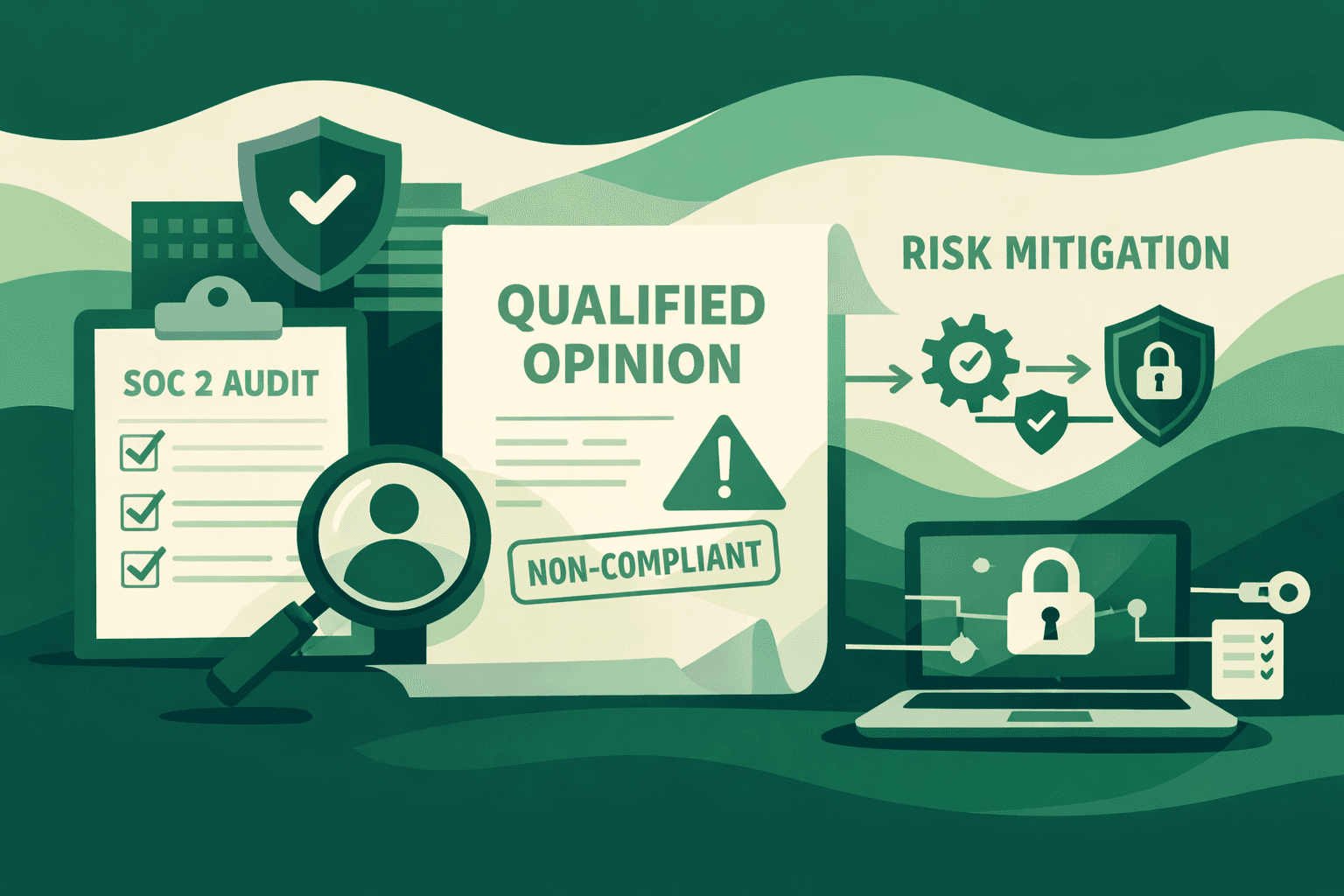
Most organizations preparing for a SOC 2 audit focus on one outcome: an unqualified opinion. They build controls, gather evidence, run readiness assessments, and assume that effort alone is enough. Then the auditor issues a qualified opinion — and suddenly the report they planned to share with enterprise customers becomes a liability instead of an asset.
A SOC 2 qualified opinion is not a catastrophic failure, but it carries real consequences: delayed deal cycles, stalled vendor approval processes, and questions from prospects that are difficult to answer without disclosing exactly what went wrong. Understanding what triggers a qualified opinion, how auditors make that determination, and what you can do before and after the fact is essential knowledge for any compliance-mature organization preparing for SOC2.
What a SOC 2 Opinion Actually Means
When a licensed CPA firm completes a SOC 2 examination, it issues an opinion on whether your system and controls meet the applicable Trust Services Criteria (TSC) over the audit period. That opinion falls into one of four categories: unqualified, qualified, adverse, or disclaimer of opinion.
An unqualified opinion — sometimes called a clean opinion — means the auditor found that your controls were suitably designed and operating effectively, with no material exceptions.
A qualified opinion means the auditor found your controls were generally effective, but identified one or more specific areas where controls were not suitably designed, not operating effectively, or both — and those exceptions were material enough to warrant a formal qualification, but not so pervasive as to require an adverse opinion.
An adverse opinion means controls failed so broadly that the report cannot support any reasonable assurance. A disclaimer means the auditor could not obtain sufficient evidence to form an opinion.
In practice, qualified opinions are the most common departure from a clean report. They represent a middle ground that compliance teams must understand precisely because they are neither catastrophic nor ignorable.
How Auditors Decide to Qualify an Opinion
The determination is not arbitrary. Auditors apply a materiality threshold to evaluate whether an exception or combination of exceptions is significant enough to affect the overall conclusion. Factors that influence this determination include the nature of the control failure (design deficiency versus operating effectiveness failure), the frequency and consistency of the failure, whether compensating controls exist, and the sensitivity of the data or systems involved.
A single isolated incident where a quarterly access review was completed two weeks late is unlikely to qualify as an opinion if all other access governance controls operated effectively. But a pattern of missed access reviews across multiple systems over a twelve-month period, particularly for systems processing sensitive PHI or financial data, is the kind of finding that moves from an exception noted to a qualified opinion.
Design deficiencies — where a control was never properly constructed to address the risk it was meant to mitigate — tend to carry more weight than operating effectiveness failures. Auditors treat a control that was improperly designed as a structural gap, whereas an operating failure may reflect execution breakdowns that management can remediate during the period.
The auditor will typically communicate findings during the audit before issuing the final report. This is the window that compliance teams must use aggressively.
Common Triggers for a Qualified Opinion
Understanding what typically drives a qualification helps organizations prioritize their pre-audit remediation efforts.
Incomplete or inconsistent evidence is one of the most frequent contributors. SOC 2 auditors rely on evidence to verify the operation of controls. If evidence is missing for a material subset of the population — logs that were not retained, screenshots that were not captured, approvals that were not documented — auditors cannot conclude the control operated effectively. The absence of evidence is treated as evidence of absence in an audit context.
Access control failures represent another significant risk category. Controls around least privilege, access provisioning and deprovisioning, privileged access management, and periodic access reviews are central to virtually every SOC 2 engagement. Failures here tend to be recurring and pattern-based, which elevates their significance under materiality analysis.
Vendor management gaps have become increasingly common as organizations scale their technology stacks. If your organization is responsible for monitoring subservice organizations that are relevant to the Trust Services Criteria, and you cannot demonstrate that monitoring occurred consistently, auditors may qualify their opinion on the availability or confidentiality criteria.
Cryptographic and configuration management failures — unpatched systems, misconfigured encryption settings, expired certificates that were not caught through a formal process — tend to be highly visible in technical evidence and difficult to explain away with compensating controls.
Incident response and change management breakdowns round out the most common triggers. If your change management process requires documented testing and approval before production deployment, but evidence shows that emergency changes were deployed without following that process, the auditor must consider whether the exception is isolated or systemic.
The Difference Between an Exception and a Qualified Opinion
Not every control failure results in a qualified opinion. Every SOC 2 Type II report contains an exceptions section where the auditor lists control deviations. These exceptions are noted in the report and visible to anyone who reads it. But a listed exception and a qualified opinion are not the same thing.
A qualified opinion happens when the exception or combination of exceptions crosses the materiality threshold. Most auditors consider whether the exception undermines the overall conclusion that controls were suitably designed and operating effectively. A single low-severity exception in a well-controlled environment does not typically trigger a qualification. A series of exceptions concentrated in a single high-risk area, or a single exception that affected a large percentage of the tested population, may.
This distinction matters because it shapes remediation strategy. Organizations that understand materiality can triage their open findings with greater precision — addressing the exceptions most likely to influence the opinion first, rather than treating all findings as equally urgent.
What Happens After a Qualified Opinion Is Issued
A qualified opinion does not invalidate the report, but it does change how the report is received. Enterprise procurement teams, enterprise risk functions, and large healthcare organizations that require SOC 2 Type II as a vendor requirement will read the opinion section before any other part of the report. A qualification triggers additional scrutiny.
Most organizations in this situation are asked to provide a management response — a formal written explanation of the exceptions, root cause analysis, and remediation steps. A well-constructed management response does not eliminate the qualification, but it demonstrates that the organization identified the issue, understands why it occurred, and has implemented controls to prevent recurrence.
The more important remediation lever is the next audit period. A qualified opinion in the current period can be resolved with a clean opinion in the following period, which is the strongest possible signal to downstream stakeholders. Organizations that receive a qualified opinion should treat the subsequent audit period as their primary remediation window, not merely a continuation of normal operations.
How to Prevent a Qualified Opinion
Prevention requires a different posture than simply running your controls and waiting for the auditor to arrive.
Continuous evidence collection is foundational. Organizations that rely on manual evidence pulls timed to the audit request are at structural risk of gaps. Automated evidence collection — through integrations between your GRC platform and your cloud providers, identity systems, endpoint management tools, and ticketing systems — creates a continuous audit trail that eliminates the most common source of exceptions. When evidence collection is automated, the absence of evidence becomes detectable in real time rather than at the point of auditor review.
Control health monitoring should run throughout the audit period, not just in the weeks before fieldwork. This means establishing internal thresholds for control metrics — access review completion rates, patch SLA compliance, incident response documentation completeness — and tracking performance against those thresholds on an ongoing basis. When a control starts to degrade, the organization catches it before the auditor does.
Scoping discipline reduces qualification risk in a way that is often underappreciated. Many organizations overscope their SOC 2 engagement by including systems, services, or data flows that are difficult to control consistently. A well-defined, well-bounded scope reduces the surface area for exceptions and concentrates the organization's investment in controls where it matters most. Revisiting scope before each audit cycle — particularly as the product and infrastructure change — is a meaningful risk reduction activity.
Mock audits conducted two to three months before the planned audit start provide the most direct pre-audit risk reduction. A thorough internal mock audit tests the quality of evidence, identifies control gaps, and enables the organization to remediate findings before the formal engagement begins. The goal is to ensure that any exception the formal auditor might find has already been found, understood, and addressed internally.
Auditor communication during fieldwork should be treated as an active process, not a passive one. When auditors raise preliminary findings, compliance teams should engage immediately — providing context, identifying compensating controls, and demonstrating remediation where possible. Not all preliminary findings will influence the opinion, but engaging with them seriously signals a mature control environment and may affect how the auditor weighs marginal exceptions.
Rebuilding Confidence After a Qualified Opinion
Organizations that receive a qualified opinion and treat it as a data point rather than a verdict tend to recover most effectively. The qualified opinion reflects performance during a specific period. It does not permanently define the organization's control posture.
A structured remediation plan — mapped to the specific exceptions cited, with assigned owners, target completion dates, and measurable milestones — provides the foundation for the next audit cycle. That plan should be operationalized in the GRC platform, not managed in a spreadsheet, so that evidence of remediation is automatically captured as controls are executed.
Transparency with existing customers and prospects requires judgment. In many cases, the right approach is to proactively provide context alongside the report — explaining the exceptions, the root causes, and the remediation steps taken — rather than allowing the qualified opinion to speak for itself. Most sophisticated procurement teams have seen qualified opinions and evaluate the management response as carefully as the opinion itself.
The Larger Lesson for Compliance-Mature Organizations
A SOC 2 qualified opinion is ultimately a signal that the audit process is working as designed. The examination is meant to surface real control gaps, not simply validate the controls that an organization chose to document. Organizations that treat the audit as a genuine test of their control environment — rather than a documentation exercise — build the kind of compliance infrastructure that sustains clean opinions over time.
The technical infrastructure required to support that posture — continuous control monitoring, automated evidence collection, real-time exception alerting, integrated audit workflows — is what separates organizations that consistently achieve unqualified opinions from those that manage audit outcomes reactively.

Explore more SOC 2 articles
Stop losing deals to compliance.
Get compliant. Keep building.
Join 100s of startups who got audit-ready in days, not months.