SOC 2 —
How to Build a SOC 2 Type II–Ready Contract Repository in 90 Days
Build a SOC 2 Type II–ready contract repository in 90 days. Includes AI-powered templates for MSAs, DPAs, BAAs, and security addenda.
Jon Ozdoruk
Getting Started with SOC 2
Share this article


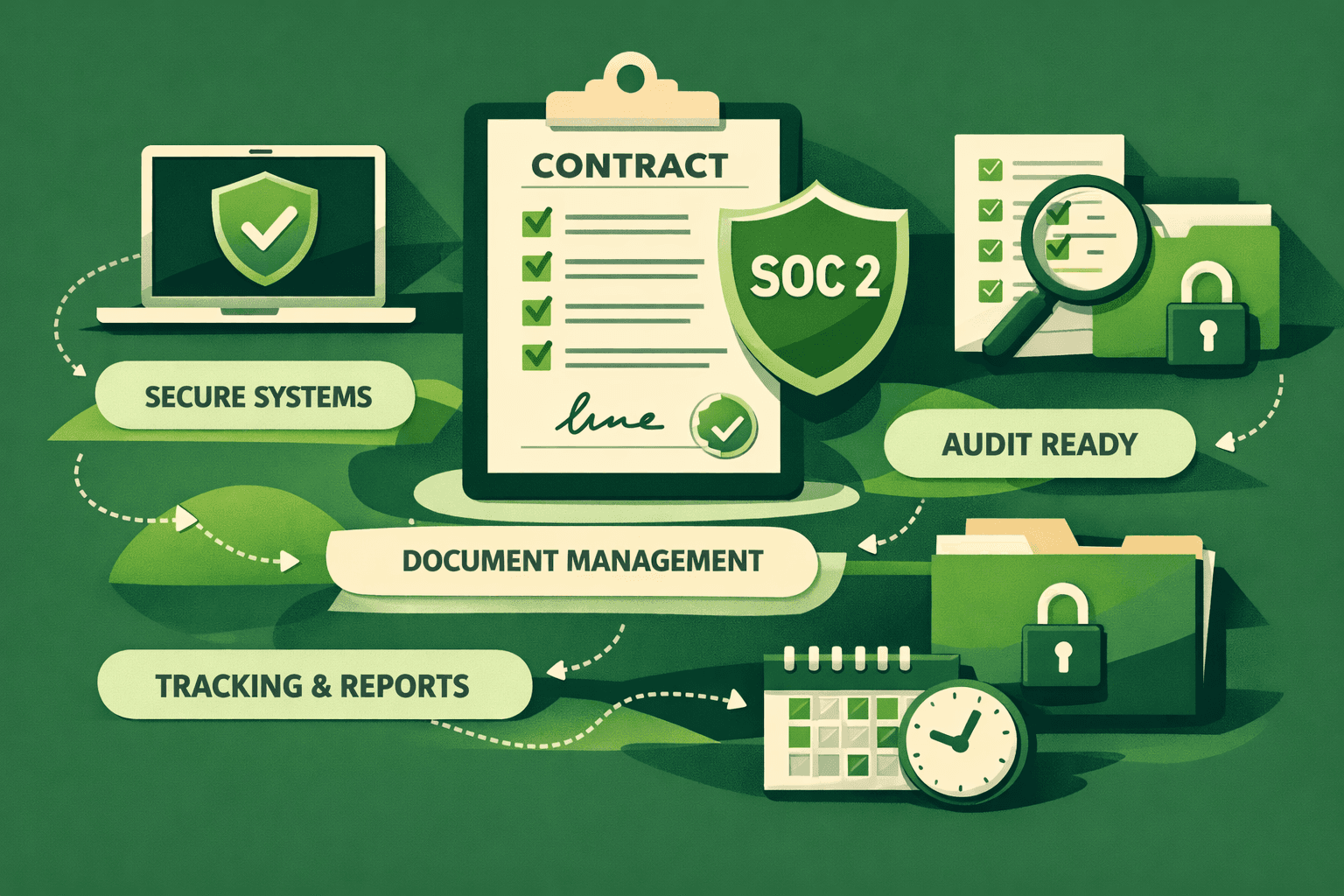
If your SaaS company is preparing for a SOC 2 Type II audit, your contract repository is one of the first things auditors scrutinize. Yet most legal and RevOps teams are still managing MSAs, DPAs, BAAs, and security addenda across disconnected folders, email threads, and spreadsheets — a setup that all but guarantees audit findings, compliance gaps, and deal-slowing delays.
The good news: you can build a SOC 2 Type II–ready contract repository in 90 days — without a six-figure CLM implementation or a full legal ops overhaul.
This guide walks SaaS legal, RevOps, and security/compliance leads through every phase: architecture, access control, encryption standards, audit logging, and continuous monitoring. You'll leave with a proven framework and downloadable templates to hit the ground running.
What Is a SOC 2 Type II–Ready Contract Repository?
A SOC 2 Type II–ready contract repository is a centralized, access-controlled system for storing, versioning, and auditing contracts that contain sensitive data obligations — primarily MSAs, DPAs, BAAs, and security addenda.
Unlike a basic contract folder or a generic cloud drive, an audit-ready repository is built around the five SOC 2 Trust Services Criteria:
Security — Access to contract data is restricted, monitored, and logged
Availability — The repository is reliably accessible to authorized users
Processing Integrity — Contract workflows execute accurately and completely
Confidentiality — Sensitive clauses (e.g., liability caps, data processing terms) are protected
Privacy — Personal data commitments in DPAs and BAAs are enforced and traceable
When your repository is built to these standards, you're not just passing an audit. You're building the operational foundation that scales with your security posture and supports enterprise sales cycles, in which security questionnaires ask exactly these questions.
Why SaaS Legal & RevOps Teams Are the Audit's Weakest Link
In most SaaS organizations, contracts live in three to five disconnected systems: a CRM, a shared drive, an email archive, a CLM tool, and someone's desktop. By the time an auditor asks for "all active DPAs with sub-processor lists," your team is scrambling.
Here's where compliance breaks down most often:
The Three Failure Points Auditors Find Every Time
1. No RBAC (Role-Based Access Control) on contract data. Sales reps often have read access to DPAs and BAAs that contain customer PII obligations. This violates the principle of least privilege — a core SOC 2 requirement.
2. Missing audit logs on contract access and changes. If you can't prove who accessed a contract, when they accessed it, and what they changed, you have no audit trail. Auditors don't accept "we trust the team."
3. Unversioned security addenda Enterprise customers send redlined security addenda — and most SaaS teams accept, sign, and store only the final version. When an auditor asks, "What obligations did you agree to in March?" you need version history, not memory.
The 90-Day Build Plan: Phase-by-Phase Breakdown
Phase 1 (Days 1–30): Audit, Architect, and Access-Control
Step 1: Inventory your current contract estate
Before you build, you need to know what you have. Pull every active contract that contains data processing obligations:
MSAs with data protection clauses
DPAs (Data Processing Agreements) with GDPR/CCPA controllers and processors
BAAs (Business Associate Agreements) for any HIPAA-covered customers
Security addenda with specific technical control requirements
NDA and confidentiality agreements with data handling provisions
Create a master contract registry — a structured spreadsheet or CLM intake form — that captures the following: contract type, counterparty, execution date, expiration date, governing law, data categories processed, and assigned owner (legal, security, RevOps).
Step 2: Define your RBAC matrix
This is the step most teams skip, and it's the one auditors go straight to. Define four permission tiers:
Role | Access Level | Example Users |
|---|---|---|
Contract Owner | Read + Edit + Version | Legal Counsel, VP Legal |
Reviewer | Read + Comment | Security Lead, RevOps Manager |
Requester | Submit + Status View | AE, CS Manager |
Auditor | Read-Only (Full) | External Auditor, Compliance Officer |
Document this matrix in writing. It becomes an exhibit in your SOC 2 evidence package.
Step 3: Select your repository architecture
You have three practical options for a SaaS team at scale:
AI-native contract platforms (like DSALTA's compliance workflow layer) — best for teams that need automated obligation extraction, risk flagging, and audit-trail generation out of the box
CLM tools with SOC 2 modules (e.g., Ironclad, Contractbook) — good coverage but often require customization for security addenda workflows
Enhanced SharePoint/Google Drive with governance overlays — lowest cost, highest operational lift; acceptable for early-stage companies
Whatever you choose, the repository must support: encryption at rest and in transit, version control with timestamped change logs, single sign-on (SSO) with MFA enforcement, and exportable audit logs - all key SOC 2 controls to know.
Phase 2 (Days 31–60): Build Your Contract Templates and Workflows
This is where Legal and RevOps alignment becomes critical. The goal is to standardize your contract templates so that every agreement entering your repository meets a minimum security and compliance baseline before execution.
The Four Core Templates Every SaaS Team Needs
Template 1: Data Processing Agreement (DPA)
Your DPA must address:
Categories of personal data processed (with explicit enumeration)
Legal basis for processing under GDPR Article 6 / CCPA
Sub-processor list with notification procedures for additions
Data subject rights fulfillment timelines (30-day default)
Data retention and deletion schedules
Security measures (must reference your SOC 2 controls framework by name)
Cross-border transfer mechanisms (SCCs, adequacy decisions)
SOC 2 audit tip: Attach your current security certification or attestation as an exhibit. Auditors want to see that your DPA commitments are backed by documented controls, not just language.
Template 2: Business Associate Agreement (BAA)
If any of your customers are covered entities under HIPAA — healthcare providers, health plans, healthcare clearinghouses — or business associates themselves, you need a fully compliant BAA before you process any PHI.
Your BAA template should include:
Permitted uses and disclosures of PHI
Safeguards (administrative, physical, and technical — mirroring your SOC 2 security controls)
Breach notification timelines (60-day HIPAA requirement; many enterprises demand 30 days)
Subcontractor/sub-BA flow-down obligations
Return or destruction of PHI upon termination
Template 3: Security Addendum (Inbound)
Enterprise customers — especially financial services, healthcare, and public sector — will send you their own security addenda. These documents are where your compliance risk concentrates. They often contain:
Specific encryption standards (AES-256, TLS 1.2+)
MFA requirements for all personnel with data access
Penetration testing frequency and report-sharing obligations
Right-to-audit clauses
Specific SLA requirements for incident notification
Build a security addendum intake checklist that routes each inbound addendum through a legal-security review workflow before it is signed. Tag every accepted obligation in your registry so you can pull a real-time obligations dashboard at any time — especially useful when auditors ask, "Show me all active pen test obligations."
Template 4: Master Service Agreement (MSA) with Security Rider
Your standard MSA should include a security rider that:
Incorporates your SOC 2 controls by reference
Specifies your data handling obligations
Defines acceptable use limitations
Includes mutual indemnification for data breaches
References your DPA as an operative exhibit
Having your MSA and DPA as linked, co-executed documents (rather than separate negotiations) dramatically streamlines enterprise sales cycles — and makes your audit evidence package clean.
Building the Intake-to-Execution Workflow
Map every contract from request to repository:
Request intake — Requester submits contract type, counterparty, and deal details via a structured form
Template selection — Legal selects appropriate template; security addenda trigger auto-routing to security review queue
Negotiation tracking — All redlines tracked in version-controlled workspace; no side-channel email changes
Approval gate — Minimum two-party approval (Legal + Security for DPAs/BAAs/addenda)
Execution — E-signature with timestamp logged to audit trail
Repository filing — Auto-tagged by contract type, counterparty, data categories, expiration date
Obligation extraction — Key obligations (notice periods, audit rights, deletion timelines) extracted and added to the obligations register
This workflow is the backbone of your continuous monitoring program — which brings us to Phase 3.
Phase 3 (Days 61–90): Continuous Monitoring, Audit Logging, and Evidence Packaging
The most common misconception about SOC 2 Type II is that it's a point-in-time assessment. It isn't. Type II covers a minimum 6-month observation period. Auditors aren't just checking whether your controls exist — they're checking whether they operated continuously.
Your contract repository needs to demonstrate operational continuity across three dimensions:
1. Audit Logging
Every action in your contract repository should generate an immutable log entry capturing:
User identity (tied to SSO/IdP)
Action type (view, download, edit, share, delete)
Timestamp (UTC)
Document identifier and version
IP address and device
These logs must be tamper-evident and retained for at least 12 months (many enterprise security addenda require 24 months). Export your logs monthly into your evidence repository — don't wait for auditor requests.
2. MFA Enforcement Verification
MFA is one of the most commonly tested SOC 2 controls — and one of the most commonly failed. For your contract repository specifically:
Enforce MFA at the IdP level, not the application level (so it can't be bypassed)
Run a monthly access review to confirm no accounts have MFA disabled
Document exceptions with formal risk acceptance sign-offs
Include MFA enforcement evidence in your quarterly compliance report
3. Encryption Verification
Auditors will ask for evidence that data is encrypted at rest and in transit. For your contract repository, document:
Encryption standard (AES-256 at rest; TLS 1.2+ in transit)
Key management process (who controls keys, rotation schedule)
Third-party attestation (your repository vendor's SOC 2 report or ISO 27001 certification)
If you're using an AI-powered compliance platform like DSALTA, encryption verification can be automated — the platform continuously monitors your encryption configuration and flags deviations before they become audit findings. Discover how AI automates SOC 2 and HIPAA compliance.
Building Your Evidence Package
By Day 90, your audit evidence package for contract repository controls should include:
RBAC matrix (current, signed by CISO or VP Legal)
Contract registry with all active MSAs, DPAs, BAAs, and security addenda
Obligations register with extraction methodology
Intake-to-execution workflow documentation
Audit logs (last 90 days minimum)
MFA enforcement evidence (screenshot + IdP policy export)
Encryption configuration documentation
Vendor SOC 2 report for your repository platform
Access review records (monthly)
Security addendum review and approval records
How AI Compliance Platforms Like DSALTA Accelerate the 90-Day Build
Manual contract repository builds work, but they are operationally expensive and fragile. A single personnel change, a missed DPA renewal, or an unreviewed security addendum can introduce material compliance risk that won't surface until your auditor's fieldwork.
AI compliance platforms change the equation in three ways:
Automated obligation extraction: Instead of manually reading every DPA and security addendum, AI extracts key obligations, notice timelines, deletion requirements, and audit rights and populates your obligations register automatically. This reduces extraction time from days to minutes and eliminates the human error that makes manual registers unreliable.
Continuous control monitoring: Rather than point-in-time snapshots, AI platforms monitor your repository controls in real time, flagging when MFA is disabled for a user, when an encryption configuration drifts, or when a contract approaches expiration without a renewal workflow initiated.
Audit-ready evidence generation: Instead of assembling evidence packages manually under audit pressure, AI platforms generate exportable evidence reports on demand, formatted to SOC 2 control mappings, timestamped, and ready for auditor review.
For SaaS teams managing rapid growth where new enterprise customers bring new security addenda every week, and the compliance surface expands, this automation isn't a luxury. It's operational leverage.
Common Mistakes SaaS Teams Make (And How to Avoid Them)
Mistake 1: Treating the DPA as a legal formality
Your DPA is an operational commitment. Every sub-processor you add, every new data category you process, every new cross-border transfer mechanism you adopt needs to be reflected in your DPA — and communicated to customers if your DPA includes notification obligations. Build a DPA change management process before you need it.
Mistake 2: Accepting security addenda without an obligations intake process
Security addenda accepted without a structured review process create hidden compliance debt. You may have agreed to quarterly pen tests, 24-hour breach notification, or specific encryption standards in an addendum signed 18 months ago — and have no operational process to meet those obligations. An obligations register surfaces this risk before your auditor does.
Mistake 3: Version-controlling the contract but not the obligation
Contracts get updated. Sub-processor lists change. DPA terms get renegotiated. Your obligations register needs to reflect the current state of your commitments — not just the original executed document. Link every obligation to its source document version so you can always answer "what did we agree to, and when?"
Mistake 4: Siloing contract compliance from your security program
Your SOC 2 auditor will test the connection between your contractual commitments and your operational controls. If your DPA commits to AES-256 encryption but your security team has documented a different standard, you have a finding. Legal and Security need to review each other's work at least quarterly. Learn how to align your SOC 2 compliance documentation with operational controls."
Your 90-Day Contract Repository Checklist
Days 1–30: Foundation
Complete contract estate inventory
Build master contract registry
Define and document the RBAC matrix
Select repository platform
Configure SSO + MFA enforcement
Establish audit logging
Days 31–60: Templates and Workflows
Finalize DPA template
Finalize BAA template
Build a security addendum intake checklist and review workflow
Update MSA with security rider
Map and document the intake-to-execution workflow
Begin obligations register population
Days 61–90: Monitoring and Evidence
Validate audit log completeness and retention
Run first access review; document results
Verify encryption configuration; obtain vendor attestation
Complete obligations register
Assemble the first evidence package
Conduct an internal readiness review with the security lead
Conclusion: The Contract Repository Is Your Compliance Backbone
For SaaS companies pursuing SOC 2 Type II, the contract repository is not a back-office function — it's a core compliance infrastructure. MSAs, DPAs, BAAs, and security addenda contain your company's most material data obligations, and your ability to demonstrate that those obligations are tracked, honored, and auditable is what separates companies that pass audits from companies that collect findings.
The 90-day framework in this guide gives Legal, RevOps, and Security teams a structured path from scattered contracts to a fully audit-ready repository — built on RBAC, encryption, MFA, audit logging, and continuous monitoring.
DSALTA helps SaaS teams accelerate this build with AI-powered obligation extraction, automated control monitoring, and on-demand generation of audit evidence. Whether you're preparing for your first SOC 2 Type II audit or hardening an existing compliance program ahead of enterprise deals, DSALTA's platform turns your contract repository from a liability into a competitive advantage.
Ready to build your SOC 2 Type II–ready contract repository? Book a 30-minute assessment with our compliance team

Explore more SOC 2 articles
Stop losing deals to compliance.
Get compliant. Keep building.
Join 100s of startups who got audit-ready in days, not months.