SOC 2 —
SOC 2 Vendor Risk Automation: Close Third-Party Gaps
Vendor risk is the #1 SOC 2 audit failure point. Here's how SOC 2 automation tools handle third-party assessments, evidence collection, and real-time monitoring.
Deepika
Getting Started with SOC 2
Share this article


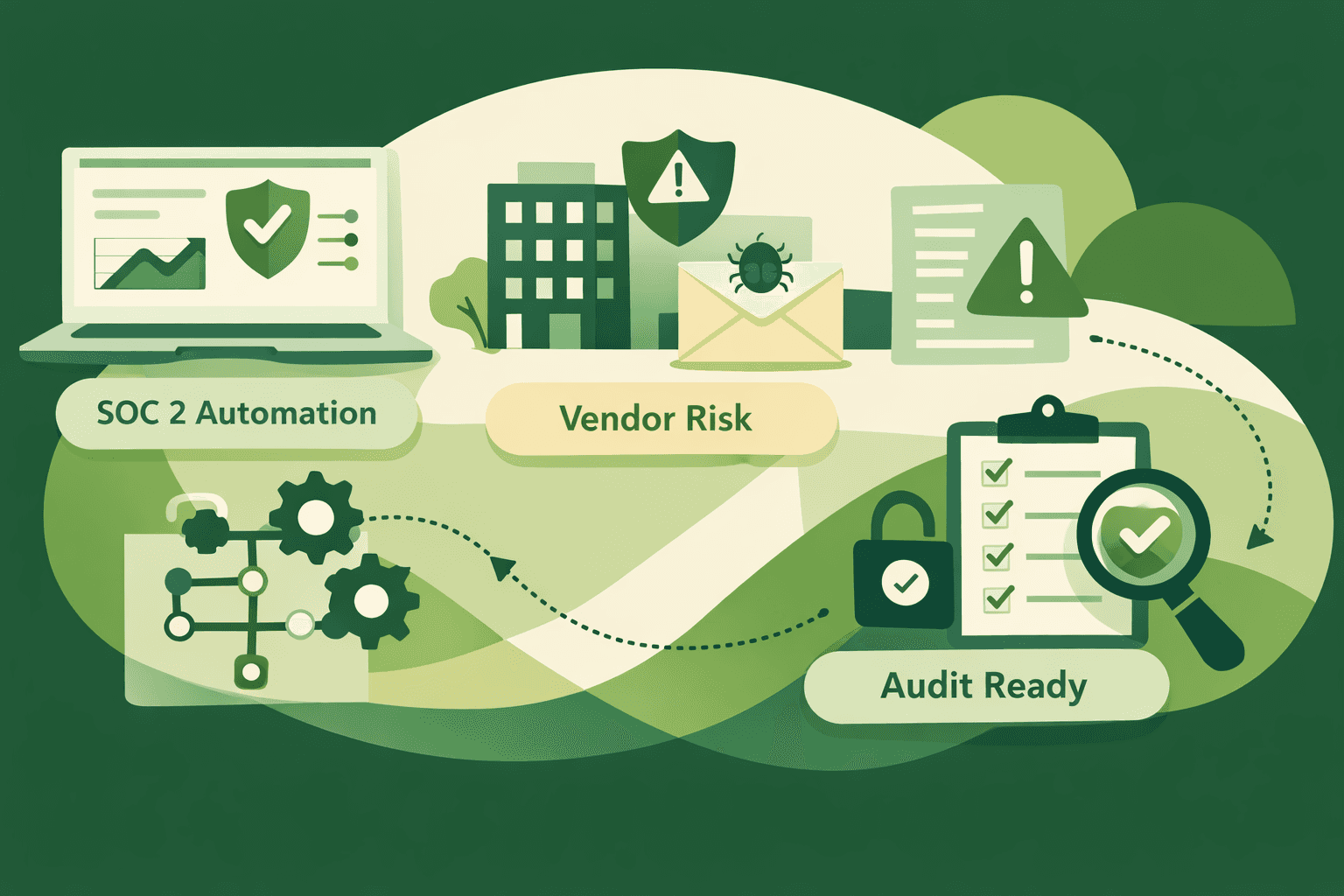
You've automated your access reviews. Your cloud infrastructure monitors itself. Your policy library is stamped and version-controlled. You feel audit-ready right up until your auditor pulls the vendor inventory and asks: "Can you show continuous monitoring evidence for your critical third-party providers?"
This is the moment most SOC 2 programs stumble. Not on access controls or encryption. On vendor risk.
Third-party gaps are among the top audit findings year after year. Mastering third-party risk management is critical to SOC 2 success. The Trust Services Criteria don't just ask whether you have a vendor list; they require documented risk tiering, evidence of due diligence, and proof that vendor controls are periodically reviewed. Manual spreadsheets and once-a-year questionnaires don't satisfy that bar. SOC 2 automation for vendor risk management does.
This guide explains exactly where vendor risk intersects with SOC 2 compliance requirements, which controls can and should be automated, and how modern SOC 2 compliance software makes continuous third-party monitoring possible without doubling your team's workload.
Why Vendor Risk Is a SOC 2 Problem, Not Just a Procurement Problem
What the TSC Actually Requires
SOC 2 is built on the AICPA's Trust Services Criteria. The Availability, Confidentiality, and especially Common Criteria categories contain explicit requirements that reach outside your organization's walls:
CC9.2 — The entity assesses and manages risks associated with vendors and business partners
CC2.1 — Information about vendor-related risks is communicated internally
CC6.1 — Logical access controls extend to third-party system access
A1.2 — Environmental protections include monitoring of vendors supporting the availability
Failing any of these doesn't just affect your vendor risk score — it affects your SOC 2 opinion. A qualified or adverse finding on vendor controls is a significant red flag for enterprise customers during due diligence. Learn more about common SOC 2 audit findings and how to fix them before your auditor arrives.
The Scope Problem Most Startups Underestimate
For most SaaS companies, 60–80% of production infrastructure is owned or operated by third parties. Cloud providers, CDNs, identity platforms, data processors, payment systems — each is a potential vector for the data your SOC 2 covers. Your auditors know this. If you can't demonstrate that you've assessed these vendors' controls and tracked their compliance posture over time, you have an evidence gap — the kind that delays audit sign-off or generates management letter findings.
The Manual Approach: Why Spreadsheets Break at Scale
The traditional TPRM workflow looks like this:
Send security questionnaires via email
Wait weeks for responses (if they come at all)
Manually score responses in a spreadsheet
File the spreadsheet and revisit it at next year's audit
Scramble to reassemble evidence when the auditor arrives
This approach has four fatal flaws in the context of SOC 2. To understand the hidden costs of manual compliance, consider these critical gaps:
1. Point-in-time snapshots don't satisfy continuous monitoring requirements. SOC 2 Type II audits cover a period — typically 6 or 12 months. A single annual questionnaire proves nothing about your vendor's security posture in month three.
2. Manual questionnaires can't scale with your vendor footprint. A startup with 30 SaaS integrations and 10 infrastructure vendors is managing 40 risk relationships manually. That's not a compliance program — it's a documentation exercise that breaks the moment someone leaves the team.
3. Evidence collection is disconnected from your audit package. When your auditor requests CC9.2 evidence, "here's a folder of PDFs from vendors" isn't the same as a timestamped, structured audit trail that shows when assessments were completed, who reviewed them, and what remediation actions were taken.
4. There's no real-time alert when vendor risk changes. A vendor's SOC 2 report expires. A new CVE hits a tool in your stack. A subprocessor gets acquired. None of these triggers a spreadsheet update automatically.
SOC 2 Automation for Vendor Risk: What It Actually Automates
Modern SOC 2 automation platforms do much more than collect audit evidence. Discover how AI automates SOC 2 and HIPAA compliance from manual spreadsheets to audit-ready in weeks.
1. Automated Vendor Intake and Risk Tiering
Instead of manually classifying vendors, automation pulls in context — data access levels, processing volume, criticality to uptime — and automatically assigns a risk tier (critical, high, medium, low). This determines assessment frequency and depth. Critical vendors get quarterly reviews; low-risk tools get annual ones. The platform enforces the cadence, not your team's memory.
2. Continuous Monitoring, Not Annual Questionnaires
This is the biggest gap SOC 2 automation closes. Rather than relying on vendor self-reported questionnaires, platforms use:
Security rating feeds — continuously scored based on exposed infrastructure, certificate health, open ports, DNS hygiene, and breach history
SOC 2 report expiry tracking — automated alerts when a vendor's Type II report is approaching expiration or has lapsed
Subprocessor and trust center scraping — monitoring vendor-published security pages for policy changes
This produces the continuous monitoring evidence trail that CC9.2 requires — timestamped, automated, auditor-ready.
3. Automated Evidence Collection via Integration
The best SOC 2 compliance platforms don't just accept document uploads — they pull evidence directly from your stack:
AWS / GCP / Azure — third-party access configurations, IAM role reviews, shared responsibility scope
Identity providers — who has access to which vendors, and whether MFA is enforced
MDM and endpoint management — device compliance for systems that touch vendor-integrated data
For vendor risk specifically, this means evidence about your controls over vendor access is collected automatically not manually assembled before each audit.
4. Security Questionnaire Automation
When you do need to send questionnaires (for custom vendors, new critical partners, or M&A diligence), automation platforms eliminate the email-and-wait loop. Features include:
Pre-built questionnaire templates mapped to SOC 2 trust service criteria
Vendor portal for structured, tracked responses (not email attachments)
AI-assisted review that flags incomplete or non-compliant answers
Response history for year-over-year comparison
This compresses questionnaire cycles from weeks to days — one of the most meaningful ways SOC 2 automation reduces audit prep time.
5. Risk Remediation Workflows and Real-Time Alerts
Finding a gap is only half the job. SOC 2 automation platforms close the loop by:
Assigning remediation tasks to owners (security team, procurement, vendor contact)
Setting SLA deadlines and escalating overdue items
Logging all activity for the audit trail
Sending real-time alerts when vendor posture drops below your defined threshold
This creates a documented, defensible record showing that your organization acted on identified vendor risks — not just identified them.
SOC 2 Automation vs. Manual Compliance: The Vendor Risk Edition
Let's compare the two approaches across the dimensions that matter most for a SOC 2 audit:
Dimension | Manual / Spreadsheets | SOC 2 Automation Platform |
|---|---|---|
Evidence continuity | Annual snapshots | Continuous, timestamped logs |
Questionnaire turnaround | 2–6 weeks | 2–5 days (vendor portal) |
Audit prep time | 4–8 weeks of manual assembly | On-demand audit package |
Real-time risk visibility | None | Live dashboard with alerts |
Scalability | Breaks at ~30 vendors | Scales to hundreds |
Auditor collaboration | Email threads and shared folders | In-platform auditor portal |
Cost over time | Low upfront, high in labor | Higher SaaS cost, lower total effort |
For SaaS startups moving from spreadsheets to a compliance platform, the vendor risk module often delivers the fastest ROI — because it's the area where manual effort is highest, and audit risk is greatest.
How to Automate Vendor Risk for SOC 2: A Step-by-Step Approach
Step 1: Build Your Vendor Inventory (Complete It — Don't Approximate It)
Your audit scope requires a complete list of vendors that handle or could affect the security of in-scope data. This means:
All SaaS tools with production data access
All infrastructure providers (IaaS, PaaS, CDN)
All subprocessors named in your privacy policy
Any tool with SSO or API access to core systems
Automation platforms can assist discovery by scanning your SSO directory, OAuth grants, and cloud billing accounts. Missing vendors are common audit findings — don't leave gaps here. Use our comprehensive vendor risk management checklist to ensure nothing slips through.
Step 2: Tier Your Vendors by Risk
Not every vendor needs a quarterly review. Use a tiering model:
Critical: Handles PHI, PII, or financial data; or is a single point of failure for availability
High: Has production system access; processes customer data
Medium: Business process tools with limited data access
Low: No data access; minimal integration
Your automation platform should automatically enforce different evidence cadences per tier.
Step 3: Establish Your Baseline Evidence Set
For each vendor tier, define what "evidence of due diligence" looks like:
Critical: Current SOC 2 Type II report (within 12 months), completed questionnaire, DPA executed, quarterly security rating reviewed
High: SOC 2 report or equivalent, annual questionnaire, DPA
Medium: Annual questionnaire or security attestation, DPA where applicable
Low: Attestation on file; periodic spot checks
Encode these requirements in your automation platform so it can track completion and flag gaps.
Step 4: Enable Continuous Monitoring
Connect your platform to security rating feeds. Set alert thresholds—for example, alert if any critical vendor falls below a defined score, if their certificate lapses, or if a CVE is published that affects their primary product.
This is what separates genuine continuous compliance from annual checkbox exercises — and it's what auditors increasingly expect as Type II evidence.
Step 5: Automate the Questionnaire Cycle
Build your questionnaire templates once, mapped to your vendor tiers. Set automated reminders for annual or quarterly reassessment. Use the vendor portal to receive and track responses. Review AI-flagged responses before logging completion.
The output is a structured, timestamped evidence record that maps directly to CC9.2 — auditor-ready without manual assembly.
Step 6: Close Remediation Loops Before the Audit Window
The worst time to discover a vendor hasn't responded to your questionnaire is during audit fieldwork. Set SLA-based escalation so that:
Non-responses trigger follow-up at 7 days and 14 days
Expired SOC 2 reports trigger procurement to request updated reports
Failed security ratings trigger a formal risk acceptance or compensating control documentation
This creates the closed-loop evidence that distinguishes a mature compliance program from a reactive one. Implement continuous compliance monitoring for real-time risk management.
Common Vendor Risk Gaps That Detail SOC 2 Audits
Based on recurring audit findings, here are the vendor risk control failures most likely to generate findings or delay your audit opinion:
1. No formal risk tiering methodology. If you can't explain how you determined that Vendor A is critical and Vendor B is medium, your assessor will note the gap.
2. Stale or expired vendor SOC 2 reports. Relying on a Type II report that's 18 months old doesn't meet continuous monitoring requirements. Track expiry dates and automate renewal requests.
3. Missing DPAs for data-processing vendors. Required for GDPR alignment and increasingly for confidentiality criteria evidence. Automation platforms can track DPA status and flag missing agreements.
4. No evidence of follow-up on identified findings. Finding a risk and doing nothing about it, documented, is worse than not finding it at all. Remediation workflows are essential.
5. Vendor inventory doesn't match your data flow diagram. If your DFD shows data flowing through a vendor that isn't in your inventory, expect questions. Automation discovery tools help close this gap.
6. No process for vendor offboarding. CC6.2 covers termination of access. If departed vendors retain data access credentials, that's both a control failure and an audit finding.
Choosing the Right SOC 2 Automation Platform for Vendor Risk
Not all SOC 2 compliance tools handle vendor risk equally. When evaluating platforms, look for:
Depth of TPRM functionality:
Does it support risk tiering with customizable criteria?
Does it have a vendor portal for questionnaire management?
Does it integrate with security rating providers?
Does it track SOC 2 report expiry and DPA status?
Evidence quality:
Does evidence collection produce auditor-ready artifacts, or just internal dashboards?
Is the evidence timestamped and tamper-evident?
Can you export a structured audit package?
Workflow automation:
Are remediation tasks assignable with SLAs?
Are alerts configurable by vendor tier and risk threshold?
Does the platform integrate with your ticketing system?
Auditor collaboration:
Does it have a dedicated auditor portal, or do you export and share manually?
Can your auditor query evidence directly, or do you answer requests manually?
Framework coverage:
If you're also pursuing ISO 27001, HIPAA, or GDPR, vendor risk controls overlap significantly. A multi-framework platform avoids duplicating effort.
SOC 2 Automation for Specific Verticals: Vendor Risk Considerations
Fintech
Financial services companies often have the most complex vendor risk footprint — payment processors, banking APIs, fraud detection tools, and data enrichment providers. SOC 2 automation for fintech must address PCI DSS overlap (vendor scope for cardholder data environments) alongside standard TSC requirements. Look for platforms that support multi-framework control mapping so vendor assessments satisfy both SOC 2 and PCI DSS simultaneously. Learn about mastering multi-framework compliance in 2025 to streamline your audit preparation
Healthcare SaaS
HIPAA Business Associate Agreements (BAAs) are required for any vendor that handles PHI, and BAA status must be tracked continuously. SOC 2 automation platforms with HIPAA module support can track BAA execution alongside the status of security questionnaires, creating a unified vendor compliance record for both frameworks.
Cloud-Native SaaS (AWS / GCP / Azure)
The shared responsibility model creates a unique vendor risk challenge: your cloud provider handles a defined set of controls, but you're responsible for documenting which controls are inherited and which are implemented. SOC 2 automation platforms with native cloud integrations can automatically pull this mapping, eliminating significant manual documentation effort.
From Zero to Audit-Ready: A 90-Day Vendor Risk Automation Roadmap
Days 1–15: Discovery and Inventory
Run automated discovery across SSO, OAuth grants, and cloud billing
Build a complete vendor inventory with initial data classification
Import into the automation platform; assign owners
Days 16–30: Risk Tiering and Baseline Assessment
Apply the tiering model; configure assessment cadences per tier
Launch questionnaire cycle for critical and high-tier vendors
Collect and upload existing SOC 2 reports and DPAs
Days 31–60: Continuous Monitoring Setup
Connect security rating integrations
Configure alert thresholds by vendor tier
Enable expiry tracking for SOC 2 reports and DPAs
Days 61–75: Remediation and Gap Closure
Review questionnaire responses; assign remediation tasks
Chase is missing SOC 2 reports and unsigned DPAs
Document formal risk acceptances where gaps can't be closed before the audit
Days 76–90: Audit Package Preparation
Generate CC9.2 evidence package from the platform
Map vendor evidence to auditor request list
Brief internal stakeholders on vendor risk responses to auditor questions
At 90 days, you have a defensible, evidence-backed vendor risk program — not a spreadsheet. Follow our SOC 2 readiness checklist for 2026 to ensure you're fully prepared for your audit.
Frequently Asked Questions
Does SOC 2 automation replace the need for auditors?
No — SOC 2 automation platforms prepare you for your audit and help you maintain compliance between audits. The audit itself must still be conducted by an independent, licensed CPA firm. Automation dramatically reduces the time and cost of the audit process, but auditors remain required for SOC 2 certification.
How much manual work does SOC 2 automation really remove for vendor risk?
Based on typical deployments, teams report a 60–80% reduction in manual vendor risk management effort. Questionnaire cycles that previously took 4–6 weeks now take less than a week. Evidence assembly that took days of manual compilation becomes an on-demand export.
Is SOC 2 automation worth it for startups?
For startups pursuing their first SOC 2, the vendor risk module alone often justifies the platform cost — particularly if you have more than 10–15 vendors with data access. The bigger ROI calculation is speed-to-certification: automation-supported programs typically reach audit-ready status 40–60% faster than manual programs.
How secure are SOC 2 automation platforms themselves?
Reputable platforms undergo their own SOC 2 audits and publish Type II reports. Before selecting a vendor, request their current Type II report and review the scope — particularly regarding how they handle the evidence they collect from your environment.
Can you stay continuously SOC 2 compliant with software?
Yes — and this is the key shift from annual compliance to continuous compliance. Modern platforms monitor controls in real time, alert on deviations, and maintain an always-current evidence record. For vendor risk specifically, continuous monitoring means your posture doesn't degrade between audits.
Conclusion: Don't Let Vendor Risk Be Your Audit's Weakest Link
SOC 2 automation has matured to the point where evidence collection, policy management, and access review cycles can run largely on autopilot. But vendor risk the hardest area to automate manually and the area most likely to generate audit findings is often where compliance programs still rely on spreadsheets and quarterly emails.
The intersection of TPRM and SOC 2 isn't a niche concern. For most SaaS companies, it's the highest-risk area in the entire audit scope. The good news: it's also one of the highest-leverage areas for automation. Together, continuous monitoring, automated questionnaire cycles, evidence-backed remediation workflows, and real-time alerts close the vendor gap that manual programs can't.
If you're preparing for your next SOC 2 audit or building toward your first the vendor risk program isn't the compliance area to leave to last. Start there, automate it properly, and the rest of the audit gets easier.

Explore more SOC 2 articles
Stop losing deals to compliance.
Get compliant. Keep building.
Join 100s of startups who got audit-ready in days, not months.