SOC 2 —
HITRUST vs SOC 2: Which Do Healthcare SaaS Companies Actually Need?
HITRUST vs SOC 2: the real differences, costs, and timelines, so your healthcare SaaS picks the right certification (or both) the first time.
Dogan Akbulut
SOC 2 & AI
Share this article


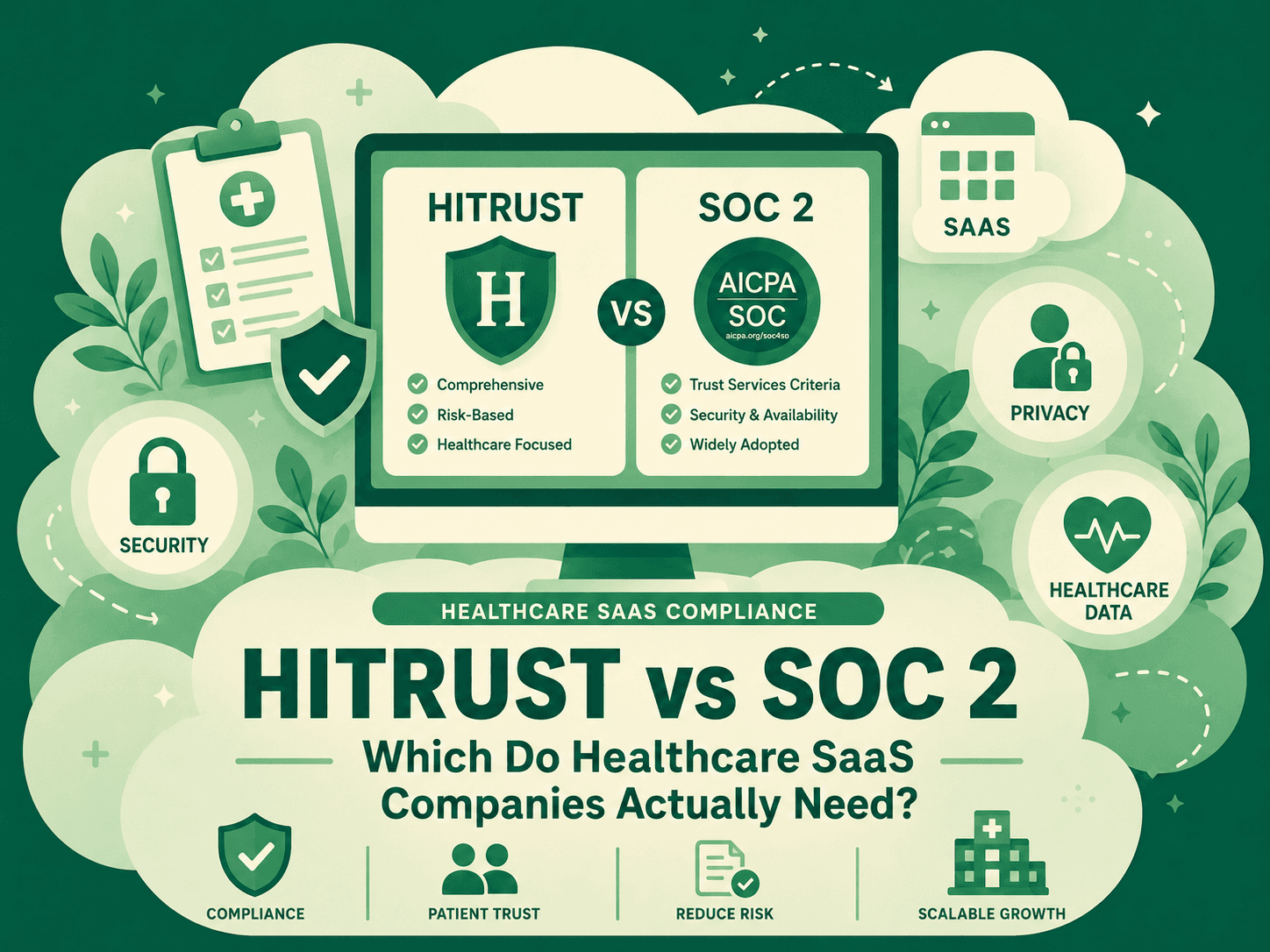
You're building a healthcare SaaS product. A hospital system, health plan, or enterprise health IT buyer just asked for your security certification. They want either HITRUST or SOC 2 — or both — before they'll sign.
You now have a decision to make, and it's not a cheap one. HITRUST r2 certification can cost $50,000–$200,000 and take 12–18 months. SOC 2 Type 2 runs $30,000–$100,000 and takes 6–12 months. Getting the wrong one first means wasted time, wasted money, and a delayed enterprise deal.
This guide breaks down the real differences between HITRUST and SOC 2 for healthcare SaaS companies — what each framework actually covers, when buyers demand one over the other, and how to make the right call for your stage and sales motion.
What Is HITRUST CSF?
HITRUST CSF (Common Security Framework) is a certifiable security and privacy framework developed specifically for the healthcare industry. It was created in 2007 by HITRUST Alliance, a private organization, in collaboration with healthcare companies, technology vendors, and information security professionals.
HITRUST CSF is built on top of — and maps to — over 40 authoritative sources, including HIPAA, NIST, ISO 27001, PCI DSS, and the HITECH Act. This is its core differentiator: it's a prescriptive, control-specific framework designed to demonstrate compliance across multiple regulatory bodies through a single certification.
HITRUST Certification Levels
HITRUST offers three tiers of assurance, each progressively more rigorous:
HITRUST e1 (Essential, 1-year): 44 controls, self-assessed with third-party validation. Best for lower-risk organizations needing a baseline credential.
HITRUST i1 (Implemented, 1-year): 182 controls, third-party validated. Designed for moderate-risk environments and faster to achieve than r2.
HITRUST r2 (Risk-based, 2-year): 200+ controls, fully validated by a HITRUST-authorized external assessor. This is the gold standard that large health systems and health plans require.
When enterprise healthcare buyers say they require "HITRUST certification," they almost always mean HITRUST r2.
What Is SOC 2?
SOC 2 (System and Organization Controls 2) is an auditing standard developed by the American Institute of Certified Public Accountants (AICPA). It evaluates a service organization's controls relevant to security, availability, processing integrity, confidentiality, and privacy — collectively called the Trust Services Criteria (TSC).
Unlike HITRUST, SOC 2 is not a prescriptive checklist. Auditors assess whether your controls are suitably designed and operating effectively relative to the criteria you've chosen to include in scope.
SOC 2 Type 1 vs Type 2
SOC 2 Type 1: Point-in-time assessment. Confirms your controls are suitably designed at a specific date. Faster (2–4 months) and cheaper, but carries less weight with mature enterprise buyers.
SOC 2 Type 2: Assessment over an observation period (typically 6–12 months). Confirms your controls operated effectively over time. This is what enterprise buyers actually want.
SOC 2 is technology-agnostic — it applies equally to HR software, fintech, data analytics, and healthcare SaaS. It is widely recognized across industries, making it the most common first compliance certification for SaaS companies.
HITRUST vs SOC 2: Core Differences
Criteria | HITRUST r2 | SOC 2 Type 2 |
|---|---|---|
Governing body | HITRUST Alliance (private) | AICPA (professional standards body) |
Industry focus | Healthcare-specific | Technology-agnostic |
Framework type | Prescriptive (control-specific) | Principles-based (flexible) |
Number of controls | 200+ (r2) | ~60 criteria (self-scoped) |
HIPAA alignment | Direct, built-in | Indirect (requires mapping) |
Certification validity | 2 years (r2) | Annual |
Who performs the assessment | HITRUST-authorized external assessor | AICPA-licensed CPA firm |
Time to certify | 12–18 months (r2) | 6–12 months |
Typical cost | $50,000–$200,000+ | $30,000–$100,000 |
Enterprise healthcare buyer demand | High (required by large health systems) | Moderate (widely accepted) |
Mid-market / SMB buyer demand | Low | Very High |
Startup-friendly | No | Yes |
Does SOC 2 Cover HIPAA?
This is one of the most searched questions in healthcare compliance, and the answer is: no, but they overlap.
SOC 2 does not certify HIPAA compliance. HIPAA is a US federal law. SOC 2 is an auditing standard. A SOC 2 report can include a HIPAA mapping section (often called a "SOC 2 + HIPAA" engagement), where the auditor assesses your controls against HIPAA Security Rule requirements. But this is additive — it does not produce a standalone HIPAA certification, because no such thing officially exists.
HITRUST r2, on the other hand, directly maps to HIPAA requirements at the control level. Because HITRUST was purpose-built for healthcare, achieving HITRUST r2 is widely accepted in the industry as strong evidence of HIPAA compliance posture — even though it is technically not a legal substitute for HIPAA compliance itself.
The practical implication: If your healthcare buyers ask specifically for evidence of HIPAA compliance, SOC 2 + HIPAA can satisfy most mid-market buyers. HITRUST r2 is what large-enterprise health systems typically require.
When Healthcare SaaS Companies Actually Need HITRUST
HITRUST r2 certification is not the right first move for most healthcare SaaS startups. It is the right move in specific, high-stakes situations:
1. You Are Selling to Large Health Systems or Integrated Delivery Networks (IDNs)
Organizations like Kaiser Permanente, Mayo Clinic, HCA Healthcare, and most Blue Cross Blue Shield plans have vendor risk management programs that require HITRUST r2 as a condition of doing business. If your primary sales motion targets these buyers, there is no substitute. Showing up with only a SOC 2 Type 2 will not clear their vendor security review.
2. You Handle Large Volumes of Protected Health Information (PHI)
If your product processes clinical data, EHR integrations, claims data, or patient records at scale, buyers will calibrate their security requirements accordingly. High-volume PHI environments demand HITRUST because the framework's controls were specifically designed for the risk profile of clinical data handling.
3. You Are a Business Associate to a Large Covered Entity
If you're entering a Business Associate Agreement (BAA) with a large covered entity as a direct technology vendor, their vendor security program may contractually require HITRUST certification as part of the BAA terms. Review the BAA requirements before committing to a compliance roadmap.
4. You Are Competing for State or Federal Healthcare Contracts
Medicaid management information systems, state health exchange platforms, and federal health agency vendors increasingly specify HITRUST r2 in their RFP requirements. If your pipeline includes government healthcare contracts, HITRUST is not optional.
5. Your Sales Cycle Involves Large Enterprise Security Reviews
If your enterprise deals routinely stall at the security review stage because procurement teams are sending HITRUST-specific questionnaires, that is a signal. HITRUST certification dramatically simplifies vendor assessments — buyers accept it in lieu of lengthy security questionnaires, thereby accelerating deal velocity.
When SOC 2 Is Enough for Healthcare SaaS
SOC 2 Type 2 remains the right choice — and often the only practical choice — for most healthcare SaaS companies at seed through Series B:
1. You're Selling to Mid-Market Hospitals, Clinics, or Digital Health Companies
Mid-market buyers (community hospitals, physician groups, digital health startups, telehealth companies) rarely require HITRUST. SOC 2 Type 2, combined with a completed HIPAA Security Risk Assessment and a signed BAA, is sufficient to pass security reviews at this tier.
2. You Are Pre-Series B with a Limited Compliance Budget
The full cost of HITRUST r2 — assessor fees, internal resource time, required remediation work, and annual maintenance — is prohibitive for most early-stage companies. SOC 2 Type 2 delivers strong security credibility at a fraction of the cost and time investment.
3. Your Product Serves Multiple Industries, Not Just Healthcare
If healthcare is one vertical among several, SOC 2's industry-agnostic scope is a better fit. HITRUST is a healthcare-specific investment; its signal value outside of healthcare is limited.
4. You Need Compliance Fast to Unblock an Enterprise Deal
SOC 2 Type 1 can be achieved in 60–90 days and will satisfy most enterprise security review checklists while you work toward Type 2. HITRUST r2 has no equivalent fast path — the minimum timeline for a legitimate r2 certification is approximately 12 months.
When Healthcare SaaS Companies Need Both
A growing number of mid-to-late-stage healthcare SaaS companies pursue both SOC 2 Type 2 and HITRUST r2, and for good reason:
Sequencing: SOC 2 first unblocks revenue and builds the compliance muscle. HITRUST second unlocks the enterprise healthcare segment.
Control overlap: Because HITRUST CSF maps to SOC 2 criteria, much of the work done for SOC 2 can be reused directly for HITRUST. Companies that are already SOC 2 compliant typically reduce HITRUST r2 prep time by 30–40%.
Market positioning: Holding both certifications is a meaningful competitive differentiator. When a health system's vendor risk team sees both, it signals a mature security program — not just a checkbox exercise.
The practical sequencing for most healthcare SaaS companies looks like this:
Seed/Series A → SOC 2 Type 2 (unblocks mid-market and early enterprise) Series B/C → HITRUST r2 (unlocks large health systems, IDNs, federal contracts)
HITRUST vs SOC 2 Cost and Timeline Comparison
SOC 2 Type 2
Phase | Timeline | Estimated Cost |
|---|---|---|
Readiness assessment | 2–4 weeks | $5,000–$15,000 |
Remediation & control buildout | 2–4 months | Internal labor + tooling |
Observation period | 6–12 months | Ongoing |
4–8 weeks | $15,000–$50,000 | |
Total (first year) | 6–12 months | $30,000–$100,000 |
HITRUST r2
Phase | Timeline | Estimated Cost |
|---|---|---|
HITRUST MyCSF scoping | 1–2 months | $5,000–$10,000 |
2–3 months | $15,000–$30,000 | |
Remediation | 3–6 months | Internal labor + tooling |
Validated assessment | 3–4 months | $30,000–$100,000+ |
HITRUST QA review | 2–3 months | Included in assessor fee |
Total | 12–18 months | $50,000–$200,000+ |
These costs do not include internal engineering time, policy development, or security tooling, which can add $50,000–$150,000 in labor costs for a team starting from scratch.
5 Questions to Decide Which Certification You Need
Use these questions to cut through the noise:
1. What is your buyer's vendor security requirement? Ask your top three target accounts directly. Their vendor security intake form or procurement team will tell you exactly what they require.
2. What is your deal size and sales cycle stage? If a single deal is worth $500K+ ARR and the buyer requires HITRUST, the ROI calculation is clear. If your average contract value is $30K, the math on HITRUST r2 investment may not work until you've scaled.
3. Do you have dedicated compliance resources? HITRUST r2 requires significant sustained internal effort — a part-time or full-time compliance owner, engineering cooperation, and policy program management. If you don't have this capacity, SOC 2 is the more realistic near-term target.
4. What is your current security maturity? HITRUST r2 is not a starting point. Companies with immature security programs that attempt HITRUST certification typically fail their initial assessment, wasting assessor fees. SOC 2 builds the foundation.
5. What does your competitive landscape look like? If your direct competitors hold HITRUST r2 and you don't, you will lose deals to them in enterprise health system evaluations. That competitive pressure is a legitimate accelerant for the HITRUST investment.
Frequently Asked Questions
Is HITRUST better than SOC 2? Neither is objectively better — they serve different purposes and different buyer segments. HITRUST r2 is the higher-assurance standard specifically built for healthcare. SOC 2 is more broadly recognized across industries and is the practical first certification for most SaaS companies. The right choice depends on your buyers, your sales stage, and your budget.
Does HITRUST certification satisfy HIPAA? HITRUST r2 is widely accepted as strong evidence of HIPAA compliance posture because it directly maps to the HIPAA Security Rule. However, it is not a legal substitute for HIPAA compliance — HIPAA is a federal law with its own enforcement mechanism (OCR). HITRUST helps demonstrate that your controls meet HIPAA requirements, significantly reducing regulatory risk.
Can I use SOC 2 + HIPAA instead of HITRUST? For many mid-market healthcare buyers, yes. A SOC 2 Type 2 report with a HIPAA mapping section (SOC 2 + HIPAA) satisfies most security reviews at the enterprise tier and below. Large health systems and health plans with formal vendor management programs typically require HITRUST r2 specifically.
How long does HITRUST R2 certification take? A realistic timeline for a first-time HITRUST R2 certification is 12–18 months from scope definition to certificate issuance. Companies that already hold SOC 2 Type 2 can typically compress this to 9–12 months due to control overlap.
What is the difference between HITRUST e1, i1, and r2? e1 is the entry-level tier (44 controls, self-assessed with validation), i1 is the implemented tier (182 controls, third-party validated), and r2 is the highest assurance tier (200+ controls, fully validated by a HITRUST-authorized assessor). Enterprise healthcare buyers require R2. e1 and i1 are useful for lower-risk environments or as stepping stones toward r2.
Do I need both SOC 2 and HITRUST? Many Series B+ healthcare SaaS companies hold both. SOC 2 serves broad market needs; HITRUST unlocks large enterprise healthcare accounts. The two certifications share significant control overlap, so having SOC 2 first reduces the cost and time required to achieve HITRUST r2.
The Bottom Line
If you're a healthcare SaaS company trying to decide between HITRUST and SOC 2, here's the honest answer:
Start with SOC 2 Type 2. It unblocks the majority of your early-stage deals, it's achievable within your budget, and it builds the compliance infrastructure that makes HITRUST attainable later. For most companies between seed and Series B, SOC 2 is the right first investment.
Add HITRUST r2 when your buyers demand it. That typically happens when you're actively pursuing large health systems, IDNs, health plans, or government healthcare contracts — and it usually becomes a growth priority somewhere between Series B and Series C, when the revenue potential from the enterprise healthcare segment justifies the investment.
The companies that get this wrong are the ones that either pursue HITRUST prematurely (burning resources before they have the security maturity or deal pipeline to justify it) or avoid HITRUST too long (losing enterprise deals to better-certified competitors).
Get your SOC 2 done right the first time, build continuous compliance practices into your engineering and operations, and you'll cut 30–40% off your HITRUST r2 timeline when the time comes.
Ready to build the compliance foundation that makes both SOC 2 and HITRUST achievable? See how Dsalta automates healthcare SaaS compliance →

Explore more SOC 2 articles
Stop losing deals to compliance.
Get compliant. Keep building.
Join 100s of startups who got audit-ready in days, not months.