AI Compliance —
EU AI Act Compliance Checklist: 7 Steps Every Business Needs
Navigate EU AI Act compliance with our 7-step checklist. Learn about AI regulations, high-risk systems, and how to prepare your business before enforcement begins.
Dogan Akbulut
AI Regulatory Compliance
Share this article


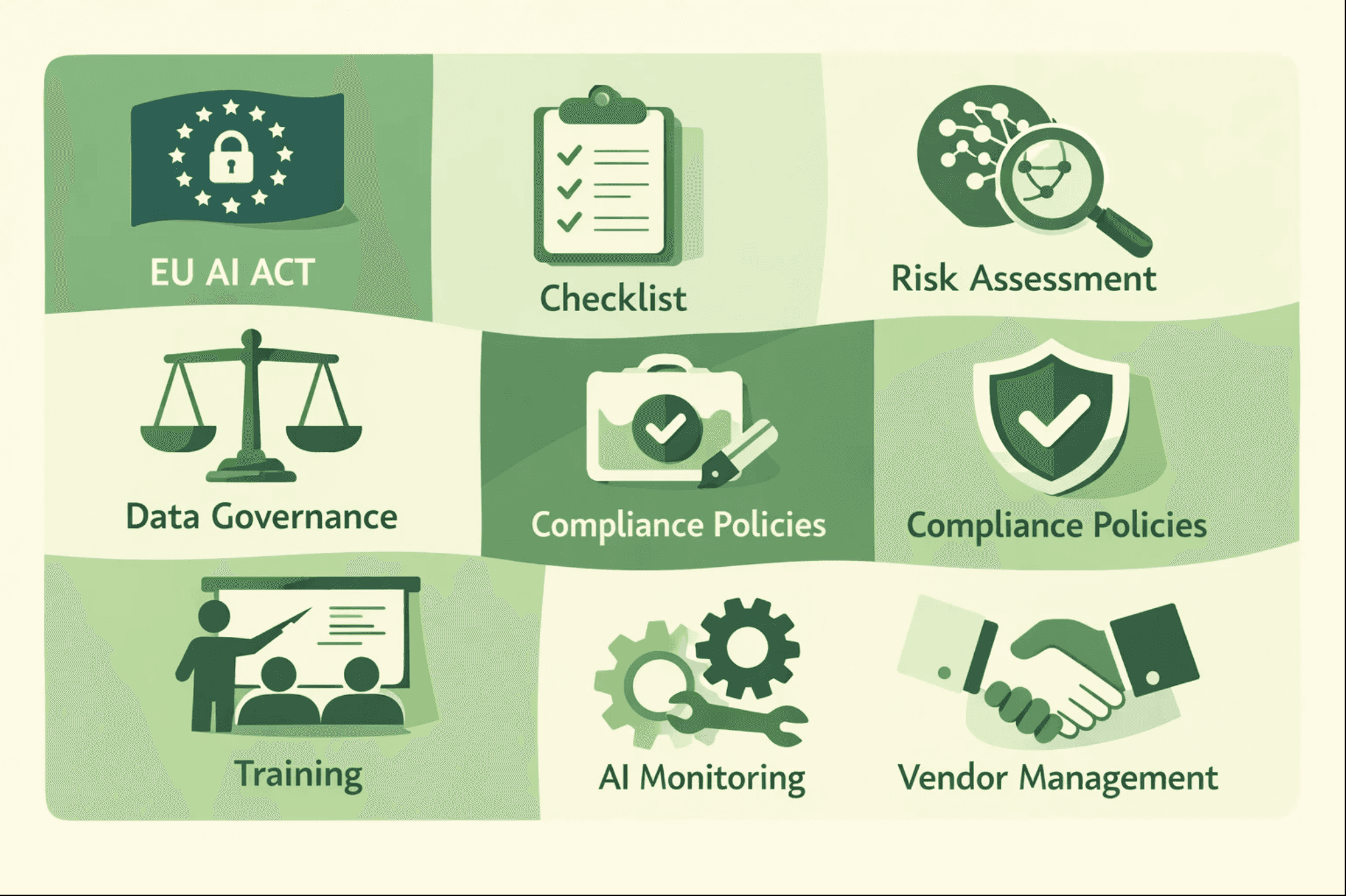
EU AI Act Compliance Checklist
The European Union's Artificial Intelligence Act is here, and businesses deploying AI systems need to act now. With enforcement beginning in 2026, understanding EU AI Act compliance requirements isn't optional; it's essential for operating in the European market.
This comprehensive guide outlines seven actionable steps to ensure your business complies with AI regulations and avoids penalties of up to €35 million or 7% of global annual turnover.
What Is the EU AI Act?
The EU AI Act is the world's first comprehensive legal framework regulating artificial intelligence. It classifies AI systems by risk level and imposes requirements based on potential harm to fundamental rights, safety, and society.
The Act establishes clear rules for AI compliance frameworks, with a particular focus on high-risk AI systems used in healthcare, law enforcement, employment, and critical infrastructure.
Who Needs to Comply with the EU AI Act?
EU AI Act compliance applies to:
• AI providers who develop or place AI systems on the EU market
• AI deployers who use AI systems under their authority within the EU
• Importers and distributors of AI products in European markets
• Non-EU companies whose AI systems affect people in the European Union
If your business develops, deploys, or uses AI technologies that impact EU citizens, these AI regulations apply to you.
Step 1: Classify Your AI Systems by Risk Level
Start your compliance journey by understanding where your AI systems fall in the risk hierarchy. Similar to ISO 27001 risk assessment processes, the EU AI Act categorizes systems into four levels:
• Unacceptable Risk - Banned practices like social scoring and real-time biometric surveillance in public spaces (with limited exceptions)
• High-Risk AI Systems - Applications in critical areas, including biometric identification, critical infrastructure management, educational assessments, employment decisions, access to essential services, law enforcement, and migration management
• Limited Risk - Systems with transparency obligations, such as chatbots and deepfakes
• Minimal Risk - AI applications with no specific requirements beyond general safety standards
Document each AI system your organization uses and assign it to the appropriate category. High-risk AI systems will require the most extensive compliance measures.
Step 2: Conduct a Comprehensive AI Inventory Audit
You can't comply with what you don't know exists.
Create a complete inventory of all AI systems across your organization, including in-house-developed AI tools, third-party AI software and platforms, AI components embedded in larger systems, automated decision-making processes, and machine learning models in production.
For each system, document its purpose and use case, the data sources and types processed, the decision-making authority level, the affected user groups, and the current risk classification.
This audit provides the foundation for your AI compliance framework and helps identify gaps in your current practices, similar to a cybersecurity compliance checklist.
Step 3: Establish Data Governance and Quality Standards
High-risk AI systems require robust data governance to ensure fairness, accuracy, and compliance.
Implement these essential practices:
Data Quality Assurance - Ensure training datasets are relevant, representative, and error-free. Establish validation processes to check for completeness and statistical accuracy.
Bias Detection and Mitigation - Examine datasets for historical biases related to protected characteristics. Implement testing protocols to identify discriminatory outcomes before deployment.
Documentation Requirements - Maintain detailed records of data sources, collection methods, and processing activities. Create audit trails showing how data influences AI decisions.
Under AI regulations, you must demonstrate that your data practices support fair and non-discriminatory AI outcomes, much like GDPR compliance requirements.
Step 4: Implement Technical Documentation and Record-Keeping
EU AI Act compliance demands meticulous documentation throughout your AI system lifecycle.
Your technical documentation must include:
• Detailed system design and architecture specifications
• Development methodologies and validation approaches
• Risk assessment procedures and mitigation strategies
• Human oversight mechanisms and intervention protocols
• Performance metrics and accuracy benchmarks
• Cybersecurity measures and data protection safeguards
Keep these documents up to date and accessible for regulatory inspections. For high-risk AI systems, you'll need to maintain logs of AI decisions for at least six months, or longer, depending on the application.
Step 5: Build Human Oversight and Monitoring Mechanisms
The EU AI Act requires human oversight for high-risk applications to prevent or minimize risks to fundamental rights.
Design your AI compliance framework to include:
Human-in-the-Loop Systems - Ensure qualified personnel can review AI recommendations before final decisions affecting individuals. Provide training so human overseers understand system capabilities, limitations, and potential biases.
Monitoring Dashboards - Create interfaces that clearly display AI decision factors and confidence levels. Enable easy escalation when AI outputs appear questionable or harmful.
Incident Response Protocols - Establish procedures for identifying, reporting, and addressing AI malfunctions. Document corrective actions taken when systems produce unexpected outcomes.
Human oversight isn't just a checkbox—it's a critical safeguard that protects both your users and your organization.
Step 6: Prepare Conformity Assessments for High-Risk Systems
Before deploying high-risk AI systems, you must complete conformity assessments proving compliance with EU AI Act requirements. This process is similar to ISO 27001 certification.
This process involves:
Quality Management Systems - Implement comprehensive procedures covering design, development, testing, and post-market monitoring. Establish change management processes for system updates.
Risk Management - Conduct thorough risk assessments, identifying potential harms. Document risk mitigation measures and their effectiveness.
Third-Party Audits - For certain high-risk categories, engage notified bodies to conduct independent assessments. Prepare for detailed technical evaluations of your systems.
Upon successful assessment, you'll receive CE marking authorization, allowing your AI system to operate legally in the EU market.
Step 7: Develop Ongoing Compliance and Training Programs
EU AI Act compliance isn't a one-time project—it's an ongoing commitment.
Continuous Monitoring - Track AI system performance against established benchmarks. Monitor for drift, bias, and degradation in accuracy over time. Update risk assessments when you modify systems or when use cases change.
Staff Training and Awareness - Educate developers on compliance requirements during AI design. Train operators and oversight personnel on their responsibilities. Create awareness programs for stakeholders affected by AI decisions.
Regulatory Updates - Stay informed about guidance documents from EU authorities. Participate in industry forums discussing the implementation of AI regulations. Adjust your AI compliance framework as standards evolve.
What Are the Penalties for Non-Compliance?
The EU AI Act imposes significant financial penalties for violations:
• Up to €35 million or 7% of global annual turnover for prohibited AI practices
• Up to €15 million or 3% of global turnover for non-compliance with AI Act obligations
• Up to €7.5 million or 1.5% of turnover for supplying incorrect information to authorities
Beyond financial penalties, non-compliance risks reputational damage, loss of market access in the EU, legal liability for harms caused by AI systems, and competitive disadvantage against compliant rivals.
Start Your EU AI Act Compliance Journey Today
The enforcement timeline is approaching quickly. Businesses must begin compliance efforts now to meet 2026 deadlines for high-risk AI systems and avoid penalties.
DSALTA specializes in helping organizations navigate complex AI regulations with practical, technology-driven solutions. Our compliance management platform simplifies EU AI Act compliance through automated risk assessments, comprehensive documentation management, continuous monitoring and reporting, and expert guidance on AI compliance frameworks.
Don't wait until enforcement begins. The seven steps outlined here provide a roadmap, but every organization's AI landscape is unique. A systematic approach tailored to your specific systems and use cases will ensure you're prepared when regulators come calling.
Ready to build a robust AI compliance framework for your business? Contact DSALTA today to learn how we can help you achieve EU AI Act compliance efficiently and effectively.


Explore more AI Compliance articles
Stop losing deals to compliance.
Get compliant. Keep building.
Join 100s of startups who got audit-ready in days, not months.