AI Compliance —
Autonomous Compliance Agents Are Revolutionizing Vendor Risk
AI compliance agents automate vendor risk management, speed up audits, and transform compliance into a proactive advantage with DSALTA.
Jon Ozdoruk
AI in Vendor Risk Management
Share this article


What Are Autonomous Compliance Agents and Why Do They Matter?
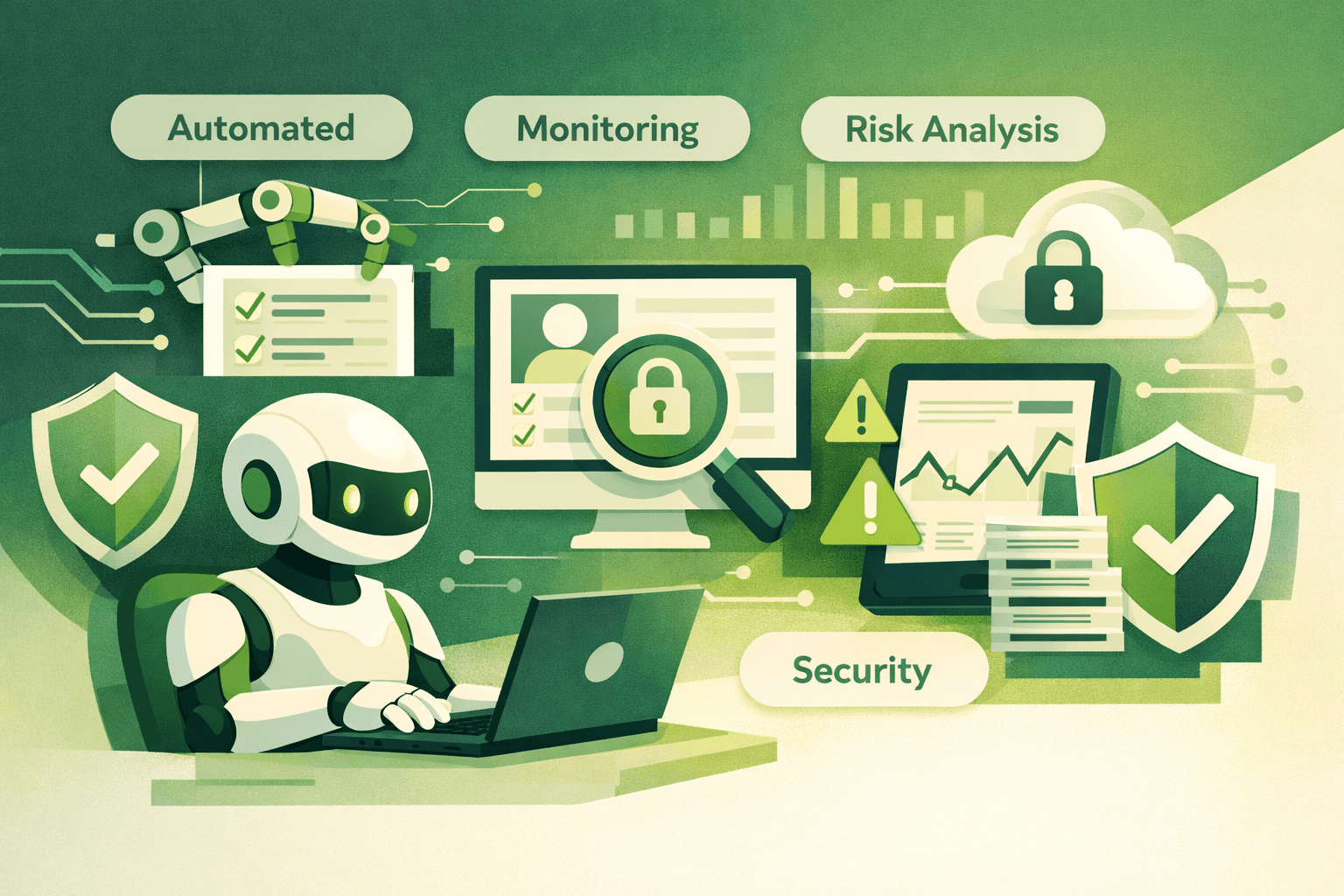
Autonomous compliance agents are AI-powered systems that handle vendor risk management tasks without constant human oversight. Unlike traditional automation tools that follow rigid scripts, these agents make intelligent decisions about evidence collection, risk scoring, and compliance monitoring in real time.
For compliance and risk leaders, this represents a fundamental shift in how organizations approach third-party risk. Manual vendor assessments that once took weeks can now be completed in hours, with greater accuracy and consistency.
Key Takeaway: Autonomous compliance agents transform vendor risk from a reactive, labor-intensive process into a proactive, scalable operation.
How Do AI Agents Actually Improve Vendor Risk Workflows?
AI agents enhance vendor risk workflows through three core capabilities:
Automated Evidence Collection – Agents continuously gather security certificates, SOC 2 reports, and compliance documentation directly from vendors without manual follow-up (see vendor questionnaires).
Intelligent Risk Scoring – ML analyzes vendor data against your risk framework, flagging high-risk relationships instantly (learn more: risk scoring).
Proactive Monitoring – Agents track regulatory changes, vendor incidents, and contract renewals, alerting teams before issues become crises (via Compliance Management + VRM).
The DSALTA platform leverages these capabilities to eliminate the bottlenecks that plague traditional vendor risk programs. Instead of compliance teams chasing down spreadsheets and emails, autonomous agents handle repetitive work, allowing humans to focus on strategic risk decisions.
Key Takeaway: AI agents don’t just speed up existing processes—they enable new levels of visibility and control in vendor risk management.
What Results Can Organizations Expect from Implementing Compliance Automation?
Organizations adopting autonomous compliance agents report transformative efficiency gains. Based on early-adopter data and VRM benchmarks, companies implementing AI-driven platforms experience:
70% reduction in vendor assessment time – 2–3 weeks → 2–3 days
85% faster audit readiness – Continuous evidence collection keeps documentation current
50% decrease in vendor-related incidents – Proactive monitoring catches risks early
3× increase in vendors monitored – Scale portfolios without proportional headcount
Mini Case Study: Financial Services Transformation
A mid-sized financial institution managing 300+ vendors struggled with quarterly assessments that consumed 40% of team time. After an autonomous agent rollout, they achieved:
Assessment completion time: 18 days → 5 days
High-risk vendor identification: +60% via AI anomaly detection
Audit prep time: 6 weeks → 10 days
Zero critical findings in the next regulatory exam
Key Takeaway: Autonomous compliance agents improve risk posture and audit outcomes—not just speed.
How Does Compliance Automation Support Different Regulatory Frameworks?
Autonomous agents excel at multi-framework compliance, simultaneously tracking requirements across:
SOC 2 Type II – Continuous monitoring of vendor security controls (SOC 2 · SOC 2 Checklist)
ISO 27001 – Automated evidence mapping to ISMS standards (ISO 27001 · Checklist)
GDPR & Privacy – Real-time tracking of DPAs and vendor locations (GDPR · Checklist)
Industry Standards – HIPAA (Checklist), PCI DSS 4.0.1, NIST AI RMF
DSALTA maintains a knowledge base of regulatory requirements that updates automatically when standards change—so your vendor risk program stays compliant without manual mapping.
Key Takeaway: AI agents turn regulatory complexity into an advantage with continuous, multi-framework compliance.
What Should Risk Leaders Look for When Evaluating AI Agent Solutions?
Must-Have Features
Bidirectional Integration – Connects with GRC, contracts, vendor portals (Compliance Management · All Features)
Explainable AI – Transparent scoring (see risk scoring)
Customizable Risk Frameworks – Align to your risk appetite
Vendor Collaboration Tools – Evidence intake via questionnaires
Advanced Capabilities
NLP for contract clause analysis
Predictive analytics for vendor stability
Automated remediation workflows for vendors
Key Takeaway: The best platforms enhance human judgment with AI—efficiency + better decisions.
How Can Organizations Get Started with Autonomous Compliance Agents?
Phase 1: Pilot with High-Volume Tasks (Week 1)
Automate evidence collection for your top 50 vendors
Measure time savings and accuracy
Phase 2: Expand Risk Scoring (Week 2)
Roll out AI assessments portfolio-wide; customize frameworks
Train teams to interpret AI insights
Phase 3: Enable Continuous Monitoring (Week 3-4)
Proactive alerts for incidents and regulatory changes
Integrate with audit workflows for perpetual readiness
DSALTA is designed for rapid deployment with minimal disruption. Most orgs see measurable ROI in ~30 days.
Key Takeaway: Start small, prove value, then scale autonomous compliance across your VRM program.
Transform Your Vendor Risk Program with AI-Powered Automation
Autonomous compliance agents represent the future of vendor risk management—and that future is available today. The DSALTA platform combines cutting-edge AI with deep compliance expertise to deliver autonomous agents that integrate with your processes.
Explore resources: Vendor Risk Transparency & Operational Continuity Whitepaper, Risk Assessment Reports, Framework Checklists.
Frequently Asked Questions
What is an autonomous compliance agent?
An autonomous compliance agent is software that helps automate routine compliance tasks such as evidence collection, monitoring, reminders, and workflow coordination. It acts as an assistant for security and compliance teams.
Can compliance agents replace compliance teams?
No. Compliance agents can reduce manual work, but humans still need to make decisions, approve exceptions, and own accountability. AI is best used as an operational accelerator.
Where are compliance agents most useful?
They are most useful in repetitive tasks like tracking controls, collecting evidence, reminding owners, and surfacing risk signals. These are high-volume activities that benefit from automation.
What should teams watch out for with compliance agents?
Teams should watch for bad data, unclear ownership, and overreliance on automation. Every automated action should still be reviewable and traceable.
How do compliance agents support SOC 2 and vendor risk?
They support both by reducing manual tracking and helping teams maintain continuous oversight. That makes audits smoother and vendor review more consistent
Request your demo today and discover how autonomous agents can revolutionize your vendor risk program.


Explore more AI Compliance articles
Stop losing deals to compliance.
Get compliant. Keep building.
Join 100s of startups who got audit-ready in days, not months.