AI Compliance —
The AI Compliance Frameworks Every Organization Needs to Know
A compliance lead's guide to the AI frameworks shaping 2026 ISO 42001, NIST AI RMF, EU AI Act, Colorado SB 24-205, and AIUC-1 explained in plain terms.
Dogan Akbulut
AI Regulatory Compliance
Share this article


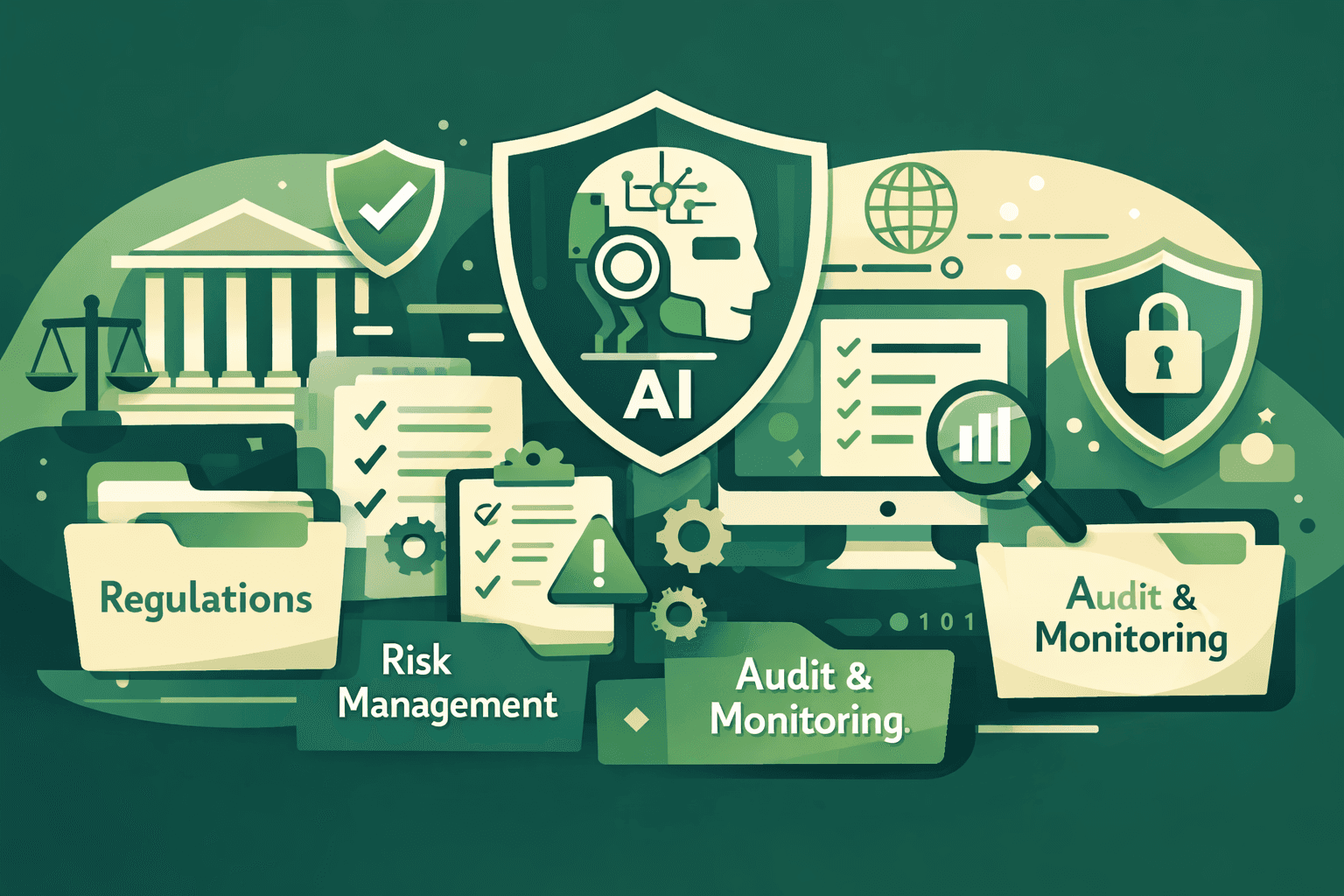
The AI Compliance Frameworks
AI governance is no longer a future-state problem. Whether your organization is deploying a clinical decision support tool, an autonomous underwriting agent, or a customer-facing chatbot, regulators, enterprise buyers, and auditors are asking the same question: how are you managing AI risk management programs? The answer increasingly requires fluency in a specific set of frameworks — some voluntary, some legally binding, and at least one that is rewriting the rules for trusting AI agents in the enterprise.
Here is what you need to know.
ISO 42001: The Enterprise Table Stake
ISO 42001 is the international standard for AI management systems. Technically, it is voluntary. No regulator will fine you for not having it. But if your sales team is trying to close deals with large health systems, insurers, financial institutions, or government-adjacent buyers, the absence of ISO 42001 is increasingly the reason deals stall at the procurement stage.
Enterprise buyers are using it as a proxy for organizational AI maturity. It maps to the same structure as ISO 27001, which means organizations already running an information security management system can extend their existing controls rather than build from scratch. For compliance and security teams, the practical implication is this: ISO 42001 is voluntary until your pipeline makes it mandatory. Learn how to implement ISO 42001 alongside other frameworks.
NIST AI RMF: The Reference Standard for "Prove It"
The National Institute of Standards and Technology (NIST) AI Risk Management Framework (RMF), released in January 2023, has become the lingua franca of AI risk in the United States. It is voluntary at the federal level. But it is the document that state legislators cite when drafting AI laws, and it is what enterprise buyers mean when they ask vendors to demonstrate responsible AI management through building comprehensive AI compliance programs.
The framework is organized around four core functions: Govern, Map, Measure, and Manage. Unlike compliance checklists, it is designed to be integrated into existing risk programs rather than treated as a standalone exercise. For organizations already operating under SOC 2 or ISO 27001, the NIST AI RMF provides a credible framework for extending those programs to AI-specific risk domains, model documentation, bias testing, explainability requirements, and incident response to AI failures.
If a prospect, a partner, or a regulator asks how you manage AI risk, NIST AI RMF is the answer they are expecting. Mastering multi-framework compliance helps you align NIST with existing standards.
EU AI Act: The Law You Cannot Opt Out Of
The EU AI Act is not voluntary. It is the world's first comprehensive binding legal framework for artificial intelligence, and if your product touches EU customers in any capacity, it applies to you.
The Act establishes a risk tiering structure. AI systems that manipulate human behavior, enable real-time biometric surveillance in public spaces, or allow governments to conduct social scoring are banned outright. High-risk AI systems, including those used in healthcare, critical infrastructure, employment, and education, are subject to mandatory conformity assessments, transparency requirements, human oversight controls, and post-market monitoring obligations. Limited- and minimal-risk systems face lighter disclosure requirements.
For US-based startups and growth-stage companies, the EU AI Act requires a deliberate product compliance strategy — not just a legal review. Compliance programs need to address risk classification, technical documentation, data governance for training sets, and audit logging requirements before a product reaches the EU market. The enforcement timeline is phased, with most high-risk obligations fully in effect by 2026 and 2027. Use our EU AI Act compliance checklist to prepare your organization.
Colorado AI Act (SB 24-205): The First US State Law That Actually Has Teeth
Colorado became the first US state to pass comprehensive legislation targeting high-risk AI systems with SB 24-205. The original effective date of February 2026 has since been pushed to June 30, 2026, giving organizations additional runway but not permission to delay.
The Colorado AI Act imposes obligations on "developers" and "deployers" of AI systems used in consequential decisions affecting a person's access to healthcare, insurance, housing, employment, credit, or education. Covered entities must exercise reasonable care to protect consumers from algorithmic discrimination, conduct impact assessments, maintain documentation, and provide notice and explanation when an AI system is used to make or substantially inform a consequential decision. Consumers also gain the right to appeal those decisions.
Colorado's model is expected to influence legislation in other states. Organizations building or deploying AI in regulated sectors should treat SB 24-205 compliance as the foundation of a US state AI compliance posture, not an isolated state-level obligation. Discover how AI-first compliance platforms streamline multi-jurisdictional requirements.
AIUC-1: The World's First Standard for AI Agents
The frameworks above address AI governance at the organizational level. AIUC-1 addresses something different and something the existing frameworks were never designed to handle.
AIUC-1 is the world's first AI agent standard. It was purpose-built to solve the specific trust problem that agentic AI creates: how does an enterprise buyer know that an AI agent operating autonomously within their environment is acting within defined limits when it reads documents, triggers workflows, calls APIs, and makes decisions, is doing so within defined limits, with auditable behavior, and in a way that a security team can actually verify?
Whereas ISO 42001 and NIST AI RMF provide organizations with a structure for managing AI programs, AIUC-1 provides a mechanism for extending that trust to the agents operating within those programs. For AI vendors selling to enterprises that have completed SOC 2 Type II audits, ISO 27001 certifications, or HIPAA compliance programs, AIUC-1 provides the missing layer of verifiable assurance that agentic systems meet the behavioral and auditability expectations that enterprise buyers require before they authorize deployment.
The enterprise AI adoption problem has never been primarily technical. It has been a trust problem. AIUC-1 is designed to solve it. Learn more about managing risk in autonomous AI systems.
What This Means for Your Compliance Program
The AI regulatory landscape in 2026 is best understood as a stack. ISO 42001 and NIST AI RMF provide your organization with a governance foundation. The EU AI Act and Colorado AI Act (SB 24-205) establish the legal floor for products operating in their respective jurisdictions. And AIUC-1 addresses the frontier problem that none of the others were built to handle: the accountability gap that opens when autonomous agents act on behalf of your organization.
Organizations that treat these frameworks as siloed compliance exercises will find themselves rebuilding the same groundwork themselves. Organizations that build toward them as an integrated program will be positioned to move faster, close more deals, and operate with a defensible AI risk posture as the regulatory environment continues to develop. Read our complete guide to AI-powered compliance to future-proof your program.


Explore more AI Compliance articles
Stop losing deals to compliance.
Get compliant. Keep building.
Join 100s of startups who got audit-ready in days, not months.