AI Compliance —
CMMC 2.0 Compliance Guide for SaaS Companies in 2026
CMMC 2.0 is now contractually binding for DoD vendors. Learn the 3 certification levels, NIST 800-171 requirements, and a 6-month roadmap to get audit-ready.
Deepika
AI Regulatory Compliance
Share this article


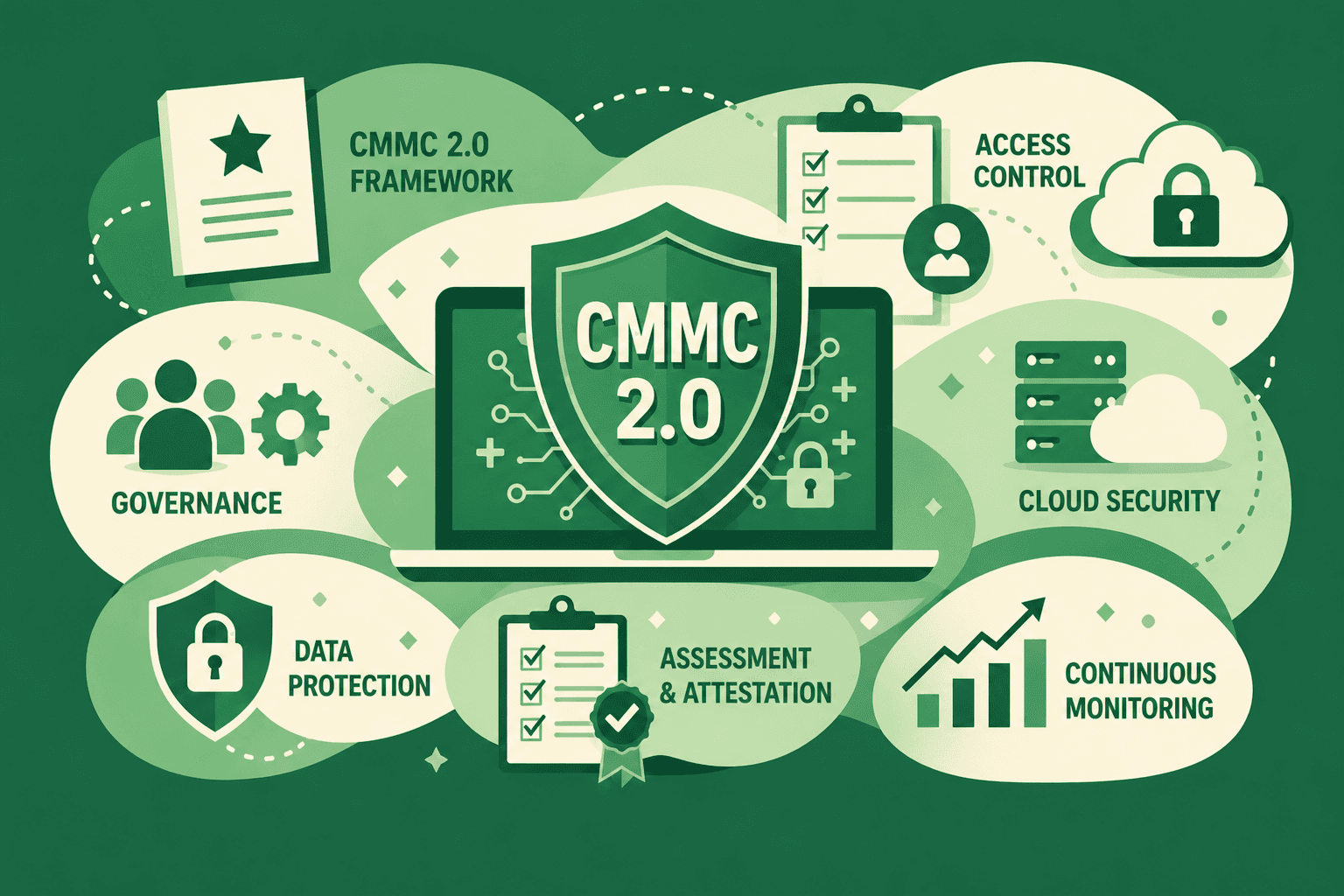
CMMC 2.0 Compliance in 2026: What Every SaaS Company Selling to the U.S. Government Needs to Know
If your SaaS platform touches a Department of Defense contract, even one step removed through a prime contractor, CMMC 2.0 is no longer a future problem. It is today's gating requirement.
The Cybersecurity Maturity Model Certification 2.0 framework became contractually binding across the U.S. defense industrial base when the DFARS final rule took effect on November 10, 2025. Defense primes, including Lockheed Martin, Raytheon, Northrop Grumman, and Booz Allen, are now actively filtering out SaaS vendors from procurement workflows if they cannot demonstrate a defensible CMMC posture.
This guide covers what CMMC 2.0 actually requires, how the three certification levels work, what a realistic compliance roadmap looks like for a SaaS team, and how it maps to frameworks you may already have in place — including SOC 2, ISO 27001, and FedRAMP.
What Is CMMC 2.0 and Why Did It Change?
The original CMMC framework was introduced in 2020 as a five-level model designed to harden the cybersecurity posture of the entire DoD supply chain. After a period of industry feedback, CMMC 2.0 was released in 2021 as a streamlined, three-level model that more closely aligns with NIST SP 800-171 — the control set that defense contractors were already familiar with from self-attestation requirements.
CMMC 2.0 exists for one reason: the DoD supply chain is a target. Adversary nations have repeatedly exploited weak links in the contractor ecosystem to exfiltrate sensitive defense data. The certification framework ensures that any organization handling Federal Contract Information (FCI) or Controlled Unclassified Information (CUI) meets a verifiable, auditable security baseline — not just a self-declared one.
The program is administered by the Cyber Accreditation Body (Cyber AB), and third-party assessments are conducted by organizations known as C3PAOs (Certified Third Party Assessment Organizations).
The Three CMMC Levels: Which One Applies to You?
Level 1 — Foundational
Who it applies to: Organizations whose systems touch only Federal Contract Information (FCI).
Control set: 17 basic safeguarding requirements drawn from FAR 52.204-21.
Assessment method: Annual self-assessment with senior official affirmation submitted to the Supplier Performance Risk System (SPRS).
Level 1 is the minimum floor. If your SaaS stores or processes any government-related data — even tangentially — you need at least this level.
Level 2 — Advanced
Who it applies to: Organizations whose systems store, process, or transmit Controlled Unclassified Information (CUI).
Control set: 110 security requirements from NIST SP 800-171.
Assessment method: Triennial third-party assessment by a certified C3PAO.
This is the level that applies to the vast majority of SaaS companies selling into the defense supply chain. If your platform handles any data that originates from a DoD contract, assume Level 2 is your target. Build your program for it, even if you start with a Level 1 self-attestation.
Level 3 — Expert
Who it applies to: Organizations involved in high-priority DoD programs handling especially sensitive CUI.
Control set: NIST SP 800-171 plus selected enhanced requirements from NIST SP 800-172.
Assessment method: Government-led assessment by the DCMA Defense Industrial Base Cybersecurity Assessment Center.
Level 3 is rare and reserved for the most sensitive programs. Most commercial SaaS teams will never reach this tier.
The CUI Boundary: The Hardest Question in Any CMMC Program
Before you can plan a CMMC compliance program, you need to answer one question with precision: where does CUI live in your environment?
The answer determines everything — which subnets, services, and storage systems need Level 2 controls; which engineering accounts require CUI segregation; which sub-processors need contractual flowdown; and whether you can isolate CUI to a dedicated environment.
The standard 2026 approach for SaaS companies is to operate a CUI enclave: a dedicated cloud environment — typically AWS GovCloud, Microsoft Azure Government, or Google Public Sector — that hosts CUI workloads exclusively. This limits your compliance scope to a smaller, more defensible surface area.
Getting the CUI boundary wrong is the most common mistake in CMMC programs. Auditors will expand the scope when they find CUI leaking outside the declared boundary. Set it tight, document it explicitly, and enforce it with technical controls, not just policy.
NIST SP 800-171 in Plain Language: The 14 Control Families
The 110 security requirements of NIST SP 800-171 are organized into 14 control families. Here is what each one means for a SaaS engineering team:
Access Control: Role-based access control, least privilege, separation of duties, and multi-factor authentication on all CUI access paths.
Awareness and Training: Annual security training for all users, plus role-specific training for anyone with privileged access.
Audit and Accountability: Centralized logging, log review processes, tamper-evident log protection, and time synchronization across all systems.
Configuration Management: Documented baseline configurations, a change control process, and a managed software inventory.
Identification and Authentication: Identity proofing procedures, enforced MFA, and password complexity and rotation requirements.
Incident Response: A documented incident response plan, regular testing through tabletop exercises, and mandatory reporting to the DoD Cyber Crime Center within 72 hours of a discovered compromise.
Maintenance: Controlled and documented maintenance activities and sanitization of equipment before disposal.
Media Protection: Encryption, marking, and sanitization procedures for removable media and physical storage.
Personnel Security: Background screening at onboarding and documented access termination workflows when personnel leave.
Physical Protection: Data center physical access controls and visitor logging requirements.
Risk Assessment: An annual formal risk assessment and continuous vulnerability scanning.
Security Assessment: An annual control self-assessment and an actively maintained Plan of Action and Milestones (POAM) for any gaps.
System and Communications Protection: Boundary protection, encryption of CUI in transit, and proper key management.
System and Information Integrity: Flaw remediation timelines, malicious code protection, and continuous system monitoring.
FedRAMP and CMMC: How They Overlap
If your SaaS hosts CUI in a cloud environment, that cloud infrastructure must be FedRAMP Moderate authorized or attested as FedRAMP Moderate equivalent under DoD guidance. There are three accepted paths:
Path 1 — Run inside an authorized FedRAMP Moderate or High cloud. AWS GovCloud, Microsoft Azure Government, Google Public Sector, and Oracle Government Cloud are the standard choices. This is the fastest path to revenue for most SaaS companies targeting DoD contractors.
Path 2 — Achieve your own FedRAMP Moderate authorization. This takes 12 to 18 months and can cost between $500,000 and $2 million. It is reserved for SaaS companies planning to scale broadly across the entire federal civilian and DoD market.
Path 3 — Submit a FedRAMP Moderate equivalency body of evidence. A third-party assessor attests that your controls meet the FedRAMP Moderate baseline. This path is permitted under DoD guidance but is subject to significant caveats and scrutiny.
For most early-stage SaaS companies entering the DoD-adjacent market, Path 1, combined with a well-scoped CUI enclave, is the right answer.
What Actually Happens During a C3PAO Assessment
A CMMC Level 2 third-party assessment typically runs three to six weeks of active fieldwork once your program is declared ready. Here is the sequence:
Planning and Pre-Assessment: The C3PAO reviews your System Security Plan (SSP) and agrees on the scope of systems, personnel, and evidence in the assessment boundary.
Evidence Collection: You provide documentation mapped to all 110 NIST SP 800-171 control objectives. This is where weak programs expose themselves — missing artifacts, outdated policies, and undocumented processes all surface here.
Interviews and Demonstrations: Control owners are interviewed and asked to demonstrate how each control operates in practice, not just in writing.
Sampling and Testing: The C3PAO selects a random sample of users, change records, and incidents to test whether controls are operating as documented.
Findings and Conditional Remediation: Unmet control objectives are documented as findings. Some deficiencies can be closed within 180 days under an approved POAM.
Final Report and Certification: The C3PAO submits the certification to the Supplier Performance Risk System (SPRS), making your CMMC status visible to DoD contracting officers and primes.
The most common failure points in 2026 are: incomplete CUI boundary documentation, missing FIPS 140-validated cryptography on CUI data flows, gaps in audit log content, and no evidence of a live incident response tabletop exercise in the past 12 months.
How CMMC Maps to SOC 2, ISO 27001, and FedRAMP
If you already have a SOC 2 Type II report or ISO 27001 certification, you have a significant head start on CMMC. Roughly 70 percent of SOC 2 controls map to CMMC requirements, and approximately 80 percent of ISO 27001 Annex A maps. FedRAMP Moderate is broader but heavily overlapping.
The practical implication: do not run CMMC as a parallel program if you already have a compliance foundation. Reuse your existing evidence aggressively. Please map your current controls to the 110 NIST SP 800-171 requirements and focus your efforts only on the gaps.
For SaaS companies that have not yet invested in SOC 2 or ISO 27001, starting from zero on CMMC Level 2 roughly triples the time and cost compared to building on an existing compliance baseline. The recommended path is to achieve SOC 2 Type II first if you have commercial enterprise customers, then layer CMMC-specific controls on top.
A Realistic 6-Month CMMC Level 2 Roadmap for SaaS Teams
Months 1–2: Scope and Gap Assessment
Define the CUI boundary precisely. Inventory all systems, services, and personnel in scope. Run a NIST SP 800-171 self-assessment against your current environment. Document your System Security Plan. Architect your CUI enclave using a FedRAMP Moderate-equivalent cloud environment.
Months 2–4: Control Implementation
Close the identified gaps. Implement FIPS 140-validated cryptography on all CUI data flows. Roll out MFA across all CUI access paths. Establish centralized logging and a SIEM solution. Update your incident response plan to include DoD-specific reporting workflows, and run a tabletop exercise. Please document your sub-processor list and verify the CMMC flowdown in vendor contracts.
Month 5: Pre-Assessment Validation
Run a mock internal assessment against all 110 control objectives. Review every piece of evidence against what a C3PAO will request. Build your Plan of Action and Milestones for any remaining gaps.
Month 6: C3PAO Engagement
Schedule and complete the C3PAO assessment. Submit the certification to SPRS. Establish your ongoing operational rhythm: continuous monitoring, quarterly access reviews, annual control assessments, and documented change management.
Real Cost Ranges for a Mid-Stage SaaS Company
CMMC Level 2 is a real investment. Here is what organizations typically spend in year one:
Readiness consulting and gap closure: $35,000 to $90,000
C3PAO assessment fees: $50,000 to $150,000, depending on scope
Tooling (GRC platform, SIEM, EDR, vulnerability scanner): $25,000 to $70,000 annually
FedRAMP-equivalent cloud uplift: $15,000 to $60,000 annually in incremental spend
Internal engineering time: 200 to 500 hours over the readiness window
Year-one totals typically range from $125,000 to $400,000 for a 30- to 100-person SaaS company. Year two costs drop by 30 to 50 percent as readiness work amortizes and ongoing operations stabilize.
The return on that investment is access to a procurement channel that represents hundreds of billions of dollars in annual DoD contracts, plus a security posture that gives you a competitive advantage with large commercial enterprise buyers as well.
The 6 Most Common CMMC Pitfalls to Avoid
Underscoping the CUI boundary. Set it tight and enforce it with technical controls. Policy alone is not sufficient.
Treating the System Security Plan as paperwork. The SSP is the C3PAO's roadmap for the entire assessment. A weak SSP triggers deep fieldwork.
Missing FIPS 140 validation. Some default cryptographic libraries shipped with cloud services are not FIPS 140 validated. Please verify this at the service and regional levels.
Ignoring vendor flowdown. Any sub-processor that handles CUI needs its own CMMC posture and a contractual obligation to maintain it.
Skipping the incident response tabletop. C3PAOs will request evidence of a live exercise conducted in the last 12 months. Run it early, not at the last minute.
Starting from zero without a compliance foundation. Achieving CMMC Level 2 without any prior SOC 2 or ISO 27001 baseline adds six to twelve months to a typical readiness timeline.
What a Defense Industrial Base Buyer Trust Pack Looks Like
Defense primes and DoD adjacent buyers now routinely request a CMMC-oriented trust pack during procurement. In 2026, a complete trust pack contains:
CMMC Level certification or verified SPRS self-attestation score
System Security Plan summary (scope and key control areas)
Plan of Action and Milestones status report
FedRAMP Moderate equivalency attestation
FIPS 140 validation statements for cryptographic modules
SOC 2 Type II report (parallel commercial assurance)
Penetration test executive summary
Sub-processor list with CMMC posture documentation
Incident response plan summary with DoD reporting workflow
Having this documentation ready before a prospect asks is one of the fastest ways to accelerate DoD adjacent deals. It removes a major friction point in the security review process and signals organizational maturity.
CMMC 2.0 and AI Compliance: What AI-Powered SaaS Teams Need to Know
If your SaaS product uses large language models, AI agents, or machine learning pipelines as part of the platform you sell to defense contractors, CMMC compliance extends to those components.
Any AI subsystem that processes CUI — including data used for model training, inference inputs, and outputs — falls within the CUI boundary and inherits all Level 2 control requirements. This includes access controls on who can interact with the AI, logging of all CUI that passes through the model, and data handling obligations that prevent CUI from leaking into shared model weights or logs accessible outside the enclave.
The intersection of AI governance frameworks like NIST AI RMF and ISO 42001 with CMMC is an emerging area that defense contractors are beginning to request visibility into. Getting ahead of this overlap now positions your organization well as requirements solidify.
Frequently Asked Questions
Does CMMC 2.0 apply to non-U.S. companies? Yes. Foreign-headquartered SaaS companies that handle CUI for a U.S. defense contractor must meet the same NIST SP 800-171 requirements and may face additional scrutiny on data residency.
How long is a CMMC Level 2 certification valid? Three years, with annual self-affirmations of continued compliance submitted to SPRS.
Can I share my CMMC certification with commercial buyers? Yes, and you should. Commercial enterprise buyers increasingly view CMMC Level 2 as a strong indicator of security maturity. Include it in your standard security trust pack.
What is the difference between CMMC 2.0 and FedRAMP? CMMC applies to DoD contractors and covers their entire IT environment. FedRAMP applies to federal agencies' use of cloud service providers. They overlap when a DoD contractor stores CUI in a cloud platform — in that case, both frameworks apply.
If I already have SOC 2 Type II, how much additional work is CMMC Level 2? Most organizations with SOC 2 Type II find that 60 to 70 percent of evidence can be reused. The primary gap areas are FIPS cryptography validation, CUI-specific logging content, and the formal incident reporting workflow to the DoD Cyber Crime Center.
Next Steps: Where DSALTA Fits In
Building a CMMC 2.0 program is a significant undertaking — but it does not have to be a siloed project. Organizations that approach CMMC as part of a unified compliance strategy, mapping controls across SOC 2, ISO 27001, and CMMC simultaneously, consistently achieve certification faster and at lower cost than those running parallel programs.
DSALTA's AI-powered compliance platform helps teams manage multi-framework control mapping, maintain continuous evidence collection, and stay audit-ready across the frameworks that matter to their buyers. Whether you are starting your CMMC journey or looking to streamline an existing compliance program, the right platform eliminates the spreadsheet-driven chaos that slows most certification timelines.
Ready to see how DSALTA handles CMMC alongside your existing compliance stack? Book a demo and see the platform in action.


Explore more AI Compliance articles
Stop losing deals to compliance.
Get compliant. Keep building.
Join 100s of startups who got audit-ready in days, not months.