AI Compliance —
SOC 2, ISO 27001, and HIPAA Compliance Costs Compared
Compare real SOC 2, ISO 27001, and HIPAA compliance costs for healthcare SaaS in 2026, including multi-framework savings and what automation does to your budget
Jon Ozdoruk
AI Regulatory Compliance
Share this article


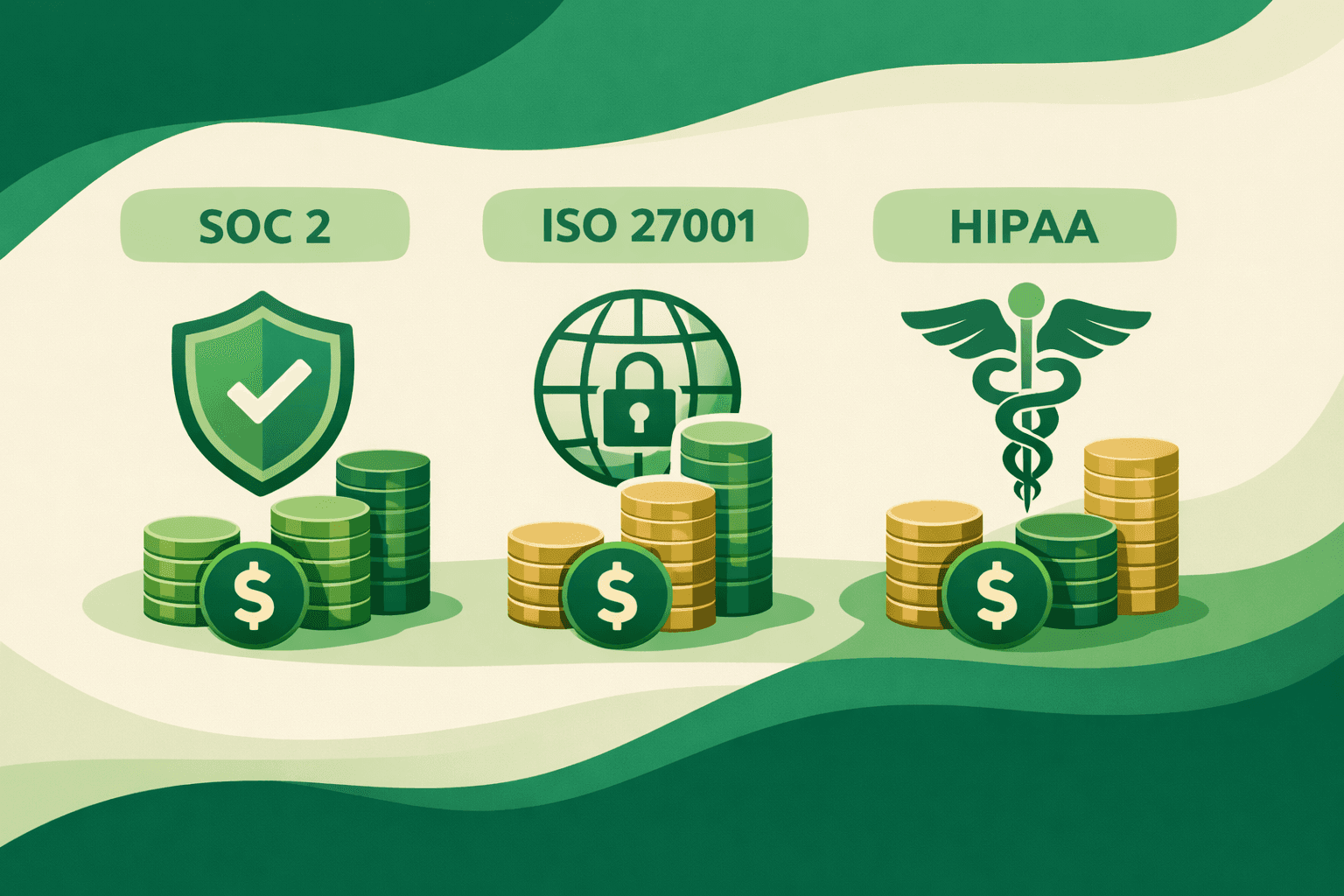
What Healthcare SaaS Companies Actually Budget in 2026
If your company handles protected health information and sells to enterprise buyers, you are likely staring down at least two of these three frameworks — and possibly all three at once. SOC 2 to satisfy security questionnaires. ISO 27001 for international contracts. HIPAA because the law requires it. The question every compliance lead and CFO eventually asks is the same: what is this actually going to cost us?
The problem is that most cost breakdowns treat each framework in isolation. That makes them almost useless for healthcare SaaS companies that need to plan a multi-framework compliance program from scratch. This guide breaks down the real cost drivers for SOC 2, ISO 27001, and HIPAA individually — then shows you how the math changes when you pursue them together, and what automation does to the total.
What Drives Compliance Costs Across All Three Frameworks
Before comparing numbers, it helps to understand that the cost of any compliance program falls into four buckets, regardless of which framework you are pursuing.
The first is readiness work — gap assessments, policy creation, control implementation, and internal remediation before an auditor ever walks in the door. The second is audit or certification fees, which you pay to the external firm that assesses or certifies you. The third is tooling — the software you use to collect evidence, manage controls, and continuously monitor your environment. The fourth is personnel time — the hours your team spends on compliance activities, which is almost always underestimated and almost never appears in vendor pricing pages.
With that framing in place, here is how the three frameworks compare.
SOC 2 Compliance Costs in 2026
SOC 2 is the most common entry point for SaaS companies because it is what enterprise security teams request during procurement. The audit is performed by a licensed CPA firm and results in a report — either a Type I, which attests to the design of controls at a point in time, or a Type II, which covers operating effectiveness over a period of at least six months.
For a healthcare SaaS company pursuing SOC 2 Type II for the first time, realistic cost ranges are as follows. Readiness and gap assessment typically runs between $15,000 and $40,000 if you use an outside consultant, or significantly more in internal staff hours if you handle it in-house. External audit fees for a mid-size SaaS company with a moderate scope generally range from $20,000 to $50,000 for a Type II, though larger organizations with complex infrastructure can see fees well above $75,000. Tooling for evidence collection and control monitoring adds another $10,000 to $30,000 annually, depending on the platform you choose. Internal personnel time — particularly for engineering leads, your security function, and legal review of the BAA if healthcare data is in scope — can represent another $30,000 to $80,000 in loaded labor costs for the first year.
Total first-year cost for a mid-market healthcare SaaS company pursuing SOC 2 Type II: $75,000 to $200,000.
Renewal years are substantially cheaper. Once controls are in place and your team knows the process, annual Type II audits typically cost $30,000 to $80,000 all-in, assuming tooling remains in place and no major infrastructure changes occur.
ISO 27001 Certification Costs in 2026
ISO 27001 is the international standard for information security management systems. Unlike SOC 2, which produces a report, ISO 27001 results in a certificate issued by an accredited certification body. That certificate is valid for three years, subject to annual surveillance audits.
The cost structure is somewhat different. ISO 27001 requires you to build and document an Information Security Management System, complete a formal risk assessment and risk treatment plan, implement and document controls from Annex A, and then pass a two-stage certification audit.
Stage 1 and Stage 2 certification audit fees for a company with 50 to 200 employees typically range from $15,000 to $35,000 for the external audit alone. Implementation consulting, if used, adds $20,000 to $60,000 for first-time certifications. Annual surveillance audits in years two and three cost roughly $5,000 to $15,000 each, followed by a recertification audit in year three at a cost similar to the initial certification.
Internal implementation work — writing the ISMS documentation, conducting the risk assessment, building the Statement of Applicability, and training staff — is where most of the real cost lives. For a company without a dedicated security team, this can represent 400 to 800 hours of combined staff time in year one.
Total first-year cost for ISO 27001 certification for a mid-market healthcare SaaS company: $60,000 to $150,000.
ISO 27001 has one advantage over SOC 2 regarding ROI clarity. The certificate is internationally recognized and accepted across the EU, UK, APAC, and Middle East markets, making it a direct revenue enabler for companies operating in those geographies.
HIPAA Compliance Costs in 2026
HIPAA is not a certification or an audit in the traditional sense. There is no third party that issues a HIPAA certificate. Instead, HIPAA compliance is an ongoing obligation enforced by the HHS Office for Civil Rights through investigations and penalties. In practice, this means your cost is driven almost entirely by what you do internally — your risk analysis, your policies, your training program, your BAA management, and your technical safeguards.
That said, the costs are real and significant. A formal HIPAA risk assessment — required under the Security Rule — typically costs between $10,000 and $30,000 when performed by an outside firm, or several hundred hours of internal time if conducted by your team. Policy and procedure development for a company with no existing HIPAA program runs $15,000 to $40,000 with outside help. Annual workforce training, which must be documented and role-specific, costs $5,000 to $20,000 depending on headcount and training vendor. Technical safeguard implementation — encryption, access controls, audit logging, transmission security — is highly variable and often the largest cost line, ranging from minimal if your infrastructure is already modern to $50,000 or more if significant remediation is required.
HIPAA also introduces BAA management as an ongoing cost. Every vendor that touches PHI must be covered by a signed Business Associate Agreement. Managing that portfolio — reviewing agreements, tracking renewals, assessing subcontractor risk — is an ongoing operational expense that most companies underestimate until their first breach investigation.
Total first-year cost to build a credible HIPAA compliance program from scratch: $50,000 to $150,000, depending on organization size and current state of technical controls.
The Multi-Framework Advantage: Why Pursuing All Three Together Costs Less Than Doing Them Sequentially
Here is what most cost guides miss. When you pursue SOC 2, ISO 27001, and HIPAA as a coordinated program rather than three separate projects, the total cost drops materially — often by 30 to 50 percent compared to sequential implementation.
The reason is control overlap. A large percentage of the controls required by all three frameworks are functionally identical. Access control policies, encryption standards, incident response procedures, vendor management programs, employee security training, and audit logging requirements appear in all three. If you implement them to the most demanding standard across the three frameworks, you satisfy all three simultaneously. You do not write three access control policies. You write one that maps to SOC 2 CC6.1, ISO 27001 Annex A 5.15 through 5.18, and the HIPAA Security Rule technical safeguard for access control at the same time.
The practical implication for budget planning: a coordinated three-framework program for a mid-market healthcare SaaS company typically runs $120,000 to $280,000 in year one, versus $185,000 to $500,000 if the three frameworks are pursued in separate multi-year initiatives.
What Compliance Automation Does to These Numbers
The figures above assume a largely manual compliance process — consultants, spreadsheets, email-based evidence collection, and point-in-time audits. That model is rapidly being replaced by continuous compliance platforms that automate control monitoring, evidence collection, policy management, and cross-framework mapping.
The impact on cost is significant. Automated evidence collection eliminates the single largest internal labor cost in both SOC 2 and ISO 27001 programs. Continuous monitoring replaces periodic manual reviews and dramatically reduces the time between control failure and remediation. Cross-framework control mapping — the ability to implement a control once and have it satisfy multiple frameworks simultaneously — is the single most powerful cost lever available to companies pursuing SOC 2, ISO 27001, and HIPAA together.
For a company using a modern compliance automation platform, total all-in costs for a three-framework program drop to roughly $80,000 to $180,000 in year one, with ongoing annual costs in the $40,000 to $90,000 range. The reduction is primarily in internal labor and consultant spend, not in external audit fees — auditors still need to be paid, but they require far less preparation time when evidence is continuously collected and organized.
What to Budget For: A Planning Checklist
When building your compliance budget for 2026, the line items to include are a readiness and gap assessment covering all three frameworks simultaneously, policy and procedure development mapped to the control overlap across SOC 2 / ISO 27001 / HIPAA, technical safeguard implementation costs including any infrastructure remediation, external audit and certification fees for SOC 2 Type II and ISO 27001 Stage 1 and 2, annual workforce training for HIPAA and general security awareness, tooling for continuous control monitoring and evidence collection, BAA management and vendor risk assessment, and dedicated personnel time — either a fractional CISO, compliance manager, or equivalent internal resource.
Trying to run a multi-framework compliance program entirely on the side of existing engineering and legal team capacity is the most common cause of failed or delayed compliance initiatives. Budget for the person, not just the tools and auditors.
The dsalta.com platform is purpose-built for exactly this challenge — continuous, multi-framework compliance that maps controls across SOC 2, ISO 27001, and HIPAA in a single environment, so you build once and satisfy all three. Learn more at dsalta.com.


Explore more AI Compliance articles
Stop losing deals to compliance.
Get compliant. Keep building.
Join 100s of startups who got audit-ready in days, not months.