AI Compliance —
AI Compliance 2026: Build Your Governance Framework
Learn how the EU AI Act, US framework, and UAE Charter affect your business — and how to build a governance strategy that protects you in 2026.
Dogan Akbulut
AI Regulatory Compliance
Share this article


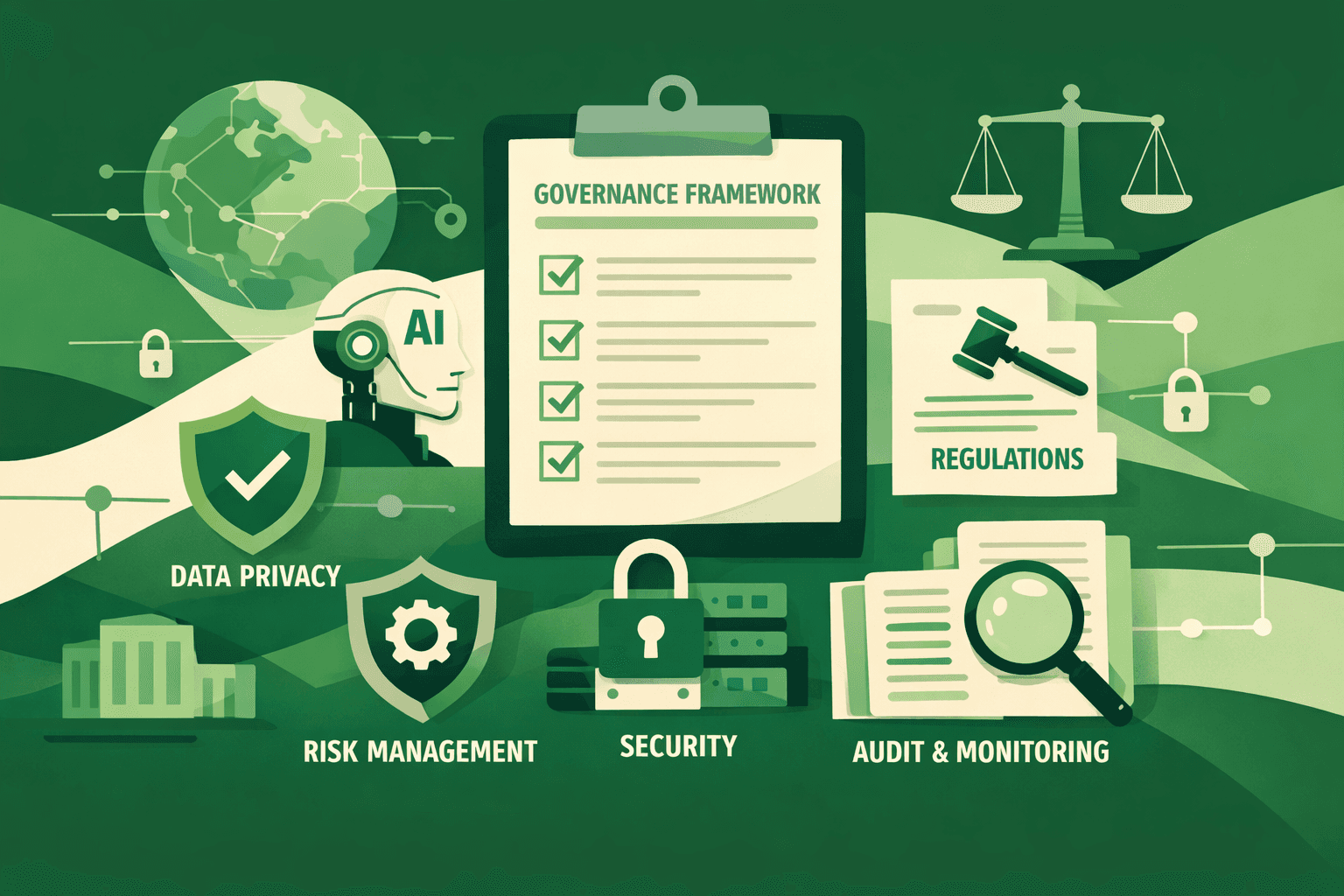
Build Your Governance Framework - AI
If your company builds, deploys, or uses AI systems in any capacity, you are already inside the scope of emerging global regulation. The EU AI Act is actively phasing in obligations. The United States issued a national AI framework in December 2025. The UAE has formalized its own AI Charter with enforcement bodies already in place. The window to get ahead of this is not 2027 — it is right now. This guide breaks down what each regulation requires, what governance actually looks like in practice, and the concrete steps compliance, legal, and technology leaders need to take before enforcement ramps up in 2026.
Why 2026 Is the Year AI Governance Becomes Non-Negotiable
For the past several years, AI governance existed in a gray zone — widely discussed but loosely enforced. That era is ending. Governments on three continents have moved from publishing principles to codifying obligations, and the penalties for non-compliance are no longer theoretical.
The organizations most at risk are not reckless ones. They are thoughtful companies that treated governance as a post-deployment concern rather than a design-stage requirement. Retrofitting accountability into an AI system that is already in production is exponentially more expensive — technically, legally, and reputationally — than building it in from the start.
The calculus has shifted. Companies that act early will carry a meaningful competitive advantage: demonstrable trustworthiness in a market where trust is increasingly scarce, and regulators are increasingly watchful.
The Three Regulatory Frameworks Shaping AI Compliance in 2026
The EU AI Act: The World's Most Comprehensive AI Law
The EU AI Act represents the most detailed and far-reaching AI regulatory framework currently in force. Throughout 2025, its key provisions began to phase in, including outright prohibitions on certain uses of biometric surveillance by law enforcement, mandatory transparency requirements for limited-risk and general-purpose AI systems, and a comprehensive set of obligations for high-risk AI systems, which are expected to take full effect in 2026.
For businesses operating in or selling into EU markets, the practical implications are significant. High-risk AI systems — those used in hiring, credit scoring, healthcare triage, education, law enforcement, critical infrastructure, and similar domains — face the most stringent requirements. These include mandatory conformity assessments, detailed technical documentation, data governance requirements, human oversight mechanisms, and ongoing post-market monitoring.
Even organizations outside these high-risk categories face baseline transparency obligations. If your product uses AI to make decisions that affect people, your customers now have the right to know that — and in many cases, to understand why.
Key compliance actions for EU AI Act:
Classify your AI systems by risk tier (unacceptable, high, limited, minimal)
Document data sourcing, model validation, and bias mitigation processes for high-risk systems
Implement human oversight mechanisms and logging for any system affecting consequential decisions
Prepare a conformity assessment process if you operate in a regulated sector
The United States National AI Framework: Reducing Fragmentation, Raising the Floor
In December 2025, an executive order introduced a national AI framework in the United States. Its primary aim is to establish unified federal standards and reduce the patchwork of state-level AI laws that have created significant compliance complexity for businesses operating across state lines.
While the US framework is less prescriptive than the EU AI Act, its significance lies in signaling. Federal standardization means that AI governance is no longer a question of whether to invest — only how much and how fast. Organizations that built compliant programs in anticipation of a national framework are already positioned to demonstrate accountability to regulators, customers, and partners.
For businesses in highly regulated US sectors — financial services, healthcare, insurance, and employment — the framework aligns with and reinforces existing sectoral obligations under FINRA, HIPAA, EEOC guidance on algorithmic hiring, and similar bodies.
Key compliance actions for the US national framework:
Conduct an AI inventory across your organization to catalog what systems exist and what decisions they influence
Map existing sectoral obligations (HIPAA, FCRA, EEOC) to your AI use cases
Establish audit trail documentation for any AI-assisted decision affecting customers or employees
The UAE AI Charter: Balancing Ethics With Innovation
Closer to the Gulf region, the UAE introduced its Charter for the Development and Use of Artificial Intelligence in mid-2024. The Charter establishes principles around safety, privacy, bias mitigation, and human oversight — and is reinforced by federal data protection laws, with the Artificial Intelligence and Advanced Technology Council serving as a dedicated governance body.
What distinguishes the UAE's approach is its dual mandate: ethical oversight without sacrificing the innovation-friendly environment the country has built. For businesses operating in the UAE or across the GCC, this signals that AI governance is both an ethical expectation and a question of market access. Government contracts, enterprise partnerships, and investment relationships will increasingly require demonstrable alignment with the Charter's principles.
Key compliance actions for UAE AI Charter:
Review privacy and data handling practices for any AI system processing personal data
Document bias mitigation steps for customer-facing AI systems
Establish human oversight mechanisms and escalation processes for AI-driven decisions
What AI Governance Actually Looks Like in Practice
The word "governance" can feel abstract. In practice, AI governance is a set of concrete decisions, documented processes, and accountable people. Here is what a functioning governance framework requires.
A Formal AI Governance Policy
Every organization using AI at any scale needs a written governance policy. This document defines how AI decisions are made, who is accountable for them, how risk is assessed before deployment, and what standards apply to fairness, transparency, security, and data quality. Without a policy, there is no baseline — and no way to demonstrate compliance to an auditor, regulator, or enterprise customer during due diligence.
The policy should cover data sourcing standards, model validation requirements, bias assessment processes, and incident response procedures for when an AI system behaves unexpectedly.
Cross-Functional Oversight Committee
AI governance cannot live inside a single team. Effective oversight requires regularly bringing together legal, technical, product, and business leaders to review the AI system portfolio, assess emerging regulatory requirements, and sign off on high-risk deployments. This committee structure is what turns a policy document into an operating practice.
It also serves a critical accountability function. When regulators or customers ask who is responsible for a given AI decision, a governance committee with clear records of its deliberations is the most defensible answer available.
Documented AI Lifecycle Management
Regulators — particularly under the EU AI Act — expect documentation at every stage of the AI lifecycle, not just at deployment. This includes records of training data sources, data quality assessments, model performance benchmarks, bias testing results, changes made over time, and ongoing monitoring outcomes.
Organizations that lack this documentation will find themselves in an expensive catch-up exercise when audits arrive. Those who build it as a standard operating procedure will find compliance reviews routine rather than disruptive.
Transparency and Explainability: Now Baseline Requirements
Two concepts that once belonged primarily to academic AI ethics discourse have become regulatory obligations: transparency and explainability.
Transparency means disclosing that an AI system is being used and for what purpose. This is now a mandatory requirement under the EU AI Act for any system that interacts with users — chatbots, recommendation engines, automated customer service — and is fast becoming an expectation in the United States and the UAE as well.
Explainability goes further. It requires that organizations be able to articulate why an AI model produced a particular outcome. Why was this loan application declined? Why was this job candidate ranked lower? Why was this medical flag raised? For high-risk applications, the answer to that question needs to be documentable and auditable.
Research from Stanford University identifies limited explainability as one of the primary barriers to scaling AI in regulated industries. Meanwhile, Microsoft's 2025 Responsible AI Transparency Report found that more than 75 percent of organizations using responsible AI tools for risk management reported measurable improvements in data privacy, customer trust, brand reputation, and decision-making confidence.
The business case for explainability is not just regulatory. It is commercial. Enterprise buyers in financial services, healthcare, and insurance are now conducting AI due diligence as part of vendor selection. If you cannot explain how your AI works, you cannot close those deals.
Practical steps for improving AI transparency:
Implement model cards or fact sheets that document the purpose, limitations, and performance metrics of each AI system
Build explainability logging into high-risk AI systems at the architecture level
Create plain-language explanations for any AI-generated decision communicated to a customer or employee
Upskilling Your Workforce Is Part of Compliance
AI regulation does not stop with your compliance or legal team. It restructures skill requirements across the entire organization, and regulators increasingly expect organizations to demonstrate that AI literacy is embedded in their operations — not siloed in a technical function.
Consider what this looks like in practice. Marketing teams using AI-driven personalization need to understand how these tools interact with privacy laws such as GDPR and CCPA. HR teams using applicant tracking or performance scoring systems need to be able to assess whether those systems introduce bias and document their oversight of that risk. Product managers need to produce the documentation regulators require — which means understanding what documentation is required in the first place.
This is not about making everyone a machine learning engineer. It is about raising the floor of AI literacy so that the people closest to real-world AI deployments can identify risk, ask the right questions, and operate responsibly within regulatory boundaries.
Organizations that invest in AI ethics training and regulatory literacy across functions now will have a demonstrable advantage when auditors arrive — and when enterprise customers conduct compliance due diligence before signing contracts.
The Cost of Waiting: Why Proactive Governance Is Cheaper Than Reactive Compliance
The argument for deferring investment in AI governance is understandable. Governance work is not revenue-generating. It consumes engineering bandwidth, legal time, and leadership attention. It can feel like overhead.
But the cost comparison is not between governance investment and zero cost. It is between investing in governance now and the cost of retrofitting compliance into production systems under regulatory pressure, with the added risk of fines, customer attrition, and reputational damage if something goes wrong in the interim.
The EU AI Act carries penalties of up to €35 million or 7% of global annual turnover for the most serious violations. US federal enforcement mechanisms, while still developing, carry significant reputational consequences in regulated industries where institutional relationships are commercially critical. And in the UAE, government and enterprise procurement increasingly requires demonstrable alignment with the AI Charter.
Guardrails built into AI systems at the design stage cost a fraction of what they cost to add after deployment. Audit trails created as a standard practice are available immediately when needed. Governance policies written proactively are coherent; those written reactively in response to a specific incident rarely are.
How DSALTA Helps You Build AI Governance That Works
DSALTA's AI compliance platform is built for exactly this transition — from ad hoc AI use to documented, auditable, regulatory-ready governance.
With DSALTA, organizations can establish a formal AI governance policy framework aligned with the EU AI Act, US national standards, and UAE Charter requirements — without starting from scratch. The platform automates evidence collection across the AI lifecycle, tracks regulatory changes as they occur, and produces the documentation compliance teams need for internal audits, customer due diligence, and regulatory review.
For organizations already managing SOC 2, ISO 27001, HIPAA, or GDPR programs, DSALTA's cross-framework architecture means AI governance integrates directly into your existing compliance infrastructure — not as a separate workstream, but as a unified program.
Key Takeaways for Compliance and Technology Leaders
The regulatory environment in 2026 is unambiguous: AI governance is a business requirement, not a voluntary best practice. The EU AI Act, the US national AI framework, and the UAE AI Charter collectively represent a global convergence toward transparency, accountability, and documented human oversight.
Organizations that build governance at the design stage reduce future compliance costs, accelerate enterprise sales cycles, and reduce the reputational risk of high-profile AI failures. Those that wait face retrofitting costs, regulatory exposure, and the harder task of rebuilding trust after the fact.
The decision is not whether to invest in AI governance. It is how early, and with what infrastructure.
Frequently Asked Questions
What is an AI governance framework? An AI governance framework is a structured set of policies, processes, oversight mechanisms, and documentation standards that define how an organization develops, deploys, and monitors AI systems responsibly and in compliance with applicable regulations.
Who needs to comply with the EU AI Act? Any organization that develops, deploys, or uses AI systems within the European Union — or whose AI systems affect EU residents — falls within the scope of the EU AI Act. High-risk AI systems face the most demanding obligations.
What does AI transparency mean in practice? AI transparency requires disclosing when an AI system is being used and, in many cases, explaining the logic behind AI-generated decisions. Under the EU AI Act, this is a mandatory obligation for a wide range of systems, not a voluntary practice.
How does DSALTA support AI compliance? DSALTA provides an AI compliance platform that helps organizations build governance policies, automate evidence collection, track regulatory requirements, and maintain audit-ready documentation across multiple frameworks, including the EU AI Act, SOC 2, ISO 27001, and HIPAA.
What are the penalties for non-compliance with the EU AI Act? Penalties for the most serious violations under the EU AI Act can reach €35 million or 7 percent of global annual turnover, whichever is higher. Penalties for other violations are scaled by severity and organization size.
DSALTA is an AI compliance software company helping organizations build audit-ready governance programs for SOC 2, ISO 27001, HIPAA, GDPR, and the EU AI Act. Learn more at dsalta.com.


Explore more AI Compliance articles
Stop losing deals to compliance.
Get compliant. Keep building.
Join 100s of startups who got audit-ready in days, not months.