AI Compliance —
AI Red Teaming for Compliance
Cyber insurers now require documented AI red teaming. Learn how adversarial testing maps to SOC 2, ISO 42001 & NIST AI RMF before your next audit.
Jon Ozdoruk
AI Regulatory Compliance
Share this article


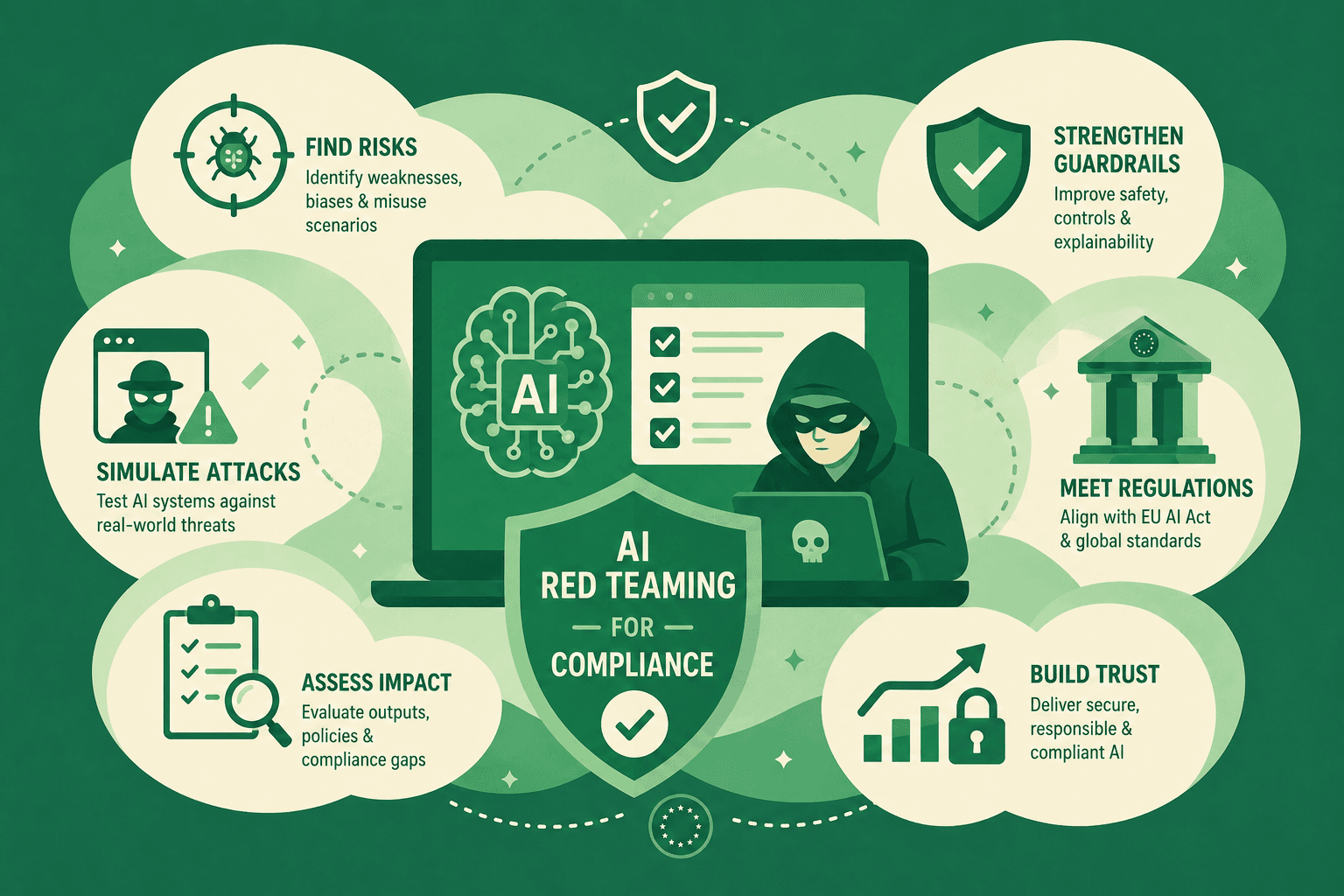
AI Red Teaming for Compliance: What SOC 2, ISO 42001, and NIST AI RMF Now Require
Your penetration testing program was built for networks and applications. It was not built for AI systems that hallucinate, leak training data under adversarial pressure, execute injected instructions from untrusted documents, and fail in ways no static vulnerability scanner can predict.
Cyber insurers noticed first. As of Q2 2026, carriers are writing AI Security Riders into policies that condition coverage on documented adversarial testing of AI deployments. The OWASP Foundation confirmed the shift in its Q2 2026 AI and Agentic Red Teaming landscape report: the compliance wave has arrived, and the EU GPAI Code of Practice, which will be enforced in August 2026, is the regulatory catalyst that made it mandatory rather than optional.
This is the problem your compliance program has not solved yet. AI red teaming — structured adversarial testing designed to find how AI systems fail before an attacker, auditor, or regulator does — is now the expected baseline for any organization deploying AI in a regulated environment. This guide maps exactly what it requires, how it connects to the frameworks you are already operating under, and what a defensible program looks like in practice.
What Is AI Red Teaming and How Is It Different from Traditional Penetration Testing?
AI red teaming is a structured process of adversarial testing designed to identify how an AI system can be manipulated, deceived, or caused to fail in ways that create security, safety, or compliance risk. It is distinct from traditional penetration testing in three fundamental ways.
Traditional pen testing probes known vulnerability classes — unpatched CVEs, misconfigured access controls, and injection vulnerabilities in deterministic code. The same input always produces the same output; testing is exhaustive within a defined scope.
AI systems are probabilistic. The same prompt can produce different outputs across sessions. Model behavior drifts as training data changes. Failure modes are emergent — they appear only under specific combinations of inputs that no static scanner can enumerate. AI red teaming is therefore inherently iterative, requires domain expertise in both adversarial machine learning and the business context of the system under test, and must cover attack classes not found in traditional security tooling.
The three attack surfaces that AI red teaming specifically targets are:
Prompt injection and jailbreaking. OWASP ranks prompt injection as the #1 LLM vulnerability for two consecutive editions of the LLM Top-10. Attackers embed instructions in user inputs or ingested documents that override the model's intended behavior. Jailbreaking uses social engineering techniques — roleplay, hypothetical framing, encoded instructions — to bypass safety guardrails. Both attacks are invisible to WAFs and traditional application security tools.
Data and model attacks. Training data poisoning introduces malicious patterns during model development, causing predictable misbehavior at inference time. Model extraction attacks reconstruct the weights of proprietary models through repeated queries. Model inversion attacks recover training data — including PII and PHI — from model outputs. MITRE ATLAS, the adversarial threat library specifically built for AI systems, documents all of these as confirmed production attack techniques rather than theoretical risks.
Agentic and supply chain attacks. When AI systems take autonomous actions across tools and APIs, the attack surface expands dramatically. A single prompt injection in a document an agent ingests can cascade into unauthorized file access, exfiltration of sensitive data, or manipulation of downstream systems. The OWASP Autonomous Pentesting Standard (APTS) v0.1.0 — the first governance framework built specifically for autonomous AI testing, hosted under the OWASP Foundation — addresses exactly this class of risk with 173 requirements across eight domains.
Why Cyber Insurers Are Now Requiring Documented AI Red Teaming
The insurance market moved faster than most compliance programs anticipated — and it is now applying direct commercial pressure on AI governance.
As of early 2026, cyber insurers are writing AI Security Riders into policies that require documented evidence of adversarial testing before coverage attaches to AI-related incidents. The pattern mirrors what happened with multi-factor authentication circa 2021: what began as a premium discount incentive became a coverage prerequisite within 18 months. AI red teaming is following the same trajectory.
The SEC identified AI-driven threats to data integrity as a FY2026 examination priority and is considering enhanced disclosure requirements for organizations that cannot demonstrate AI security practices. Carriers that cannot price AI risk are excluding it — and the exclusion language in Insurance Services Office filings CG 40 47 and CG 40 48 (effective January 2026) is broad enough to encompass incidents where an AI system's output causes harm that the organization could have identified through adversarial testing.
The practical consequence: organizations that deploy AI in customer-facing systems, handle regulated data through AI workflows, or use agentic AI for business-critical decisions now face a binary choice. Either demonstrate a documented red teaming program with scope, methodology, findings, and remediation, or accept that AI-related incidents may be uninsured.
Organizations with documented AI security testing already pay lower premiums than those without. The governance documentation you produce for a red teaming exercise is the same documentation your carrier's underwriting questionnaire will request at renewal.
How AI Red Teaming Maps to SOC 2, ISO 42001, and NIST AI RMF
This is the section most compliance programs get wrong. AI red teaming is not a standalone exercise outside your existing framework. It maps directly to controls you are already required to operate — and the absence of AI-specific testing creates findings in frameworks you thought you had covered.
SOC 2 — Relevant Trust Services Criteria
CC7.1 — Detection of Security Events. SOC 2 requires that you detect and monitor security events affecting system components. An AI system that can be manipulated through prompt injection or jailbreaking represents an unmonitored attack surface if it has never been adversarially tested. Auditors in 2026 are increasingly asking: how do you know your AI components behave as intended under adversarial conditions?
CC4.1 — Risk Assessment. Common Criteria 4.1 requires periodic risk assessment of changes to the system environment. Every AI model update, new AI feature deployment, or expansion of an AI system's access permissions constitutes a change that triggers a risk assessment obligation — one that must include an assessment of adversarial behavior under the 2026 audit interpretation of the criteria.
CC9.2 — Vendor Risk Management. If your organization uses third-party AI APIs, foundation models, or AI-powered SaaS tools in your in-scope environment, those systems must be included in your vendor risk program. Documenting that a vendor has conducted AI red teaming — or commissioning your own red team exercise against the integration — is the evidence that satisfies CC9.2 for AI-specific vendor risk.
A1.2 — Capacity and Performance Monitoring (Availability criterion). Denial-of-service attacks against inference endpoints — including prompt flooding attacks designed to exhaust rate limits or degrade model performance — fall under the Availability trust service category. AI red teaming scope should include availability testing for customer-facing AI components.
ISO/IEC 42001:2023 — AI Management System Controls
ISO 42001 is the first internationally certifiable AI Management System standard. Its controls address AI risk across the full lifecycle, and several map directly to adversarial testing requirements.
Clause 6.1 — Actions to address risks and opportunities. ISO 42001 requires that organizations identify AI-specific risks and plan actions to address them. A risk register that does not account for prompt injection, model extraction, training data poisoning, or excessive agency in agentic systems is incomplete under this clause. Red teaming is the primary mechanism for validating that identified risks have been correctly characterized.
Clause 9.1 — Monitoring, measurement, analysis, and evaluation. Organizations must establish what to monitor in their AI systems, how to do it, and when to analyze results. Adversarial testing is the monitoring mechanism for behavioral risks that continuous telemetry cannot detect — a model may perform correctly on production traffic while remaining vulnerable to crafted adversarial inputs that only appear during deliberate testing.
Clause 10.1 — Continual improvement. ISO 42001 explicitly requires that organizations improve their AI management system based on findings. Red teaming findings — documented, triaged, and remediated — are the evidence base that satisfies this clause and demonstrates maturity progression between certification cycles.
Organizations already holding ISO 27001 certification can achieve ISO 42001 certification approximately 40% faster due to control overlap. Both standards share requirements for access control, supplier relationships, incident management, and audit logging — the AI-specific additions under 42001 build on what you have already built.
NIST AI RMF 1.0 — Govern, Map, Measure, Manage
The NIST AI Risk Management Framework does not use the term "red teaming" in its core document — but adversarial testing is the operational mechanism behind its Measure function, and the April 7, 2026, NIST concept note for an AI RMF Profile on Trustworthy AI in Critical Infrastructure explicitly addresses adversarial robustness testing as a sector-specific practice.
Govern. The Governance function requires policies, roles, and accountability structures for AI risk. Your AI red teaming program needs a charter: who commissions it, who conducts it (internal or third-party), what scope and methodology it covers, and how findings flow into remediation and risk acceptance decisions.
Map. The Map function requires identifying AI system context, stakeholders, and risk exposure. Red teaming scope definition is the operationalization of Map — you cannot define what to test adversarially until you have mapped what the system does, what data it accesses, what actions it can take, and who is affected when it fails.
Measure. This is where red teaming lives. NIST AI RMF Measure asks: how do you know your AI system performs safely and securely under the conditions it will actually encounter? Adversarial robustness testing, prompt injection testing, and behavioral red teaming are the Measure-function activities that provide evidence-based answers rather than attestations.
Manage. Red teaming findings must flow into a management process: triage, risk rating, remediation ownership, and closure verification. Findings that sit in a report without a documented management response are not Manage-function evidence — they are an audit liability.
The MITRE ATLAS Framework: Your Adversarial Threat Library for AI
MITRE ATLAS (Adversarial Threat Landscape for Artificial-Intelligence Systems) is the AI-specific equivalent of the ATT&CK framework. It catalogs adversarial tactics, techniques, and procedures (TTPs) observed or demonstrated against AI systems in production environments.
For compliance purposes, MITRE ATLAS serves two functions. First, it provides a threat taxonomy to drive your red teaming scope — rather than running ad hoc tests, an ATLAS-structured exercise systematically covers documented attack patterns. Second, it provides the evidence language that regulators and auditors understand: demonstrating that your red teaming addressed ATLAS technique AML.T0043 (Craft Adversarial Data) or AML.T0048 (Erode ML Model Integrity) is more defensible than describing tests in natural language that an auditor cannot map to a recognized framework.
Key ATLAS tactic categories relevant to compliance-driven red teaming:
Reconnaissance and resource development: how attackers learn enough about your AI system to craft targeted attacks. Testing should include what information about your AI systems is publicly discoverable.
Model access and inference attacks that extract information from a deployed model or manipulate its behavior through the inference API. This includes model extraction, membership inference, and evasion attacks.
Exfiltration techniques for extracting training data, model weights, or sensitive information through AI system outputs. Particularly relevant for systems trained on or processing regulated data.
What a Compliance-Ready AI Red Teaming Program Looks Like
A documented AI red teaming program that satisfies SOC 2, ISO 42001, NIST AI RMF, and cyber-insurance underwriting requirements has five components. The absence of any one of them creates an evidence gap that your auditor or carrier will find.
1. Scope Definition Document
Before testing begins, document in writing: which AI systems are in scope (specific models, versions, integrations, and agentic workflows), what data categories those systems access or process, what the trust boundary is (what can a red teamer do that an external attacker cannot, and why), and what success and failure criteria look like. This document is the charter evidence for NIST AI RMF Governance and ISO 42001 Clause 6.1.
2. Threat Model Aligned to MITRE ATLAS and OWASP LLM Top-10
Produce a written threat model that identifies the most plausible adversarial scenarios for your specific AI system, mapped to MITRE ATLAS techniques and OWASP LLM Top-10 categories. This is not generic — a customer service chatbot with access to order history has a different threat model than a coding assistant with repository access or a clinical decision support tool processing PHI.
The threat model drives test case design: if your most plausible threat is a prompt-injection attack via customer-submitted text, your test cases should systematically cover direct injection, indirect injection via ingested documents, context manipulation, and role-confusion attacks. If your most plausible threat is training data extraction, test cases should cover membership inference attacks and verbatim memorization probes.
3. Test Execution and Evidence Package
Execute tests against your documented threat model and preserve an evidence package that includes: test case descriptions, exact inputs used, model outputs observed, classification of each finding (critical, high, medium, low), and the MITRE ATLAS or OWASP LLM Top-10 category each finding maps to.
This package is the Measure-function evidence for NIST AI RMF and the monitoring evidence for ISO 42001 Clause 9.1. It is also what your cyber-insurance carrier's underwriter will request when AI Security Rider conditions are verified at renewal.
4. Findings Register with Remediation Tracking
Every finding from the red team exercise must be entered into a findings register with the risk rating, remediation owner, target remediation date, and current status. Findings that are accepted rather than remediated require documented risk acceptance with business justification and approval from an appropriate authority.
This register is the Manage function evidence for NIST AI RMF and satisfies the ISO 42001 Clause 10.1 continual improvement requirements. SOC 2 auditors reviewing CC4.1 (risk assessment) and CC7.1 (security event detection) will ask to see this register and confirm that open findings have active remediation plans.
5. Cadence and Trigger-Based Retesting
A single red teaming exercise does not produce a program — it produces a point-in-time assessment. A program requires a defined cadence (annual at minimum for stable systems, following each major model update, and following each significant expansion of AI system access permissions) and defined triggers for out-of-cycle testing: discovery of a new OWASP-classified vulnerability class, a relevant incident at a peer organization, or a significant change in the threat landscape.
Document your cadence and triggers in your AI red teaming charter. This documentation is what distinguishes a compliance-ready program from a one-time exercise that satisfies this year's audit and creates a gap next year.
What to Do in the Next 30 / 60 / 90 Days
Days 1–14: Inventory every AI system in your environment that touches regulated data or is deployed in a customer-facing context. For each system, document: model or API used, data categories it accesses, actions it can take autonomously, and current testing coverage. This inventory is the prerequisite for everything that follows.
Days 15–30: Select a starting scope — one AI system or integration that represents your highest-risk deployment — and produce a threat model for it using MITRE ATLAS and OWASP LLM Top-10 as the taxonomy. Assign a remediation owner for findings before testing begins, not after. Draft your AI red teaming charter and get it approved by your security and compliance leadership.
Days 31–60: Execute your first red teaming exercise against the scoped system. Prioritize prompt injection, indirect prompt injection through ingested documents, and excessive agency testing for any agentic components. Document findings with MITRE ATLAS mappings. Open findings in your remediation tracking system with owners and target dates.
Days 61–90: Map your red teaming program documentation to your active compliance frameworks. For SOC 2, update your risk assessment documentation to include coverage of adversarial AI testing. For ISO 42001 (or your ISO 27001 program if 42001 is a future target), document the red teaming exercise as evidence for Clauses 6.1, 9.1, and 10.1. Pull your cyber-insurance policy's AI Security Rider (if applicable) and verify that your documented program satisfies the rider's evidence requirements. If it does not, close the gap before your next renewal conversation.
Frequently Asked Questions
What is AI red teaming, and why does it matter for compliance? AI red teaming is structured adversarial testing of AI systems designed to find how they fail under attack conditions, including prompt injection, model manipulation, and data extraction. It matters for compliance because SOC 2, ISO 42001, NIST AI RMF, and cyber-insurance underwriting now treat it as an expected security control for organizations deploying AI in regulated environments.
Is AI red teaming the same as penetration testing? No. Traditional penetration testing covers deterministic software vulnerabilities — unpatched CVEs, misconfigured access controls, and injection flaws in code. AI red teaming addresses probabilistic system failures that emerge only under adversarial input conditions: prompt injection, jailbreaking, training data extraction, and agentic system manipulation. Both are needed; neither substitutes for the other.
Does SOC 2 require AI red teaming? SOC 2 does not use the term "AI red teaming," but Common Criteria CC7.1, CC4.1, and CC9.2 create obligations that AI red teaming satisfies. Auditors in 2026 are interpreting these criteria to require evidence that AI system components have been tested for adversarial behavior, particularly for in-scope systems processing regulated data.
What frameworks should an AI red teaming program reference? OWASP LLM Top-10 v2025 for vulnerability taxonomy, MITRE ATLAS for adversarial technique mapping, NIST AI RMF 1.0 for governance structure, and ISO/IEC 42001:2023 for certifiable management system requirements. For agentic AI systems specifically, the OWASP Autonomous Pentesting Standard (APTS) v0.1.0 provides the first framework purpose-built for autonomous AI testing.
How often should AI red teaming be conducted? Annually at minimum for stable systems, plus after every significant model update, after any expansion of AI system access permissions, and whenever a new OWASP-classified AI vulnerability class is publicly disclosed. One-time exercises satisfy a point-in-time audit question; a defined cadence with documented triggers is what satisfies a program-level compliance requirement.
Build Your AI Red Teaming Program Before Your Next Audit Asks for It
The OWASP Q2 2026 AI and Agentic Red Teaming landscape is unambiguous: the compliance wave has arrived. Cyber insurers are writing coverage conditions around documented adversarial testing. Auditors are requesting it under the existing SOC 2 and ISO 27001 criteria. NIST AI RMF and ISO 42001 both require evidence of what it produces. The EU GPAI Code of Practice, enforcing August 2026, makes adversarial robustness testing an obligation for GPAI model deployers.
The organizations that build their AI red teaming programs now with documented scope, MITRE ATLAS threat models, evidence packages, and remediation registers will enter their next audit cycle with a defensible posture. Those who treat it as a future initiative will be explaining a gap to their auditor and insurer simultaneously.
DSALTA's AI compliance platform connects your red teaming evidence directly to your SOC 2, ISO 42001, NIST AI RMF, and ISO 27001 control frameworks so findings flow into your compliance program automatically, not manually.


Explore more AI Compliance articles
Stop losing deals to compliance.
Get compliant. Keep building.
Join 100s of startups who got audit-ready in days, not months.