AI Compliance —
California AI Laws 2026: Compliance Guide for SaaS & Enterprise
18+ California AI laws are already in force. Colorado AI Act hits June 30. Get the complete US state AI compliance guide covering CCPA ADMT, SB 53 & more.
Deepika
AI Regulatory Compliance
Share this article


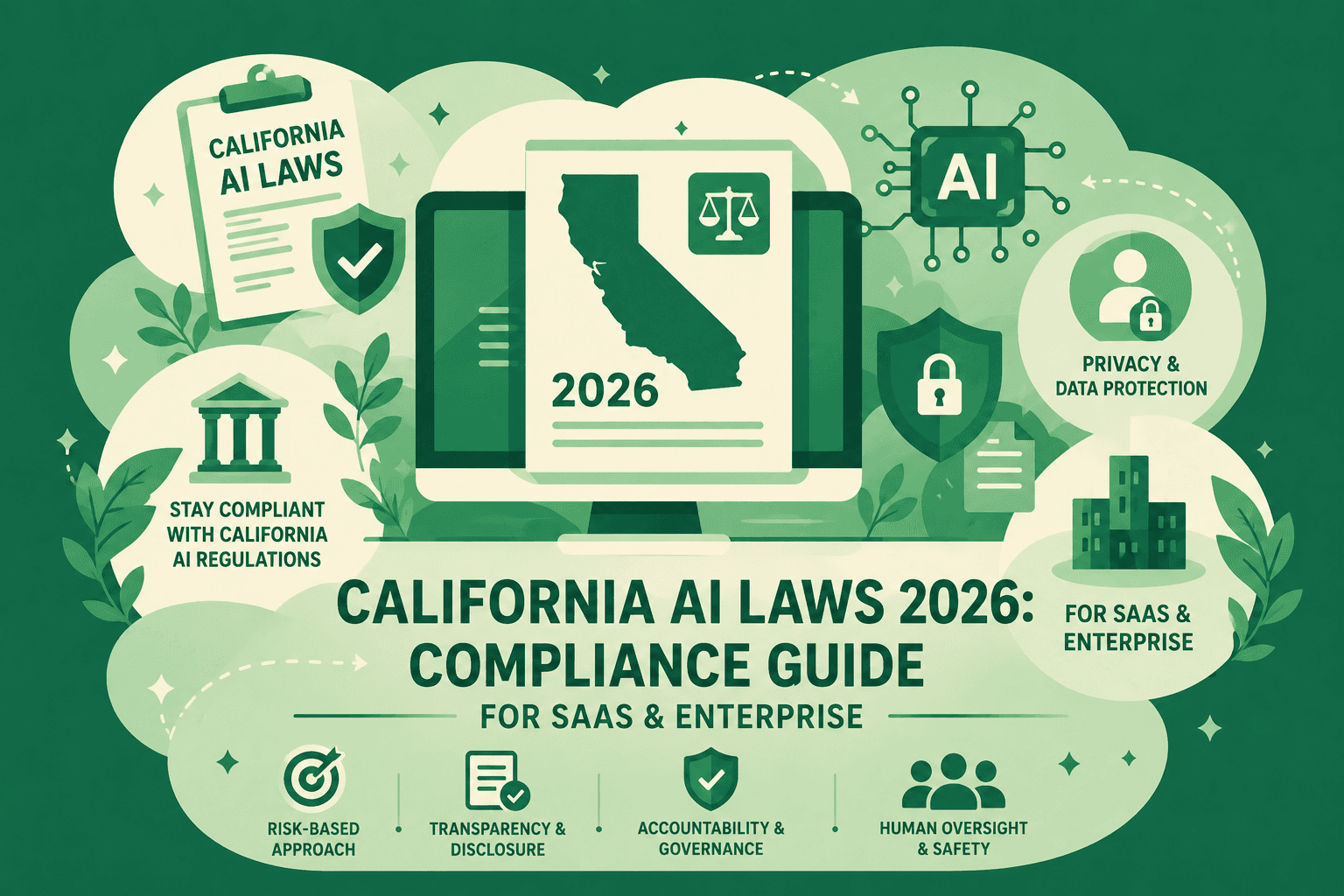
California AI Laws 2026: The Complete Compliance Guide for SaaS and Enterprise
If your AI compliance program only covers the EU AI Act, you have a gap that is already being enforced.
California enacted more than 18 AI-related laws in 2023 and 2024. Most of them became operative on January 1, 2026. A second wave, including the California AI Transparency Act, hits on August 2, 2026. And the Colorado AI Act, the most comprehensive high-risk AI law in the US, goes into effect June 30, 2026 — 45 days from now.
These laws are not theoretical. The California Privacy Protection Agency has hundreds of active investigations open. Fines can reach $7,500 per intentional violation, assessed per consumer. A hiring AI that screened 40,000 applicants without required disclosures compounds that exposure rapidly.
This guide maps every US state AI law currently in force or imminent in 2026, what each requires from your compliance and security teams, and how they connect to the frameworks you are already operating under — SOC 2, ISO 27001, and NIST AI RMF.
Why California Is Now the De Facto US AI Regulator
The federal government has not passed comprehensive AI legislation. The Trump administration's January 2025 executive order focused on removing barriers to AI development rather than imposing governance requirements, and the White House's National Policy Framework for AI urged Congress to preempt certain state laws — but Congress has not acted.
In that vacuum, California has moved. More than 20 new AI laws signed by Governor Newsom regulate AI, data privacy, automated decision systems, and generative AI across diverse sectors, including employment, healthcare, education, and social media. Enforcement mechanisms include state agency oversight and, in several cases, a private right of action.
The practical consequence for any SaaS company, B2B platform, or enterprise with California-resident customers, employees, or users: California's regulatory framework is now your AI governance baseline in the US, regardless of where your company is incorporated.
As of January 1, 2026, California's CCPA ADMT regulations — finalized in September 2025 — impose pre-use notices, opt-out rights, access rights, and risk assessments on businesses that use automated decision-making for significant decisions affecting California consumers. The compliance question is no longer whether California regulates your AI. It is which of your systems triggered which obligations, and when.
The Complete California AI Law Stack: What Is in Effect Now
SB 53 — Transparency in Frontier Artificial Intelligence Act (Effective January 1, 2026)
SB 53 is California's first law to directly target the developers of powerful AI models. SB 53 primarily requires large frontier developers to draft and implement protocols to manage and mitigate catastrophic risk, publish transparency reports disclosing information about their frontier models, and establish regular reporting to California regulators regarding critical safety incidents.
Who it applies to: Developers of AI models trained using more than 10²⁶ floating-point operations — frontier-scale models — with annual revenue exceeding $500 million. This covers the major foundation model providers: OpenAI, Google DeepMind, Anthropic, Meta AI, and comparable organizations.
What it requires:
A published Frontier AI safety and risk management framework
Transparency reports disclosing model capabilities, limitations, and known risks
Reporting of critical safety incidents to California regulators within 15 days (24 hours if imminent danger to life exists)
Whistleblower protections for employees who report safety concerns
Civil penalties up to $1 million per violation
Why it matters for enterprise compliance teams: SB 53 regulates your AI vendors, not your internal deployments directly. But it changes what you must demand in vendor due diligence. If your organization uses GPT-class or comparable foundation models, your vendor is now subject to California safety disclosure obligations — and your contracts should reflect the right to receive those disclosures. Vendor risk assessments that do not account for SB 53 compliance are incomplete.
Even developers of AI systems that are below SB 53's model scale or developer revenue thresholds should monitor their growth trajectories. Because SB 53's obligations trigger once a company crosses defined thresholds, developers approaching frontier scale should begin building compliance infrastructure well in advance.
AB 2013 — Generative AI Training Data Transparency Act (Effective January 1, 2026)
AB 2013, effective January 1, 2026, requires developers of generative AI systems intended for public use in California to publish high-level information about the training data used, including dataset summaries, intellectual property, and privacy flags, and processing history. Disclosures must be posted on the developer's website and updated when substantial system modifications occur.
Who it applies to: Developers of generative AI systems intended for public use in California. This includes any SaaS company that has built or fine-tuned a generative AI system and makes it available to users in California.
What it requires:
A publicly accessible summary of datasets used in model development
Disclosure of whether training data included copyrighted or personal information
Update obligations when the system undergoes substantial modification
Compliance reality: Industry stakeholders have raised concerns regarding feasibility and scope, and clear patterns around the form of compliance — such as the format or level of detail for the summary — have not yet emerged. The lack of guidance or action from the California attorney general has contributed to some uncertainty regarding the regulatory compliance obligations. Despite this uncertainty, the law is in force. The prudent approach is to publish a training data disclosure page now and refine it as AG guidance emerges.
CCPA ADMT Regulations — Automated Decision-Making Technology (Operative January 1, 2026; Consumer Rights Compliance Due January 1, 2027)
This is the most operationally consequential development in California AI law for enterprise SaaS companies — and the most misunderstood in terms of timing.
The CCPA ADMT regulations became operative on January 1, 2026. The amended regulations introduce three major new components: requirements for automated decision-making technology (ADMT), cybersecurity audits, and risk assessments for high-risk processing.
What counts as a "significant decision": A "significant decision" is defined as a decision that results in the provision or denial of financial or lending services, housing, education enrollment or opportunities, employment or independent contracting opportunities or compensation, or healthcare services. Advertising was explicitly excluded from the final regulations.
Critical definitional shift: The CPPA removed all references to "artificial intelligence" from the ADMT text and replaced them with a functional definition — technologies that use computation to replace or substantially replace human decision-making. The compliance question is not "does this use AI?" It is "Does this technology replace human judgment in covered contexts?"
What businesses must do:
Businesses using ADMT for significant decisions must be compliant by January 1, 2027, if they are already using the technology; those that begin using it after that date must comply immediately. This means the preparation window is now, not next year.
Compliance obligations include:
Pre-use notice to consumers before ADMT is used to make a significant decision about them
Opt-out rights — consumers must be able to opt out of ADMT for significant decisions, subject to limited exceptions
Access rights — consumers may request information about the logic of the ADMT and how outputs are used in decision-making
Privacy risk assessments before initiating significant-risk processing activities, including AI-powered profiling
Annual cybersecurity audits (phased by company size: April 1, 2028, for businesses with >$100M 2026 revenue; April 1, 2029, for $50M–$100M; April 1, 2030, for <$50M)
Who this affects in practice: Any SaaS platform whose product makes or supports employment screening, credit decisions, housing applications, healthcare triage, or educational admissions is directly in scope. The January 1, 2027, compliance deadline sounds distant, but it is not. For organizations deploying or expanding ADMT in significant decision workflows during 2026, risk assessment work may be required before launch or change, not at the end of 2027.
AB 853 — California AI Transparency Act (Effective August 2, 2026)
Originally scheduled for January 2026, the California AI Transparency Act was delayed to August 2, 2026. The California AI Transparency Act requires providers of highly trafficked generative AI models to provide users with a free AI detection tool and to include certain provenance data in content generated by their models.
Who it applies to: AI providers whose generative models have more than one million California monthly active users.
What it requires:
AI-generated content must include provenance metadata indicating it was AI-produced
Users must be offered a free tool to detect whether the content was AI-generated
Platform-level disclosure mechanisms for provenance data availability
Compliance note: August 2, 2026, is 79 days from now. If your platform crosses the one-million-monthly-active-user threshold in California, provenance infrastructure needs to be on your engineering roadmap today.
AB 316 — AI Civil Liability (Effective January 1, 2026)
AB 316 broadly applies to any civil action in which AI involvement is alleged to have caused damage. The bill limits affirmative defenses to civil liability, prohibiting defendants — including developers, modifiers, or users of AI — from raising an "autonomous-harm defense" in lawsuits alleging harm caused by AI-generated or AI-modified content.
In plain terms, you cannot shift liability to the AI system. Human responsibility remains, regardless of whether the harmful output was produced without direct human instruction. Organizations that deploy AI in customer-facing contexts need to review their terms of service, indemnification provisions, and incident response procedures in light of this expansion of liability.
SB 243 — Companion AI Chatbots (Effective January 1, 2026)
SB 243 regulates AI companion chatbots — systems designed to simulate personal relationships with users. Requirements include mandatory disclosures that the user is interacting with AI, crisis intervention referrals for users who express suicidal ideation or self-harm, and data minimization obligations. Any SaaS platform with an AI assistant or agent that handles personal interactions should review whether SB 243's scope applies.
Colorado AI Act: The High-Risk AI Law That Hits June 30, 2026
The Colorado AI Act (SB 24-205) is the most comprehensive high-risk AI governance law in the United States — and it goes into effect in 45 days.
Colorado's SB 24-205 requires a developer of a high-risk artificial intelligence system to use reasonable care to protect consumers from any known or reasonably foreseeable risks of algorithmic discrimination in the high-risk system, and requires a deployer of a high-risk system to use reasonable care to protect consumers from any known or reasonably foreseeable risks of algorithmic discrimination in the high-risk system, and is now effective on June 30, 2026.
What counts as a "high-risk AI system": AI systems that make or substantially inform consequential decisions in employment, credit, housing, education, healthcare, and legal services — the same decision categories as California's ADMT framework, with Colorado's law applying the "high-risk" label explicitly.
Developer obligations:
Document training data sources, limitations, and risk mitigation strategies
Provide deployers with sufficient documentation to conduct their own impact assessments
Disclose known risks of algorithmic discrimination
Maintain and provide access to model documentation on request
Deployer obligations:
Conduct annual algorithmic impact assessments
Provide consumer notice that a high-risk AI system is being used in decisions affecting them
Establish an appeal process for consumers who receive adverse decisions from a high-risk AI system
Implement a risk management policy aligned with a nationally recognized framework, the law explicitly references the NIST AI Risk Management Framework
The Texas RAIGA provides affirmative defenses for parties that adhere to state agency guidelines or an internal review process, provided that the party is otherwise in compliance with a nationally recognized AI risk management framework, such as NIST's AI Risk Management Framework. Colorado takes the same approach: NIST AI RMF alignment is both good governance and a legal defense posture.
Important caveat: Colorado's SB 24-205 enforcement has been stayed by a federal court pending litigation and potential legislative replacement. The Colorado legislature is considering a replacement bill (SB 26-189) and adjourns on May 13, 2026. Companies should continue preparing for June 30 compliance under the current framework while monitoring for a potential replacement that could reshape obligations.
Penalties: A violation constitutes a violation of Colorado's Unfair and Deceptive Trade Practices Act, with civil penalties up to $20,000 per violation.
How US State AI Laws Map to Your Existing Compliance Frameworks
The most practical question for compliance and security teams is not "what do these laws require in isolation" — it is "how do I evidence compliance across US state AI laws and the frameworks my auditor already reviews?"
The answer is that the control infrastructure is largely shared. Here is how the mapping works.
NIST AI RMF → Colorado AI Act and California CCPA ADMT
Both Colorado SB 24-205 and California's CCPA ADMT framework require documented risk assessments for high-risk AI deployments. The NIST AI RMF's Map and Measure functions produce exactly this documentation. An organization operating NIST AI RMF already has the governance structure to satisfy Colorado's impact assessment requirement and California's pre-deployment risk assessment obligation. The key step is ensuring your NIST AI RMF documentation is scoped to cover the specific AI systems and decision types each state law targets.
SOC 2 → California CCPA ADMT and AB 2013
SOC 2 CC9.2 (vendor risk management) requires documented oversight of third-party vendors processing your data. AB 2013 requires your AI vendors to disclose training data. If your AI vendors cannot produce documentation on training data transparency, that is both an AB 2013 gap and a CC9.2 finding. SOC 2 CC4.1 (risk assessment) maps directly to the CCPA ADMT risk assessment requirement — the same risk assessment process that satisfies your auditor satisfies California regulators, provided it covers AI-specific decision-making risks.
ISO 27001 → SB 53 Vendor Due Diligence
ISO 27001 Annex A Controls A.5.19–A.5.23 govern supplier relationships and require documented oversight of vendors processing your organizational information. SB 53 compliance documentation — safety frameworks, transparency reports, and incident notification procedures — should be collected from your AI vendors as part of your ISO 27001 supplier assessment process. One vendor review, two compliance frameworks.
ISO 42001 → All Five California Laws
ISO/IEC 42001 is the first certifiable AI Management System standard. Its Clause 6.1 (risk identification), Clause 9.1 (monitoring and evaluation), and Clause 10.1 (continual improvement) map cleanly to the documentation California and Colorado require: impact assessments, consumer-facing risk disclosures, and ongoing monitoring of AI system behavior. Organizations building toward ISO 42001 certification are simultaneously building the documentation infrastructure California regulators will request.
The Compliance Actions Your Program Needs Now
These actions close the most material gaps across all five California laws and the Colorado AI Act. Sequence them by exposure, not by alphabetical order.
1. Map your ADMT deployments immediately. The highest-priority action for any SaaS company is to identify every automated system that makes or substantially influences decisions in employment, credit, housing, healthcare, or education for California residents. This inventory drives every other obligation. A system that does not appear in your ADMT inventory does not get a risk assessment, a pre-use notice, or an opt-out mechanism — and those absences are enforcement targets.
2. Assess your AB 2013 obligations if you build generative AI. If your company has built, fine-tuned, or significantly modified a generative AI system accessible to California users, publish a training data disclosure page before your next release cycle. The format is still evolving, but the obligation is current. Document what you publish and when.
3. Build your Colorado AI Act compliance package for June 30. If your product makes or supports consequential decisions for Colorado residents, assign an owner for the Colorado compliance package today: impact assessment, consumer notice template, appeal process documentation, and evidence of NIST AI RMF alignment. June 30 is the deadline; May and early June are the preparation window.
4. Conduct vendor due diligence against SB 53. Request SB 53 compliance documentation from every AI vendor in your supply chain that exceeds the $500M revenue threshold. Specifically request: their published Frontier AI framework, most recent transparency report, and safety incident reporting procedures. Document your requests and their responses in your vendor risk register.
5. Prepare your CCPA cybersecurity audit timeline. Annual cybersecurity audit requirements under CCPA apply based on revenue thresholds and company size, with the first deadlines in 2028. But audit preparation requires identifying scope, selecting an auditor, and resolving gaps — work that takes 12–18 months for most organizations. Start the gap assessment now.
6. Review terms of service and liability provisions under AB 316. Any product that generates or modifies content that could cause harm to a third party, such as AI-generated documents, automated decisions, or synthetic media, should have its terms of service and indemnification structure reviewed for compliance with AB 316's prohibition on autonomous harm defenses.
What to Do in the Next 30 / 60 / 90 Days
Days 1–14: Complete your ADMT and high-risk AI inventory. Pull every AI-powered feature in your product, every internal AI tool, and every third-party AI integration that touches employment, credit, housing, healthcare, or education decisions for California or Colorado residents. This list is the foundation of every deadline that follows.
Days 15–30: For Colorado AI Act (June 30 deadline), complete your impact assessment for each in-scope high-risk AI system. Draft your consumer notice language and your appeal process documentation. Align both to the NIST AI RMF. If your Colorado compliance package is not reviewable by legal by June 1, you will not be ready by June 30.
Days 31–60: For California ADMT (January 1, 2027 deadline), complete privacy risk assessments for in-scope ADMT uses. Draft pre-use notice templates for each significant decision workflow. Update your privacy policy to reflect ADMT use and consumer opt-out rights. Confirm vendor DPAs cover training data transparency consistent with AB 2013.
Days 61–90: Map your full documentation package to your active compliance frameworks — SOC 2, ISO 27001, NIST AI RMF, ISO 42001. Identify gaps between what US state laws require and what your existing audit evidence already covers. Close those gaps before your next SOC 2 audit window opens, because auditors in late 2026 will ask about AI-specific governance, and these state laws are now part of the legal landscape your controls operate in.
Frequently Asked Questions
Does California have a single "California AI Act"? No. California's AI regulation is a layered framework of more than 18 individual laws and regulations, each targeting a different aspect of AI development or deployment. The most significant for enterprise compliance are SB 53 (frontier AI transparency), AB 2013 (training data transparency), and the CCPA ADMT regulations (automated decision-making governance). There is no single statute called the "California AI Act."
Who does the Colorado AI Act apply to? The Colorado AI Act (SB 24-205, effective June 30, 2026) applies to developers and deployers of high-risk AI systems that make consequential decisions — employment, credit, housing, healthcare, education — affecting Colorado residents. Both developers (who build the systems) and deployers (who use them in business operations) have distinct obligations.
Does the CCPA ADMT regulation apply to B2B SaaS companies? Yes, if your SaaS product enables or performs automated decision-making that results in significant decisions for California consumers, including employment screening, credit assessment, or healthcare triage. The regulation applies to the decision outcome, not to whether your customers are businesses or consumers.
How do California's AI laws interact with the EU AI Act? Both California and the EU AI Act target high-risk AI systems in similar decision categories — employment, credit, healthcare, and education. The control infrastructure overlaps significantly: impact assessments, transparency disclosures, human oversight mechanisms, and risk documentation satisfy requirements under both frameworks. Organizations already building toward EU AI Act compliance should map their existing controls to California's ADMT framework — most of the work is done.
What is the penalty for violating SB 53? SB 53 imposes civil penalties of up to $1 million per violation for breaches of its core requirements — risk management protocols, transparency reports, and safety incident reporting. Violations of whistleblower provisions are subject to civil action by the employee, who may recover damages, injunctive relief, and attorneys' fees.
Your US State AI Compliance Clock Is Already Running
The EU AI Act gets most of the compliance attention. But California's 18+ AI laws are already in force, Colorado's high-risk AI law goes into effect in 45 days, and the California AI Transparency Act follows in August. None of these frameworks offers a grace period based on the EU AI Act workload.
The organizations that close their US state AI compliance gaps now — with documented ADMT inventories, completed impact assessments, and vendor due diligence packages aligned to SB 53 — enter the second half of 2026 with a defensible posture across every major AI compliance framework their customers and auditors will ask about.
DSALTA's AI compliance platform maps your AI governance controls to SOC 2, ISO 27001, ISO 42001, NIST AI RMF, the EU AI Act, and now US state AI laws — in one place, with continuous evidence collection that keeps your documentation current as deadlines move.


Explore more AI Compliance articles
Stop losing deals to compliance.
Get compliant. Keep building.
Join 100s of startups who got audit-ready in days, not months.