Spreadsheets to AI: Achieve Compliance in Days, Not Months
Written by
John Ozdemir
Published on
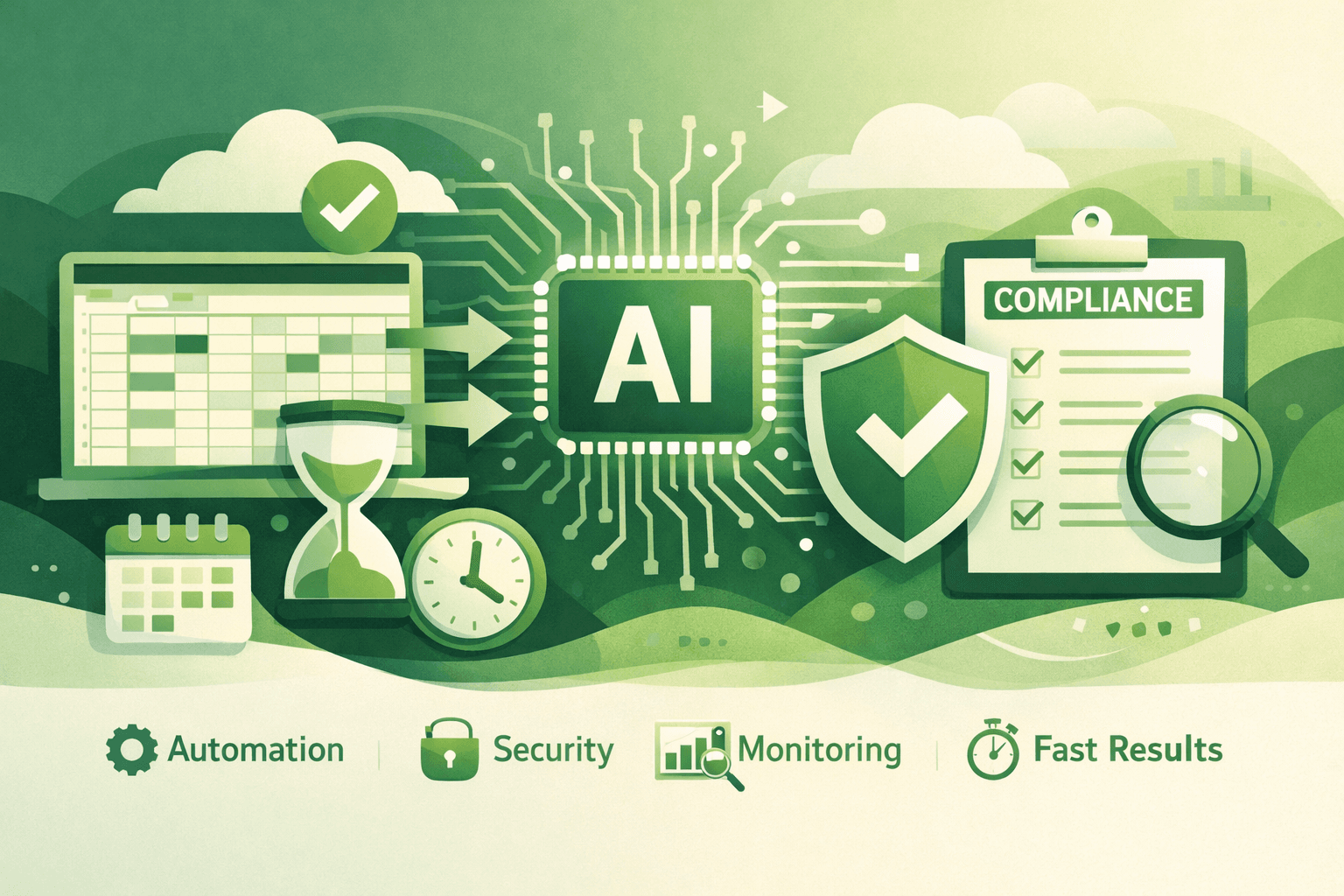
From Spreadsheets to AI: How Modern Companies Achieve Compliance in Days, Not Months
The compliance manager stares at another security questionnaire from a potential customer. She opens the compliance folder containing 47 tabs tracking controls across three frameworks. The audit starts in six weeks, but half the evidence remains uncollected. This scene repeats daily across thousands of companies still managing compliance manually through endless documents and disconnected tools.
Modern organizations are abandoning this broken approach for AI-powered automation that compresses months of compliance work into weeks. This article examines real transformations showing how companies achieved SOC 2 certification in 14 days instead of 6 months. The journey from manual chaos to automated clarity demonstrates why compliance automation represents a strategic advantage rather than a mere efficiency gain.
The Spreadsheet Nightmare: Understanding Manual Compliance Costs
Organizations beginning compliance journeys typically default to familiar tools like spreadsheets and shared drives. The approach seems reasonable initially until teams discover hidden costs that multiply as compliance programs mature.
Time Consumption That Compounds
Manual evidence collection consumes 15-20 hours monthly for single framework compliance. Security teams take screenshots of AWS configurations, export access reports, and compile vulnerability scan results. Each framework adds proportional work, creating situations where compliance managers spend 40+ hours monthly gathering evidence alone.
The time investment extends beyond collection into organization and verification. Teams must map evidence to specific controls, verify screenshots show current configurations, and maintain version control across documentation. This administrative burden prevents security teams from improving the actual security posture.
The Accuracy Problem Nobody Discusses
Human error introduces compliance risk that organizations rarely quantify until audits reveal gaps. Teams forget monthly evidence collection, creating temporal gaps in audit trails. Screenshots capture wrong system views or outdated configurations. Access reports miss recently provisioned accounts.
These accuracy issues create audit findings requiring remediation and potential delays in certification. Organizations discover gaps weeks into audit observation periods when remediation options become limited and stress levels peak.
Cross-Framework Duplication Waste
Companies pursuing multiple compliance frameworks face massive duplication of work. SOC 2 and ISO 27001 share 70% of control requirements, but manual approaches treat them as separate programs. Teams gather identical evidence twice, maintain duplicate policies, and conduct redundant control testing.
This duplication prevents organizations from scaling compliance efficiently. Adding each new framework requires proportional resource increases rather than marginal effort through shared control coverage.
The Breaking Point: When Companies Seek Change
Organizations reach compliance automation decision points through various catalysts, though patterns emerge consistently.
Growth Outpaces Manual Processes
Startups managing compliance manually reach breaking points around 50-100 employees. The compliance manager who handled everything alone suddenly cannot keep pace with infrastructure changes, new vendor relationships, and increased customer security requirements.
Sales teams lose deals because security questionnaire responses take weeks instead of days. Audit preparation disrupts entire quarters as teams scramble to collect evidence they should have gathered continuously. Engineering velocity slows as manual change approval processes create deployment bottlenecks.
Audit Findings Expose Systematic Gaps
Failed audits or significant findings force organizations to reconsider manual approaches. Auditors identify evidence gaps showing inconsistent control operations. Organizations discover their documented policies don't match actual practices. Control testing reveals failures that manual processes have never detected.
The remediation effort required after problematic audits often exceeds the investment needed for proper automation from the start. Organizations realize that reactive approaches cost more than proactive compliance infrastructure.
Customer Requirements Accelerate Timelines
Enterprise sales opportunities create compressed compliance timelines. Prospects require SOC 2 reports within 90 days or no deal. Healthcare customers need HIPAA attestations before contract signatures. These hard deadlines make manual compliance timelines unworkable.
Organizations attempting to compress 6-month manual compliance processes into 90 days through overtime and consultant support often spend $50,000-$100,000 in external costs while still delivering marginal quality.
Real Transformation Stories
SaaS Company: SOC 2 in 14 Days. A 75-person SaaS company needed SOC 2 for enterprise sales. DSALTA's automated platform delivered audit-readiness in 14 days vs traditional 4-6 months. Results: Evidence collection dropped from 20 hours monthly to 2 hours. Policy generation completed in 3 hours vs 2-3 weeks. Saved $45,000 in consultant fees.
Healthcare Tech: Multi-Framework Consolidation
Managing SOC 2 and HIPAA separately created massive duplication. Automation unified control libraries, eliminating 60% duplicate work. A single compliance manager handled both programs vs the previous two-person team. Added ISO 27001 six months later without additional headcount.
Enterprise Software: Zero Audit Findings Manual, quarterly testing missed configuration drift, causing significant SOC 2 findings. Continuous monitoring detected issues within hours instead of months. The second audit achieved zero findings. Customer confidence increased through transparent compliance dashboards.
Technology Enabling Transformation
API-Based Evidence Collection: Platforms connect directly to cloud infrastructure, capturing evidence automatically. Eliminates 85% manual effort while maintaining complete audit trails.
AI Policy Generation: Large language models create customized policies from framework requirements. Teams review rather than write from scratch, reducing weeks to hours.
Continuous Monitoring: Hourly control testing detects drift immediately. Prevents configuration errors from becoming audit findings.
Cross-Framework Mapping: Automated control mapping eliminates duplication. Single documentation satisfies multiple framework requirements.
Making the Transition Successfully
Organizations follow structured five-phase approaches: Audit current pain points, measuring baseline effort. Select platform Organizations follow a structured five-phase approach: audit current pain points and measure baseline effort. Select a platform to verify infrastructure compatibility. Configure integrations to establish baseline controls. Generate policies to organize existing evidence. Train teams to establish automated workflows. Verifying infrastructure compatibility. Configure integrations, establishing baseline controls. Generate policies organizing existing evidence. Train teams in establishing automated workflows.
DSALTA's automated platform implementation completes within 2-3 weeks, enabling organizations to achieve audit-readiness in under 90 days vs traditional 6-month timelines.
Beyond Automation: Strategic Compliance as Competitive Advantage
Organizations viewing compliance strategically beyond mere regulatory requirements gain advantages extending past audit success.
Companies with mature automated compliance programs respond to customer security requirements within hours instead of weeks. This responsiveness directly impacts win rates in competitive enterprise sales situations. Transparent compliance through automated trust centers builds customer confidence before sales conversations begin.
Automated compliance infrastructure supports market expansion, enabling entry into regulated industries efficiently. Organizations add new frameworks incrementally rather than treating each as a separate major project. This agility creates competitive moats as less sophisticated competitors struggle with compliance barriers.
The transformation from spreadsheets to AI-powered automation represents more than operational efficiency. Organizations achieve strategic positioning where compliance accelerates rather than constrains business objectives.
Explore more AI Compliance articles
AI Regulatory Compliance
AI-Powered Compliance Automation
HIPAA & Healthcare AI
GDPR & ISO 27001 with AI
AI in Vendor Risk Management
Stop losing deals to compliance.
Get compliant. Keep building.
Join 100s of startups who got audit-ready in days, not months.