AI Compliance —
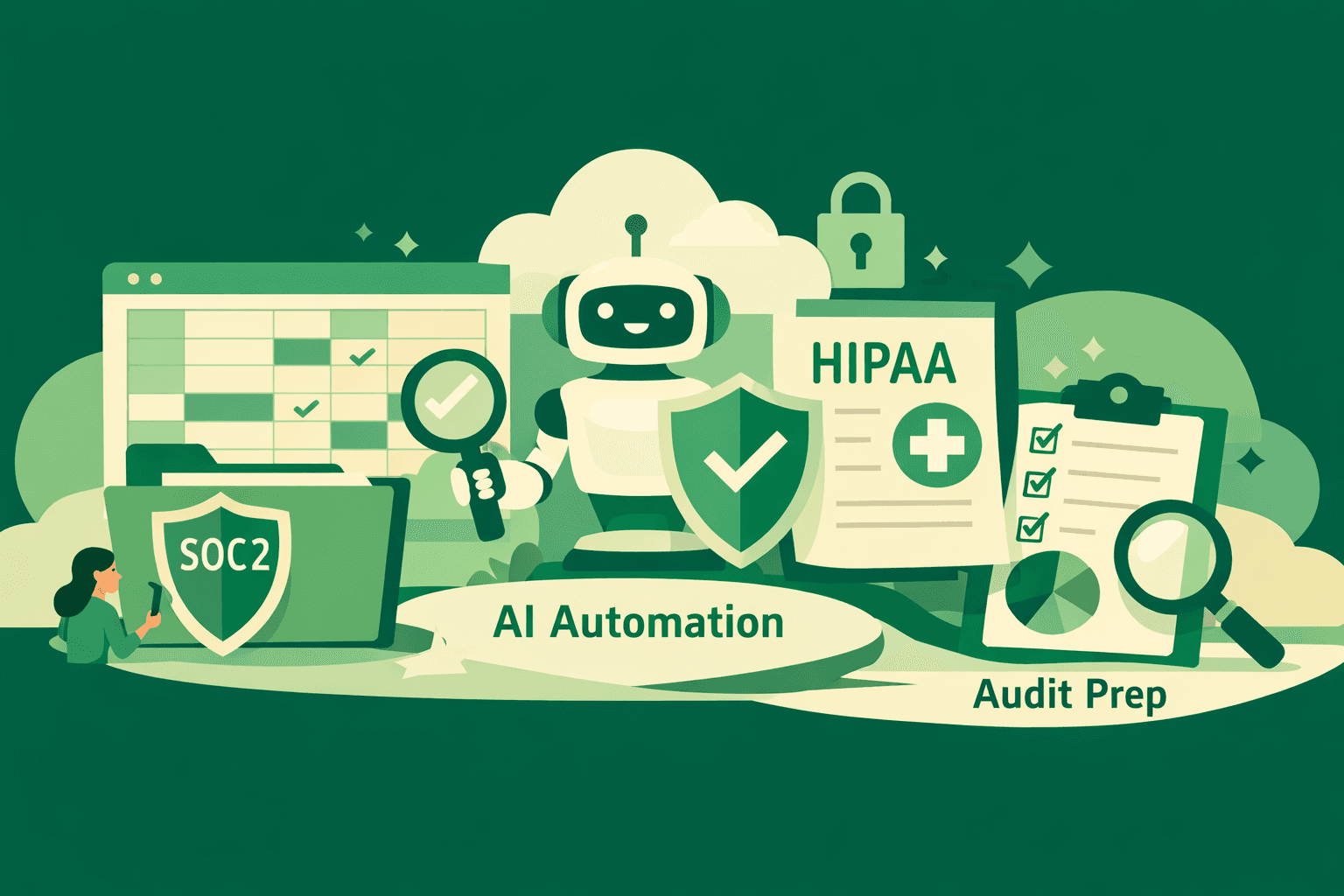
AI-Powered SOC 2 & HIPAA Compliance: Ditch Your Spreadsheets
Automate SOC 2 and HIPAA compliance with AI. Reduce audit prep time by 80% using automated compliance platforms. Go from spreadsheets to audit-ready in weeks.
Jon Ozdoruk
SOC 2 & AI
Share this article


AI-Powered SOC 2 & HIPAA Compliance
For healthcare startups and health-tech companies, compliance isn't optional; it's the foundation of customer trust and market access. If you're building a platform that handles Protected Health Information (PHI) or selling to healthcare enterprises, you need both HIPAA compliance and SOC 2 audit readiness. Often simultaneously.
The traditional approach involves months of manual work: hunting for screenshots, filling spreadsheets, tracking vendor questionnaires, and praying nothing critical falls through the cracks. Most teams spend 300-500 hours preparing for their first SOC 2 audit, with HIPAA compliance adding another layer of complexity.
AI compliance software and automated compliance platforms are changing this reality. What used to take 6-9 months of manual preparation can now be achieved in weeks, with continuous monitoring replacing annual scrambles.
This guide explains how AI automates SOC 2 and HIPAA compliance, what security compliance software can and cannot do, and how platforms like DSALTA reduce audit preparation time by 80% while maintaining the human judgment essential for mature compliance programs.
Why Healthcare Companies Need Both SOC 2 and HIPAA
Before diving into automation, let's clarify why most health-tech companies face dual compliance requirements:
HIPAA Compliance: The Legal Requirement
HIPAA compliance is mandatory for any organization that creates, receives, maintains, or transmits Protected Health Information (PHI). This includes:
Healthcare providers (hospitals, clinics, telehealth platforms)
Health plans and insurance companies
Healthcare clearinghouses
Business associates (any vendor or service provider that handles PHI on behalf of covered entities)
HIPAA requires the implementation of administrative, physical, and technical safeguards to protect PHI. The framework includes specific requirements for access controls, encryption, audit logging, breach notification, and Business Associate Agreements with any third-party vendors touching PHI.
Penalties for HIPAA violations range from $100 to $50,000 per violation, with annual maximums reaching $1.5 million per violation category. More importantly, breaches damage patient trust and often result in costly lawsuits.
SOC 2 Audit: The Business Requirement
While HIPAA compliance is legally mandated, a SOC 2 audit is typically a business requirement driven by customer demands. Enterprise healthcare customers—hospitals, health systems, insurance companies—require SOC 2 reports before signing contracts.
SOC 2 evaluates your controls across five Trust Services Criteria:
Security: Protection against unauthorized access
Availability: System uptime and performance
Processing Integrity: Accurate, complete, timely processing
Confidentiality: Protection of confidential information
Privacy: Collection, use, retention, and disposal of personal information
A SOC 2 Type I report shows your controls are properly designed. A SOC 2 Type II report proves those controls operated effectively over a period (typically 6-12 months). Most enterprise customers require Type II reports.
The Overlap and the Gap
SOC 2 and HIPAA compliance overlap significantly in areas such as access controls, encryption, monitoring, and incident response. However, they differ in:
Scope: HIPAA specifically focuses on PHI protection; SOC 2 covers broader security and operational controls
Requirements: HIPAA has specific technical requirements (e.g., encryption standards); SOC 2 is more flexible but must meet auditor standards
Evidence: HIPAA requires policy documentation; SOC 2 demands operational evidence of control effectiveness over time
The challenge is managing both frameworks without duplicating effort—precisely where automated compliance platforms provide the most value.
The Manual Compliance Problem: Why Traditional Approaches Fail
Most health-tech startups begin their compliance journey with spreadsheets, shared drives, and good intentions. This approach breaks down rapidly.
The Typical Manual Compliance Process
For SOC 2 Audit Preparation:
Spend weeks documenting policies and procedures
Implement security controls across the infrastructure
Wait 6-12 months to gather operational evidence
Scramble before the audit to collect screenshots proving controls worked
Hunt through Slack messages, email, and drives for missing evidence
Manually map evidence to each Trust Services Criteria control
Hope auditors don't find gaps requiring another review cycle
For HIPAA Compliance:
Conduct risk assessment, identifying PHI locations and vulnerabilities
Implement administrative, physical, and technical safeguards
Create HIPAA policies covering all required areas
Train the workforce on HIPAA requirements
Execute Business Associate Agreements with all vendors touching PHI
Maintain ongoing documentation of security measures
Track and document all PHI access and modifications
Why Manual Processes Don't Scale
Evidence Collection is Impossible at Scale: Modern cloud infrastructure generates thousands of log events daily. Manually capturing relevant evidence for SOC 2 audits across 50+ controls is practically impossible.
Vendor Risk Management Becomes a Bottleneck: Healthcare companies typically use 30-100 third-party vendors. Tracking vendor security assessments, Business Associate Agreements, and ongoing risk monitoring in spreadsheets doesn't work.
Continuous Compliance is Manual Compliance's Nemesis: Both HIPAA compliance and SOC 2 require continuous control operation, not just annual documentation. Manual processes can't provide real-time visibility into control effectiveness.
Framework Overlap is Wasted Effort: Many controls satisfy both SOC 2 and HIPAA requirements, but manual processes often duplicate work rather than leveraging shared evidence.
Human Error is Inevitable: When compliance relies on remembering to take screenshots, update spreadsheets, and track dozens of recurring tasks, something will be missed.
The result? Teams spend 6-9 months preparing for compliance, burn out security staff with manual work, and still face audit findings due to incomplete evidence.
How AI Transforms SOC 2 and HIPAA Compliance
AI compliance software doesn't replace auditors or eliminate human judgment. What it replaces is the chaos of manual evidence collection, the fragmentation of scattered documentation, and the reactive nature of annual compliance cycles.
Here's what automated compliance platforms actually do:
1. Continuous Evidence Collection
Instead of manually collecting screenshots before audits, AI-powered security compliance software continuously gathers evidence from your infrastructure:
Cloud Infrastructure: Automated platforms connect to AWS, Azure, Google Cloud, and other cloud providers to continuously monitor configurations, access controls, encryption status, and security group settings.
Identity and Access Management: AI-compliance software automatically tracks user provisioning, access reviews, MFA enrollment, and privilege escalations, creating audit trails required for both SOC 2 and HIPAA compliance.
Security Monitoring: Integration with SIEM systems and logging platforms enables continuous collection of security event data, failed login attempts, and evidence of anomalies.
Change Management: Automated platforms track all infrastructure changes, code deployments, and configuration modifications—critical evidence for SOC 2 Trust Services Criteria and HIPAA technical safeguards.
Training and Awareness: Security compliance software tracks employee training completion, policy acknowledgments, and participation in the security awareness program required by both frameworks.
The result: evidence that used to require weeks of manual collection is automatically available when auditors request it.
2. Intelligent Control Mapping
One of the biggest time-wasters in multi-framework compliance is mapping evidence to specific controls across SOC 2 and HIPAA requirements.
AI-powered automated compliance platforms automatically map evidence to:
SOC 2 Trust Services Criteria (CC1.1 through CC9.2, plus criteria-specific points)
HIPAA Administrative Safeguards (§164.308)
HIPAA Physical Safeguards (§164.310)
HIPAA Technical Safeguards (§164.312)
HIPAA Organizational Requirements (§164.314)
When you implement MFA, for example, the platform recognizes this satisfies:
SOC 2 CC6.1 (logical and physical access controls)
HIPAA Technical Safeguard §164.312(a)(2)(i) (unique user identification)
HIPAA Technical Safeguard §164.312(d) (person or entity authentication)
This eliminates duplicate evidence collection and ensures nothing falls through the cracks.
3. Real-Time Compliance Monitoring
Traditional compliance is backward-looking: you implement controls, wait months, then verify they worked. AI compliance software provides forward-looking visibility.
Live Control Status: Dashboards show real-time status of every SOC 2 and HIPAA control—implemented, operating effectively, needs attention, or failing.
Drift Detection: When configurations change in ways that weaken security posture, automated platforms alert immediately rather than discovering issues during annual audits.
Gap Identification: AI identifies missing controls before auditors do, allowing remediation on your timeline rather than under audit pressure.
Continuous Readiness Scoring: See your audit readiness percentage in real time, and understand exactly what's needed to achieve SOC 2 Type II and HIPAA compliance.
4. Automated Vendor Risk Management
Healthcare companies face unique vendor risk challenges. Every SaaS tool, cloud provider, and service vendor that touches PHI requires:
Security assessment before implementation
Business Associate Agreement (BAA) execution
Ongoing monitoring of vendor security posture
Evidence of vendor oversight for SOC 2 audits
Manual vendor risk management software approaches using spreadsheets collapse under this burden. AI-powered third-party risk management automates:
Vendor Inventory: Automatically discover all vendors accessing your systems or data.
Risk Scoring: Dynamically score vendors based on data access, PHI exposure, security posture, and certifications.
BAA Tracking: Monitor which vendors have executed Business Associate Agreements and flag missing BAAs for vendors exposed to PHI.
Continuous Monitoring: Track vendor certifications, security questionnaire updates, and breach notifications automatically.
Audit Evidence: Generate vendor oversight evidence required for SOC 2 CC9.2 and HIPAA organizational requirements.
This transforms third-party risk management from an annual questionnaire exercise into continuous oversight.
5. Unified Audit Reporting
When audit time arrives, manual processes require assembling evidence from dozens of sources into coherent audit packets. Automated compliance platforms generate:
SOC 2 Evidence Packets: Pre-organized evidence mapped to Trust Services Criteria, ready for auditor review.
HIPAA Documentation: Complete policy sets, risk assessments, safeguard implementation evidence, and training records.
Cross-Framework Reports: Unified view showing how controls satisfy both SOC 2 and HIPAA requirements simultaneously.
Auditor Portals: Secure access for auditors to review evidence, ask questions, and track remediation—no more email chains with dozens of attachments.
The DSALTA Approach: 80% Reduction in Audit Preparation Time
DSALTA's AI compliance software is purpose-built for companies managing multiple frameworks simultaneously. Here's how it works in practice:
Week 1-2: Rapid Integration and Baseline
Day 1-3: Connect Your Infrastructure
DSALTA integrates with your cloud providers (AWS, Azure, GCP), identity management (Okta, Azure AD, Google Workspace), security tools (SIEM, EDR, vulnerability scanners), and business systems (HR, ticketing, training platforms).
This provides immediate visibility into your current security posture across SOC 2 and HIPAA requirements.
Day 4-7: Automated Gap Analysis
DSALTA's AI analyzes your current controls against:
SOC 2 Trust Services Criteria requirements
HIPAA Administrative, Physical, and Technical Safeguards
Industry best practices for healthcare security
You receive a prioritized gap list showing exactly what's needed for compliance, with each gap mapped to specific controls.
Week 2: Policy Framework and Control Design
DSALTA provides healthcare-specific policy templates covering both SOC 2 and HIPAA requirements:
Information Security Policy
Access Control Policy
Encryption and Data Protection Policy
Incident Response Policy
Business Continuity and Disaster Recovery Policy
HIPAA Privacy Policy
Breach Notification Procedures
These aren't generic templates—they're customized based on your infrastructure, risk profile, and framework requirements.
Week 3-8: Control Implementation and Evidence Collection
Automated Implementation Guidance
For each control gap, DSALTA provides step-by-step implementation guidance:
Technical requirements and configuration standards
Recommended tools and services
Implementation verification steps
Evidence that will be automatically collected once implemented
Continuous Evidence Gathering Begins
As you implement controls, DSALTA begins automatically collecting evidence:
Access logs showing MFA enforcement
Encryption verification for data at rest and in transit
User access reviews and privilege changes
Security monitoring alerts and responses
Training completion records
Vulnerability scan results and remediation
Real-Time Compliance Scoring
Watch your SOC 2 and HIPAA compliance scores increase as controls are implemented and evidence accumulates. The dashboard shows:
Overall readiness percentage
Control status by Trust Services Criteria and HIPAA safeguard category
Time remaining until the minimum evidence period is met (for SOC 2 Type II)
High-priority items requiring immediate attention
Week 9-12: Vendor Risk Management Automation
Automated Vendor Discovery
DSALTA scans your environment to identify all third-party vendors and SaaS applications, automatically categorizing them by:
Data access type (PHI vs. non-PHI)
Integration method and access scope
Vendor criticality to operations
BAA Management
For vendors identified as Business Associates (those accessing PHI), DSALTA:
Flags missing Business Associate Agreements
Provides BAA templates compliant with HIPAA requirements
Tracks BAA execution status
Monitors BAA renewal dates
Continuous Vendor Monitoring
DSALTA's vendor risk management software continuously monitors:
Vendor security certifications (SOC 2, ISO 27001, HIPAA attestations)
Security questionnaire updates
Breach notifications affecting your vendors
Vendor risk score changes
This creates always-ready vendor oversight evidence required for SOC 2 CC9.2 and HIPAA organizational requirements.
Week 13+: Continuous Assurance and Audit Readiness
Ongoing Monitoring Replaces Manual Checks
After initial implementation, DSALTA maintains continuous monitoring:
Configuration drift detection
Access anomaly identification
Control effectiveness verification
Policy compliance tracking
Automated Audit Preparation
When you're ready for a SOC 2 audit or HIPAA assessment:
DSALTA generates complete evidence packets organized by control
Auditors receive secure portal access to review evidence
Questions and remediation requests are tracked within the platform
Final reports demonstrate continuous control operation over the required period
The Result: 80% Time Reduction
Where manual compliance required 300-500 hours of preparation, DSALTA customers typically spend:
40-60 hours on initial setup and integration
20-30 hours on policy customization and review
30-50 hours on control implementation (varies by gaps)
20-30 hours on auditor interaction and final review
Total: 110-170 hours versus 300-500 hours manually—an 80% reduction in effort while improving evidence quality and completeness.
What AI Cannot Replace: The Human Control Plane
Despite powerful automation, certain aspects of compliance require human expertise and judgment:
Strategic Risk Decisions
Only your team can determine:
Which risks are acceptable given your business model
How to prioritize competing compliance requirements
When to accept risk versus implementing additional controls
Resource allocation for security investments
AI compliance software provides data for these decisions, but cannot make them.
HIPAA Privacy Determinations
Complex questions require legal and compliance expertise:
Is specific data considered PHI under HIPAA?
When does your organization qualify as a Business Associate versus a Covered Entity?
How to handle unique data processing scenarios
State-specific privacy laws that may exceed HIPAA requirements
Auditor Relationship Management
SOC 2 audits involve human judgment and relationship building:
Explaining control intent and design
Negotiating scope and testing approach
Addressing auditor concerns and questions
Building auditor confidence in your security culture
Organizational Culture and Training
While automated platforms track training completion, humans must:
Develop a security awareness culture
Address employee security concerns
Make training relevant to your organization
Handle security policy violations appropriately
Incident Response Leadership
During actual security incidents or potential PHI breaches:
Assessing incident severity and business impact
Making time-sensitive containment decisions
Determining breach notification requirements
Managing stakeholder communication
These require human judgment, considering factors AI cannot evaluate.
Building Your Automated Compliance Roadmap
If you're planning to pursue SOC 2 and HIPAA compliance, here's a practical roadmap leveraging AI compliance software:
Month 1: Foundation and Assessment
Week 1-2: Infrastructure Integration
Connect the automated compliance platform to all critical systems: cloud infrastructure, identity management, security tools, and business applications.
Week 3-4: Gap Analysis and Prioritization
Review AI-generated gap analysis, prioritize based on audit timeline and resource availability, and create an implementation plan.
Month 2-3: Core Control Implementation
Focus Areas:
Access controls and MFA enforcement
Encryption for data at rest and in transit
Security monitoring and logging
Vulnerability management
Business continuity and disaster recovery
Let your automated platform continuously collect evidence as you implement these controls.
Month 4: Vendor Risk Management
Vendor Inventory and Risk Assessment:
Use vendor risk management software to identify all vendors, classify by PHI access, and score by risk level.
BAA Execution:
Execute Business Associate Agreements with all vendors identified as Business Associates.
Ongoing Monitoring Setup:
Enable continuous vendor monitoring for certifications, security posture changes, and risk score updates.
Month 5-6: Policy and Documentation
Policy Development:
Customize healthcare-specific policy templates from your automated compliance platform covering SOC 2 and HIPAA requirements.
Training Program:
Implement security awareness training tracked through your security compliance software, ensuring HIPAA-specific training for workforce members handling PHI.
Risk Assessment Documentation:
Complete HIPAA risk assessment using AI-driven analysis from your automated platform as a foundation.
Month 7-9: Evidence Period for SOC 2 Type II
Continuous Monitoring:
Let AI compliance software continuously collect operational evidence demonstrating control effectiveness over time.
Monthly Reviews:
Conduct monthly compliance reviews using automated dashboards to verify controls remain effective and address any gaps.
Mock Audit:
Perform an internal audit using evidence from the automated platform to identify any final gaps before engaging auditors.
Month 10+: Audit Execution
Auditor Engagement:
Provide auditors secure portal access to evidence through an automated compliance platform.
Audit Support:
Use unified reporting to quickly respond to auditor questions and requests.
Continuous Improvement:
After achieving SOC 2 and HIPAA compliance, maintain continuous monitoring and annual re-certification using your automated platform.
Common Implementation Challenges and Solutions
Even with AI-powered automation, companies encounter predictable challenges:
Challenge 1: Integration Complexity
Problem: Multiple systems need integration, each with different APIs and access models.
Solution: Choose automated compliance platforms like DSALTA, with pre-built integrations for common healthcare infrastructure, including AWS, Azure, Okta, major SIEM platforms, and healthcare-specific systems.
Challenge 2: Resource Constraints
Problem: Small security teams lack the capacity for major compliance projects.
Solution: AI compliance software dramatically reduces manual effort, allowing small teams to achieve compliance. Prioritize automation for the most time-consuming activities: evidence collection, vendor tracking, and continuous monitoring.
Challenge 3: Vendor Cooperation
Problem: Third-party vendors are slow to complete security assessments or execute BAAs.
Solution: Vendor risk management software automates follow-up and tracking. Start vendor assessments early, use automated reminders, and escalate non-responsive vendors to procurement leadership.
Challenge 4: Evidence Gaps for Historical Period
Problem: SOC 2 Type II requires 6-12 months of evidence, but you're just starting.
Solution: Begin continuous evidence collection immediately, even before all controls are implemented. Some automated platforms can backfill certain evidence types. For truly missing evidence, consider SOC 2 Type I initially, then Type II after the evidence period.
Challenge 5: Control Exceptions and Compensating Controls
Problem: Not every control can be implemented exactly as described in frameworks.
Solution: Security compliance software should support the documentation of exceptions and compensating controls. Work with auditors early to ensure alternative approaches will be accepted.
Measuring Success: Compliance Program Metrics
Track these metrics to demonstrate compliance program effectiveness and ROI on automated compliance platform investment:
Efficiency Metrics
Audit Preparation Hours: Target an 80% reduction compared to the manual approach (from 300-500 hours to 100-150 hours).
Evidence Collection Time: Target near-zero ongoing effort with continuous, automated collection, versus 40-80 hours of manual effort per audit.
Vendor Assessment Cycle Time: Target 60-75% reduction in time from vendor identification to completed risk assessment.
Quality Metrics
Audit Findings Count: Track findings over multiple audit cycles; should decrease as automated monitoring catches issues proactively.
Evidence Completeness: Measure the percentage of auditor evidence requests satisfied immediately from the automated repository versus requiring manual follow-up.
Control Failure Detection Time: Compare the time to detect control failures with automated monitoring versus manual quarterly reviews.
Business Impact Metrics
Sales Cycle Length: Track reduction in enterprise sales cycle length after achieving SOC 2 Type II and HIPAA compliance.
Security Questionnaire Response Time: Measure the time to respond to customer security questionnaires, comparing automated evidence to manual responses.
RFP Win Rate: Track improvement in RFP win rate for enterprise healthcare customers after demonstrating a mature compliance posture.
Conclusion: From Compliance Burden to Competitive Advantage
SOC 2 and HIPAA compliance don't have to be overwhelming, manual processes consuming hundreds of hours and delaying market entry. AI compliance software and automated compliance platforms transform compliance from a reactive burden into a proactive competitive advantage.
The shift from manual to automated compliance means:
Faster Time to Market: Achieve audit-ready status in weeks instead of 6-9 months, accelerating enterprise sales and fundraising timelines.
Reduced Operational Burden: Security teams spend 80% less time on manual evidence collection and can focus on strategic security improvements.
Continuous Assurance: Real-time visibility into the compliance posture replaces periodic checks, enabling proactive remediation of gaps before audits.
Better Risk Management: AI-driven monitoring catches control failures and vendor risks early, preventing security incidents.
Scalable Framework Support: When you need to add ISO 27001, GDPR, or PCI DSS compliance, your automated platform scales easily rather than requiring separate processes.
For healthcare companies and health-tech startups, robust SOC 2 and HIPAA compliance isn't just about avoiding penalties—it's about building patient trust, winning enterprise customers, and demonstrating operational maturity to investors and partners.
The future of compliance is automated, continuous, and intelligent. Organizations that embrace AI-powered security compliance software today will build sustainable compliance programs that scale with growth while competitors still struggle with spreadsheets.
Ready to Automate Your SOC 2 and HIPAA Compliance?
DSALTA's AI-powered automated compliance platform is purpose-built for healthcare and health-tech companies managing SOC 2 and HIPAA compliance simultaneously.
Our platform delivers:
80% reduction in audit preparation time through continuous automated evidence collection
Unified compliance visibility across SOC 2 Trust Services Criteria and HIPAA safeguards in a single dashboard
Intelligent vendor risk management with automated BAA tracking and continuous third-party monitoring
Real-time compliance scoring showing exact readiness for SOC 2 audit and HIPAA assessment
Healthcare-specific controls and policies pre-mapped to both frameworks
Always-ready audit evidence organized by control and framework for instant auditor access
Stop spending months on manual compliance preparation. Start building continuous trust with customers, patients, and regulators.
Schedule a demo to see how DSALTA's AI compliance software can take you from compliance chaos to audit-ready in weeks, not months.


Explore more AI Compliance articles
Stop losing deals to compliance.
Get compliant. Keep building.
Join 100s of startups who got audit-ready in days, not months.