AI for GDPR & ISO 27001: Streamline Controls & Certification
Written by
John Ozdemir
Published on
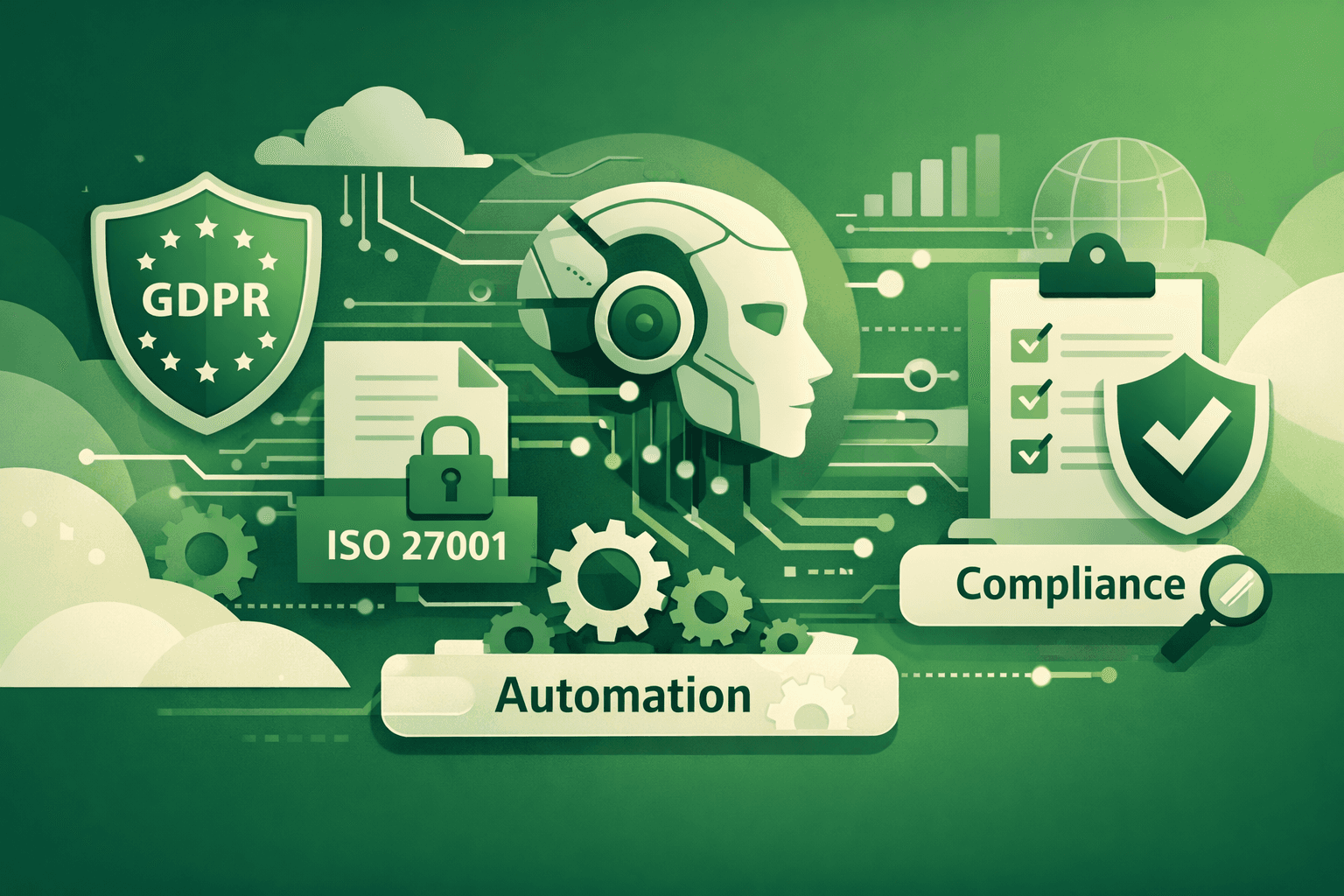
Organizations pursuing both GDPR compliance and ISO 27001 certification face a common challenge: managing two comprehensive frameworks that overlap significantly but use different terminology, structures, and requirements. Most teams treat them as separate projects, duplicating work and missing the natural synergies between these standards.
The reality is simpler: GDPR and ISO 27001 are complementary frameworks that reinforce each other. GDPR focuses on data protection and privacy rights, while ISO 27001 provides the broader Information Security Management System (ISMS) structure. When mapped correctly, controls implemented for one framework satisfy requirements in the other—dramatically reducing compliance burden.
This guide explores how AI compliance software and automated compliance platforms transform the relationship between GDPR and ISO 27001 from a dual-compliance headache into a unified security program. We'll cover control mapping, automated Data Protection Impact Assessments (DPIAs), Statement of Applicability generation, and vendor risk management across both frameworks.
Why GDPR and ISO 27001 Belong Together
Many organizations approach GDPR compliance and ISO 27001 compliance as separate initiatives. This creates unnecessary work and missed opportunities.
The Natural Alignment
GDPR requires organizations processing EU personal data to implement appropriate technical and organizational measures to protect that data. Article 32 specifically mandates security measures, including pseudonymization, encryption, confidentiality, integrity, availability, and resilience.
ISO 27001 provides a systematic approach to managing information security through 93 controls across 14 domains. These controls cover everything from access management to incident response to supplier relationships.
The overlap is substantial. Many ISO 27001 Annex A controls directly support GDPR compliance requirements. For example:
ISO 27001 Control 5.34 (Privacy and Protection of PII) maps directly to GDPR's core data protection principles
ISO 27001 Control 5.19-5.23 (Supplier Relationships) supports GDPR Article 28 processor requirements
ISO 27001 Control 5.24-5.28 (Incident Management) enables GDPR breach notification obligations
Organizations that implement ISO 27001 certification build the foundation for GDPR compliance. Those pursuing GDPR compliance gain momentum toward ISO 27001 by systematically documenting controls.
The Business Case for Joint Implementation
Efficiency: Implementing controls that satisfy both frameworks eliminates duplication. One access control system, properly documented, meets both the GDPR Article 32 requirements and the ISO 27001 Control 5.15-5.18 requirements.
Cost Reduction: Joint audits cost less than separate assessments. Many certification bodies offer combined ISO 27001 and ISO 27017 (cloud privacy) audits that address GDPR requirements simultaneously.
Customer Trust: Organizations with both ISO 27001 certification and documented GDPR compliance signal comprehensive security maturity to customers, particularly in Europe.
Audit Efficiency: Evidence collected for ISO 27001 certification—policies, access reviews, training records—also demonstrates GDPR compliance when properly mapped.
Framework Synergy: ISO 27001's risk management approach provides the structure that GDPR requires to demonstrate "appropriate technical and organizational measures."
The Traditional Mapping Challenge
Despite this natural alignment, most organizations struggle to effectively connect GDPR and ISO 27001.
Common Pain Points
Different Terminology: The GDPR uses terms such as "controller," "processor," and "data subject." ISO 27001 discusses "asset owners," "suppliers," and "interested parties." Teams struggle to translate between frameworks.
Scattered Evidence: GDPR documentation lives in privacy tools, while ISO 27001 evidence sits in security compliance software. During audits, teams scramble to connect related evidence across systems.
Manual Mapping: Spreadsheets that attempt to map GDPR articles to ISO 27001 controls quickly become outdated and don't reflect operational reality.
Duplicate Work: Security teams implement access controls for ISO 27001, then privacy teams document the same controls differently for GDPR, creating maintenance nightmares.
Statement of Applicability Complexity: The ISO 27001 Statement of Applicability (SoA) should reference GDPR requirements, but manually maintaining these connections as regulations evolve is impractical.
Vendor Risk Fragmentation: Third-party risk management for ISO 27001 supplier controls operates separately from GDPR processor assessments, missing the obvious overlap.
This is where AI compliance software transforms the relationship between these frameworks.
How AI Automates GDPR-ISO 27001 Control Mapping
Modern automated compliance platforms use AI to create intelligent, living connections between GDPR requirements and ISO 27001 controls.
Intelligent Control Mapping
AI-powered security compliance software analyzes both frameworks to identify relationships:
Direct Mappings: Where ISO 27001 controls directly implement GDPR requirements. For example, ISO 27001 Control 8.10 (Information Deletion) directly supports GDPR Article 17 (Right to Erasure).
Partial Mappings: Where ISO 27001 controls partially satisfy GDPR requirements, but need additional elements. For instance, ISO 27001 Control 5.16 (Identity Management) covers access control but needs GDPR-specific enhancements for data subject access requests.
Gap Identification: Where GDPR requires controls not fully covered in ISO 27001, such as specific requirements for data portability (Article 20) or automated decision-making transparency (Article 22).
Traditional approaches use static mapping documents. AI compliance software creates dynamic mappings that update as you implement controls, so you always know which GDPR requirements your ISO 27001 controls satisfy.
Real-Time Compliance Visibility
Instead of wondering whether your ISO 27001 controls meet GDPR requirements, automated compliance platforms provide dashboard views showing:
Which GDPR articles are fully satisfied by existing ISO 27001 controls
Which GDPR requirements need additional controls beyond ISO 27001
Which ISO 27001 controls primarily serve GDPR compliance
Where control gaps affect both frameworks simultaneously
This visibility transforms compliance from guesswork into data-driven decision-making.
Automating Data Protection Impact Assessments (DPIAs)
GDPR Article 35 requires Data Protection Impact Assessments for high-risk processing activities. Traditional DPIAs involve manual questionnaires, spreadsheet risk scoring, and static documents that quickly become outdated.
AI compliance software transforms DPIAs into living risk assessments that integrate with your ISO 27001 risk management process.
AI-Powered DPIA Generation
Modern security compliance software can:
Auto-Detect High-Risk Processing: By analyzing your data flows and processing activities, AI identifies which activities trigger DPIA requirements under GDPR Article 35—automated decision-making, large-scale processing of sensitive data, and systematic monitoring of public areas.
Pre-Populate DPIA Content: Using information already in your ISMS (asset inventory, data classification, control implementation), automated platforms generate draft DPIAs with processing descriptions, data categories, retention periods, and security measures.
Map to ISO 27001 Risk Register: Instead of maintaining separate GDPR risk assessments and ISO 27001 risk registers, AI links DPIA risks to your existing ISO 27001 risk assessment, showing how existing controls mitigate privacy risks.
Identify Control Gaps: By comparing DPIA requirements against implemented ISO 27001 controls, AI highlights where additional privacy-specific controls are needed.
Maintain Living DPIAs: When controls change, processing activities evolve, or new vendors are added, automated compliance platforms flag DPIAs needing review rather than letting them become stale documents.
DPIA-ISO 27001 Integration
The most powerful aspect of AI-driven DPIAs is integration with ISO 27001 compliance processes:
Unified Risk Treatment: Risks identified in DPIAs flow into your ISO 27001 risk treatment plan, ensuring privacy risks receive the same systematic management as security risks.
Shared Control Evidence: Controls implemented to mitigate DPIA risks generate evidence for both GDPR compliance and ISO 27001 certification audits.
Continuous Monitoring: Instead of annual DPIA reviews, security compliance software monitors the conditions that triggered the DPIA—if processing changes significantly, automated alerts trigger DPIA updates.
This integration means DPIAs stop being compliance paperwork and become genuine risk management tools.
Generating Intelligent Statements of Applicability
The ISO 27001 Statement of Applicability (SoA) documents which Annex A controls you've implemented, which you've excluded, and your justification for each decision. Creating an SoA manually is tedious, and maintaining it as your organization evolves is nearly impossible.
AI compliance software automates SoA generation while ensuring GDPR requirements influence control selection.
AI-Driven SoA Creation
Automated compliance platforms generate Statements of Applicability by:
Analyzing Your Environment: Scanning your infrastructure, applications, data flows, and vendors to understand which controls are relevant to your specific context.
Mapping to GDPR Requirements: Identifying which ISO 27001 controls are necessary to meet your GDPR compliance obligations based on the personal data you process.
Recommending Control Implementation: Suggesting which currently-excluded controls should be implemented to close GDPR gaps, with justification based on your processing activities.
Generating Justifications: Creating detailed rationales for control inclusion or exclusion that reference both ISO 27001 risk assessment results and GDPR requirements.
Maintaining Version Control: Tracking SoA changes over time as your organization implements new controls or processing activities change.
GDPR-Enhanced Control Selection
When generating your SoA, AI compliance software ensures GDPR considerations influence control decisions:
Data Subject Rights Controls: Flagging that ISO 27001 Controls 5.34 (Privacy and Protection of PII) and 8.10 (Information Deletion) cannot be excluded if you process EU personal data.
Processor Management: Ensuring ISO 27001 Controls 5.19-5.23 (Supplier Relationships) are included with GDPR-specific enhancements for processor oversight.
Breach Response: Highlighting that ISO 27001 Controls 5.24-5.28 (Incident Management) must include GDPR breach notification procedures.
Lawful Processing: Identifying where ISO 27001 controls need GDPR-specific enhancements around consent management, legitimate interest assessments, or contractual necessity.
This GDPR-aware SoA generation ensures your ISO 27001 certification audit reveals a system designed for privacy compliance, not just security.
Unified Third-Party Risk Management Across Frameworks
One of the biggest areas of duplicate work in GDPR and ISO 27001 compliance is vendor management. Organizations assess vendors for ISO 27001 supplier controls, then separately assess the same vendors as GDPR processors.
AI-powered vendor risk management software eliminates this duplication through unified third-party risk management.
Integrated Vendor Assessment
Modern automated compliance platforms assess vendors once against both frameworks:
Dual-Purpose Questionnaires: Security questionnaires that cover both ISO 27001 supplier security requirements and GDPR processor obligations, eliminating redundant vendor surveys.
Framework-Mapped Vendor Profiles: Vendor profiles showing how their security posture affects both your ISO 27001 certification scope and GDPR processor accountability.
Automated Risk Scoring: AI analyzes vendor responses to generate separate risk scores for ISO 27001 supplier risk and GDPR processor risk, highlighting where vendors meet one framework's requirements but not the other's.
Contract Intelligence: AI scanning vendor contracts and Data Processing Agreements (DPAs) to ensure they contain both ISO 27001-required supplier terms and GDPR Article 28 processor clauses.
GDPR Processor Tracking in ISO 27001 Context
GDPR requires maintaining records of all processors (Article 30). ISO 27001 requires the management of supplier relationships (Controls 5.19-5.23). AI compliance software unifies these requirements:
Single Vendor Inventory: One comprehensive vendor list tagged with roles (processor, sub-processor, supplier) and applicable frameworks, eliminating separate vendor databases.
DPA Management: Tracking which vendors need Data Processing Agreements, monitoring DPA status, and flagging missing or expired agreements, all within your ISO 27001 supplier management process.
Sub-Processor Chains: Mapping sub-processor relationships to understand third-party risk depth, satisfying both GDPR transparency requirements and ISO 27001 supplier oversight.
Breach Coordination: When vendors experience security incidents, automated platforms assess the impact on both ISO 27001 controls and GDPR breach notification obligations.
Continuous Vendor Monitoring for Both Frameworks
Traditional vendor risk management involves annual reassessments. AI-powered security compliance software provides continuous monitoring that benefits both frameworks:
Certification Tracking: Monitoring vendor ISO 27001 certifications, SOC 2 reports, and other attestations relevant to both frameworks.
Security Posture Changes: Detecting when a vendor's security posture deteriorates, triggering reassessment of both ISO 27001 supplier risk and GDPR processor risk.
Processing Activity Changes: Alerting when vendors change what data they process or how they process it, requiring DPIA updates and ISO 27001 supplier risk reassessment.
Geographic Changes: Flagging when vendors move processing to new jurisdictions, impacting GDPR international transfer requirements and ISO 27001 supplier risk.
This unified approach to third-party risk management means vendor assessments serve both ISO 27001 certification and GDPR compliance without duplicate effort.
Implementing Your GDPR-ISO 27001 Integration Strategy
Organizations ready to unify GDPR compliance and ISO 27001 compliance should follow a structured approach.
Phase 1: Framework Assessment and Gap Analysis
Document Current State: Inventory existing GDPR compliance activities (DPIAs, Records of Processing Activities, privacy policies) and ISO 27001 preparations (risk assessment, control selection, evidence collection).
Identify Overlaps: Map where you're doing similar work for both frameworks—vendor assessments, access controls, incident response, training.
Analyze Gaps: Determine which GDPR requirements aren't addressed by your current ISO 27001 controls and which ISO 27001 controls don't yet meet GDPR standards.
Select Tools: Evaluate AI compliance software and automated compliance platforms based on their ability to support unified GDPR-ISO 27001 management, not separate modules.
Phase 2: Unified Control Implementation
Merge Control Frameworks: Implement controls that satisfy both frameworks rather than separate GDPR and ISO 27001 implementations.
GDPR-Enhanced Access Controls: Ensure access management (ISO 27001 Controls 5.15-5.18) includes data subject access request workflows required by GDPR.
Privacy-Aware Incident Response: Build GDPR breach notification procedures into your ISO 27001 incident management (Controls 5.24-5.28).
Integrated Vendor Management: Consolidate supplier oversight and processor management into unified third-party risk management processes.
Unified Training: Combine information security awareness (ISO 27001 Control 6.3) with GDPR data protection training.
Phase 3: Evidence and Documentation Consolidation
Shared Evidence Repository: Store evidence in security compliance software that tags artifacts for both GDPR and ISO 27001 relevance.
Cross-Framework Policies: Write policies that reference both frameworks where applicable to reduce documentation volume.
Integrated Records of Processing Activities: Ensure GDPR Article 30 records reference the assets and controls documented in your ISO 27001 ISMS.
Unified Risk Register: Maintain a single risk register covering both information security risks (ISO 27001) and data protection risks (GDPR).
Phase 4: Automated Compliance Operations
Deploy AI Control Mapping: Implement automated compliance platforms that maintain dynamic links between GDPR articles and ISO 27001 controls.
Automate DPIA Generation: Configure AI compliance software to generate DPIAs based on your ISO 27001 asset inventory and risk assessment.
Enable SoA Automation: Use security compliance software to generate and maintain your Statement of Applicability with GDPR considerations built in.
Activate Continuous Monitoring: Set up automated monitoring that detects control changes affecting both frameworks simultaneously.
Phase 5: Joint Audit Preparation
Unified Audit Readiness: Prepare for ISO 27001 certification audits with GDPR compliance evidence already organized.
Cross-Framework Evidence Packets: Create auditor packages showing how each ISO 27001 control supports specific GDPR requirements.
Integrated Management Review: Conduct ISO 27001 management reviews that include GDPR compliance metrics, demonstrating unified oversight.
Coordinated Certification: Where possible, schedule ISO 27001 certification audits to include a GDPR compliance assessment from the same auditor.
Key Control Mappings: GDPR to ISO 27001 Annex A
Understanding specific mappings between GDPR requirements and ISO 27001 controls helps organizations implement efficiently.
Data Subject Rights (GDPR Articles 15-22) → ISO 27001 Controls
Right of Access (Article 15): ISO 27001 Control 5.34 (Privacy and Protection of PII) covers access request procedures. Add specific GDPR timelines (one month) and required information elements.
Right to Rectification (Article 16): ISO 27001 Control 8.3 (Information Access Restriction) ensures data accuracy. Enhance with GDPR-specific rectification request workflows.
Right to Erasure (Article 17): ISO 27001 Control 8.10 (Information Deletion) provides the foundation. Add GDPR-specific handling and verification for erasure requests.
Right to Data Portability (Article 20): No direct ISO 27001 control. Implement as a GDPR-specific enhancement to Control 5.34.
Right to Object (Article 21): Add to ISO 27001 Control 5.34 with specific handling for marketing objections and legitimate interest processing.
Security of Processing (GDPR Article 32) → ISO 27001 Controls
Pseudonymization and Encryption: ISO 27001 Controls 8.24 (Cryptography) and 5.33 (Records Protection) provide the technical foundation.
Confidentiality, Integrity, Availability: Core ISO 27001 principles covered throughout Annex A, particularly Controls 8.1-8.34 (Technological Controls).
Resilience of Systems: ISO 27001 Controls 5.29-5.30 (Business Continuity) and 8.6-8.14 (System Resilience).
Regular Testing: ISO 27001 Control 8.8 (Management of Technical Vulnerabilities) and Control 5.7 (Threat Intelligence).
Processor Obligations (GDPR Article 28) → ISO 27001 Controls
Processor Security: ISO 27001 Controls 5.19-5.23 (Supplier Relationships) establish vendor oversight framework. Add GDPR-specific processor terms.
Sub-Processor Authorization: ISO 27001 Control 5.20 (Addressing Information Security in Supplier Agreements) covers sub-contractor management. Enhance with GDPR notification requirements.
Processor Assistance: ISO 27001 Control 5.23 (Information Security for Use of Cloud Services) addresses service provider responsibilities. Add GDPR data subject rights assistance requirements.
Breach Notification (GDPR Articles 33-34) → ISO 27001 Controls
Incident Detection: ISO 27001 Controls 5.24-5.25 (Incident Response) provides the detection framework.
Breach Assessment: ISO 27001 Control 5.26 (Assessment and Decision on Information Security Events) covers impact analysis. Add GDPR-specific 72-hour notification timeline.
Notification Procedures: ISO 27001 Control 5.27 (Learning from Information Security Incidents) covers stakeholder communication. Enhance with GDPR supervisory authority and data subject notification requirements.
International Transfers (GDPR Chapter V) → ISO 27001 Controls
Transfer Mechanisms: No direct ISO 27001 control. Add an enhancement to Control 5.34 (Privacy and Protection of PII).
Transfer Risk Assessment: Include in ISO 27001 Clause 6.1.2 (Information Security Risk Assessment) with specific GDPR considerations.
Transfer Safeguards: Document in ISO 27001 Control 5.20 (Addressing Information Security in Supplier Agreements) for international vendors.
Real-World Implementation: GDPR-ISO 27001 Success Pattern
Organizations that successfully integrate GDPR compliance and ISO 27001 certification follow similar patterns:
Start with Risk Assessment: Use ISO 27001's risk management methodology to identify data protection risks and automatically generate the foundation for DPIAs.
Build Privacy into ISMS: Rather than adding privacy as an afterthought, make GDPR requirements core considerations in your Information Security Management System design.
Unify Vendor Management: Assess vendors once against a combined set of criteria, with AI-powered vendor risk management software maintaining separate scoring for each framework.
Automate Evidence Collection: Implement security compliance software that collects evidence tagged for both frameworks, eliminating duplicate artifact collection.
Conduct Integrated Reviews: Management reviews cover both the effectiveness of the ISO 27001 ISMS and the GDPR compliance status in a single discussion.
Leverage Joint Audits: Many certification bodies offer combined ISO 27001 and ISO 27017 (cloud privacy) audits that efficiently assess GDPR compliance alongside certification requirements.
The result: Organizations achieve ISO 27001 certification while simultaneously demonstrating comprehensive GDPR compliance, typically in 30-40% less time than treating frameworks separately.
Common Challenges and Solutions
Despite the natural synergies, organizations encounter predictable challenges when integrating these frameworks.
Challenge: Different Stakeholder Ownership
Problem: Privacy teams own GDPR while security teams own ISO 27001, creating organizational silos.
Solution: Establish a unified governance structure where privacy and security leaders jointly own the integrated compliance program. Use automated compliance platforms as shared systems of record accessible to both teams.
Challenge: Conflicting Terminology
Problem: GDPR's "controller/processor" and ISO 27001's "organization/supplier" cause confusion in documentation.
Solution: AI compliance software automatically translates between framework terminologies. Documentation uses both terms where applicable, with automated tools maintaining consistent mapping.
Challenge: Separate Audit Cycles
Problem: GDPR compliance assessments and ISO 27001 certification audits happen at different times, requiring separate preparation.
Solution: Align audit schedules where possible. Use security compliance software that maintains continuous audit readiness for both frameworks, minimizing preparation regardless of timing.
Challenge: Evidence Duplication
Problem: Same evidence (access reviews, training records, incident logs) stored separately for each framework.
Solution: Implement automated compliance platforms with multi-framework tagging, storing evidence once but making it available for both GDPR and ISO 27001 audits.
Challenge: Update Management
Problem: When GDPR guidance changes or ISO 27001 updates are published, maintaining current control mappings manually is impractical.
Solution: AI compliance software automatically updates control mappings when framework requirements evolve, flagging where your implementation needs adjustment.
Measuring GDPR-ISO 27001 Integration Success
Track these metrics to evaluate your unified compliance program:
Time Savings: Compare the hours spent on GDPR compliance and ISO 27001 activities before and after integration. Most organizations see a 35-50% reduction.
Evidence Reuse Rate: Measure what percentage of evidence serves both frameworks. Target 60%+ reuse to indicate effective integration.
Vendor Assessment Efficiency: Track time to complete vendor risk assessments. Unified third-party risk management should cut assessment time by 40-60%.
Audit Findings: Monitor whether audit findings in one framework reveal gaps in the other, indicating incomplete integration.
Control Coverage: Measure how many ISO 27001 controls explicitly address GDPR requirements in their implementation. Target 75%+ of relevant controls.
DPIA Efficiency: Track time from DPIA initiation to completion. AI-generated DPIAs should reduce this from weeks to days.
SoA Maintenance Time: Measure how long Statement of Applicability updates take when controls change. Automated generation should reduce from days to hours.
The Competitive Advantage of Unified Compliance
Organizations that successfully integrate GDPR compliance and ISO 27001 certification gain strategic advantages:
Faster Enterprise Sales: Customers receive comprehensive privacy and security evidence in one package rather than requesting separate assessments.
Reduced Audit Burden: Joint audits cost less and disrupt operations less than separate assessments for each framework.
Operational Efficiency: Security and privacy teams collaborate rather than duplicating work, freeing resources for strategic initiatives.
Better Risk Management: Unified visibility into privacy and security risks enables better prioritization and resource allocation.
Global Credibility: ISO 27001 certification combined with demonstrated GDPR compliance signals world-class security maturity to international customers.
Scalability: As you add frameworks such as SOC 2, PCI DSS, or HIPAA, the unified approach scales efficiently.
Conclusion: The Future of Unified Privacy and Security Compliance
The artificial separation between GDPR compliance and ISO 27001 certification made sense when organizations first encountered these frameworks. Today, it's an unnecessary source of inefficiency and risk.
Modern AI compliance software and automated compliance platforms make unified privacy and security compliance not just possible but practical. Intelligent control mapping, automated DPIA generation, AI-driven Statement of Applicability creation, and unified third-party risk management transform dual compliance from a burden into a competitive advantage.
Organizations pursuing ISO 27001 certification should simultaneously address GDPR requirements, using AI to identify overlaps and eliminate duplicate work. Those focused on GDPR compliance should adopt ISO 27001's systematic approach and use the same security compliance software to manage both frameworks.
The result is faster certification, lower costs, better security outcomes, and genuine privacy protection—not just compliance documentation.
Whether you're preparing for your first ISO 27001 certification audit, expanding into European markets that require GDPR compliance, or managing mature programs across multiple frameworks, including SOC 2, PCI DSS, and HIPAA, unified privacy and security compliance powered by AI represents the path forward.
Ready to Unify Your GDPR and ISO 27001 Compliance?
DSALTA's AI-powered compliance platform eliminates the artificial barrier between privacy and security compliance, enabling organizations to pursue GDPR compliance and ISO 27001 certification as one integrated program.
DSALTA provides:
Intelligent Control Mapping: AI automatically maps GDPR requirements to ISO 27001 Annex A controls, showing exactly which controls satisfy which privacy obligations
Automated DPIA Generation: Generate comprehensive Data Protection Impact Assessments in minutes, not weeks, with content pre-populated from your existing ISMS
AI-Driven Statement of Applicability: Create and maintain your ISO 27001 SoA with GDPR considerations automatically incorporated
Unified Vendor Risk Management: Assess processors and suppliers once with AI-powered vendor risk management software that scores against both frameworks
Continuous Compliance Monitoring: Track GDPR and ISO 27001 control effectiveness in real-time with automated evidence collection
Joint Audit Readiness: Maintain always-ready evidence organized for both GDPR assessments and ISO 27001 certification audits
Stop treating privacy and security as separate compliance projects. Start building the unified, AI-powered compliance program that efficiently achieves both ISO 27001 certification and comprehensive GDPR compliance.
Schedule a demo to see how DSALTA transforms GDPR and ISO 27001 from dual compliance burden into unified competitive advantage.
Explore more AI Compliance articles
AI Regulatory Compliance
AI-Powered Compliance Automation
HIPAA & Healthcare AI
GDPR & ISO 27001 with AI
AI in Vendor Risk Management
Stop losing deals to compliance.
Get compliant. Keep building.
Join 100s of startups who got audit-ready in days, not months.