AI Cybersecurity Compliance Checklist 2026: A Complete Guide
Written by
John Ozdemir
Published on
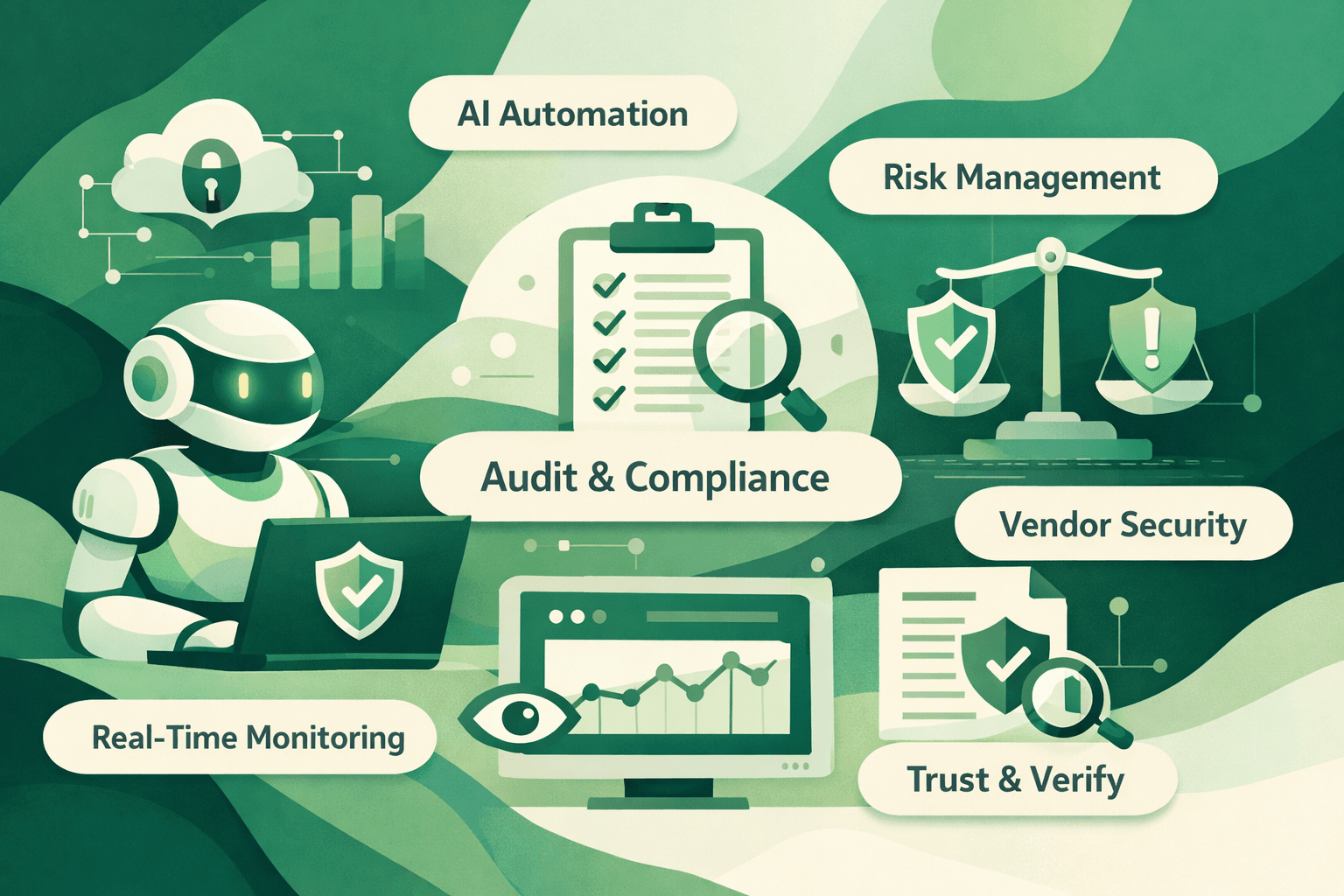
AI Cybersecurity Compliance Checklist
Security compliance has fundamentally changed. In 2026, organizations can no longer rely on annual audit preparation sprints, static checklists, and spreadsheet-based processes. With evolving requirements across SOC 2 audits, ISO 27001 compliance, GDPR compliance, PCI DSS compliance, and HIPAA compliance, security teams need a new approach that combines human expertise with intelligent automation.
This comprehensive guide explores how to build a practical cybersecurity compliance checklist that leverages AI compliance software and automated compliance platforms while maintaining the human judgment essential for mature security programs.
Why Traditional Compliance Checklists Fail in 2026
Most organizations start their compliance journey with good intentions and a detailed cybersecurity compliance checklist. The typical approach includes:
Annual SOC 2 audit preparation cycles
Static policy documents that quickly become outdated
Manual evidence collection through screenshots and spreadsheets
Periodic vendor assessments for third-party risk management
Disconnected processes for each compliance framework
This model breaks down rapidly when organizations face:
Multiple Framework Requirements: Modern businesses must simultaneously maintain SOC 2 audit readiness, pursue ISO 27001 certification, ensure GDPR compliance for EU data, achieve PCI DSS compliance for payment processing, and meet HIPAA compliance standards for healthcare data.
Continuous Monitoring Expectations: Regulators and customers no longer accept annual snapshots. GDPR enforcement actions focus on ongoing data protection practices. PCI compliance requires continuous security validation. HIPAA compliance demands operational accountability between audits.
Third-Party Risk Complexity: Organizations now manage dozens or hundreds of vendors, each with its own security posture affecting their overall compliance. Traditional vendor risk management software approaches that rely on annual questionnaires cannot keep pace with this complexity.
Audit Fatigue: Teams spend months preparing for each framework audit, pulling evidence from multiple systems, and recreating documentation that should already exist.
The solution lies in transforming your cybersecurity compliance checklist from a static document into a living system powered by security compliance software, providing continuous visibility and automation.
The 2026 Multi-Framework Compliance Landscape
Before building your checklist, understand what modern compliance programs must address:
SOC 2 Audit Requirements
SOC 2 remains the foundation for trust in B2B SaaS. The framework evaluates controls across five Trust Services Criteria: Security, Availability, Processing Integrity, Confidentiality, and Privacy. A SOC 2 audit examines whether your organization has designed and implemented adequate controls, with Type II reports testing control effectiveness over time (typically 6-12 months).
Key focus areas include access controls, change management, system monitoring, incident response, and vendor management. Most enterprise customers now require SOC 2 Type II reports before signing contracts.
ISO 27001 Compliance and Certification
ISO 27001 represents the international standard for Information Security Management Systems (ISMS). Achieving ISO 27001 certification requires implementing a comprehensive framework covering 93 controls across 14 domains in Annex A.
Unlike SOC 2, ISO 27001 compliance emphasizes systematic risk management, continuous improvement, and organizational security culture. ISO 27001 certification is often required for international business, government contracts, and regulated industries.
GDPR Compliance
The General Data Protection Regulation applies to any organization processing EU personal data. GDPR compliance requires implementing privacy by design, maintaining data processing records, ensuring lawful processing bases, managing data subject rights, and reporting breaches within 72 hours.
GDPR enforcement has intensified significantly, with fines reaching hundreds of millions for major violations. Organizations must demonstrate continuous compliance, not just policy documentation.
PCI DSS Compliance
PCI DSS compliance is mandatory for any organization that stores, processes, or transmits cardholder data. The Payment Card Industry Data Security Standard includes 12 requirements covering network security, access controls, monitoring, and security testing.
PCI compliance levels depend on transaction volume, with Level 1 merchants (over 6 million transactions annually) requiring annual audits by Qualified Security Assessors. All levels require continuous compliance validation.
HIPAA Compliance
HIPAA compliance applies to healthcare providers, health plans, clearinghouses, and their business associates handling Protected Health Information (PHI). Requirements span administrative, physical, and technical safeguards, with specific rules for data encryption, access controls, audit logging, and breach notification.
HIPAA compliance extends throughout your entire vendor ecosystem—any third party accessing PHI must sign Business Associate Agreements and maintain equivalent security standards.
Building Your Modern Cybersecurity Compliance Checklist
A practical 2026 cybersecurity compliance checklist addresses standard requirements across frameworks while accommodating framework-specific needs. Here's the essential baseline every organization should implement:
1. Comprehensive Asset and Data Inventory
What Must Exist:
Complete inventory of systems, applications, databases, and infrastructure
Data classification scheme (PII, PHI, payment data, intellectual property, confidential business data)
Data flow mapping showing where sensitive data moves
Asset ownership with clear accountability
System criticality ratings based on business impact
How AI Compliance Software Helps:
Automated compliance platforms continuously discover assets across cloud environments, SaaS applications, and on-premises infrastructure. AI-driven security compliance software detects new systems, identifies unmanaged assets, and flags configuration drift that could create compliance gaps.
Where Human Judgment Remains Essential:
Only your team can determine business criticality, acceptable risk levels, and data classification policies aligned with your organization's risk appetite. Automated tools provide visibility, but humans decide how to categorize and protect different asset types.
Framework Mapping:
ISO 27001: Annex A Control 8.1 (Asset Responsibility)
SOC 2: Common Criteria CC6.1 (Logical and Physical Access Controls)
GDPR: Article 30 (Records of Processing Activities)
PCI DSS: Requirement 2 (Configuration Standards)
HIPAA: Administrative Safeguards §164.308(a)(1)(ii)(A) (Risk Analysis)
2. Access Control and Identity Management
What Must Exist:
Role-based access control (RBAC) aligned with job functions
Multi-factor authentication (MFA) for all users, especially privileged accounts
Joiner-Mover-Leaver (JML) processes, ensuring timely access provisioning and deprovisioning
Regular access reviews (quarterly for privileged access, annually for standard users)
Privileged access management with session monitoring
Principle of least privilege enforcement
How AI Compliance Software Helps:
AI-powered security compliance software analyzes access logs to identify dormant accounts, excessive permissions, and unusual access patterns. Automated compliance platforms can flag users whose access is inconsistent with their role, detect privileged accounts without MFA, and maintain audit trails to prove access review completion.
Where Human Judgment Remains Essential:
Access logic requires understanding organizational structure, business processes, and separation-of-duties requirements. Humans must approve access exceptions, define role hierarchies, and determine appropriate access levels for unique situations.
Framework Mapping:
ISO 27001: Annex A Controls 5.15-5.18, 8.2-8.5 (Access Control)
SOC 2: CC6.1-CC6.3 (Logical and Physical Access)
GDPR: Article 32 (Security of Processing)
PCI DSS: Requirements 7-8 (Access Control and Authentication)
HIPAA: Technical Safeguards §164.312(a) (Access Control)
3. Risk Management and Assessment
What Must Exist:
Comprehensive risk register identifying security threats and vulnerabilities
Risk assessment methodology with likelihood and impact scoring
Risk treatment plans (mitigate, accept, transfer, avoid)
Control mapping showing how controls address specific risks
Regular risk reassessment (at least annually and after significant changes)
How AI Compliance Software Helps:
AI compliance software identifies patterns across risk data, detects emerging threats based on industry intelligence, and highlights risk trends over time. Automated platforms can suggest control improvements based on similar organizations' experiences and continuously monitor control effectiveness.
Where Human Judgment Remains Essential:
Risk appetite, acceptance thresholds, and mitigation priorities require executive-level business judgment. Only your leadership team can decide which risks are acceptable given your organization's strategy, resources, and tolerance levels.
Framework Mapping:
ISO 27001: Clause 6.1.2 (Information Security Risk Assessment)
SOC 2: CC3.2 (Risk Assessment Process)
GDPR: Article 32 (Risk-Based Security Measures)
HIPAA: Administrative Safeguards §164.308(a)(1)(ii)(A) (Risk Analysis)
4. Third-Party Risk Management and Vendor Oversight
What Must Exist:
Complete vendor inventory with service descriptions
Vendor criticality classification based on data access and business impact
Security assessment process for new vendors
Ongoing monitoring of vendor security posture
Contract review, ensuring appropriate security terms
Data Processing Agreements (DPAs) for GDPR compliance
Business Associate Agreements (BAAs) for HIPAA compliance
Vendor incident response procedures
How AI Compliance Software Helps:
Modern vendor risk management software continuously monitors vendor certifications, tracks responses to security questionnaires, analyzes contracts for compliance gaps, and alerts when vendor certifications expire. AI-powered third-party risk management systems can scan for vendor breaches, assess vendor financial stability, and dynamically score vendor risk based on multiple factors.
Automated compliance platforms eliminate the manual spreadsheet tracking that plagues most vendor risk programs, providing real-time visibility into your third-party risk landscape.
Where Human Judgment Remains Essential:
Vendor selection involves business relationship considerations beyond pure security metrics. Humans must evaluate contractual negotiations, accept risks with critical vendors without a perfect security posture, and develop vendor exit strategies when relationships end.
Framework Mapping:
ISO 27001: Annex A Controls 5.19-5.23 (Supplier Relationships)
SOC 2: CC9.2 (Vendor Management)
GDPR: Article 28 (Processor Requirements)
PCI DSS: Requirement 12.8 (Service Provider Management)
HIPAA: Business Associate Requirements §164.308(b)
5. Security Monitoring and Incident Response
What Must Exist:
Security information and event management (SIEM) or equivalent logging
Log retention policies meeting compliance requirements
Alert rules for security-relevant events
Incident response plan with defined roles and procedures
Incident classification and escalation criteria
Post-incident review process
Breach notification procedures for GDPR and HIPAA
How AI Compliance Software Helps:
AI-driven security compliance software detects anomalies in log data that rule-based systems miss. Machine learning identifies unusual behavior patterns, correlates events across multiple systems, and reduces false-positive alerts that cause alert fatigue.
Automated compliance platforms maintain the continuous evidence trail required for SOC 2 audits and ISO 27001 certification, automatically collecting and timestamping security logs.
Where Human Judgment Remains Essential:
Incident classification, escalation decisions, and breach notification determinations require human assessment of business context, legal implications, and stakeholder impact. Only your team can decide when an incident rises to the level requiring executive notification or regulatory reporting.
Framework Mapping:
ISO 27001: Annex A Controls 5.24-5.28 (Incident Management)
SOC 2: CC7.3 (Security Incident Response)
GDPR: Articles 33-34 (Breach Notification)
PCI DSS: Requirement 10 (Logging and Monitoring)
HIPAA: Security Incident Procedures §164.308(a)(6)
6. Change Management and Configuration Control
What Must Exist:
Documented change management process
Change approval requirements based on risk level
Configuration baselines for critical systems
Change testing and rollback procedures
Change documentation and audit trails
How AI Compliance Software Helps:
Automated compliance platforms detect unauthorized changes, compare current configurations against approved baselines, and maintain continuous configuration monitoring. AI can identify high-risk changes based on past incidents and flag changes that could impact compliance controls.
Where Human Judgment Remains Essential:
Change prioritization during incidents, emergency change authorization, and business impact assessment require human decision-making that considers factors beyond technical risk.
Framework Mapping:
ISO 27001: Annex A Control 8.32 (Change Management)
SOC 2: CC8.1 (Change Management Process)
PCI DSS: Requirement 6 (Secure Development)
7. Security Awareness and Training
What Must Exist:
Security awareness training for all employees
Role-specific training (developers, IT staff, management)
Training completion tracking
Phishing simulation programs
Security policy acknowledgment process
How AI Compliance Software Helps:
Security compliance software tracks training completion, identifies employees overdue for training, and correlates training effectiveness with security incidents. AI can personalize training content based on role and past performance.
Where Human Judgment Remains Essential:
Training content development, organizational security culture building, and determining appropriate consequences for security policy violations require human leadership.
Framework Mapping:
ISO 27001: Annex A Control 6.3 (Information Security Awareness)
SOC 2: CC1.4 (Commitment to Competence)
GDPR: Article 32 (Security Measures Including Training)
HIPAA: Workforce Training §164.308(a)(5)
8. Business Continuity and Disaster Recovery
What Must Exist:
Business impact analysis identifying critical systems
Recovery time objectives (RTO) and recovery point objectives (RPO)
Documented backup and recovery procedures
Annual disaster recovery testing
Business continuity plan with alternative processing arrangements
How AI Compliance Software Helps:
Automated platforms monitor backup success rates, track recovery testing schedules, and alert when backups fail or when recovery procedures haven't been tested within required timeframes.
Where Human Judgment Remains Essential:
RTO and RPO determination requires business judgment about acceptable downtime and data loss. Humans must make real-time decisions during actual disaster scenarios.
Framework Mapping:
ISO 27001: Annex A Controls 5.29-5.30 (Business Continuity)
SOC 2: A1.2 (Availability Commitments)
HIPAA: Contingency Plan §164.308(a)(7)
9. Data Protection and Privacy
What Must Exist:
Data retention and disposal policies
Encryption for data at rest and in transit
Data subject rights management procedures (GDPR)
Privacy impact assessments for high-risk processing
Consent management for applicable processing
Data minimization practices
How AI Compliance Software Helps:
AI-powered automated compliance platforms can identify unnecessary data retention, detect unencrypted sensitive data, and track data subject requests through completion. Machine learning can classify data automatically to support GDPR compliance.
Where Human Judgment Remains Essential:
Privacy policy decisions, consent strategy, data retention period determination, and responding to complex data subject requests require legal and business judgment.
Framework Mapping:
GDPR: Articles 5-6, 15-22 (Data Protection Principles and Rights)
ISO 27001: Annex A Control 5.34 (Privacy and PII Protection)
HIPAA: Privacy Rule §164.502-§164.514
PCI DSS: Requirement 3 (Data Protection)
10. Continuous Evidence Collection for Audit Readiness
What Must Exist:
Policy and procedure documentation
Control evidence organized by framework
Configuration validation artifacts
Access review records
Training completion reports
Vendor assessment documentation
Incident response records
Change management logs
How AI Compliance Software Helps:
This is where automated compliance platforms provide the most dramatic improvement over manual processes. AI compliance software continuously collects evidence from your infrastructure, automatically timestamps artifacts for auditability, organizes evidence by control and framework, and maintains the complete audit trail required for SOC 2 audits, ISO 27001 certification, and other assessments.
Modern security compliance software eliminates the "audit scramble" where teams spend weeks pulling screenshots and reconstructing evidence. Instead, evidence collection happens automatically in the background.
Where Human Judgment Remains Essential:
Humans must verify the completeness of evidence, prepare audit narratives explaining control implementation, and respond to auditor questions that require business context. Auditors assess judgment and culture, not just technical controls.
Framework Mapping:
All frameworks require documented evidence of control implementation and effectiveness.
The Role of AI in Modern Cybersecurity Compliance
AI compliance software and automated compliance platforms represent a fundamental shift in how organizations approach security compliance. Understanding what AI can and cannot do is essential for building an effective compliance program.
What AI Compliance Software Excels At
Continuous Monitoring at Scale: AI systems monitor thousands of configurations, logs, and control states simultaneously, detecting issues humans would miss due to volume.
Pattern Recognition: Machine learning identifies subtle anomalies in access patterns, configuration drift, and user behavior that rule-based systems cannot catch.
Evidence Automation: Automated platforms continuously collect, timestamp, and organize evidence across multiple frameworks, eliminating manual screenshot hunting.
Predictive Risk Scoring: AI analyzes historical data to predict which controls are most likely to fail and which vendors present elevated risk.
Cross-Framework Mapping: Intelligent systems map controls across SOC 2, ISO 27001, GDPR, PCI DSS, and HIPAA, showing how a single control satisfies multiple requirements.
Real-Time Alerting: AI-driven security compliance software detects control failures and policy violations in real-time rather than discovering them during annual audits.
What Requires Human Expertise and Judgment
Strategic Risk Decisions: Only humans can determine your organization's risk appetite, which risks to accept, and how to prioritize competing security investments.
Business Context: AI cannot understand customer relationships, competitive positioning, or organizational politics that influence compliance decisions.
Regulatory Interpretation: Complex GDPR compliance questions, HIPAA applicability determinations, and PCI DSS scope decisions require legal and compliance expertise.
Audit Interaction: Building relationships with auditors, explaining control intent, and negotiating audit findings require human communication skills.
Policy Development: Creating security policies that balance protection with business enablement requires understanding organizational culture and business processes.
Incident Response Leadership: During actual security incidents, humans must make time-sensitive decisions considering factors AI cannot evaluate.
Vendor Relationships: Third-party risk management includes relationship considerations, contract negotiations, and trust assessments beyond what vendor risk management software can quantify.
Moving from Annual Audits to Continuous Assurance
The most significant change in 2025 compliance is the shift from periodic verification to continuous assurance. Traditional compliance operated on annual cycles: prepare intensively, survive the audit, then relax until next year. This model no longer works.
Why Continuous Compliance Matters
Customer Expectations: Enterprise buyers want assurance of security between SOC 2 audit periods, not just historical reports.
Regulatory Requirements: GDPR enforcement focuses on operational practices, not just documentation. PCI DSS compliance requires ongoing validation, not annual certification.
Threat Landscape: Security risks evolve daily. Annual assessments cannot catch vulnerabilities introduced between audits.
Business Velocity: Organizations change constantly—new systems, vendors, employees, and data flows. Compliance must keep pace.
How Automated Compliance Platforms Enable Continuous Assurance
Modern security compliance software transforms static checklists into living compliance systems:
Real-Time Control Monitoring: Instead of testing controls annually, automated platforms continuously monitor control effectiveness. When access controls weaken, encryption fails, or configurations drift, alerts trigger immediately.
Always-Ready Evidence: Rather than scrambling to collect evidence before audits, AI compliance software maintains a continuously updated evidence repository organized by framework and control.
Proactive Gap Detection: Automated compliance platforms identify control gaps before they become audit findings, allowing remediation on your timeline rather than under audit pressure.
Trend Analysis: AI analyzes compliance metrics over time, helping security teams understand whether their security posture is improving or degrading.
Multi-Framework Visibility: Dashboards display compliance status for SOC 2, ISO 27001, GDPR, PCI, and HIPAA simultaneously, eliminating framework silos.
The Human Control Plane in Continuous Compliance
Continuous assurance doesn't eliminate human involvement—it changes how humans spend their time. Instead of manual evidence collection and reactive firefighting, security teams focus on:
Strategic Planning: Using compliance data to inform security roadmaps and investment decisions.
Risk Prioritization: Evaluating which gaps require immediate remediation versus those that are acceptable risk.
Process Improvement: Analyzing why controls fail and implementing systematic improvements.
Stakeholder Communication: Translating compliance metrics into business language for executives and board members.
Audit Preparation: Reviewing evidence narratives and preparing for auditor discussions rather than hunting for documents.
Implementing Your AI-Enhanced Cybersecurity Compliance Checklist
Moving from traditional compliance to an AI-powered approach requires a structured implementation strategy.
Phase 1: Assessment and Foundation (Months 1-2)
Document Current State: Inventory existing compliance activities, frameworks in scope (SOC 2, ISO 27001, GDPR, PCI DSS, HIPAA), and current security compliance software.
Identify Gaps: Compare current practices against your cybersecurity compliance checklist to understand where automation would provide the most value.
Define Requirements: Determine which capabilities of automated compliance platforms are essential for your organization's specific compliance needs.
Select Tools: Evaluate AI compliance software options based on framework support, integration capabilities, evidence automation, and vendor risk management software features.
Phase 2: Core Control Implementation (Months 3-6)
Deploy Security Compliance Software: Implement your chosen automated compliance platform and integrate with existing systems (identity management, cloud infrastructure, SIEM).
Establish Baselines: Document current control implementation and evidence for SOC 2 audit, ISO 27001 compliance, and other in-scope frameworks.
Configure Monitoring: Set up continuous monitoring for critical controls, configuration baselines, and policy compliance.
Implement Vendor Risk Management Software: Centralize third-party risk management in your automated platform, including vendor inventory, assessments, and continuous monitoring.
Phase 3: Evidence Automation (Months 4-7)
Map Evidence to Controls: Link evidence sources to specific controls across frameworks to enable automated collection.
Automate Collection: Configure AI compliance software to continuously gather evidence from logs, configurations, access reviews, and training systems.
Structure Repository: Organize evidence by framework, control, and time period for efficient auditor access.
Test Completeness: Validate that automated evidence collection covers all control requirements before relying on it for actual audits.
Phase 4: Continuous Improvement (Months 6+)
Monitor Trends: Use security compliance software dashboards to track control effectiveness trends over time.
Refine Alerts: Tune AI-driven alerts to reduce false positives while ensuring real issues are caught.
Expand Coverage: Gradually extend continuous monitoring to additional controls and systems.
Optimize Processes: Use insights from your automated compliance platform to streamline security processes and reduce friction.
Measuring Cybersecurity Compliance Program Effectiveness
A practical cybersecurity compliance checklist includes metrics for measuring program maturity and effectiveness:
Operational Metrics
Audit Preparation Time: Track the number of hours your team spends preparing for SOC 2 audits, ISO 27001 certification assessments, and other audits. AI compliance software should dramatically reduce this.
Evidence Collection Time: Measure time from evidence request to delivery. Automated compliance platforms should provide evidence in minutes, not days.
Control Failure Rate: Track how frequently controls fail between assessments. Continuous monitoring should catch and remediate failures faster.
Remediation Time: Measure time from gap identification to closure. Proactive detection enables faster remediation than reactive audit findings.
Risk Metrics
Vendor Risk Score Distribution: Using vendor risk management software, track what percentage of vendors fall into high, medium, and low risk categories.
Open High-Risk Findings: Monitor the number of unresolved high-risk security gaps across all frameworks.
Third-Party Incidents: Track security incidents originating from third-party vendors to assess third-party risk management effectiveness.
Compliance Metrics
Framework Coverage: Measure the percentage of applicable controls implemented for SOC 2, ISO 27001, GDPR, PCI DSS, and HIPAA compliance.
Audit Findings Trend: Track whether audit findings are decreasing over time as your continuous assurance program matures.
Certification Status: Monitor ISO 27001 certification, PCI DSS certification levels, and SOC 2 report types (I vs II).
Common Pitfalls to Avoid
Organizations implementing AI-enhanced compliance programs frequently encounter these challenges:
Over-Reliance on Automation: AI compliance software is powerful, but cannot replace human judgment. Maintain appropriate human oversight and decision-making.
Tool Sprawl: Implementing multiple security compliance software solutions that don't integrate creates new silos. Choose an integrated automated compliance platform when possible.
Checkbox Mentality: Focusing on control counts rather than actual risk reduction leads to ineffective compliance programs regardless of automation level.
Neglecting Vendor Risk: Even with excellent internal controls, inadequate third-party risk management can undermine your entire compliance posture.
Documentation Gaps: AI can collect evidence, but humans must maintain clear policies and procedures that auditors can understand.
Ignoring Compliance Debt: Deferring control improvements creates compliance debt that compounds over time. Address gaps systematically rather than deferring to future audit cycles.
The Future of Cybersecurity Compliance
The evolution toward AI-powered compliance represents a fundamental shift in how organizations approach security:
From Reactive to Proactive: Catching control failures in real-time rather than during annual audits.
From Periodic to Continuous: Maintaining constant audit readiness rather than intense preparation cycles.
From Siloed to Integrated: Managing multiple frameworks through unified security compliance software rather than separate processes.
From Manual to Automated: Eliminating repetitive evidence collection while preserving human judgment for complex decisions.
From Compliance to Trust: Using compliance as a competitive differentiator and customer trust signal rather than a checkbox exercise.
Organizations that embrace automated compliance platforms, AI compliance software, and continuous assurance will find that compliance becomes an enabler of business growth rather than an obstacle. Fast enterprise sales cycles, efficient audits, and genuine improvements in security posture are the returns on investment in modern security compliance software.
Conclusion: Building Your Compliance Advantage
A modern cybersecurity compliance checklist powered by AI compliance software and automated compliance platforms transforms security from a cost center into a strategic advantage.
Your compliance program should enable:
Faster Sales Cycles: Enterprise buyers receive immediate evidence of SOC 2 audit compliance, ISO 27001 certification, and framework-specific compliance rather than waiting for annual reports.
Reduced Audit Costs: Continuous evidence collection through automated compliance platforms eliminates weeks of audit preparation, reducing both internal costs and auditor fees.
Better Risk Management: Real-time visibility into control effectiveness enables proactive risk management rather than reactive gap remediation.
Scalable Growth: As you expand internationally (requiring ISO 27001 compliance), enter healthcare (requiring HIPAA compliance), or process payments (requiring PCI DSS compliance), your automated platform scales efficiently.
Competitive Differentiation: Mature security compliance demonstrates operational excellence to customers, investors, and partners.
The future belongs to organizations that combine human expertise with intelligent automation, letting AI handle continuous monitoring, evidence collection, and pattern recognition. In contrast, humans retain control over strategy, judgment, and accountability.
Whether you're preparing for your first SOC 2 audit, pursuing ISO 27001 certification, ensuring GDPR compliance, achieving PCI compliance, maintaining HIPAA compliance, or managing third-party risk, an AI-enhanced cybersecurity compliance checklist provides the foundation for sustainable, scalable security programs.
Ready to Transform Your Compliance Program?
DSALTA's AI-powered compliance platform helps organizations move from reactive, spreadsheet-based compliance to continuous, intelligent assurance across SOC 2, ISO 27001, GDPR, PCI DSS, and HIPAA.
Our automated compliance platform provides:
Continuous control monitoring and evidence collection
AI-driven vendor risk management software for third-party oversight
Multi-framework compliance visibility in a single dashboard
Always-ready audit evidence for faster, more efficient assessments
Intelligent gap detection before issues become findings
Stop scrambling before audits. Start building continuous trust.
Request a demo to see how DSALTA's AI compliance software can transform your security compliance program from a periodic obligation into a continuous competitive advantage.
Explore more AI Compliance articles
AI Regulatory Compliance
AI-Powered Compliance Automation
HIPAA & Healthcare AI
GDPR & ISO 27001 with AI
AI in Vendor Risk Management
Future of AI Compliance
Stop losing deals to compliance.
Get compliant. Keep building.
Join 100s of startups who got audit-ready in days, not months.