Streamline Compliance With AI: SOC 2, ISO 27001, GDPR & More
Written by
John Ozdemir
Published on
The Multi-Framework Compliance Challenge
Security teams don't fail audits because they lack commitment to compliance. They fail because every framework exists in its own silo, creating impossible operational burdens.
SOC 2 audit preparation occurs in a single set of folders. ISO 27001 compliance documentation lives somewhere else. GDPR compliance requirements get tracked in spreadsheets. PCI DSS compliance gets bolted on as an afterthought. HIPAA compliance becomes yet another separate initiative.
The result? Duplicate work across frameworks, scattered evidence that's impossible to maintain, months lost to manual tracking and verification, exhausted teams that can't keep up with compliance demands, and failed audits despite genuine security investments.
For organizations pursuing multiple compliance frameworks, and in 2026, most growing companies need at least 2-3 certifications the traditional approach is fundamentally broken. You end up reimplementing the same controls five different ways, collecting the same evidence multiple times, and managing five parallel workflows that share 60-80% of requirements.
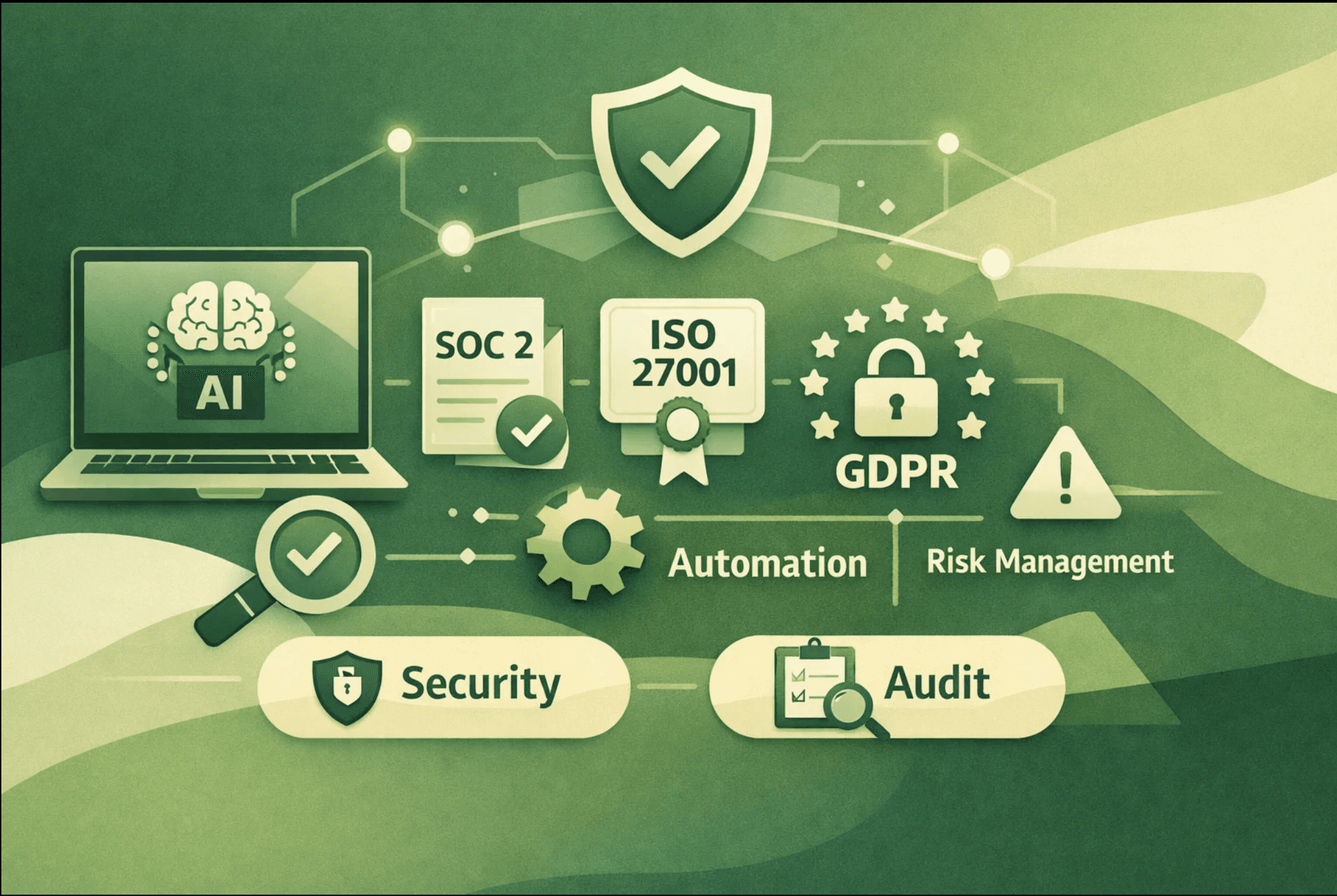
This is precisely the problem modern AI compliance software solves. Instead of treating each framework as a separate mountain to climb, intelligent automation recognizes that SOC 2, ISO 27001 certification, GDPR compliance, PCI compliance, and HIPAA compliance are variations on the same security story and should be managed in a single unified system.
Understanding the Traditional Compliance Problem
How Most Organizations Approach Multi-Framework Compliance
The typical compliance journey looks like this:
Year 1: Launch a SOC 2 audit project because enterprise customers demand it. Spend 6-12 months implementing controls, gathering evidence, and achieving Type 1 certification. Your team finally celebrates after an enormous effort.
Year 2: International customers require ISO 27001 compliance. Despite 70% overlap with SOC 2, you start from scratch because nothing is mapped or connected. Another 9-12 months and significant budget consumed.
Year 3: European operations trigger GDPR compliance requirements. You manually answer data protection questionnaires, realizing you're documenting many controls you already implemented for SOC 2 and ISO 27001, but in entirely different formats.
Year 4: Handling payment data requires PCI DSS compliance. Once again, access controls, logging, monitoring, and incident response are reimplemented and documented separately, even though they are fundamentally the same controls.
Year 5: Healthcare expansion demands HIPAA compliance. The pattern repeats—similar safeguards, different documentation, separate audit preparation.
Why This Approach Breaks Down
Resource exhaustion occurs when compliance becomes multiple full-time jobs. Small security teams can't maintain five separate compliance programs simultaneously.
Evidence chaos emerges as teams store SOC 2 evidence in one location, ISO 27001 documentation elsewhere, GDPR records scattered across systems, and audit artifacts impossible to find when needed.
Duplicate implementation wastes engineering time. Access control gets implemented in five different ways. Logging systems get configured separately for each framework. Incident response procedures exist in multiple versions.
Knowledge gaps grow as only a few people understand the connections between frameworks. When they leave, institutional knowledge disappears.
Audit failures happen not from a lack of security but from the inability to produce evidence across multiple frameworks when auditors need it.
This is why spreadsheets, ticketing tools, and static GRC platforms collapse under the complexity of multi-framework environments. They weren't designed for intelligent cross-framework automation.
How AI Compliance Software Unifies Multiple Frameworks
The Fundamental Shift: Shared Control Architecture
An automated compliance platform powered by AI fundamentally changes the compliance model. Instead of tracking frameworks separately, modern platforms normalize controls across all major standards.
DSALTA's approach treats compliance frameworks as different views of the same underlying security program. The platform maps controls from SOC 2 Trust Services Criteria, ISO 27001 Annex A controls, GDPR technical and organizational measures, PCI DSS security requirements, and HIPAA administrative, physical, and technical safeguards into a unified control architecture.
Real-World Control Mapping Example
Consider access control one of the most fundamental security requirements. Traditional approaches implement it separately for each framework. AI compliance software recognizes it's the same control viewed through different lenses:
Real Control: User Access Provisioning and Reviews
SOC 2: CC6.1, CC6.2, CC6.3 (Logical and physical access controls)
ISO 27001: A.5.15, A.5.16, A.5.18 (Access control and user access management)
GDPR: Article 32 (Security of processing, access controls)
PCI DSS: Requirement 7, 8 (Restrict access, identification, and authentication)
HIPAA: 164.308(a)(3), 164.312(a)(1) (Workforce security, access control)
Real Control: Security Monitoring and Logging
SOC 2: CC7.2, CC7.3 (System operations, incident management)
ISO 27001: A.8.15, A.8.16 (Logging, monitoring activities)
GDPR: Article 30, 32 (Records of processing, security measures)
PCI DSS: Requirement 10 (Track and monitor network access)
HIPAA: 164.308(a)(1), 164.312(b) (Security management, audit controls)
Instead of five separate implementations, teams manage one control that satisfies all frameworks simultaneously. The security compliance software automatically maps evidence to each framework's specific requirements.
Automated Evidence Collection at Scale
The Evidence Bottleneck
The biggest operational challenge in any SOC 2 audit, ISO 27001 certification, or other compliance initiative is evidence collection. Traditional approaches require manual effort that doesn't scale:
Manually exporting access logs from identity providers quarterly, taking screenshots of system configurations before audits, chasing down change management approvals from developers, gathering vendor security assessments from scattered emails, re-uploading everything during each audit cycle, and recreating evidence that should have been captured continuously.
This manual evidence-gathering consumes 60-80% of the compliance team's time and creates enormous risk. If you can't find evidence when auditors request it, you fail—regardless of whether controls actually operated.
How AI Automates Evidence Collection
AI compliance software fundamentally changes evidence management through continuous, automated collection:
Cloud infrastructure evidence is automatically pulled from AWS CloudTrail, Google Cloud Logging, Azure Monitor, and other cloud platforms—tracking configuration changes, access patterns, and security events without manual exports.
Identity and access evidence flows from Okta, Azure AD, Google Workspace, and other IAM systems, automatically capturing user provisioning, access reviews, MFA enforcement, and termination activities.
Code and deployment evidence comes from GitHub, GitLab, Bitbucket, and CI/CD platforms—documenting code reviews, deployment approvals, and change management without developer effort.
Security tool evidence integrates data from vulnerability scanners, SIEM platforms, endpoint protection, and monitoring systems, continuously collecting scan results, security alerts, and incident data.
Training and HR evidence connect to learning management systems and HRIS platforms to track security awareness completion, background checks, and employee lifecycle events.
Vendor risk evidence aggregates vendor security assessments, SOC 2 reports, contract security terms, and review schedules in centralized repositories.
All evidence is automatically timestamped, mapped to specific control requirements, retained to meet compliance needs, and organized for efficient auditor review.
This eliminates 70-80% of manual audit preparation work while actually improving evidence quality and completeness.
The Unified Cybersecurity Compliance Checklist
Beyond Fragmented Checklists
Most organizations operate with compliance checklists scattered across Google Docs, Excel spreadsheets, Jira tickets, and team member memories. Each framework has its own checklist that nobody can find when needed.
AI compliance software provides a unified cybersecurity compliance checklist that shows control gaps in real-time across all frameworks, links each requirement to live evidence from integrated systems, flags missing controls before auditors identify them, tracks remediation progress with clear accountability, and generates audit-ready reports for SOC 2, ISO 27001, GDPR, PCI DSS, and HIPAA simultaneously.
Real-Time Compliance Visibility
Instead of discovering gaps during audits, teams see precisely where they stand:
Control coverage shows which SOC 2, ISO 27001, GDPR, PCI DSS, and HIPAA controls are implemented, partially implemented, or missing entirely.
Evidence completeness indicates which controls have sufficient proof and which need additional documentation before audits.
Risk prioritization identifies the highest-impact gaps that could lead to audit failures or security incidents.
Remediation tracking monitors progress on fixing identified issues with clear owners and deadlines.
This transforms compliance from guesswork into data-driven program management.
Integrated Vendor Risk Management Software
Why Vendor Risk Matters for Compliance
Compliance isn't only about internal systems and controls. Every compliance framework includes requirements for managing third-party and vendor risks:
SOC 2 requires management of subservice organizations and vendor oversight under CC9 (Risk Mitigation).
ISO 27001 mandates supplier relationships and supply chain security through multiple controls.
GDPR imposes strict requirements for processor agreements, data processing addenda, and ongoing vendor monitoring.
PCI DSS requires service provider management and ensuring vendors protect cardholder data appropriately.
HIPAA mandates Business Associate Agreements and ongoing monitoring of business associates handling PHI.
Traditional vendor risk management software operates separately from compliance platforms, creating disconnected workflows and duplicate vendor assessments.
Unified Third-Party Risk Management
AI compliance software with integrated third-party risk management capabilities transforms vendor oversight:
Automated vendor inventory maintains a complete list of all vendors with system access, data processing, or service delivery roles.
Risk-based classification automatically categorizes vendors by criticality, data sensitivity, and compliance impact across SOC 2, ISO 27001, GDPR, PCI DSS, and HIPAA.
Intelligent risk scoring uses AI to analyze vendor security posture based on collected documentation, historical performance, industry benchmarks, and breach databases.
Automated review workflows schedule and track vendor assessments based on risk tier—critical vendors reviewed annually, lower-risk vendors assessed less frequently.
Centralized evidence repository stores SOC 2 reports, ISO 27001 certificates, security questionnaire responses, BAAs for HIPAA, DPAs for GDPR, and contract security terms in one location.
Compliance mapping shows which vendors impact which compliance requirements, making it easy to understand vendor-related audit exposure.
This prevents the typical scenario in which audit preparation is delayed because teams can't locate vendor security documentation or demonstrate ongoing vendor monitoring.
Continuous Compliance vs. Annual Fire Drills
The Traditional Audit Cycle
Most organizations operate compliance as an annual or semi-annual event:
Month 1-2: Realize audit is approaching, and panic begins.
Month 3-6: Scramble to gather evidence, implement missing controls, and prepare documentation.
Month 7-8: Survive the audit through heroic effort from exhausted teams.
Month 9-12: Ignore compliance until the following audit cycle approaches.
This creates enormous stress, wastes resources on last-minute preparation, catches problems too late to fix properly, and results in compliance that exists only on paper during audit windows.
How AI Enables Continuous Compliance
Automated compliance platforms shift from periodic audits to continuous monitoring:
Daily control validation checks that controls operate correctly every day, not just during audit preparation.
Real-time evidence collection captures proof continuously as controls execute, eliminating evidence-gathering sprints.
Immediate gap detection surfaces problems when they occur, allowing prompt remediation rather than discovering issues during audits.
Always-ready posture means organizations can schedule audits with confidence anytime, because evidence and documentation are perpetually current.
This is how startups using AI compliance software achieve SOC 2 audit readiness in 8-12 weeks instead of 6-12 months, maintain ISO 27001 compliance without dedicated full-time staff, and add GDPR compliance, PCI compliance, or HIPAA compliance without proportional resource increases.
Real Business Impact of Unified Compliance
Shorter Sales Cycles
Security reviews are now mandatory in almost every enterprise deal. AI compliance software dramatically compresses security review timelines:
Instant documentation allows sales teams to share SOC 2 reports, ISO 27001 certificates, and compliance attestations immediately rather than after weeks of internal coordination.
Structured evidence packages answer security questionnaires efficiently with correctly mapped, audit-ready documentation.
Faster approvals occur when procurement teams see comprehensive compliance coverage across multiple frameworks.
This often becomes the difference between closing deals in weeks versus months—or winning competitive evaluations against vendors still building compliance programs manually.
Resource Efficiency
Traditional multi-framework compliance requires dedicated staff for each certification. Automated compliance platforms allow small teams to manage comprehensive programs:
One person can oversee SOC 2, ISO 27001, and GDPR simultaneously, rather than requiring separate specialists for each framework.
Engineering teams spend less time on compliance evidence gathering and more time building product features.
Leadership gets clear visibility without attending endless compliance meetings or reviewing massive spreadsheets.
Reduced Audit Costs
Audit preparation efficiency directly impacts costs:
Fewer auditor hours are needed when evidence is organized, complete, and instantly accessible.
Reduced consultant fees because teams can self-manage much of the compliance work that previously required expensive external help.
Eliminated re-work from failed audits or missing evidence that delays certification.
Organizations typically see a 40-60% reduction in total compliance costs when moving from manual processes to AI compliance software.
Competitive Advantages
Comprehensive compliance becomes a differentiator:
Win more enterprise deals because you satisfy security requirements that competitors can't meet.
Enter regulated markets like healthcare and finance that require specific certifications.
Command premium pricing because compliance demonstrates operational maturity and reduces customer risk.
Attract better investors who value companies with strong governance and compliance foundations.
How DSALTA Implements AI-Driven Compliance
DSALTA's automated compliance platform was purpose-built to solve the multi-framework compliance challenge. Instead of bolt-on automation, the platform treats unified compliance as its core design principle.
Core Platform Capabilities
Intelligent control mapping automatically maps your controls to SOC 2, ISO 27001, GDPR, PCI DSS, and HIPAA requirements, eliminating the need for manual framework translation.
Continuous evidence collection integrates with your technology stack to automatically gather proof from AWS, Google Cloud, Azure, Okta, GitHub, and other systems.
AI-powered gap analysis compares your current state against all framework requirements simultaneously, prioritizing remediation by risk and audit impact.
The unified compliance dashboard provides single-pane visibility across all compliance initiatives with real-time status updates.
Automated vendor risk management tracks third-party security posture and maps vendors to compliance impact across all frameworks.
Cross-framework reporting generates audit-ready documentation for any certification without duplicate effort.
Learn more about DSALTA's approach:
Integration With Your Existing Stack
DSALTA connects to the tools you already use:
Cloud platforms: AWS, Google Cloud, Azure, Kubernetes. Identity management: Okta, Azure AD, Google Workspace, OneLogi.n Development: GitHub, GitLab, Bitbucket, Jira, Jenkins Security tools: Vulnerability scanners, SIEM platforms, endpoint protection HR systems: BambooHR, Workday, Rippling, Gusto Communication: Slack, Microsoft Teams
Evidence flows automatically from these integrations without requiring manual exports or screenshots.
From Months to Weeks
Traditional timeline for achieving SOC 2, ISO 27001, and GDPR compliance manually: 18-24 months with significant resource investment.
DSALTA-accelerated timeline: 3-6 months to comprehensive multi-framework compliance with fractional resource requirements.
This acceleration comes from intelligent automation that eliminates duplicate work, continuous evidence collection that eliminates preparation sprints, and a unified architecture that enables parallel progress across frameworks.
Book a demo to see how DSALTA can transform your compliance program.
Best Practices for Implementing AI Compliance Software
Start With Framework Prioritization
Identify which certifications your customers and regulations require. Most organizations prioritize in this order:
SOC 2 for B2B SaaS sales and enterprise customers, ISO 27001 for international business and regulated industries, GDPR for European operations and data processing, HIPAA for healthcare data handling, PCI DSS for payment card processing
Implement them sequentially, but architect from the beginning for multi-framework support.
Connect Your Technology Stack Early
The value of AI compliance software lies in its automated evidence collection. Connect your key systems during implementation:
Cloud infrastructure first (AWS, Google Cloud, Azure) because most compliance controls relate to production environments.
Identity and access management is second (Okta, Azure AD) because access controls are universal requirements.
Development tools, third (GitHub, GitLab), for evidence of change management.
Security tools are fourth for proof of vulnerability and threat management.
The more integrations you enable, the more automation you achieve.
Assign Clear Ownership
Even with automation, compliance requires program management:
The executive sponsor provides leadership support and resources. The program manager coordinates across teams and manages relationships with auditors. Control owners maintain specific compliance areas aligned with job functions. Technical liaisons connect the platform to your infrastructure
Distributed ownership with centralized coordination works better than assigning everything to one overwhelmed person.
Build Continuous Improvement Loops
Use the visibility that automated compliance platforms provide to actually improve security:
Review control health metrics monthly to identify areas of weakness.
Analyze audit findings across frameworks to identify systemic issues.
Track vendor risk trends to improve procurement security requirements.
Use compliance data to inform security roadmap priorities.
The goal isn't just passing audits, it's building genuinely more secure operations.
Conclusion: The Future of Multi-Framework Compliance
Security compliance in 2025 is no longer about choosing between frameworks or managing them separately. Growing organizations need SOC 2 audit readiness, ISO 27001 certification, GDPR compliance, and often PCI DSS compliance or HIPAA compliance simultaneously.
The traditional approach managing each framework separately with manual processes—doesn't scale. It exhausts teams, wastes resources, creates duplicate work, and ultimately fails to keep pace with business growth.
AI compliance software represents a fundamental shift in how organizations approach multi-framework compliance. By treating frameworks as variations of the same security story rather than separate initiatives, automated compliance platforms enable small teams to achieve what previously required dedicated specialists for each certification.
The unified approach means one control implementation satisfies multiple frameworks, one evidence artifact serves multiple audits, one monitoring system protects all certifications, and one team manages comprehensive compliance programs.
This isn't just efficiency; it's enabling companies to compete in markets that demand robust compliance while maintaining the agility that drives growth. When compliance runs in the background through intelligent automation rather than consuming your team's attention, security becomes a competitive advantage rather than an operational burden.
Organizations using platforms like DSALTA move from compliance-as-crisis to compliance-as-system, where SOC 2, ISO 27001, GDPR, PCI DSS, and HIPAA requirements are met continuously through automated processes rather than through annual scrambles.
The future of compliance is unified, automated, and intelligent. The question isn't whether to adopt AI compliance software, it's how quickly you can implement it before competitors gain the advantages it enables.
Explore more AI Compliance articles
AI Regulatory Compliance
AI-Powered Compliance Automation
HIPAA & Healthcare AI
GDPR & ISO 27001 with AI
AI in Vendor Risk Management
Stop losing deals to compliance.
Get compliant. Keep building.
Join 100s of startups who got audit-ready in days, not months.