AI-Driven Vendor Monitoring for ISO 27001, GDPR & SOC 2
Written by
John Ozdemir
Published on
Jan 7, 2026
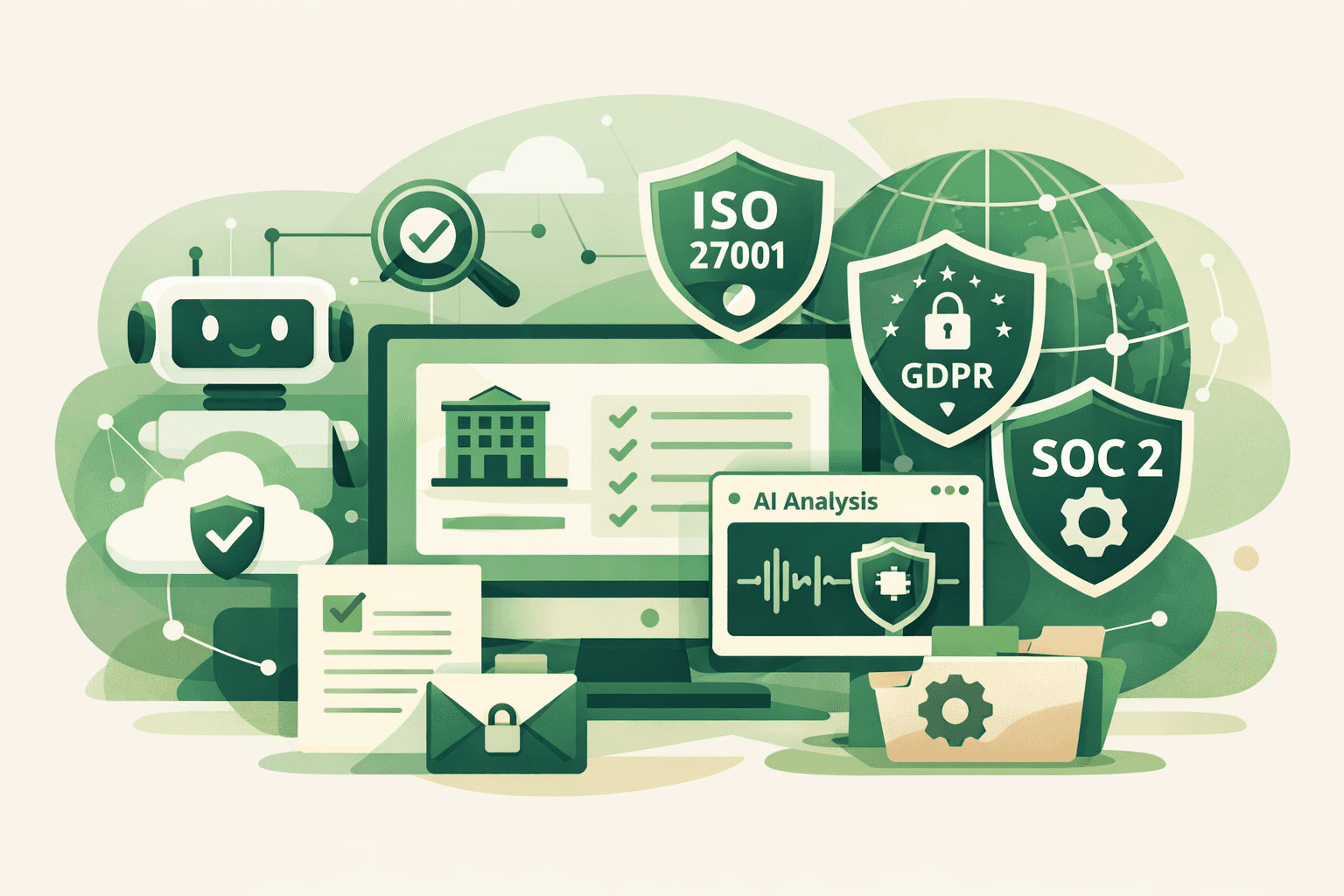
Security compliance has evolved far beyond annual audits and static checklists. For modern startups and enterprises, the most significant compliance risk no longer lives within your perimeter; it lives with your vendors.
Every SaaS tool, cloud platform, and outsourced service you rely on touches sensitive data, from customer PII affecting GDPR compliance to payment information requiring PCI DSS compliance. Yet most organizations still assess vendor risk once a year using spreadsheets and outdated questionnaires.
This approach fails in today's regulatory environment, where ISO 27001 compliance, SOC 2 audits, HIPAA compliance, and PCI compliance all demand continuous vendor oversight. This is where AI compliance software and automated compliance platforms are transforming third-party risk management from reactive paperwork into predictive intelligence.
The Hidden Cost of Manual Vendor Risk Management
Traditional vendor risk management software approaches break down because they rely on point-in-time assessments. Security teams manage vendor compliance with:
Annual questionnaires that become outdated within weeks
Static risk scores that don't reflect real-time changes
Spreadsheet-based tracking that fragments evidence
Manual contract reviews that miss critical GDPR or HIPAA clauses
Disconnected evidence collection during SOC 2 audits
The result? Vendor risk becomes a blind spot that undermines your entire compliance posture across ISO 27001 certification, GDPR compliance, and other frameworks.
Why Your Vendors Are Your Compliance Achilles Heel
Consider the compliance exposure created by your typical vendor stack:
Customer Data Processors: Impact GDPR compliance and require valid Data Processing Agreements with breach notification timelines and liability clauses.
Payment Processors: Trigger PCI DSS compliance requirements with specific security standards for handling cardholder data.
Healthcare Platforms: Must meet HIPAA compliance standards when processing Protected Health Information.
Infrastructure Providers: Directly affect your SOC 2 audit scope and ISO 27001 certification by controlling the security controls you rely on.
Without proper third-party risk management, a single vendor security incident can invalidate months of compliance work and jeopardize customer trust.
How AI Transforms Third-Party Risk Management
An AI-powered automated compliance platform doesn't just store vendor documents; it creates continuous intelligence about your third-party risk landscape.
Intelligent Questionnaire Analysis
AI compliance software automatically scans security questionnaires to identify gaps against specific framework requirements. Instead of manually reviewing hundreds of responses, the system flags missing controls for ISO 27001 compliance, weak answers impacting SOC 2 audit readiness, or insufficient data protection measures required by GDPR compliance.
Automated Contract Intelligence
Data Processing Agreements and vendor contracts are parsed to detect missing clauses, ambiguous liability terms, or non-compliant breach notification timelines. This ensures your GDPR and HIPAA compliance obligations are adequately documented before regulators or auditors ask.
Continuous Security Posture Monitoring
Rather than annual snapshots, AI-driven vendor risk management software continuously monitors:
Vendor certification status and expiry dates
Security policy updates and control changes
Access scope modifications that increase risk
Industry security incidents affecting your vendors
This creates always-ready audit evidence for SOC 2 audits, ISO 27001 certification assessments, and regulatory examinations.
Dynamic Risk Scoring
Vendors receive real-time risk scores based on data sensitivity, access scope, regulatory impact, and security posture. High-risk vendors are automatically flagged before they create compliance incidents, not after.
Mapping Vendor Risk to Your Cybersecurity Compliance Checklist
Modern security compliance software must support multiple frameworks simultaneously. Here's how AI-powered third-party risk management maps to major compliance requirements:
ISO 27001 Compliance: Clause 8 and Annex A controls require organizations to assess and monitor supplier security. AI platforms automatically map vendor risks to specific Annex A controls, maintaining continuous evidence of supplier oversight.
GDPR Compliance: Article 28 mandates processor accountability and requires valid Data Processing Agreements. Automated platforms track all processors, monitor DPA compliance, and flag vendors with access to EU personal data.
SOC 2 Audit: Trust Services Criteria require controls over vendor management and change management. AI systems build structured evidence folders showing continuous vendor oversight and control effectiveness.
PCI DSS Compliance: Requirements 12.8 and 12.9 mandate service provider management for any vendor handling cardholder data. Automated monitoring ensures payment-related vendors maintain required security standards.
HIPAA Compliance: Business Associate Agreements must be in place for any vendor accessing Protected Health Information. AI platforms automatically flag PHI exposure and track BAA compliance.
Building Your AI-Driven Vendor Risk Engine: A Framework
Moving from spreadsheet chaos to continuous compliance requires a structured approach.
Step 1: Centralize Your Vendor Inventory
Create a unified source of truth containing:
Complete vendor list with ownership
Data types and sensitivity levels accessed
System integrations and access methods
Applicable compliance frameworks per vendor
This inventory serves as your control center for every SOC 2 audit, ISO 27001 certification, and regulatory examination.
Step 2: Implement Automated Risk Profiling
Replace manual assessments with AI-driven analysis of:
Security questionnaire responses
Vendor certifications and attestations
Contract Terms and Data Processing Agreements
Historical security incidents or breaches
Each vendor receives a dynamic risk score that updates as conditions change, not just once per year.
Step 3: Enable Continuous Monitoring
Shift from annual snapshots to continuous oversight:
Track certification expirations automatically
Monitor security posture changes in real-time
Detect access scope modifications
Flag policy updates requiring review
This maintains perpetual third-party risk management across GDPR, PCI, HIPAA, and other frameworks.
Step 4: Map Controls to Framework Requirements
Ensure every vendor control links directly to:
ISO 27001 Annex A supplier requirements
SOC 2 Trust Services Criteria
GDPR Article 28 processor obligations
PCI DSS service provider management requirements
HIPAA Business Associate Agreement terms
When auditors arrive, your evidence is pre-organized and audit-ready.
Step 5: Create Executive Visibility
Leadership needs risk trending, not compliance status reports. Your vendor risk management software dashboard should display:
High-risk vendors requiring immediate attention
Compliance gap analysis by framework
Audit readiness across SOC 2, ISO 27001, GDPR, PCI DSS, and HIPAA
Upcoming vendor recertifications and reviews
This transforms compliance from a technical checklist into a strategic business metric.
The Modern Cybersecurity Compliance Checklist for Vendor Management
A comprehensive vendor compliance program powered by an automated compliance platform should include:
Onboarding Risk Assessment: Automated security questionnaires with AI-powered gap detection against ISO 27001 compliance and other framework requirements.
Continuous Certification Tracking: Monitoring of SOC 2 reports, ISO 27001 certifications, PCI DSS attestations, and HIPAA security assessments.
Contract Intelligence: AI-driven analysis of vendor agreements, Data Processing Agreements, and Business Associate Agreements to ensure GDPR compliance and HIPAA compliance.
Evidence Automation: Continuous collection and organization of vendor documentation mapped to specific controls for SOC 2 audits and ISO 27001 certification.
Risk-Based Segmentation: Dynamic vendor categorization based on data sensitivity, regulatory impact, and security posture.
Incident Response Integration: Automated vendor notification and impact assessment when security events occur.
From Annual Audits to Always-On Compliance
The fundamental shift happening in security compliance software is from periodic verification to continuous assurance.
Traditional compliance operated on an annual cycle: prepare for months, survive the audit, then start over. This approach fails when customers demand proof of security between audits, when regulations require continuous controls, and when vendor risks change weekly rather than yearly.
AI compliance software enables a new model where:
Controls are monitored continuously, not tested annually
Evidence collection happens automatically, not during audit prep
Vendor risks are visible in real-time, not discovered during incidents
Multi-framework compliance operates from shared data, not duplicated work
This is what organizations mean by "autonomous audits"—not eliminating auditors, but eliminating the frantic scramble before they arrive.
The Startup Advantage in Adopting Automated Compliance Platforms
Startups are uniquely positioned to benefit from AI-driven third-party risk management:
Fewer Legacy Systems: Less technical debt means cleaner integrations with security compliance software.
Smaller Vendor Ecosystems: Easier to establish comprehensive vendor risk management software from the start.
Growth Flexibility: An automated compliance platform scales from initial SOC 2 audit through ISO 27001 certification, GDPR compliance, PCI DSS compliance, and HIPAA compliance without rebuilding processes.
Competitive Advantage: Demonstrating mature third-party risk management accelerates enterprise sales cycles and builds customer trust faster.
Instead of hiring compliance consultants to patch together spreadsheets, startups can implement intelligent systems that grow with the business.
Why Continuous Third-Party Risk Management Matters Now
Several converging trends make AI-powered vendor risk management essential:
Regulatory Expansion: More jurisdictions requiring GDPR-style compliance and stricter vendor accountability.
Customer Expectations: Enterprise buyers demanding continuous security evidence, not annual reports.
Supply Chain Attacks: High-profile breaches through third-party vendors are increasing scrutiny on vendor risk.
Framework Proliferation: Organizations managing 3-5 compliance frameworks simultaneously (SOC 2, ISO 27001, GDPR, PCI DSS, HIPAA).
Remote Infrastructure: Cloud-first architectures are creating larger vendor attack surfaces.
Manual vendor risk management cannot keep pace with these pressures. AI compliance software provides the scalability and continuous monitoring modern compliance demands.
The Future of Security Compliance Software
The evolution toward automated compliance platforms represents a fundamental change in how organizations approach security:
From reactive to proactive risk detection. From manual evidence collection to continuous automation. From siloed frameworks to unified control management. From annual audits to perpetual audit readiness.
Organizations implementing AI-powered third-party risk management report:
60-80% reduction in audit preparation time
40-50% faster vendor onboarding
90%+ improvement in evidence completeness for SOC 2 audits
Unified visibility across ISO 27001 compliance, GDPR compliance, PCI compliance, and HIPAA compliance
Implementing Your AI Compliance Software Strategy
Organizations ready to modernize their third-party risk management should prioritize:
Framework Alignment: Ensure your automated compliance platform supports all required standards—SOC 2, ISO 27001 certification, GDPR, PCI DSS, and HIPAA.
Integration Capabilities: Look for vendor risk management software that connects with your existing identity systems, cloud infrastructure, and business tools.
Evidence Automation: Prioritize platforms that eliminate manual screenshot collection and maintain continuous audit trails.
Scalability: Choose security compliance software that grows from startup needs through enterprise requirements.
Vendor Coverage: Ensure the platform handles diverse vendor types from SaaS tools to infrastructure providers to data processors.
Conclusion: Compliance as Continuous Trust
Security compliance is no longer about passing periodic audits. It's about continuously demonstrating trustworthiness to customers, partners, and regulators.
You don't lose compliance because your policies are inadequate. You lose it because your vendors drift silently, risks emerge between audits, and manual processes cannot maintain the continuous oversight modern frameworks demand.
AI-powered third-party risk management transforms vendor compliance from annual paperwork into continuous intelligence. An automated compliance platform provides the visibility, automation, and evidence needed to maintain compliance across ISO 27001, GDPR, SOC 2, HIPAA, and PCI DSS—every day, not just during audit season.
The future of compliance is not manual. It's intelligent, automated, and continuous. Organizations that embrace AI compliance software today will build the foundation for scalable growth, faster enterprise sales, and genuine customer trust—while competitors still scramble through spreadsheets.
Ready to move beyond spreadsheet-based vendor risk? Modern security compliance software powered by AI enables continuous third-party risk management across all major frameworks. Discover how an automated compliance platform like DSALTA can transform your approach to ISO 27001 compliance, SOC 2 audits, GDPR compliance, and vendor risk management.
Explore more AI Compliance articles
AI Regulatory Compliance
AI-Powered Compliance Automation
HIPAA & Healthcare AI
GDPR & ISO 27001 with AI
AI in Vendor Risk Management
Stop losing deals to compliance.
Get compliant. Keep building.
Join 100s of startups who got audit-ready in days, not months.