SOC 2 Type 2 Audit Guide: 10 AI Controls for SaaS Teams
Written by
Deepika
Published on
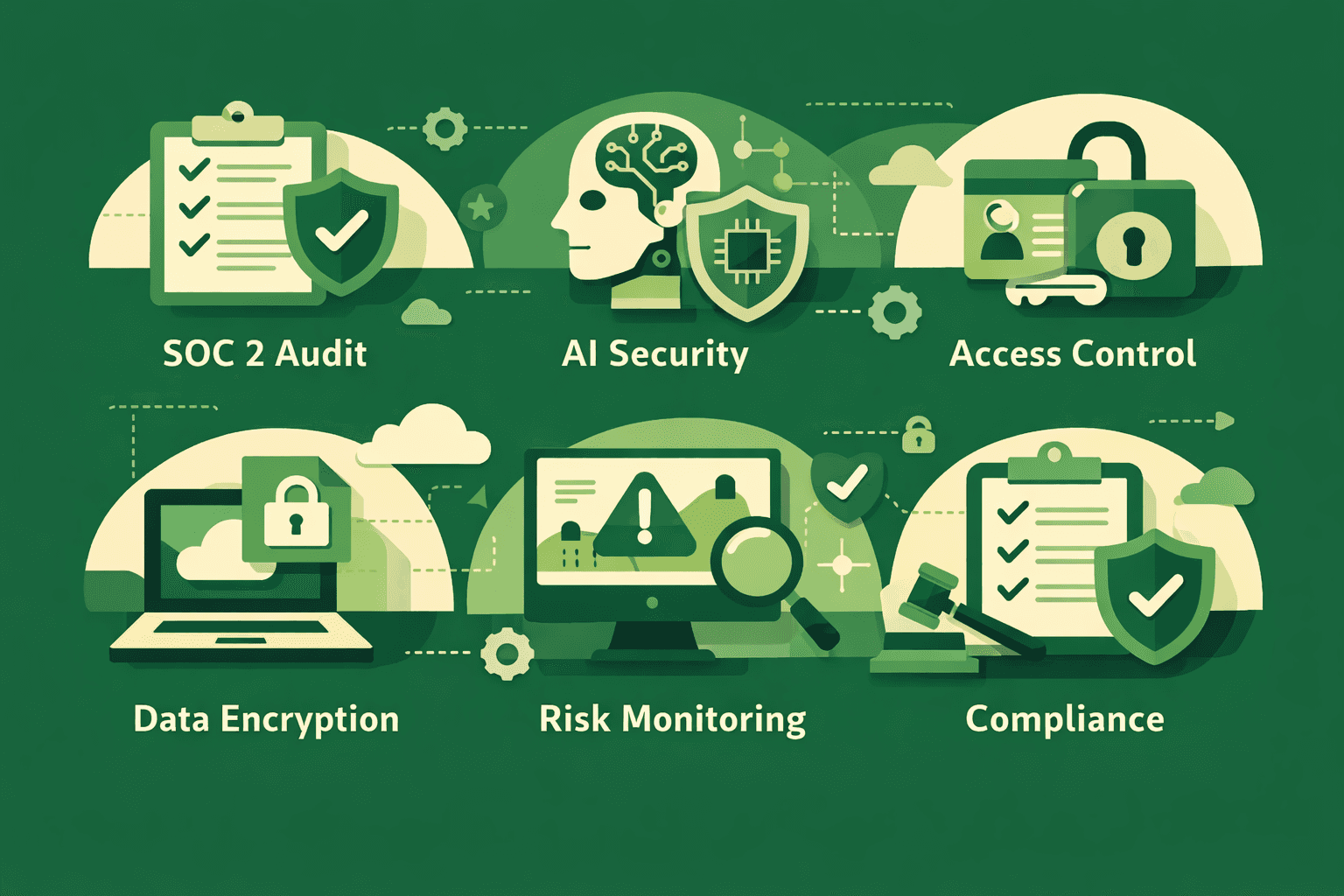
SOC 2 Type 2 Audit Guide
If your last SOC 2 audit involved hunting through Slack for screenshots, copying logs into spreadsheets, and spending three months on evidence collection, you're experiencing the pain that drives most SaaS teams to explore security compliance software. The good news? 2026 brings a fundamentally different approach to SOC 2 Type 2 compliance—one powered by AI compliance software that transforms reactive audits into continuous assurance.
This comprehensive guide breaks down the 10 essential SOC 2 controls that make or break audits, explains how AI-powered automated compliance platforms change the game, and shows how modern teams prepare for SOC 2 audits while maintaining ISO 27001, GDPR, PCI DSS, and HIPAA compliance.
Understanding SOC 2 Type 2 in 2026
SOC 2 (Service Organization Control 2) remains the gold standard for demonstrating security and availability to enterprise customers. While a SOC 2 Type 1 report shows that your controls exist at a point in time, a SOC 2 Type 2 report demonstrates that those controls operated effectively over a period (typically 6-12 months).
Enterprise buyers won't sign contracts without seeing your SOC 2 Type 2 report. It's not optional—it's table stakes for B2B SaaS growth. But the traditional approach to SOC 2 audits creates a massive operational burden:
Manual Evidence Collection: Security teams spend weeks pulling screenshots, exporting logs, and documenting control execution.
Fragmented Documentation: Evidence lives in Drive folders, Slack threads, ticketing systems, and individual inboxes.
Audit Stress: The 2-3 months before audit fieldwork become organizational fire drills, pulling engineers away from product work.
Reactive Gap Discovery: Teams discover control failures only when auditors do, leading to last-minute scrambles.
This is where AI compliance software and automated compliance platforms transform the SOC 2 journey from painful to predictable.
The Five Trust Services Criteria
SOC 2 audits evaluate controls across five Trust Services Criteria (TSC). Understanding these categories helps structure your cybersecurity compliance checklist:
Security (Common Criteria): The foundation for all SOC 2 audits. Covers access controls, change management, risk assessment, and security monitoring. Every SOC 2 report includes Security criteria.
Availability: Proves your system is available for operation and use as committed. Essential for SaaS platforms with uptime SLAs. Covers infrastructure monitoring, incident response, and capacity management.
Processing Integrity: Demonstrates that system processing is complete, valid, accurate, timely, and authorized. Critical for platforms handling transactions or calculations.
Confidentiality: Shows that information designated as confidential is protected as committed. Applies when handling sensitive customer data beyond just security needs.
Privacy: Addresses the collection, use, retention, disclosure, and disposal of personal information. Increasingly important as GDPR compliance and privacy regulations expand.
Most SaaS companies start with Security + Availability, then add other criteria based on their specific commitments to customers.
The 10 AI-Powered Controls Every SaaS Team Needs
Let's break down the controls that consistently challenge teams during SOC 2 audits—and how modern security compliance software solves each one.
Control 1: Access Control & Multi-Factor Authentication (CC6.1, CC6.2)
What Auditors Examine: Do you control who accesses what? Is access granted based on job role? Do you enforce multi-factor authentication? Are access reviews performed regularly?
Traditional Manual Challenges:
Quarterly access reviews mean exporting user lists from multiple systems
Identifying orphaned accounts requires manual comparison
Tracking MFA coverage across tools is fragmented
Proving access removal when employees leave is screenshot-dependent
How AI Compliance Software Solves This:
Modern automated compliance platforms continuously monitor access across your infrastructure. AI-driven security compliance software automatically detects dormant accounts, flags users without MFA, and identifies excessive permissions that violate least-privilege principles.
When auditors ask, "Show me access reviews for Q2," your evidence is already collected and timestamped. When they ask, "How do you ensure terminated employees lose access within 24 hours?" your system automatically shows the complete audit trail.
This control also supports ISO 27001 compliance (Annex A controls 5.15-5.18), GDPR compliance (Article 32 access controls), and HIPAA compliance (Technical Safeguards §164.312(a)).
Control 2: Change Management (CC8.1)
What Auditors Examine: Do you have a documented change process? Are changes approved before implementation? Do you test changes? Can you track what changed and when?
Traditional Manual Challenges:
Engineers make emergency changes without tickets
Change documentation lives in multiple systems (Jira, GitHub, Slack)
Proving rollback capability requires manual testing evidence
Linking changes to incidents requires detective work
How AI Compliance Software Solves This:
AI-powered automated compliance platforms detect unauthorized changes to production infrastructure, automatically link code deployments to approval tickets, and maintain a continuous timeline of all configuration changes.
When auditors select a sample period, your security compliance software automatically provides evidence of approval for every change, test records, and deployment timestamps. No screenshot hunting required.
Strong change management also satisfies ISO 27001 compliance (Annex A 8.32), supports PCI DSS compliance (Requirement 6), and reduces incidents that trigger HIPAA compliance breach notifications.
Control 3: Incident Response (CC7.3, CC7.4)
What Auditors Examine: Do you have an incident response plan? Are incidents detected, logged, and resolved? Do you perform post-incident reviews? Are stakeholders notified appropriately?
Traditional Manual Challenges:
Incident documentation is inconsistent across team members
Timeline reconstruction requires reviewing multiple chat logs
Customer notification evidence lives in email archives
Post-incident review completion is tracked in spreadsheets
How AI Compliance Software Solves This:
AI compliance software automates incident logging, captures timeline data from multiple sources, and tracks the incident lifecycle from detection through resolution. Machine learning detects potential security incidents from log patterns before they escalate.
Your automated compliance platform maintains the complete incident history auditors need—including severity classification, response times, affected systems, and remediation actions. For incidents that trigger GDPR compliance breach notifications (Article 33) or HIPAA compliance reporting requirements, the system automatically tracks notification timelines.
Control 4: Data Protection & Encryption (CC6.7)
What Auditors Examine: Is sensitive data encrypted at rest and in transit? Do you classify data by sensitivity? Are encryption keys properly managed? Can you provide evidence of data protection over the audit period?
Traditional Manual Challenges:
Finding unencrypted databases requires a manual infrastructure review
Proving TLS enforcement across all services needs configuration exports
Key rotation evidence requires digging through cloud provider logs
Data classification relies on tribal knowledge
How AI Compliance Software Solves This:
Automated compliance platforms continuously scan your infrastructure for unencrypted data stores, validate TLS configuration across services, and monitor encryption key usage. AI-driven data classification automatically identifies PII, payment data, and health information.
This control directly supports GDPR compliance (Article 32 encryption requirements), PCI DSS compliance (Requirement 3 data protection), and HIPAA compliance (Technical Safeguards §164.312(a)(2)(iv) encryption).
When auditors ask about encryption coverage, your security compliance software provides the current state plus historical evidence proving continuous encryption throughout the audit period.
Control 5: Vendor Risk Management (CC9.2)
What Auditors Examine: Do you assess vendor security before onboarding? Are vendor risks reviewed regularly? Do you have appropriate contracts in place? Can you demonstrate vendor oversight?
Traditional Manual Challenges:
Annual vendor questionnaires go stale immediately
Tracking vendor certifications means checking websites manually
Vendor risk scores live in spreadsheets nobody trusts
Proving continuous oversight requires reconstructing email chains
How AI Compliance Software Solves This:
This is where vendor risk management software becomes essential. AI-powered third-party risk management systems continuously monitor vendor security posture, automatically detect expired certifications, and dynamically update risk scores based on multiple factors.
Your automated compliance platform tracks vendor SOC 2 reports, ISO 27001 certifications, and compliance status across your entire supply chain. When auditors sample vendors, evidence of assessment, monitoring, and contract review is instantly available.
Strong vendor risk management also satisfies ISO 27001 compliance (Annex A 5.19-5.23 supplier controls), GDPR compliance (Article 28 processor requirements), PCI DSS compliance (Requirement 12.8), and HIPAA compliance (Business Associate requirements).
Control 6: Security Monitoring & Logging (CC7.2)
What Auditors Examine: Do you collect security logs? Are logs retained appropriately? Do you monitor for security events? Are alerts investigated and responded to?
Traditional Manual Challenges:
Alert fatigue creates thousands of false positives
Proving log retention requires manual storage checks
Correlating alerts across systems is manual detective work
Response evidence lives in chat conversations
How AI Compliance Software Solves This:
AI-driven security compliance software uses machine learning to detect genuine anomalies while filtering noise. Behavioral analysis identifies unusual patterns that rule-based alerts miss. Your automated compliance platform maintains the complete log and alert history auditors need.
When auditors ask "show me how you detected and responded to security events in May," your AI compliance software provides the complete timeline with log evidence, alert details, and response actions—automatically organized and timestamped.
This control also supports ISO 27001 compliance (Annex A, 8.15-8.16 logging) and PCI DSS compliance (Requirement 10), and provides the audit trail required for GDPR and HIPAA compliance.
Control 7: Backup & Disaster Recovery (A1.2)
What Auditors Examine: Do you back up critical systems? Are backups tested regularly? Can you prove recovery capability? Do you have documented recovery procedures?
Traditional Manual Challenges:
Backup success monitoring requires checking multiple systems
Recovery testing evidence is stored haphazardly
Proving backup retention periods needs manual verification
Recovery time objective (RTO) evidence requires reconstruction
How AI Compliance Software Solves This:
Automated compliance platforms monitor backup completion across all systems, alert when backups fail, and track recovery testing schedules. Your security compliance software maintains continuous evidence of backup success rates and test results.
When auditors request backup evidence for a specific period, your system provides success metrics, remediation details for any failures, and recovery test results—without manual collection.
This control supports ISO 27001 compliance (Annex A 5.29-5.30 business continuity), PCI DSS compliance backup requirements, and HIPAA compliance contingency planning (§164.308(a)(7)).
Control 8: Vulnerability Management (CC7.1)
What Auditors Examine: Do you scan for vulnerabilities? Are critical vulnerabilities patched promptly? Can you demonstrate patch management? How do you prioritize remediation?
Traditional Manual Challenges:
Tracking patch SLAs across infrastructure requires spreadsheets
Proving that critical patches were applied needs manual evidence gathering
Exception approvals for delayed patches live in email
Vulnerability scan results exist in multiple tools
How AI Compliance Software Solves This:
AI-powered automated compliance platforms aggregate vulnerability data from all scanners, prioritize based on exploitability and exposure, and track remediation against your defined SLAs. Machine learning identifies which vulnerabilities pose actual risk versus theoretical concerns.
Your security compliance software automatically documents the vulnerability lifecycle from detection through remediation, including any approved exceptions. Auditors get complete visibility into your vulnerability management program without manual report generation.
This control also satisfies the ISO 27001 compliance requirement (Annex A 8.8: vulnerability management), supports PCI DSS compliance (Requirement 6.2), and reduces HIPAA compliance risk posed by exploitable vulnerabilities.
Control 9: System Availability Monitoring (A1.1)
What Auditors Examine: Can you prove availability commitments? Do you monitor system performance? Are outages documented and resolved? Do you measure against SLAs?
Traditional Manual Challenges:
Calculating uptime percentages requires pulling data from monitoring tools
Incident impact on availability needs manual correlation
Customer SLA reporting exists separately from internal monitoring
Proving availability over 6-12 months requires extensive data compilation
How AI Compliance Software Solves This:
Automated compliance platforms continuously track uptime metrics, automatically calculate availability percentages, and maintain the complete availability history auditors need. Your AI compliance software correlates incidents with their availability impact and automatically tracks SLA performance.
When auditors ask about availability during the audit period, your system provides exact uptime percentages, root-cause outages, and evidence of SLA achievement—all automatically collected and calculated.
Control 10: Continuous Evidence Collection (All Trust Services Criteria)
What Auditors Examine: Can you provide evidence for every control throughout the audit period? Is documentation current and complete? Can you demonstrate the effectiveness of control over time?
Traditional Manual Challenges:
Evidence collection takes 2-3 months of full-time work
Screenshots become outdated immediately after capture
Organizing evidence by control and period is manual
Proving continuous control operation requires reconstructing history
How AI Compliance Software Solves This:
This is where automated compliance platforms provide the most dramatic improvement. Rather than scrambling before audits, AI compliance software continuously collects evidence from your infrastructure, applications, and business systems.
Your security compliance software automatically organizes evidence by Trust Services Criteria, timestamps all artifacts for auditability, and maintains always-ready audit folders. When auditors arrive, evidence isn't "prepared"—it's simply exported from your continuous evidence repository.
This transformation from reactive to proactive evidence collection is the single biggest time-saver in modern SOC 2 audits. Teams report a 60-80% reduction in audit preparation time when implementing proper automated compliance platforms.
Beyond SOC 2: The Multi-Framework Reality
Modern SaaS companies rarely need just SOC 2 compliance. As you grow, customers and regulations demand additional frameworks:
ISO 27001 Certification: International customers, especially in Europe and government sectors, require ISO 27001 compliance. This comprehensive Information Security Management System (ISMS) standard covers 93 controls across 14 domains. Many SOC 2 controls map directly to ISO 27001 Annex A, meaning good security compliance software handles both simultaneously.
GDPR Compliance: Any company processing EU personal data must comply with GDPR. Requirements include Data Processing Agreements with vendors, breach notification within 72 hours, data subject rights management, and privacy-by-design principles. Strong vendor risk management software ensures your processors meet GDPR requirements.
PCI DSS Compliance: Processing credit card payments triggers PCI DSS compliance requirements. The standard includes 12 requirements covering network security, access control, monitoring, and testing. Many PCI DSS controls overlap with SOC 2 Security criteria, allowing unified control implementation.
HIPAA Compliance: Healthcare SaaS platforms must meet HIPAA Security and Privacy Rules when handling Protected Health Information (PHI). Requirements include administrative, physical, and technical safeguards, as well as Business Associate Agreements with vendors that access PHI.
Smart organizations use automated compliance platforms that map controls across frameworks. One well-implemented access control satisfies SOC 2 CC6.1, ISO 27001 A.5.15, GDPR Article 32, PCI DSS Requirement 7, and HIPAA §164.312(a) simultaneously. This is why choosing security compliance software with multi-framework support is essential for scaling companies.
Building Your SOC 2 Cybersecurity Compliance Checklist
Whether you're preparing for your first SOC 2 audit or improving an existing program, use this cybersecurity compliance checklist to ensure readiness:
Pre-Audit Preparation (3-6 Months Before):
Define SOC 2 scope (which systems, which Trust Services Criteria)
Select your auditor and understand their specific evidence preferences
Implement or validate all 10 core controls covered above
Deploy security compliance software for continuous evidence collection
Conduct a readiness assessment to identify gaps
Evidence Collection Period (6-12 Months):
Let your automated compliance platform collect evidence continuously
Perform quarterly access reviews
Conduct monthly vendor risk assessments using vendor risk management software
Test incident response and disaster recovery procedures
Document any control exceptions with business justification
Audit Fieldwork (4-8 Weeks):
Provide evidence directly from your AI compliance software
Respond to auditor questions with timestamped artifacts
Explain control intent and implementation to auditors
Address any findings with remediation plans
Post-Audit (Ongoing):
Maintain continuous compliance using your automated compliance platform
Address any audit findings before the next cycle
Expand monitoring to additional controls
Prepare for ISO 27001 certification, GDPR compliance, or other frameworks
The ROI of AI-Powered SOC 2 Compliance
Organizations implementing AI compliance software for SOC 2 audits report significant returns:
Time Savings: 60-80% reduction in audit preparation time, freeing security teams for strategic work instead of evidence hunting.
Faster Sales Cycles: Always-current SOC 2 evidence accelerates enterprise deals. Prospects receive proof immediately rather than waiting for annual reports.
Audit Cost Reduction: Efficient evidence provision reduces auditor hours, lowering audit fees by 20-40%.
Continuous Improvement: Real-time control monitoring enables proactive gap remediation instead of reactive audit findings.
Multi-Framework Efficiency: Unified security compliance software supporting SOC 2, ISO 27001, GDPR, PCI DSS, and HIPAA compliance eliminates duplicate work.
Reduced Risk: Continuous monitoring catches control failures before they become security incidents or audit findings.
The investment in automated compliance platforms pays for itself through the first audit cycle while providing ongoing value through continuous assurance.
Choosing the Right Security Compliance Software
When evaluating AI compliance software for your SOC 2 journey, prioritize these capabilities:
Trust Services Criteria Coverage: Ensure the platform addresses all five TSC with control monitoring and evidence collection.
Continuous Evidence Automation: The system should automatically collect, timestamp, and organize evidence—not just store what you upload manually.
Vendor Risk Management: Strong third-party risk management and vendor risk management software capabilities are essential, given how much SOC 2 auditors focus on vendor oversight.
Multi-Framework Support: Choose automated compliance platforms that support SOC 2 plus ISO 27001 certification, GDPR compliance, PCI compliance, and HIPAA compliance to avoid rebuilding processes as requirements expand.
Integration Capabilities: Your security compliance software must connect with your actual infrastructure (cloud providers, identity systems, SIEM, ticketing) to provide genuine automation.
Audit-Ready Output: The platform should generate audit folders organized by control with properly timestamped evidence, not raw data dumps.
Scalability: As your company grows from 50 to 500 employees, your automated compliance platform should scale without requiring replacement.
Common SOC 2 Audit Pitfalls to Avoid
Even with AI compliance software, teams encounter these challenges:
Scope Creep: Starting with too many Trust Services Criteria in your first audit. Begin with Security + Availability, then add others in subsequent years.
Vendor Neglect: Weak third-party risk management undermines your entire SOC 2 posture. Invest in proper vendor risk management software.
Documentation Gaps: AI can collect evidence, but humans must write clear policies and procedures. Don't neglect documentation while focusing on automation.
Last-Minute Implementation: Controls implemented during the audit period create compliance gaps. Deploy your automated compliance platform 3+ months before your audit period begins.
Over-Reliance on Automation: While security compliance software dramatically improves efficiency, auditors still want to speak with humans about control intent and organizational culture.
Ignoring Findings: Treating audit findings as checkbox items rather than genuine opportunities for security improvement.
The Future of SOC 2 Compliance
The evolution toward AI-powered compliance represents a fundamental shift in how organizations approach SOC 2 audits:
From Annual to Continuous: Moving from yearly audit prep cycles to always-on compliance monitoring using automated compliance platforms.
From Reactive to Predictive: AI compliance software predicts which controls are likely to fail, enabling proactive remediation.
From Manual to Automated: Eliminating weeks of evidence collection through continuous automation.
From Siloed to Integrated: Managing SOC 2, ISO 27001 compliance, GDPR compliance, PCI DSS compliance, and HIPAA compliance through unified security compliance software.
From Compliance to Trust: Using compliance as a competitive differentiator and customer trust signal rather than a checkbox.
Organizations embracing this future find that SOC 2 audits become enablers of growth rather than obstacles to overcome.
Conclusion: Your Path to SOC 2 Success
Achieving SOC 2 Type 2 compliance in 2026 doesn't require sacrificing months to manual evidence collection and audit stress. By implementing the 10 AI-powered controls covered in this guide and leveraging modern security compliance software, SaaS teams transform SOC 2 from a painful obligation to a competitive advantage.
The key is to move from reactive annual audits to continuous assurance through automated compliance platforms. When your AI compliance software continuously monitors controls, automatically collects evidence, and maintains always-ready audit folders, SOC 2 becomes manageable—even as you simultaneously pursue ISO 27001 certification, ensure GDPR compliance, achieve PCI DSS compliance, and maintain HIPAA compliance.
Start by implementing strong access controls, change management, and vendor risk management software. Build your cybersecurity compliance checklist around continuous monitoring rather than periodic verification. Choose automated compliance platforms that provide genuine AI-driven intelligence, not just document repositories.
The future of SOC 2 compliance is continuous, automated, and intelligent. Organizations that embrace this approach will find compliance becomes an enabler of faster sales cycles, better security posture, and genuine customer trust.
Ready to Transform Your SOC 2 Audit Experience?
DSALTA's AI-powered compliance platform eliminates the manual evidence collection that makes SOC 2 audits painful. Our automated compliance platform provides:
Continuous control monitoring across all Trust Services Criteria
Automated evidence collection that's always audit-ready
AI-driven vendor risk management software for third-party oversight
Multi-framework support for SOC 2, ISO 27001, GDPR, PCI DSS, and HIPAA compliance
Real-time compliance dashboards showing control status and audit readiness
Stop scrambling before audits. Start building continuous trust with customers.
Request a demo to see how DSALTA's AI compliance software can reduce your SOC 2 audit preparation time by 60-80% while improving your overall security posture.
Explore more AI Compliance articles
AI Regulatory Compliance
AI-Powered Compliance Automation
HIPAA & Healthcare AI
GDPR & ISO 27001 with AI
AI in Vendor Risk Management
Future of AI Compliance
Stop losing deals to compliance.
Get compliant. Keep building.
Join 100s of startups who got audit-ready in days, not months.