Governance, Risk, and Compliance (GRC) —
What Is GRC? Governance, Risk and Compliance Guide
What is GRC? A complete guide to governance, risk, and compliance — what it covers, why it matters for SaaS companies, and how to build a GRC program.
Jon Ozdoruk
Compliance Fundamentals for Startups
Share this article


What Is GRC? Governance, Risk and Compliance Guide 2026
At a certain point in a company's growth, the informal ways of managing security, risk, and regulatory obligations stop working. Policies that exist in someone's head need to be written down. Security controls that were implemented because an engineer thought they were a good idea need to be documented, evidenced, and reviewed. Vendor relationships managed through personal trust require formal contracts and security assessments. Regulatory obligations that were ignored because the company was too small to matter are now starting to matter.
The discipline that addresses all of this — the structured, integrated approach to managing governance, risk, and compliance across an organization — is called GRC. It is one of the most-searched terms in the enterprise security and compliance space and one of the most frequently misunderstood. Companies buy GRC software without being clear on what GRC is. Compliance teams implement GRC programs without a shared definition of what they are trying to achieve. Executives approve GRC budgets without understanding what the investment produces.
This guide explains what GRC is, what each of its three components means in practice, why GRC matters specifically for SaaS companies, what a GRC program looks like at different stages of organizational maturity, and how to build one that delivers genuine value rather than compliance theater.
The Definition of GRC
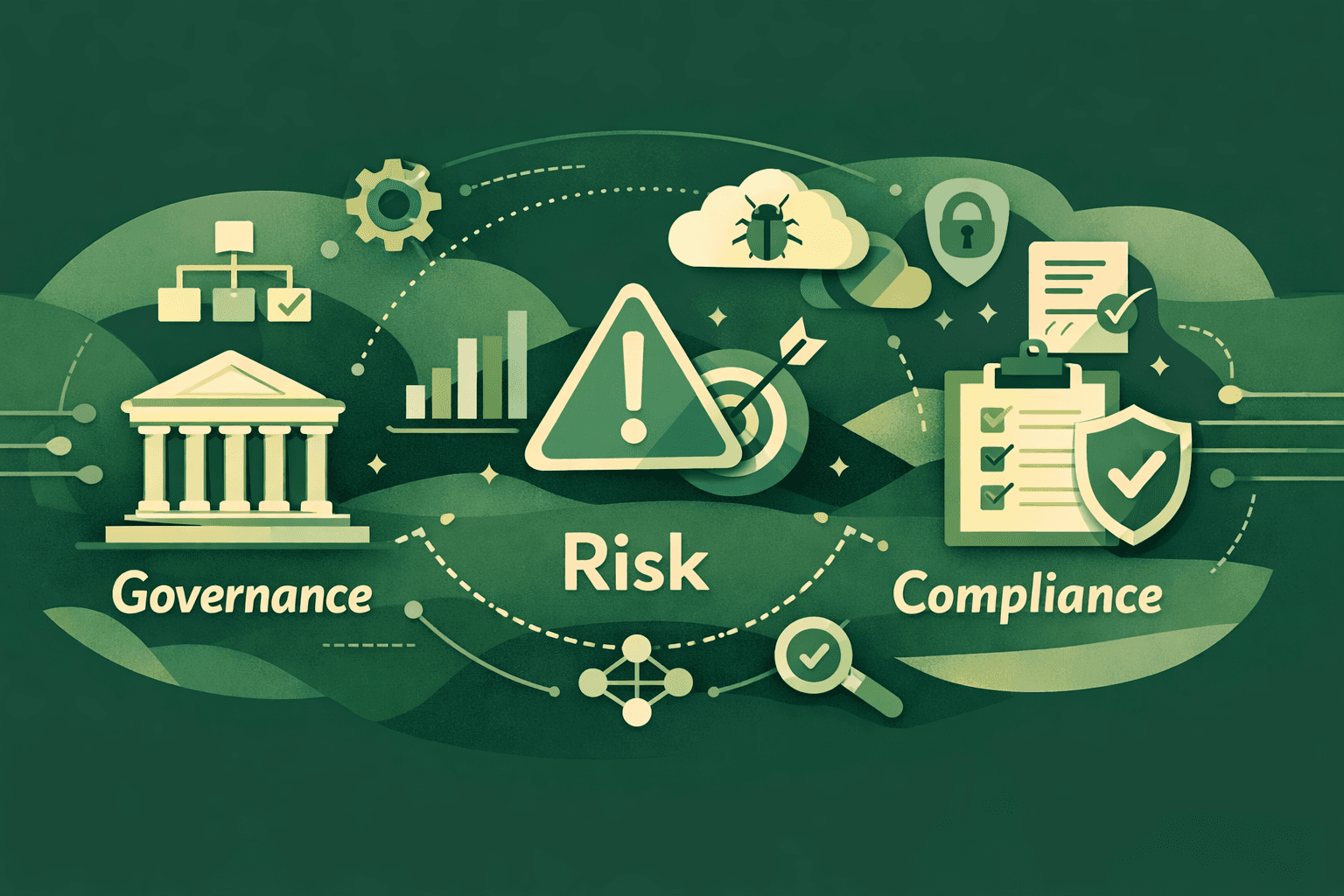
GRC stands for Governance, Risk, and Compliance. It is a framework — and increasingly a category of software — that integrates three closely related organizational disciplines, often managed in silos.
Governance refers to the structures, policies, and processes through which an organization directs and controls its activities. In a security and compliance context, governance encompasses the policies that define how the organization manages information security; the organizational roles and responsibilities for security and compliance; the processes by which decisions about risk and compliance are made and documented; and the oversight mechanisms by which leadership ensures that policies are followed.
Risk refers to the identification, assessment, and management of events or conditions that could negatively affect the organization's ability to achieve its objectives. In a security and compliance context, risk management covers the identification of threats to information assets, the assessment of the likelihood and potential impact of those threats, the selection and implementation of controls to mitigate risks to an acceptable level, and the ongoing monitoring of the risk environment to detect changes that require a reassessment.
Compliance refers to adherence to laws, regulations, standards, and contractual obligations applicable to the organization. In a security and compliance context, compliance covers the frameworks and regulations the organization is subject to — SOC 2, ISO 27001, GDPR, HIPAA, PCI DSS, CCPA, and others — the controls required to meet those obligations, the evidence that demonstrates compliance, and the audit and assessment processes through which compliance is formally verified.
The reason these three disciplines are grouped together is that they are deeply interdependent. Governance without risk management produces policies that are disconnected from the actual threats the organization faces. Risk management without governance produces risk assessments that influence no decisions and drive no actions. Compliance without risk management produces checkbox exercises that satisfy auditors but do not actually protect the organization. An integrated GRC program treats all three as components of a single system rather than separate functions operated by separate teams.
Why GRC Matters for SaaS Companies
GRC is not exclusively an enterprise concern. The forces that make GRC necessary — regulatory obligations, customer security requirements, vendor risk exposure, and the operational complexity of managing controls across a growing technology stack — affect SaaS companies at every stage of growth. The difference is that early-stage SaaS companies can manage these concerns informally, while growth-stage and scale-up companies cannot.
The trigger for most SaaS companies is an enterprise sales requirement. A large prospect asks for a SOC 2 report, an ISO 27001 certificate, or a completed security questionnaire. The company recognizes that it lacks a documented security program, a risk assessment, and the policies and evidence required to satisfy the request. The immediate response is to pursue the requested certification. The strategic response is to build a GRC program that can support not just the current certification requirement but the full range of compliance obligations the company will face as it grows.
Regulatory exposure increases with company size and market expansion. A SaaS company with ten employees and no personal data processing obligations can operate without a formal compliance program. The same company, with 100 employees, processes the personal data of European customers, handles protected health information for healthcare clients, and stores payment card data for e-commerce customers, and is subject to GDPR, HIPAA, and PCI DSS obligations simultaneously. Managing these obligations without a structured GRC program means that each one is handled ad hoc, controls are duplicated across frameworks, evidence is scattered across systems, and the organization has no reliable way to know whether it is actually compliant. A multi-framework compliance guide can help establish a unified approach.
Customer security reviews have become more sophisticated. Enterprise buyers no longer accept self-attestation for most security questions. They ask for third-party audit reports, review your security policies, and, in some cases, conduct their own vendor security assessments. A GRC program that produces well-documented policies, current risk assessments, and a maintained evidence library makes these reviews faster and less disruptive to your team.
Investor due diligence now includes security and compliance. Series B and later-stage investors routinely include security and compliance in their due diligence process. A well-documented, effectively operating GRC program is a positive signal. A program that exists only in fragments — a SOC 2 report here, an ISO 27001 certificate there, no unified program connecting them — raises questions about organizational maturity.
The Three Components of GRC in Practice
Understanding the GRC conceptually is useful. Understanding what each component looks like in practice enables you to build a program that works.
Governance in Practice
Governance is the foundation on which risk management and compliance operate. Without a functioning governance structure, risk assessments produce findings that nobody acts on, and compliance programs produce documentation that nobody maintains.
An information security policy is the foundational governance document for any GRC program. It defines the organization's commitment to information security, the principles guiding security decisions, and the high-level requirements that apply to all information assets and employees. It is typically supported by a set of subsidiary policies — access control policy, change management policy, incident response policy, business continuity policy, data classification policy, vendor management policy, and others — that provide specific requirements for each domain.
Organizational roles and responsibilities for security and compliance must be defined and documented. This does not require a dedicated security team at an early stage. It requires clarity on who is responsible for maintaining security policies, who conducts risk assessments, who owns the evidence library for compliance, who reviews and approves access to sensitive systems, and who is accountable for the organization's overall security posture. Ambiguity about ownership is one of the most common root causes of GRC program failures — when something falls between two teams' responsibilities, it tends not to get done.
Management review is a governance requirement in ISO 27001 and a best practice in any mature GRC program. Senior leadership should review the organization's security and compliance posture on a defined schedule — typically quarterly or annually — and make documented decisions about risk treatment, resource allocation, and program priorities. The output of management reviews should be documented. This documentation demonstrates to auditors that security and compliance are genuinely managed at the organizational level rather than delegated entirely to a technical team.
Policy communication and acknowledgment ensure that policies are not just written but known and followed. Employees should receive security awareness training that covers the organization's key policies, and acknowledgment of policy review should be documented. This is both a governance requirement and an evidence requirement for most compliance frameworks.
Risk Management in Practice
Risk management in a GRC context is a structured, repeatable process — not a one-time assessment or a spreadsheet that gets updated before an audit.
Asset inventory is the starting point for risk management. You cannot assess risks to information assets you have not identified. Your asset inventory should cover information assets — customer data, employee data, intellectual property, system configurations — and the systems and infrastructure that process, store, or transmit them. For a SaaS company, this typically includes cloud infrastructure, application systems, databases, development environments, employee endpoints, and third-party integrations.
Threat identification maps the threats relevant to each asset category. Threats in an information security context include external attackers seeking unauthorized access to systems or data, malicious insiders, accidental data exposure by employees, third-party vendor compromises, ransomware and other malware, physical threats to infrastructure, and natural disasters that affect data availability. The threat landscape relevant to your organization depends on your industry, your data types, and your market — a healthcare SaaS company faces different threat priorities than a payments infrastructure company.
Risk assessment evaluates each identified threat against each relevant asset to produce a risk rating — typically based on the likelihood of the threat occurring and the potential impact if it does. Risk assessments can be qualitative (using scales like high, medium, low) or quantitative (using financial impact estimates). Most SaaS companies start with qualitative assessments and move toward quantitative frameworks as their program matures. The output of a risk assessment is a risk register — a documented inventory of identified risks, their ratings, and their treatment status. See the ISO 27001 risk assessment guide for a step-by-step methodology.
Risk treatment is the decision about how to respond to each identified risk. The four standard treatment options are mitigation (implementing controls to reduce the likelihood or impact of the risk), acceptance (acknowledging the risk and deciding not to take additional action because the cost of mitigation exceeds the benefit), transfer (shifting the financial consequence of the risk through insurance or contractual mechanisms), and avoidance (eliminating the activity that creates the risk). Every risk in your risk register should have a documented treatment decision and an owner responsible for implementing and monitoring that treatment.
Ongoing monitoring ensures that your risk posture is current. The threat environment changes — new vulnerabilities are discovered, new attack techniques emerge, new regulations impose new obligations, and your own systems and processes change in ways that affect your risk profile. Risk assessments should be reviewed at least annually and updated when significant changes occur. Your risk register should reflect your current risk environment, not the environment that existed when you last conducted a formal assessment.
Compliance in Practice
Compliance in a GRC context is not about satisfying auditors. It is about maintaining a documented, evidence-backed demonstration that your organization's controls actually work — continuously, not just during audit windows.
Framework selection is the first compliance decision. Which frameworks and regulations apply to your organization, and which ones should you pursue proactively for commercial reasons? The answer depends on your industry (healthcare companies typically need HIPAA; payment companies need PCI DSS), your markets (European customers bring GDPR obligations; US federal customers may require FedRAMP), and your buyer requirements (enterprise SaaS buyers frequently require SOC 2; international enterprise buyers often require ISO 27001).
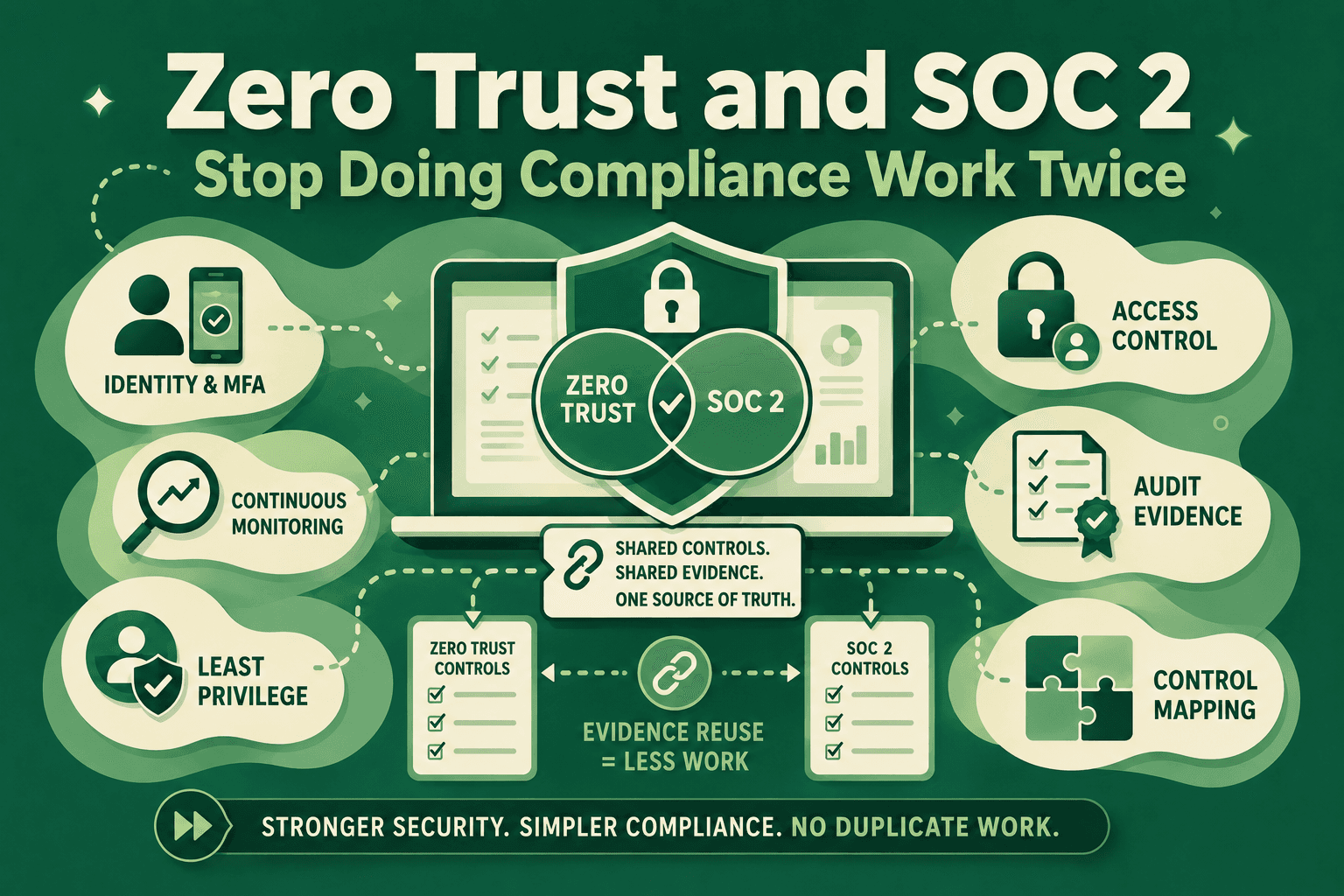
Control mapping identifies the specific controls required by each applicable framework and maps them to one another to identify overlaps. SOC 2 and ISO 27001 share approximately eighty percent of their control requirements — mapped in detail in the SOC 2 and ISO 27001 control mapping guide. SOC 2 and HIPAA have significant overlap in access control, audit logging, encryption, and incident response. Building a unified control framework that satisfies multiple frameworks simultaneously — rather than building separate programs for each — dramatically reduces the cost and operational burden of multi-framework compliance.
Evidence collection is the operational backbone of any compliance program. For every control in your framework, you need evidence that the control is operating as designed. Evidence takes many forms — access review records, change management tickets, security training completion records, vulnerability scan results, penetration test reports, vendor security assessment records, incident response logs, and monitoring alert records. The challenge for most SaaS companies is that this evidence is scattered across multiple systems and must be organized, maintained, and made available to auditors on demand.
Continuous monitoring replaces the point-in-time compliance model — where evidence is collected in a sprint before an audit — with a model in which evidence is collected continuously throughout the year and the compliance posture is visible in real time. This is both more accurate (it reflects actual control performance rather than a snapshot taken when everyone knows an auditor is watching) and less operationally disruptive (there is no pre-audit scramble because evidence is always current).
Audit management encompasses engaging with auditors, responding to evidence requests, managing findings, and tracking remediation. A mature compliance program treats auditors as a predictable operational event rather than a stressful exception — because the evidence is organized, the controls are documented, and the team knows exactly what the auditor will ask for.
GRC Program Maturity: What It Looks Like at Each Stage
GRC programs do not spring into existence fully formed. They develop incrementally as organizations grow and as their compliance obligations become more complex. Understanding what GRC looks like at each stage of maturity helps you calibrate your investment and avoid either under-building (which creates compliance gaps and audit findings) or over-building (which creates operational overhead without proportionate benefit).
Stage One — Reactive and Informal
Most early-stage SaaS companies are at Stage One. Security decisions are made by engineers based on intuition and best practices. There are no written policies. Risk is not formally assessed. Compliance obligations are addressed when customers or auditors ask about them. There is no unified evidence library. This stage is sustainable at very small scale but creates increasing risk as the company grows, processes more sensitive data, and attracts more sophisticated buyers.
Stage Two — Foundational Documentation
The transition from Stage One to Stage Two is typically triggered by a compliance requirement — a SOC 2 audit, an enterprise customer security questionnaire, or a regulatory obligation. At Stage Two, the organization writes its key security policies, conducts a formal risk assessment, implements the controls needed for its first compliance certification, and builds a basic evidence library. This is a significant investment but creates the foundation for a sustainable program.
Stage Three — Operational Consistency
At Stage Three, the GRC program operates consistently between compliance events. Controls are monitored. Evidence is collected continuously. Risk assessments are updated on schedule. Policy reviews happen annually. Security training is tracked. The compliance program does not require a crisis mobilization before every audit because the evidence is already organized and the controls are already documented. Most mid-stage SaaS companies with one or two compliance certifications should be operating at Stage Three.
Stage Four — Integrated and Automated
At Stage Four, the GRC program is fully integrated with the organization's technology stack through a compliance automation platform. Evidence collection is automated for all controllable controls. Risk assessments are informed by real-time monitoring data. Multi-framework compliance is managed through a unified control architecture. The compliance team spends its time on judgment-intensive activities — risk assessment, vendor evaluation, audit management, policy development — rather than manual evidence collection and spreadsheet maintenance. Growth-stage and enterprise SaaS companies with multiple compliance frameworks should be operating at Stage Four.
Building a GRC Program: Where to Start
For SaaS companies building a GRC program for the first time, the most common mistake is trying to build everything at once. A GRC program that attempts to implement governance, risk management, and compliance simultaneously across multiple frameworks, with no existing foundation, is almost always either abandoned as impractical or implemented so poorly that it creates compliance theater rather than genuine security maturity.
Start with governance. Write your information security policy and your subsidiary policies. Define roles and responsibilities. Establish your management review cadence. This foundational work takes two to four weeks for a typical SaaS company and creates the structure within which risk management and compliance can operate effectively.
Conduct your first risk assessment. Build your asset inventory, identify your threat landscape, assess your risks, and produce your risk register. The first risk assessment is always the most time-consuming because it requires building the methodology from scratch. Subsequent assessments update an existing register and are substantially faster.
Select your compliance frameworks and map your controls. Based on your regulatory obligations and buyer requirements, identify the frameworks you need to comply with. Map the controls required across all frameworks to identify overlaps and build a unified control architecture that satisfies all applicable frameworks with minimal duplicated effort.
Implement missing controls and begin evidence collection. Your risk assessment and gap analysis will identify controls that are required by your frameworks but not yet implemented. Prioritize implementation based on risk — address the highest-risk gaps first. As you implement controls, establish evidence-collection processes to demonstrate their operation to auditors.
Automate what can be automated. Manual evidence collection is the primary source of operational overhead in GRC programs. Compliance automation platforms integrate with your cloud infrastructure, identity systems, endpoint management, and other technology to collect evidence automatically, continuously, and in a format that auditors can review directly. The ROI on automation increases significantly as the number of controls and frameworks in your program grows.
GRC Software: What It Does and When You Need It
GRC software — also called compliance automation platforms — automates evidence collection, control monitoring, policy management, risk assessment workflows, and audit management, forming the operational backbone of a GRC program. The market has matured significantly, and there are now platforms designed for companies at every stage of GRC maturity, from seed-stage startups pursuing their first SOC 2 to enterprises managing ten or more compliance frameworks simultaneously.
You need GRC software when manual management becomes the bottleneck. For a company with a single compliance framework, a small number of controls, and a single annual audit, a well-organized combination of policy documents, spreadsheets, and a shared drive may be sufficient. For a company with multiple frameworks, dozens of controls, quarterly evidence collection requirements, and multiple audits per year, manual management creates unsustainable overhead and unacceptable error rates.
The primary value of GRC software is not documentation — it is continuous evidence collection. A platform that integrates with your AWS environment and automatically collects evidence of your access controls, encryption configurations, logging settings, and vulnerability scan results every day is providing value that no amount of spreadsheet discipline can replicate — and eliminates the hidden costs of manual compliance that accumulate over time. That continuous evidence collection is what makes compliance a sustainable operational function rather than a periodic crisis.
Integration depth determines the actual value. A GRC platform that claims two hundred integrations but has shallow connections to the specific tools your company uses will automate a smaller percentage of your evidence collection than a platform with fewer but deeper integrations into your specific stack. Evaluate platforms based on their integration with the specific tools you use — your cloud provider, your identity platform, your endpoint management system, your HR platform, and your code repository.
GRC is not a destination. It is an ongoing organizational capability that evolves as your company grows, as your regulatory environment changes, and as your customers' security expectations increase. The companies that build GRC programs early — before compliance requirements become urgent, before audit findings accumulate, before enterprise deals stall on security reviews — have a significant advantage over those that build their programs reactively. A GRC program that is functioning well is invisible to most of the organization most of the time. The evidence is collected. The controls are monitored. The policies are current. The auditors find nothing surprising. And the enterprise deals close without the security review becoming the reason they do not.
dsalta helps SaaS companies build GRC programs designed for operational sustainability — from foundational policies and risk assessments to automated multi-framework compliance and continuous audit readiness.

Explore more GRC articles
Stop losing deals to compliance.
Get compliant. Keep building.
Join 100s of startups who got audit-ready in days, not months.