Governance, Risk, and Compliance (GRC) —
CISO Compliance Checklist 2025: Essential Quarterly Review Guide
CISO compliance checklist for 2025 with quarterly reviews and evidence tracking. Covers SOC 2, ISO 27001, HIPAA, and multi-framework compliance management.
Dogan Akbulut
Audit Preparation & Management
Share this article


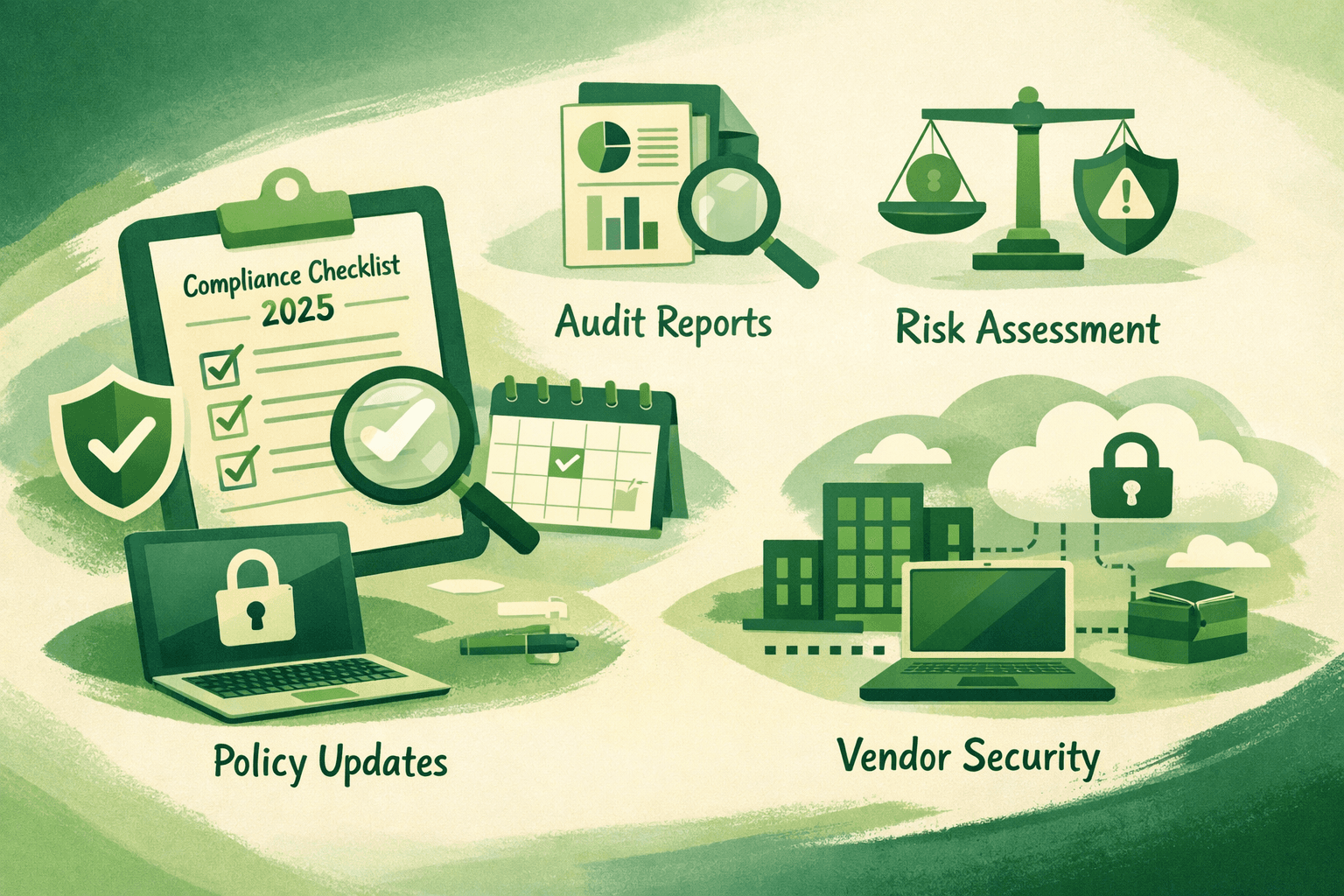
Introduction: Why CISOs Need a Strategic Compliance Approach
Chief Information Security Officers face an unprecedented challenge in 2025. Security threats are evolving faster than ever, regulatory requirements are multiplying, and enterprise customers demand proof of comprehensive security programs before signing contracts.
The traditional approach—scrambling to collect evidence weeks before audits—no longer works. Modern CISOs need systematic processes for maintaining continuous compliance across multiple frameworks, including SOC 2, ISO 27001, HIPAA, and emerging regulations.
This compliance checklist provides CISOs with a structured quarterly review process and evidence maintenance plan. Instead of annual compliance sprints, you'll build sustainable practices that keep your organization audit-ready year-round while actually improving security posture.
Whether you're managing SOC 2 compliance requirements, preparing for ISO 27001 certification, or maintaining HIPAA compliance, this guide helps you work smarter, not harder.
Understanding the Modern CISO's Compliance Landscape
The Frameworks CISOs Must Navigate
SOC 2 compliance requirements dominate the SaaS industry, with enterprise customers routinely requiring Type II reports before procurement approval. The framework evaluates security, availability, processing integrity, confidentiality, and privacy controls through external audits.
ISO 27001 requirements provide internationally recognized certification for Information Security Management Systems. Global enterprises, regulated industries, and international customers increasingly mandate ISO 27001 as a prerequisite for vendor relationships.
HIPAA compliance becomes mandatory the moment you handle protected health information. Healthcare customers require comprehensive safeguards, Business Associate Agreements, and documented compliance programs.
Industry-specific regulations continue emerging. Financial services are subject to PCI DSS and SOX requirements. Government contractors must meet FedRAMP or CMMC standards. Privacy regulations like GDPR and CCPA add additional layers of complexity.
Why Quarterly Reviews Matter
Annual compliance efforts create multiple problems. Evidence gaps emerge when controls change throughout the year. Staff turnover means institutional knowledge disappears. Technology changes faster than annual review cycles can keep up with.
Quarterly reviews transform compliance from crisis management to continuous improvement. You catch issues early when they're easy to fix. Evidence collection becomes routine rather than overwhelming. Your team develops compliance habits rather than treating it as a special project.
Most importantly, quarterly reviews dramatically reduce audit stress. When auditors arrive, you're presenting organized evidence of consistent operations rather than scrambling to reconstruct what happened months ago.
The CISO Quarterly Compliance Checklist
Quarter 1: Foundation and Risk Assessment
January: Compliance Program Review
Review your compliance roadmap against business objectives. Did the company expand into new markets requiring additional certifications? Are you pursuing new customer segments with different compliance expectations?
Update your compliance scope documentation. New products, services, systems, or data types may expand the scope of what your compliance programs must cover.
Verify all compliance roles and responsibilities remain current. Organizational changes often leave compliance responsibilities unclear or assigned to people who have moved to different roles.
Schedule all compliance activities for the year, including internal audits, management reviews, vendor assessments, and external audit windows.
February: Annual Risk Assessment
Conduct your comprehensive annual risk assessment required by most frameworks. This foundational activity drives all other compliance work.
Update your asset inventory, documenting all systems, applications, data repositories, infrastructure components, and third-party services. Automated discovery tools prevent assets from being missed.
Identify threats relevant to your current environment. Consider cyberattacks, insider threats, vendor incidents, system failures, natural disasters, and regulatory changes.
Assess vulnerabilities in your controls. Review vulnerability scan results, penetration test findings, incident post-mortems, and audit observations from the previous year.
Rate risks using your established methodology. Most organizations use likelihood multiplied by impact to create risk scores that prioritize attention.
Develop risk treatment plans for risks exceeding your risk appetite. Document whether you'll mitigate, accept, transfer, or avoid each significant risk.
March: Control Gap Analysis
Compare your current controls against framework requirements. SOC 2 compliance requirements, ISO 27001 controls, and HIPAA safeguards all need systematic gap analysis.
Documented gaps with specific details on what's missing and what's needed to achieve compliance.
Prioritize gap remediation based on risk ratings, audit timelines, and available resources. Not everything can be fixed immediately—systematic prioritization ensures critical gaps get addressed first.
Create remediation project plans with owners, timelines, resource requirements, and success criteria.
Quarter 2: Implementation and Testing
April: Access Control Review
Conduct comprehensive access reviews across all systems handling sensitive data. This quarterly review meets the requirements of every major framework.
Review user access rights against current job responsibilities. People change roles but often retain access from previous positions.
Verify that all access for terminated employees was removed promptly. Delayed deprovisioning creates significant security risks.
Audit privileged access accounts to ensure administrative access is limited to those who genuinely need it.
Document the review with dates, reviewers, systems covered, and any access changes made.
May: Vendor Risk Assessment
Review your vendor inventory to ensure all third-party services are documented with accurate information about data access and business criticality.
Conduct scheduled vendor security assessments based on your vendor risk tiers. Critical vendors typically need annual assessments, while lower-risk vendors may be reviewed less frequently.
Verify that Business Associate Agreements exist for all vendors that handle protected health information. Missing BAAs represent critical HIPAA compliance gaps.
Collect updated vendor security documentation, including SOC 2 reports, ISO 27001 certificates, penetration test results, and security questionnaire responses.
Update vendor risk ratings based on assessment findings, security incidents, or changes in services provided.
June: Security Testing and Validation
Conduct or review vulnerability scanning results from the quarter. Most frameworks require regular vulnerability assessments.
Review penetration testing results if annual testing occurred this quarter: document findings, remediation plans, and timeline for addressing identified vulnerabilities.
Test incident response procedures through tabletop exercises. Gather your incident response team, present realistic scenarios, and evaluate your readiness.
Validate backup and disaster recovery procedures through actual restoration testing. Untested backups are useless when you actually need them.
Document all testing with dates, participants, findings, and any improvements implemented based on results.
Quarter 3: Monitoring and Optimization
July: Security Monitoring Review
Analyze security monitoring effectiveness over the previous quarter. Are your detection capabilities identifying relevant security events?
Review security incident logs documenting all incidents detected, investigated, and resolved. Even minor incidents provide valuable evidence for auditors.
Evaluate alert tuning to reduce false positives while ensuring genuine threats are detected. Security teams drowning in false alerts miss real problems.
Assess log retention compliance by ensuring audit logs are maintained for the required retention periods. Six years is standard for many regulations.
Test monitoring coverage by conducting controlled tests that should trigger alerts. If tests don't generate expected alerts, there are gaps in detection capabilities.
August: Training and Awareness Assessment
Review training completion rates across your organization. Compliance frameworks require regular security awareness training for all employees.
Evaluate training effectiveness through assessments, phishing simulations, or security behavior metrics. Training that doesn't change behavior wastes resources.
Update training content based on emerging threats, recent incidents, policy changes, or audit findings.
Plan upcoming training cycles, including new hire onboarding, annual refresher training, and role-specific security training.
Document all training activities with dates, attendees, topics covered, and verification of completion.
September: Policy and Procedure Updates
Review all security policies for accuracy and relevance. Technology changes, business evolution, and lessons learned all drive policy updates.
Update procedures based on operational changes, tool deployments, or process improvements implemented during the year.
Ensure policy approval and acknowledgment processes are documented. Policies without formal approval and distribution don't satisfy compliance requirements.
Communicate policy changes to affected staff through announcements, training, or targeted notifications.
Maintain version-control documentation that shows policy history, change rationale, and approval dates.
Quarter 4: Audit Preparation and Improvement
October: Internal Audit Execution
Conduct internal audits covering your entire compliance scope. ISO 27001 requirements mandate internal audits at planned intervals.
Test control design by reviewing documentation and interviewing control owners about how controls operate.
Test control operating effectiveness by examining evidence that controls actually work as documented.
Document audit findings, categorizing them as observations, minor nonconformities, or major nonconformities based on severity.
Create corrective action plans for all findings with specific remediation steps, responsible parties, and completion deadlines.
November: Management Review and Metrics
Prepare management review presentations for executive leadership. ISO 27001 and other frameworks require documented management reviews.
Present compliance program performance metrics, including control effectiveness, incident trends, training completion, vendor risk status, and audit findings.
December: Final Documentation and Readiness
Ensure all Required Documentation is finalized and centralized for the auditor.
Final check on all corrective actions from the internal audit to ensure completion.
Prepare your team for the external audit kick-off (if scheduled early next year).
Ready to Operationalize Your Compliance Strategy?
Stop playing catch-up with compliance. Book a free DSALTA demo today to see how our platform automates quarterly evidence collection, manages cross-framework control mapping, and maintains continuous audit-readiness across SOC 2, ISO 27001, and HIPAA.

Explore more GRC articles
Stop losing deals to compliance.
Get compliant. Keep building.
Join 100s of startups who got audit-ready in days, not months.