Governance, Risk, and Compliance (GRC) —
DORA Compliance for SaaS Vendors in Financial Services
DORA enforcement is live across EU financial services. Learn what ICT third-party risk requirements mean for SaaS vendors and how to build a compliant program.
Jon Ozdoruk
Compliance Fundamentals for Startups
Share this article


DORA Compliance for SaaS Vendors in Financial Services: The Complete 2026 Guide
If your SaaS platform is used by a bank, insurer, payment provider, or investment firm operating in the European Union, you are already inside the DORA compliance perimeter — whether you know it or not.
The Digital Operational Resilience Act (Regulation EU 2022/2554) became fully enforceable on January 17, 2025. The informal tolerance period is over. National regulators across the EU are now conducting active enforcement reviews, demanding real-time evidence of ICT resilience, defensible vendor registers, and incident reporting workflows that actually work under pressure.
Most of the compliance conversation has focused on what DORA means for banks and insurers. Far less has been written about what it means for the SaaS companies supplying technology to those institutions — and that is precisely where the most significant blind spots exist in 2026.
This guide covers what DORA actually requires, how its obligations flow down to SaaS vendors through customer contracts, what Article 30 demands of your agreement templates, and how to build a DORA-ready posture without treating it as a project that runs in parallel with everything else you already operate.
What Is DORA and Why Was It Created?
Before DORA, operational resilience requirements for EU financial institutions were fragmented across dozens of sector-specific directives, national guidelines, and supervisory expectations. A bank in Germany faced different ICT risk rules than a payment provider in the Netherlands, even though both were interconnected nodes in the same financial system.
That fragmentation created systemic risk. A poorly secured SaaS vendor supplying critical infrastructure to multiple financial institutions could become a single point of failure for the entire sector — and regulators had no unified authority to address it.
DORA eliminates that gap. It establishes one harmonized framework for digital operational resilience that applies consistently across 21 categories of financial entities and, by extension, to every ICT service provider in their supply chain.
The European Insurance and Occupational Pensions Authority describes the regulation's scope plainly: DORA brings harmonized rules on operational resilience applicable to 20 types of financial entities and their ICT third-party service providers. If you supply software, data services, cloud infrastructure, or IT support to any of those entities, you are part of the framework.
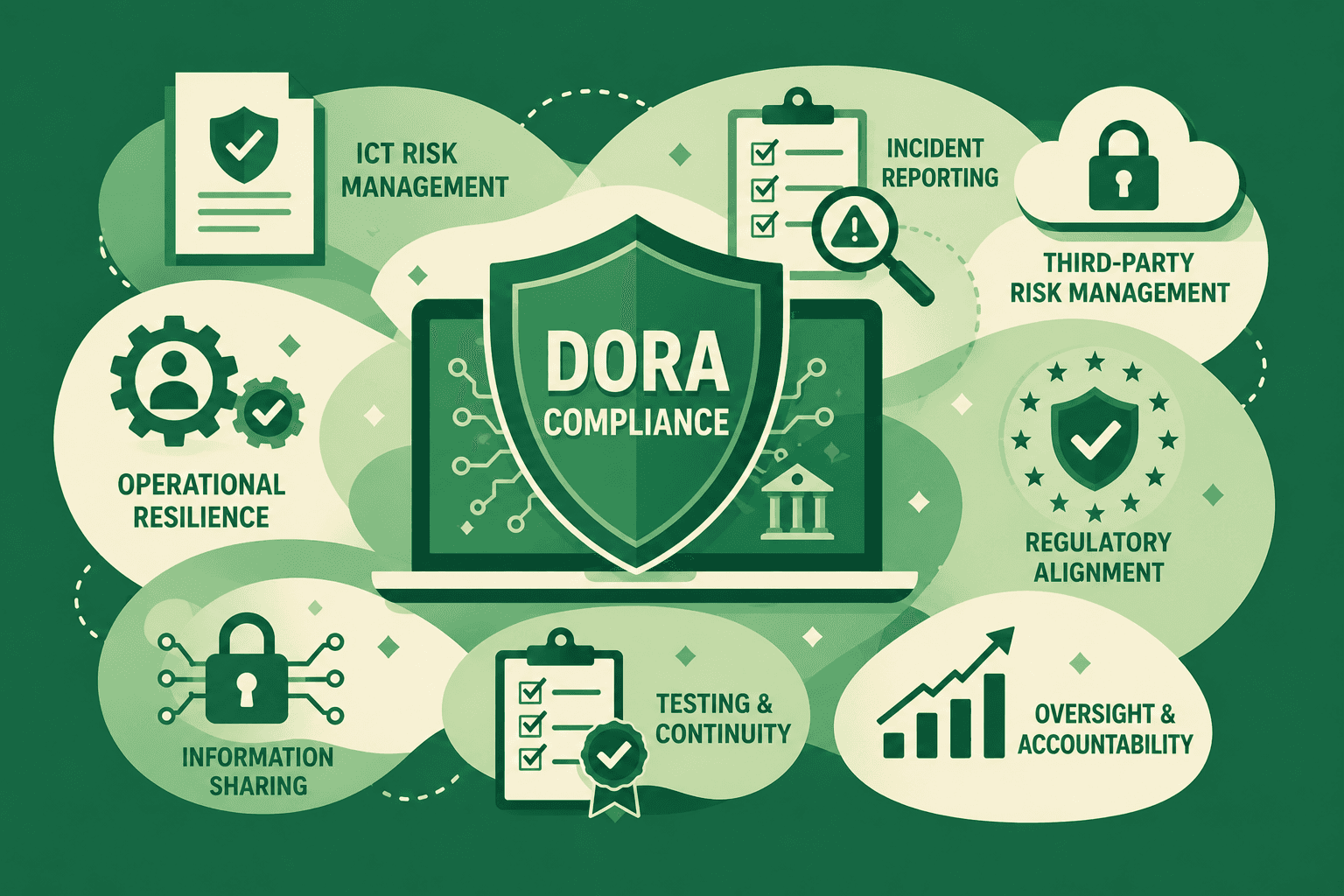
The Five Pillars of DORA
DORA organizes its requirements into five interconnected pillars. Understanding all five is essential — because financial institution customers will expect their SaaS vendors to demonstrate alignment with each one through contracts, evidence, and operational behavior.
Pillar 1 — ICT Risk Management (Articles 5–16)
Financial institutions must implement a comprehensive ICT risk management framework that covers identification, protection, detection, response, and recovery from ICT disruptions. Senior management bears ultimate accountability for approving and overseeing this framework.
What this means for SaaS vendors: Your customers need to understand where your platform sits in their ICT risk landscape. They will ask you to provide documentation of your own risk management practices, business continuity plans, and disaster recovery capabilities. Vendors who cannot provide this evidence slow down their customers' compliance programs and risk being removed from the approved vendor list.
Pillar 2 — Incident Management and Reporting (Articles 17–23)
Financial institutions must classify ICT incidents using standardized EU criteria and report major incidents to competent authorities in a structured three-stage process: initial notification, intermediate report, and final report. Significant incidents must be reported within 72 hours of detection.
What this means for SaaS vendors: If your platform experiences an outage, security breach, or data integrity failure, your customer may be legally required to report it to a regulator — on your timeline. That means you need a clear, documented incident notification process with defined SLAs for informing affected customers, and your contracts need to specify how and when you will notify financial institution clients of incidents that affect their operations or data.
Pillar 3 — Digital Operational Resilience Testing (Articles 24–27)
Covered entities must conduct regular resilience testing, including vulnerability assessments and network security reviews. Significant institutions must also conduct advanced Threat-Led Penetration Testing (TLPT) on live production systems at least every three years, using qualified external threat intelligence providers.
What this means for SaaS vendors: Customers subject to TLPT requirements may need to include your platform in their testing scope. You should be able to demonstrate that your systems have been independently tested, share penetration test executive summaries under NDA, and cooperate with a customer-initiated TLPT exercise without disrupting your broader platform operations.
Pillar 4 — ICT Third-Party Risk Management (Articles 28–44)
This is the pillar that most directly impacts SaaS vendors. Financial institutions must maintain a Register of Information (RoI) documenting every ICT third-party arrangement — including sub-processors and intra-group ICT services — and submit it annually to their competent authority by March 31. Contracts with ICT providers must include specific mandatory provisions, defined in Article 30.
What this means for SaaS vendors: Your customer needs specific information from you to populate their Register of Information accurately. Missing or incomplete vendor data is one of the leading causes of RoI deficiencies. You also need DORA-compliant contract language ready to go, or deals with regulated financial institutions will stall in procurement.
Pillar 5 — Information Sharing (Articles 45–49)
DORA encourages financial entities to voluntarily share cyber threat intelligence with one another to strengthen collective defense across the sector. This includes intelligence on emerging attack patterns, indicators of compromise, and threat actor tactics.
What this means for SaaS vendors: While direct participation in threat intelligence sharing is voluntary for most vendors, maintaining transparency about security incidents and known vulnerabilities affecting your platform is increasingly expected as a baseline of vendor hygiene in the financial services sector.
Who Must Comply: The Full Scope
DORA applies to 21 categories of financial entity, covering virtually the entire EU financial ecosystem:
Credit institutions, payment institutions, and e-money institutions
Investment firms and alternative investment fund managers
Insurance and reinsurance undertakings and their intermediaries
Central counterparties, central securities depositories, and trade repositories
Crypto-asset service providers and crowdfunding platforms
Credit rating agencies and data reporting service providers
ICT third-party service providers, including designated Critical Third-Party Providers (CTPPs)
The regulation incorporates a principle of proportionality. Microenterprises and smaller entities benefit from a simplified ICT risk management framework under Article 16, with lighter documentation and testing requirements. However, this simplified regime still requires a documented risk management approach, basic resilience testing, and DORA-aligned vendor contracts — it is not an exemption.
The Critical Third-Party Provider Designation
In November 2025, the European Supervisory Authorities published their first list of 19 designated Critical Third-Party Providers (CTPPs). This list includes Amazon Web Services, Google Cloud Platform, Microsoft Azure, Oracle Cloud, SAP, and Deutsche Telekom, among others.
CTPPs are now subject to direct EU oversight through a lead overseer model. This includes annual risk assessments, on-site inspections, mandatory information requests, and the ability for regulators to impose operational recommendations. Financial institutions that depend on designated CTPPs must demonstrate they have assessed and mitigated the concentration risk arising from those dependencies.
If your SaaS platform runs on any of the designated CTPP cloud providers, your customers may need to document that dependency explicitly in their risk assessments and their Register of Information.
Article 30: The Contract Requirements Every SaaS Vendor Needs to Know
Article 30 of DORA specifies the mandatory provisions that must appear in contracts between financial institutions and their ICT third-party service providers. If your customer is subject to DORA and you do not have these provisions in your contract, their compliance team cannot approve the vendor relationship.
Here is what Article 30 requires, translated into plain language for SaaS vendor contracts:
Service description: A clear description of all ICT services provided, the functions they support, and the locations from which services are delivered and data is processed.
Data processing location: Explicit disclosure of which countries and data centers process and store your customer's data, including any sub-processor locations. Vague language about "global infrastructure" is not acceptable.
Incident notification obligations: Defined timelines and procedures for notifying your customer of any ICT incidents that affect service availability, data integrity, or security — with SLAs that allow your customer to meet their own 72-hour regulatory reporting obligations.
Availability and performance standards: Clearly defined service level agreements covering uptime, response times, and performance benchmarks, with mechanisms for reporting deviations.
Cooperation with regulators: An explicit commitment to cooperate with your customer's competent authority, including providing information and access to documentation during regulatory examinations or incident investigations.
Audit rights: Your customer must have the contractual right to conduct — or commission — audits of your ICT systems and controls. This includes on-site inspections and third-party assessments. Many SaaS vendors resist this clause. In a DORA context, it is non-negotiable.
Exit strategy and data return: Clear provisions for service termination, including data portability, transition assistance timelines, and the conditions under which data will be returned or securely deleted. Financial institutions must be able to exit a vendor relationship without disrupting operations.
Sub-processor transparency: Disclosure of any sub-contractors or sub-processors involved in delivering the service, along with their roles and ICT security standards.
If your current contract template does not address all of these elements, you need to develop a DORA addendum before your next financial services renewal cycle.
The Register of Information: What Your Customers Need From You
The Register of Information (RoI) is one of the most operationally demanding DORA requirements and the area where most vendor relationships have created problems. The second annual RoI submission cycle closed in March 2026, and the pattern from the first cycle was consistent: financial institutions could not get complete, accurate, standardized information from their SaaS vendors fast enough.
Research from Deloitte found that 46% of financial entities named the Register of Information as the single most challenging DORA requirement. The most common barriers were inconsistent vendor metadata, incomplete contract inventories, and unclear ownership of sub-contractor relationships.
To populate their RoI accurately, your financial institution customers need the following information from you:
Legal entity name and LEI (Legal Entity Identifier) code
Registered address and country of establishment
Nature of ICT services provided, using the standardized DORA function classification
Data processing locations — every country and data center
Sub-processor list with their respective roles and countries
Contract start date, notice periods, and termination conditions
SLA performance data for the prior reporting period
Date and results of your most recent third-party security assessment
If you want to be a preferred vendor to EU financial institutions, the most practical thing you can do today is build a DORA vendor information pack that provides all of this data in a structured, shareable format. Financial institutions will route their procurement toward vendors who make this easy.
Enforcement: What Regulators Are Actually Doing in 2026
The grace period that existed in the first months after the January 2025 application date has ended. National Competent Authorities across the EU have moved from reviewing paperwork to demanding proof.
The penalty framework under DORA is severe:
Financial entities: Fines up to 2% of total annual worldwide turnover for ongoing violations
Critical Third-Party Providers: Up to €5 million, plus periodic penalty payments for continued non-compliance
Senior management individuals: Personal fines up to €1 million; temporary bans from management positions
Penalty implementation varies across Member States. Italy has set ceilings of up to €20 million or 10% of annual turnover. Ireland allows fines up to €10 million or 10% of turnover. Germany and the Netherlands differentiate between intentional and negligent breaches. Article 52 of DORA permits criminal penalties in extreme cases, including imprisonment.
Critically, enforcement risk does not sit only with financial institutions. CTPPs face direct regulatory action from the lead overseer. And while most SaaS vendors are not directly regulated under DORA, the contractual obligations their financial institution customers now carry create substantial indirect enforcement pressure. A vendor that causes a financial institution to breach its DORA obligations — through an undisclosed incident, a failed audit, or incomplete RoI data — is a vendor at risk of losing its entire financial services customer base.
DORA and AI-Powered SaaS: The January 2026 BaFin Guidance
In January 2026, Germany's Federal Financial Supervisory Authority (BaFin) issued guidance clarifying how AI-based systems must be integrated into DORA-compliant ICT risk management frameworks. The guidance confirms that AI systems — including large language models, generative AI tools, and automated decision systems — are not subject to a separate compliance regime under DORA.
Instead, AI systems must be fully embedded into existing ICT governance, testing, and third-party risk frameworks. Key focus areas flagged in the BaFin guidance include:
Model monitoring and logging: AI outputs must be logged in a way that supports post-incident forensic analysis
Access controls: Role-based access to AI systems must be documented and reviewed regularly
Resilience testing: AI-dependent workflows must be included in business continuity and disaster recovery testing
Third-party risk: AI models or inference infrastructure provided by third parties must be documented in the RoI
For SaaS vendors whose platforms use AI — including automated compliance tools, risk scoring engines, or LLM-powered workflows — this guidance makes AI governance a DORA compliance requirement when selling to EU financial institutions. Nordic National Competent Authorities have similarly flagged AI-integrated ICT systems as a supervisory priority for 2026.
How DORA Relates to NIS2, GDPR, and the EU AI Act
DORA does not operate in isolation. It is part of an interconnected web of EU digital regulation, and understanding these relationships matters for building an efficient compliance strategy.
DORA and NIS2: DORA functions as lex specialis for the EU financial sector — meaning it takes precedence over the NIS2 Directive for in-scope financial entities. Where NIS2 sets baseline cybersecurity requirements across critical sectors broadly, DORA imposes more specific and stringent obligations tailored to financial services. Financial institutions subject to DORA do not need to maintain a separate NIS2 compliance program; DORA compliance subsumes it.
DORA and GDPR: DORA and GDPR operate in parallel. DORA governs ICT risk and operational resilience; GDPR governs personal data protection. A data breach at a financial institution may trigger obligations under both simultaneously — DORA's incident reporting to the competent authority and GDPR's 72-hour breach notification to the supervisory authority. SaaS vendors processing personal data for financial institution customers must address both sets of obligations in their contracts and incident response procedures.
DORA and the EU AI Act: Article 9(10) of the EU AI Act explicitly permits financial institutions to integrate AI risk management systems into DORA ICT risk management frameworks. This creates a genuine opportunity: organizations that approach both regulations together can build a unified governance structure rather than running parallel compliance programs. For AI-powered SaaS vendors selling to the financial sector, alignment between DORA and EU AI Act obligations is increasingly a procurement requirement, not just a regulatory best practice.
Building a DORA-Ready Posture as a SaaS Vendor: A Practical Roadmap
DORA readiness for a SaaS vendor does not require a completely new compliance program. It requires you to make specific, targeted investments in four areas.
Step 1 — Audit Your Contracts (Weeks 1–4)
Review every active contract with EU financial institution customers against the Article 30 mandatory provision checklist. Identify which contracts are missing incident notification SLAs, audit rights, sub-processor disclosure, or exit strategy provisions. Develop a DORA contract addendum that closes these gaps. Apply it at the next renewal cycle or proactively where customers have requested DORA alignment.
Step 2 — Build Your Vendor Information Pack (Weeks 2–6)
Create a structured, standardized document that gives financial institution customers everything they need to populate your entry in their Register of Information. Include your LEI code, data processing locations, sub-processor list, SLA performance data, and your most recent third-party security assessment summary. Make this available through your trust center or on request. This alone will differentiate you from competitors who make their customers chase down vendor data.
Step 3 — Formalize Your Incident Notification Process (Weeks 4–8)
Document your internal incident classification criteria and map them to the DORA major incident threshold criteria. Define the internal escalation path and external customer notification timeline — ideally within 4 hours of incident classification for events that materially affect service availability or data integrity. Test this process through a tabletop exercise and document the results. Financial institution customers will ask whether you have tested your incident response procedures.
Step 4 — Prepare for Audit Cooperation (Months 2–3)
Accept the reality that audit rights are now a standard contract term for any financial services customer subject to DORA. Develop a structured process for handling audit requests: a standard evidence package for remote assessments, a defined process for on-site visits, and clear ownership of who in your organization coordinates with external auditors. Organizations that have an existing SOC 2 Type II report can use that evidence as the foundation for financial institution audit requests, significantly reducing the operational burden.
The Cost of DORA Compliance vs. the Cost of Exclusion
Research indicates that most financial institutions are spending between €2 million and €5 million on DORA compliance programs, with 70% expecting permanently higher run costs for technology controls once the frameworks are embedded.
For SaaS vendors, the investment is substantially lower — but the cost of not making it is disproportionately high. EU financial institutions are now actively rationalizing their vendor lists based on DORA readiness. Vendors who cannot provide Article 30-compliant contracts, complete Register of Information data, or evidence of security testing are being moved to remediation watchlists or replaced entirely.
The sales math is straightforward: a financial services customer representing €200,000 in annual recurring revenue is not worth losing over a €15,000 investment in DORA contract alignment and an updated vendor information pack.
DORA Compliance Checklist for SaaS Vendors
Use this checklist to assess your current DORA readiness:
Contracts
Article 30 mandatory provisions included in all financial services customer contracts
Incident notification SLAs defined and mapped to customer's regulatory reporting obligations
Audit rights clause accepted and process documented
Exit strategy and data return provisions specified
Sub-processor disclosure complete and current
Operations
Incident classification criteria documented and tested
Internal escalation path and customer notification timeline defined
Business continuity and disaster recovery plan documented and tested annually
Penetration test conducted in the last 12 months with executive summary available under NDA
Vendor Information
LEI code obtained and current
Data processing locations documented at country and data center level
Sub-processor list maintained and updated at each change
SLA performance data available for prior 12-month period
Third-party security assessment summary available
AI Systems (if applicable)
AI systems included in ICT risk management documentation
Model monitoring and logging in place
Access controls documented and reviewed
AI-dependent workflows included in business continuity testing
Third-party AI infrastructure included in sub-processor disclosure
Frequently Asked Questions
Does DORA directly regulate SaaS vendors? DORA directly regulates financial entities and designated Critical Third-Party Providers (CTPPs). Most SaaS vendors are not directly regulated. However, the contractual and procurement behavior of regulated financial institutions means that DORA obligations flow down to SaaS vendors through Article 30 contract requirements. If you cannot meet those requirements, you cannot contract with DORA-regulated customers.
Does DORA apply to non-EU SaaS vendors? Yes. If your SaaS platform is used by financial institutions operating in the EU, DORA's contractual obligations apply regardless of where your company is headquartered or where your servers are located. Data processing location must be disclosed regardless.
How does DORA interact with SOC 2 and ISO 27001? SOC 2 and ISO 27001 are not substitutes for DORA alignment, but they provide a strong foundation. A current SOC 2 Type II report can serve as primary evidence for the security control questions that arise in financial institution vendor assessments and audit requests. Organizations with ISO 27001 certification have significant overlap with DORA's ICT risk management pillar requirements. Neither standard addresses DORA-specific obligations like the Register of Information data, Article 30 contract provisions, or incident notification timelines — those require DORA-specific work.
What is a CTPP and could my company be designated one? A Critical Third-Party Provider is an ICT service provider whose services are deemed critical to the stability of the EU financial system. Designation is made by the ESAs based on criteria including the number of financial entities using the service, the systemic importance of those entities, and the substitutability of the service. Most SaaS vendors will not be designated CTPPs. However, if your platform provides services to a significant number of regulated financial institutions, you should monitor the designation criteria.
My financial institution customer is asking for a DORA addendum to our contract. What should I do? Review the addendum against the Article 30 mandatory provision checklist. The mandatory provisions are non-negotiable from a regulatory standpoint — your customer cannot waive them. Focus your negotiation on the operational specifics: incident notification timelines, audit procedures, sub-processor update processes, and transition assistance commitments. Build a standard DORA addendum template that you can apply consistently across financial services customers rather than negotiating each one from scratch.
How DSALTA Helps You Meet DORA Obligations
DORA compliance is not a single-framework project. It intersects with GDPR, the EU AI Act, NIS2, ISO 27001, and your existing SOC 2 obligations. Managing those overlaps through separate spreadsheets and point-in-time assessments is how organizations end up missing requirements across all of them.
DSALTA's AI-powered compliance platform maps controls across frameworks simultaneously — so your DORA ICT risk management evidence, your ISO 27001 Annex A controls, and your SOC 2 documentation share a single evidence base. When you make a change to your incident response process, that update propagates across every framework it affects. When a customer requests audit evidence, you pull from a centralized, audit-ready repository rather than scrambling across systems.
Ready to see how DSALTA handles DORA alongside your existing compliance stack? Book a demo and see the platform in action.

Explore more GRC articles
Stop losing deals to compliance.
Get compliant. Keep building.
Join 100s of startups who got audit-ready in days, not months.