SOC 2 vs ISO 27001: Which Compliance Path is Best for Your SaaS?
Written by
Published on
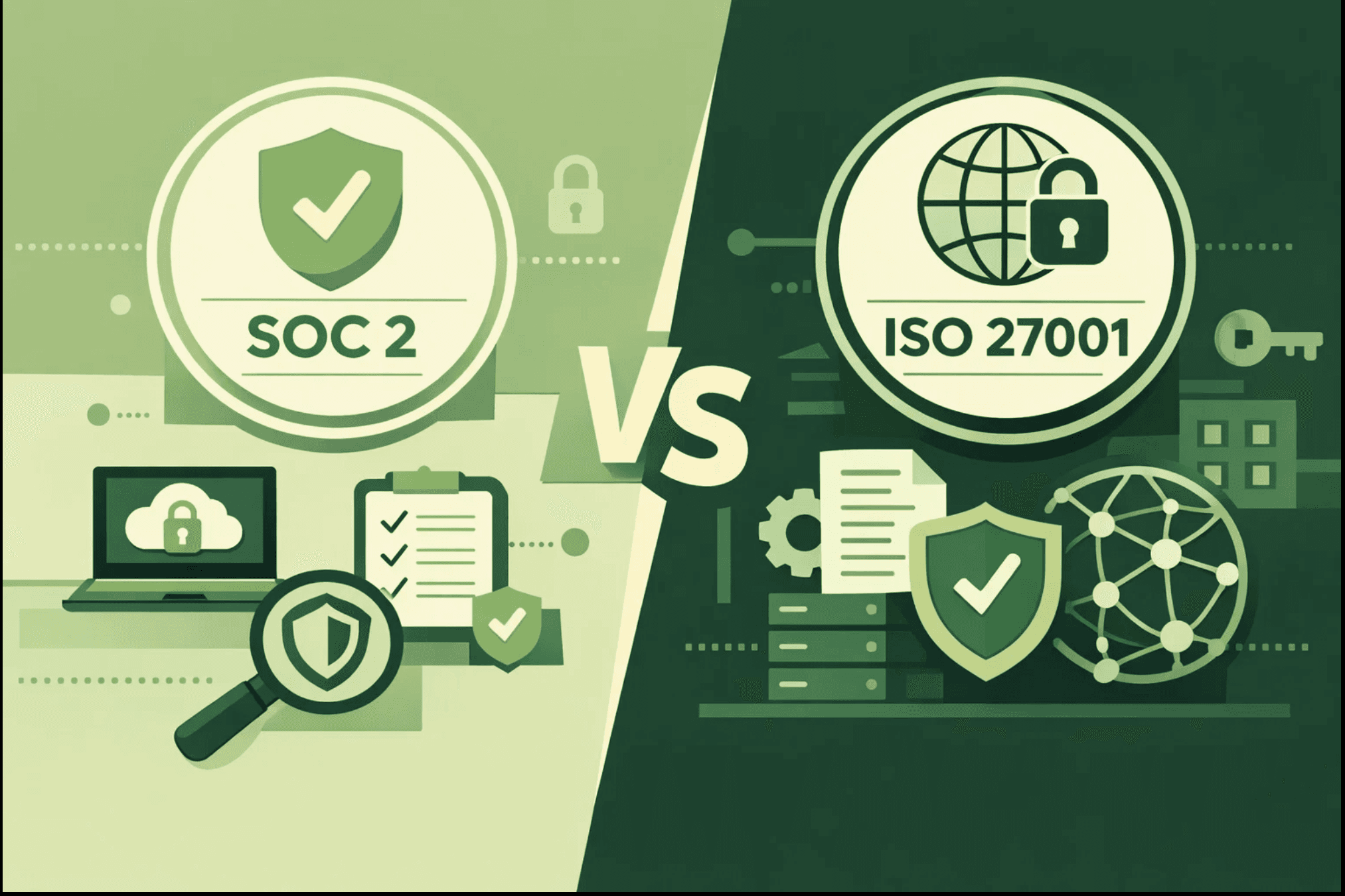
SOC 2 vs ISO 27001: Which Compliance Path is Best for Your SaaS?
If you're leading a fast-growing SaaS company, compliance quickly shifts from "security hygiene" to a strategic growth lever.
Enterprise buyers demand proof. Procurement teams want frameworks. Your sales cycle slows down if you can't answer:
Are you SOC 2 compliant?
Do you have ISO 27001?
Can you share a SOC report?
But here's the real question executives wrestle with:
Which compliance path makes the most sense for us — SOC 2, ISO 27001, or SOC 3?
Let's break it down in plain English.
Understanding SOC 2 vs ISO 27001 vs SOC 3 at a Glance
Framework | Primary Use Case | Best For | Geographic Fit |
|---|---|---|---|
SOC 2 | Detailed attestation of internal controls | SaaS selling to US enterprises | US-centric |
ISO 27001 | Global security management system certification | SaaS expanding internationally | Global |
SOC 3 | Public trust badge | Marketing & sales enablement | Global visibility |
Each framework signals trust — but in very different ways.
Understanding SOC 2 vs ISO 27001 which is better for us starts with recognizing what each framework accomplishes and who requires it. If you want quick definitions first, see:
SOC 2 is built on the Trust Services Criteria (TSC): Security, Availability, Confidentiality, Processing Integrity, and Privacy.
It answers the buyer's biggest fear: "Can I trust this company with my customer data?"
Why Executives Choose SOC 2 First
When evaluating SOC 2 vs ISO 27001, most US-based SaaS companies start with SOC 2 because:
It's the default requirement in US enterprise sales
It enables vendor onboarding and procurement approvals
It satisfies legal, security, and procurement stakeholders simultaneously
If you want a deeper comparison page specifically on this decision:
ISO 27001 vs SOC 2 — key differences
SOC 2 Reporting Timeline: What Executives Need to Know
Understanding the SOC 2 reporting timeline is critical for revenue planning:
Type I: Snapshot at a point in time (4-8 weeks to complete)
Type II: Proof your controls work over 3–12 months (3-6 months total)
For the timeline detail and planning logic, these are useful:
Pro tip: Most enterprise buyers require Type II, not Type I—budget for the longer reporting timeline from day one.
If you’re budgeting, link this directly in the “cost” conversation: Estimating the cost of a SOC 2 audit
ISO 27001 - The Global Standard
ISO 27001 isn't a report — it's a certification of your Information Security Management System (ISMS).
Instead of focusing on point-in-time controls, ISO asks:
Do you have a system to continuously manage risk?
Can you prove governance, leadership involvement, and improvement cycles?
If you want the “requirements” view to anchor expectations: What are the ISO 27001 requirements?
Why Global SaaS Companies Prefer ISO 27001
When considering SOC 2 vs ISO 27001 for international expansion:
Recognized across Europe, APAC, and LATAM
Required by multinational customers — European enterprises often mandate ISO certification
Strong foundation for long-term security maturity
For planning ISO specifically:
The Trade-Off
ISO 27001 is slower to implement upfront (4-9 months) — but easier to extend as you scale internationally.
For executives asking SOC 2 vs ISO 27001, which is better for us, the answer often depends on your customer geography:
US-heavy customer base? Start with SOC 2
EU/global expansion? Prioritize ISO 27001
Both? You'll eventually need both (more on that below)
SOC 3 — The Marketing Badge
Understanding SOC 2 vs SOC 3 Differences for Executives
SOC 3 is derived from your SOC 2. It strips out sensitive details and gives you something powerful: a publicly shareable trust report.
If you want the clean “SOC 1 vs SOC 2 vs SOC 3” explainer as a supporting internal link:
SOC 1 vs SOC 2 vs SOC 3 — what’s the difference?
The key SOC 2 vs SOC 3 differences for executives:
Feature | SOC 2 | SOC 3 |
|---|---|---|
Audience | Shared under NDA with prospects | Publicly available |
Detail Level | Detailed control descriptions | High-level summary |
Use Case | Sales cycles & procurement | Marketing & website trust signals |
Timeline | 3-6 months for Type II | 1-2 weeks after SOC 2 completion |
Cost | $15k-$40k | $2k-$6k (addon to SOC 2) |
When SOC 3 Makes Sense
Understanding SOC 2 vs SOC 3 differences for executives helps determine when to invest:
You already completed SOC 2 Type II
You want a lightweight public trust signal
You're optimizing top-of-funnel conversion and credibility
SOC 3 doesn't replace SOC 2 — it amplifies it.
Choosing the Right Path for Growth, Budget, and Global Expansion
Which Framework Fits Your Company Stage?
Company Stage | Best Fit | Why |
|---|---|---|
Seed – Series A SaaS selling to mid-market | SOC 2 Type I → Type II | Fastest path to enterprise trust. Customers ask for SOC 2 before contracts. |
Scaling SaaS in regulated industries | SOC 2 Type II + ISO 27001 | SOC 2 proves operational maturity. ISO 27001 gives structured risk management. |
Global expansion or EU-heavy customer base | ISO 27001 | Recognized internationally and aligns well with GDPR expectations. |
Marketing-driven trust signals | SOC 3 | High-level seal you can publish without NDAs. |
Enterprise multi-region platform | SOC 2 + ISO 27001 + SOC 3 | Full maturity stack: operational trust + international recognition + public proof. |
SOC 2 vs ISO 27001 vs SOC 3 — Cost & Timeline Reality
Executives need real numbers. Here's what to budget:
Framework | Typical Timeline | Effort Level | Cost Range |
|---|---|---|---|
SOC 2 Type I | 4–8 weeks | Medium | $5k–$15k |
SOC 2 Type II | 3–6 months | High | $15k–$40k |
ISO 27001 | 4–9 months | High | $12k–$35k |
SOC 3 | 1–2 weeks (after SOC 2) | Low | $2k–$6k |
Remember the SOC 2 reporting timeline when planning: Type II requires 3-12 months of operational evidence. Start early.
Why Executives Choose the Wrong Framework
Common mistakes leaders make when deciding between SOC 2 vs ISO 27001, which is better for us:
Picking ISO 27001 first when customers only want SOC 2
Treating compliance as a one-time project instead of an operational system
Running parallel evidence programs for each framework
Not planning the SOC 2 reporting timeline into revenue goals early enough
This is where DSALTA changes the game.
How DSALTA Makes Multi-Framework Compliance Possible
Most executives struggle with SOC 2 vs SOC 3 differences for executives and SOC 2 vs ISO 27001 which is better for us because they assume each framework requires separate, parallel work streams.
The traditional approach:
Build separate compliance programs for SOC 2, ISO 27001, and SOC 3
Maintain different evidence repositories
Repeat audits and assessments for each framework
Watch the SOC 2 reporting timeline drag while juggling other frameworks
The DSALTA approach:
Instead of building three separate programs, DSALTA lets you:
Map one control set across SOC 2, ISO 27001, and SOC 3 — identify overlapping requirements automatically
Maintain a single evidence stream — collect once, apply everywhere
Track framework readiness in one dashboard — see exactly where you stand on each framework in real-time
Generate reporting artifacts without manual spreadsheet chaos
Manage your SOC 2 reporting timeline alongside ISO 27001 milestones in one view
What That Means For You
Without DSALTA | With DSALTA |
|---|---|
Separate projects for each framework | One unified compliance system |
Weeks lost to evidence chaos | Automated collection across cloud tools |
Compliance fatigue across teams | Compliance becomes background hygiene |
Delayed enterprise deals | Trust becomes a growth accelerator |
Manual tracking of the SOC 2 reporting timeline | Automated milestone tracking and alerts |
When you understand the SOC 2 vs SOC 3 differences for executives and the SOC 2 vs ISO 27001 question, the next question becomes: How do we manage all of this without doubling our security team?
That's where multi-framework mapping delivers ROI.
Executive Decision Checklist: SOC 2 vs ISO 27001 vs SOC 3
Before choosing your framework path and committing to a SOC 2 reporting timeline, ask:
Revenue blockers:
Are enterprise buyers blocking deals without SOC 2?
Are international customers requesting ISO alignment?
Is marketing asking for public trust badges (SOC 3)?
Operational readiness:
Is your team already drowning in manual evidence collection?
Can you dedicate resources to a 3-6 month SOC 2 reporting timeline?
Do you have the capacity to pursue multiple frameworks simultaneously?
Strategic priorities:
Is US enterprise revenue your primary growth driver? → SOC 2
Are you expanding into Europe or APAC? → ISO 27001
Do you need public trust signals for top-of-funnel conversion? → SOC 3
Understanding the SOC 2 vs SOC 3 differences for executives and SOC 2 vs ISO 27001, which is better for us, becomes clearer when you map frameworks to business outcomes:
SOC 2 = Unlock US enterprise deals
ISO 27001 = Enable global expansion
SOC 3 = Accelerate marketing and sales velocity
If you answered yes to two or more revenue blockers, you're ready for a multi-framework strategy.
And with DSALTA's unified approach, that doesn't mean 3x the work.
Final Thought: From Compliance Pain to Growth Strategy
SOC 2, ISO 27001, and SOC 3 aren't competing standards.
Why Executives Choose the Wrong Framework
Common mistakes leaders make when deciding between SOC 2 vs ISO 27001:
Picking ISO 27001 first when customers only want SOC 2
Treating compliance as a one-time project instead of an operational system
Running parallel evidence programs for each framework
Not planning the SOC 2 reporting timeline into revenue goals early enough
This is where DSALTA changes the game.
How DSALTA Makes Multi-Framework Compliance Possible
Most executives struggle with SOC 2 vs SOC 3 differences for executives and SOC 2 vs ISO 27001 because they assume each framework requires separate, parallel work streams.
The DSALTA approach:
Instead of building three separate programs, DSALTA lets you:
Map one control set across SOC 2, ISO 27001, and SOC 3 — identify overlapping requirements automatically
Maintain a single evidence stream — collect once, apply everywhere
Track framework readiness in one dashboard — see exactly where you stand on each framework in real-time
Generate reporting artifacts without manual spreadsheet chaos
Manage your SOC 2 reporting timeline alongside ISO 27001 milestones in one view
Relevant product pages you can link when you mention “unified system/dashboards/evidence”:
If you want to connect compliance → buyer enablement (security reviews/questionnaires/trust assets):
What That Means For You
Manual tracking of the SOC 2 reporting timeline is replaced by automated milestone tracking and alerts.
Executive Decision Checklist: SOC 2 vs ISO 27001 vs SOC 3
Before choosing your framework path and committing to a SOC 2 reporting timeline, ask:
Revenue blockers:
Are enterprise buyers blocking deals without SOC 2?
Are international customers requesting ISO alignment?
Is marketing asking for public trust badges (SOC 3)?
Operational readiness:
Is your team already drowning in manual evidence collection?
Can you dedicate resources to a 3-6 month SOC 2 reporting timeline?
Do you have the capacity to pursue multiple frameworks simultaneously?
Strategic priorities:
Is US enterprise revenue your primary growth driver? → SOC 2
Are you expanding into Europe or APAC? → ISO 27001
Do you need public trust signals for top-of-funnel conversion? → SOC 3
Final Thought: From Compliance Pain to Growth Strategy
SOC 2, ISO 27001, and SOC 3 aren't competing standards.
They're layers of trust maturity.
For executives asking SOC 2 vs ISO 27001, the honest answer is often "eventually both" — but the sequencing matters.
Start with what unblocks revenue:
SOC 2 for US deals
ISO 27001 for global expansion
SOC 3 for public trust
Plan your SOC 2 reporting timeline around your sales roadmap, not the other way around.
Ready to map your compliance roadmap?
Book a demo with DSALTA
Explore more SOC 2 articles
Getting Started with SOC 2
Audit Preparation & Evidence
Controls & Technical Implementation
Multi-Framework Strategy
Business & Trust
Stop losing deals to compliance.
Get compliant. Keep building.
Join 100s of startups who got audit-ready in days, not months.