SOC 2 Control Mapping: Guide to Trust Services Criteria
Written by
Published on
Introduction: Why Control Mapping Determines Audit Success
Your security is probably stronger than you think. You have single sign-on, multi-factor authentication, centralized logging, vendor security reviews, and documented incident response procedures. Your engineering team takes security seriously. Your operations are solid.
Yet somehow, your SOC 2 audit feels chaotic. Auditors ask dozens of clarifying questions. Evidence requests seem random. Your team scrambles to gather documentation. Engineers get pulled away from product work to help explain security controls.
The problem isn't your security—it's your SOC 2 control mapping to Trust Services Criteria.
Most teams don't fail SOC 2 because they lack the security capabilities needed. They fail because they can't explain their security in the language auditors expect. That language is the Trust Services Criteria framework developed by the AICPA.
You may have excellent controls, but if those controls aren't correctly mapped to the TSC framework, your audit becomes a frustrating, time-consuming exercise in translation rather than a straightforward verification of what you already do.
Control mapping is the difference between saying "We are secure" and providing "Here is proof our controls meet CC6.1, CC7.2, and CC8.1 across the entire audit period with documented evidence."
This guide provides the technical deep dive compliance officers, security engineers, and GRC leads need to master Trust Services Criteria, understand SOC 2 security criteria example controls, and prepare for 2025 audits efficiently.
If you want a quick refresher before you go deeper, start here: What is SOC 2? and Trust Services Criteria.
What Are the Trust Services Criteria?
The Framework That Structures All SOC 2 Reports
The Trust Services Criteria are the formal framework defined by the American Institute of Certified Public Accountants to evaluate SOC 2 compliance—every SOC 2 report, whether Type I or Type II, is structured around these criteria.
Understanding TSC is not optional for compliance professionals. It's the foundation of how auditors think, how they test controls, and how they structure findings in your report.
If your readers need clarity on what auditors actually deliver and how it’s structured, these help: What is included in a SOC 2 report and Explaining the SOC 2 report.
The Five TSC Categories Explained
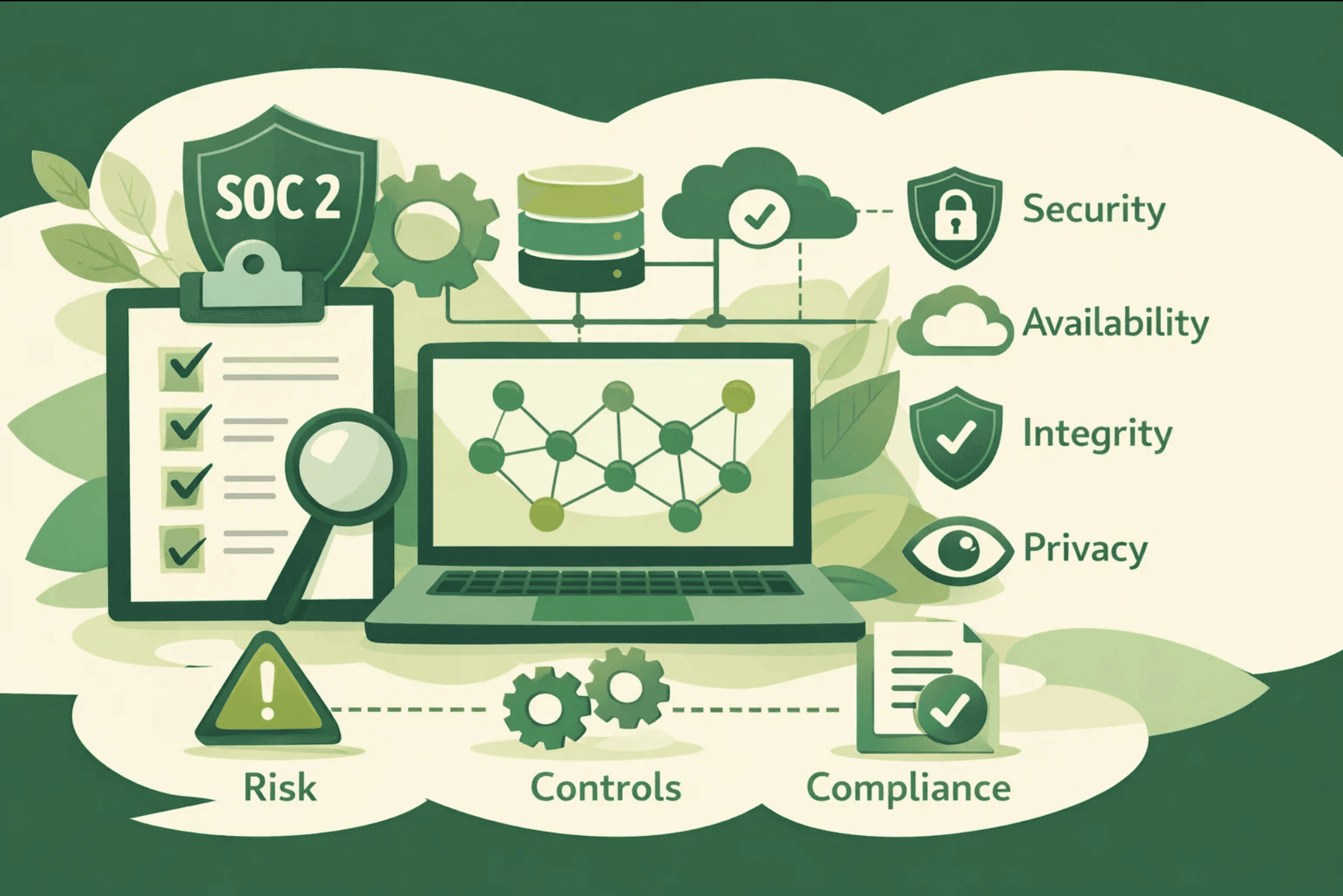
Security (Common Criteria) is required for all SOC 2 reports. This category covers access control mechanisms, system operations and monitoring, change management procedures, risk assessment and mitigation, and logical and physical security boundaries.
Availability addresses system uptime and accessibility, including disaster recovery capabilities, business continuity planning, capacity management and scaling, incident response for availability issues, and monitoring and alerting for performance.
Confidentiality focuses on protecting information designated as confidential through data classification schemes, encryption requirements, access restrictions beyond general security, retention and disposal procedures, and contractual confidentiality obligations.
Processing Integrity verifies system processing is complete, valid, accurate, timely, and authorized. This includes data validation controls, error detection and correction, processing completeness checks, authorization workflows, and reconciliation procedures.
Privacy addresses the collection, use, retention, disclosure, and disposal of personal information in accordance with your privacy notice and applicable regulations, including consent mechanisms, data subject rights, cross-border transfer controls, and third-party data sharing.
If someone wants the broader SOC 2 hub for context: SOC 2 framework overview.
Typical SOC 2 Scope for First-Time Audits
In approximately 90% of first-time SOC 2 audits, companies scope only Security and sometimes add Availability. This makes sense because Security criteria are mandatory, and most SaaS customers primarily care about data protection and system reliability.
Confidentiality, Processing Integrity, and Privacy get added when specific customer contracts require them or when your business model makes them particularly relevant. Healthcare companies often include Privacy. Financial services companies frequently add Processing Integrity.
Start focused and intentionally expand the scope based on customer requirements, rather than trying to implement all five categories simultaneously.
For scoping and planning: Defining your SOC 2 audit scope and Building your SOC 2 project plan.
Understanding the Common Criteria: Your Audit Backbone
The Nine Common Criteria Categories
The Security criteria, also called the Common Criteria and abbreviated as CC1 through CC9, form the core of every SOC 2 audit. These are mandatory, and where auditors spend most of their testing time.
CC1: Control Environment examines whether leadership demonstrates commitment to security, organizational structure defines security responsibilities, management establishes accountability, competence requirements are defined, and performance measures include security objectives.
CC2: Communication and Information verifies that internal communication supports security, including documented policies and procedures, security awareness training, incident reporting channels, and management communication of security expectations.
CC3: Risk Assessment requires formal risk identification processes, assessment of likelihood and impact, prioritization of risks for treatment, and documentation of risk responses.
CC4: Monitoring Activities addresses ongoing and periodic evaluations of security control effectiveness, including internal audits, management reviews, and remediation tracking.
CC5: Control Activities covers policies and procedures that help ensure management directives are carried out, including authorization, approval, segregation of duties, and verification activities.
CC6: Logical and Physical Access is one of the most heavily tested areas, covering user provisioning and deprovisioning, authentication mechanisms such as MFA, role-based access for authorization, access reviews, and physical security controls.
CC7: System Operations examines day-to-day security operations, including logging and monitoring, vulnerability management, malware protection, backup and recovery, and capacity management.
CC8: Change Management verifies controls around system changes, including change approval workflows, testing requirements, deployment procedures, emergency change processes, and rollback capabilities.
CC9: Risk Mitigation addresses how you manage risks outside direct control, including vendor risk management, business partner security, incident response, and business continuity.
For practical examples tied to real SaaS operations: Key SOC 2 controls to know and SOC 2 controls explained: 20 real-world examples.
Points of Focus: The Devil in the Details
Each Common Criteria category contains multiple Points of Focus that describe specific aspects auditors will evaluate. For example, CC6.1 (Logical and Physical Access Controls) includes points of focus for:
Identification and authentication mechanisms
Authorization of users
Physical access controls
Removal of access rights
Review of access rights
This granularity is where SOC 2 control mapping becomes critical. You need controls that address each relevant point of focus, not just the high-level category.
Why SOC 2 Control Mapping Is Challenging
The Translation Problem
Auditors don't evaluate your tools directly. They assess how controls operate, how frequently they execute, who owns and monitors them, and what evidence proves consistent operation.
Teams struggle because they try to answer TSC questions with screenshots from a single day, loosely organized documentation, one-time reports generated for the audit, and verbal explanations of what they "normally" do.
Instead, auditors need repeatable control-to-evidence relationships that show controls operate consistently over the entire observation period.
The Gap Between Security and Compliance
Your security team thinks in terms of threats, vulnerabilities, and technical controls. Auditors think in terms of Trust Services Criteria, control objectives, and evidence trails.
This creates a translation gap. Your team says, "We have MFA enabled." The auditor asks, "Which systems? For all users or just some? What's your enforcement policy? Can you prove it was enabled throughout the observation period? How do you handle exceptions?"
SOC 2 control mapping bridges this gap by creating explicit connections between what you do and what auditors need to verify.
The Evidence Chain Problem
Without proper mapping, evidence collection becomes reactive. Auditors request evidence for CC6.2, and you scramble to figure out what that means, which systems it covers, what evidence would satisfy it, where that evidence might exist, and who can provide it.
With proper mapping, evidence collection is proactive. You know precisely which evidence satisfies which TSC criteria before auditors ask because the mapping defines these relationships in advance.
If you want a practical audit-readiness companion: Preparing for your SOC 2 audit and Mastering SOC 2 compliance documentation.
What Effective SOC 2 Control Mapping Looks Like
The Four Essential Elements
Every correctly mapped control must answer four critical questions:
What is done? The specific control activity is described clearly and unambiguously. "Quarterly access reviews" is clear. "We check access sometimes" is not.
How often? The frequency of control operation. Daily, weekly, monthly, quarterly, annually, or event-driven with specific trigger conditions.
By whom? The person or role responsible for executing the control. Distributed ownership is fine, but someone must be accountable for each control.
Where is the proof stored? The specific location and format of evidence demonstrating control operation. Auditors need to find proof quickly and verify it's authentic.
Real-World Control Mapping Examples
Let's examine how effective the SOC 2 security criteria example controls look in practice.
CC6.1 - Logical Access Controls
Control: Enforce SSO with MFA for all employees accessing production systems
Owner: IT Security team
Frequency: Continuous enforcement with quarterly verification reviews
Evidence: Okta access logs showing MFA enforcement, identity provider configuration screenshots, and quarterly access review sign-offs
CC7.2 - System Monitoring
Control: Daily security log review with automated alerting for suspicious activities
Owner: Security Operations team
Frequency: Continuous monitoring with daily review of alerts
Evidence: SIEM alert reports, incident ticket IDs for investigated alerts, and a monthly summary of monitoring coverage
CC8.1 - Change Management
Control: All production changes require code review and approval before deployment
Owner: Engineering team
Frequency: Event-driven for each change
Evidence: GitHub pull request approvals, deployment tickets in Jira, change log showing approvals and timestamps
CC9.2 - Vendor Risk Management
Control: Quarterly security reviews of critical vendors with annual complete assessments
Owner: Procurement and IT teams
Frequency: Quarterly for critical vendors, annually for others
Evidence: Completed vendor risk questionnaires, vendor SOC 2 reports or security documentation, risk classification records, and review approval documentation
If you want to connect vendor controls to a concrete solution page: Vendor Risk Management.
Creating the Control Matrix
Organize your mapped controls in a comprehensive matrix that serves as your compliance blueprint:
TSC Criteria
Control Description
Owner
Frequency
Evidence Location
CC6.1
SSO + MFA enforcement
IT Security
Continuous
Okta logs, quarterly review files
CC6.3
Quarterly access reviews
IT Security
Quarterly
Access review exports, approval emails
CC7.2
Security monitoring
SecOps
Daily
SIEM reports, incident tickets
CC8.1
Change approval workflow
Engineering
Per change
GitHub PRs, Jira change tickets
CC9.1
Vendor risk assessment
Procurement
Annual
Vendor risk files, security questionnaires
This matrix becomes your operational guide during normal operations and your roadmap during audits.
To keep this matrix “alive” year-round: Staying continuously SOC 2 compliant.
Building Controls Into Daily Operations
From Theory to Execution
Understanding Trust Services Criteria intellectually is one thing. Another is building controls into daily operations, so they execute consistently without constant attention.
The integration challenge is that compliance controls often feel like additional work layered on top of normal operations. Engineering ships features. Operations maintains infrastructure. Compliance asks for documentation proving they did these things securely.
The solution is embedding compliance into existing workflows rather than creating parallel compliance processes.
If you want a broader “modern SOC 2 readiness” reference: SOC 2 compliance in 2025: requirements, readiness, and audit success.
Making Controls Operational
Access management example: Instead of maintaining a separate spreadsheet for access reviews, integrate with your identity provider's native capabilities. Configure automated quarterly reports pulling current access. Create a workflow requiring manager approval to close reviews. Store approvals automatically.
The control isn't "someone manually reviews access in a spreadsheet." The power is "our identity management system enforces quarterly access reviews with required approvals."
Change management example: Instead of asking developers to separately document compliance changes, make your existing GitHub workflow satisfy compliance requirements. Require pull request reviews (already a good practice). Link PRs to Jira tickets (already tracked for velocity). Capture deployment logs (already needed for troubleshooting).
The control isn't "create compliance documentation for each change." The power is "our existing development workflow captures required change evidence automatically."
Vendor management example: Instead of maintaining vendor information in random spreadsheets and emails, establish a vendor risk register with scheduled reviews. When vendor assessments are due, notifications go out automatically. Completed assessments get stored in a centralized location organized by vendor.
The control isn't "someone hopefully remembers to review vendors." The power is "our vendor management system enforces scheduled assessments."
If you want a single supporting link for this mindset: SOC 2 automation vs manual.
Distributed Control Ownership
SOC 2 compliance shouldn't live entirely in a compliance or security team. Effective programs distribute ownership:
Engineering teams own change management controls, code review processes, secure development practices, and deployment procedures.
IT and Operations teams manage access provisioning and reviews, system monitoring and logging, backup and recovery operations, and vulnerability management.
Human Resources handles onboarding security procedures, security awareness training, background checks, and offboarding access removal.
Procurement and Legal oversee vendor risk assessments, contract security terms, and business associate agreements.
Security and Compliance teams provide oversight, coordinate audits, maintain the control framework, and track remediation.
This distribution ensures that controls are owned by teams who actually perform the work, rather than by compliance teams trying to enforce controls on others.
Why Manual Control Mapping Breaks at Scale
The Spreadsheet Death Spiral
Teams often start SOC 2 control mapping with spreadsheets. For a first Type I audit with a limited scope, this might work. Then you pursue Type II with a 6-12 month observation period.
Suddenly, you must run controls continuously for months, track evidence across time periods, prove nothing was skipped or missed, answer auditor questions instantly about any point in the timeline, and maintain this while your business and systems evolve.
This is where spreadsheet-based mapping collapses under its own weight.
The Problems That Compound
Missed control executions occur when calendar reminders get dismissed, ownership transitions during employee changes, everyone assumes someone else handled it, and nothing flags that quarterly reviews are overdue.
Broken evidence chains happen when evidence is stored inconsistently—some in Dropbox, some in Google Drive, some in email, with naming conventions that vary by person, and nobody can find evidence from six months ago.
Version control chaos arises when multiple people maintain separate spreadsheets, conflicting information about control descriptions, uncertainty about which version is current, and no clear change history to show updates.
Audit panic becomes predictable as the observation period ends and teams realize that evidence is incomplete, controls were missed, documentation is scattered, and everyone is working late nights reconstructing history.
This isn't a people problem—it's a system problem. Manual processes don't scale to the continuous operation requirements of SOC 2 Type II.
If your reader needs the Type I vs Type II anchor: SOC 2 Type I vs Type II and How long SOC 2 takes.
How DSALTA Automates Trust Services Criteria Mapping
From Manual to Intelligent Automation
Instead of asking you to map controls manually, DSALTA embeds SOC 2 control mapping directly into your workflows, directly into the Trust Services Criteria.
Automatic evidence collection integrates with your existing tools—Okta, AWS, GitHub, Jira, and PagerDuty—and captures evidence as controls execute. You don't manually screenshot or export—the platform does this continuously in the background.
Intelligent control mapping analyzes your technology stack and automatically identifies which TSC criteria apply. The platform shows you precisely which controls you need based on your specific environment, not generic templates.
Scheduled compliance activities send reminders when quarterly access reviews are due, vendor assessments need completion, or policy reviews are required. Nothing falls through cracks because the system enforces schedules.
Real-time control health shows which controls are operating correctly and which need attention. Instead of discovering problems during an audit, you see issues immediately when they occur and can remediate before they become findings.
Audit-ready evidence packages automatically organize all documentation and evidence by TSC criteria. When auditors request evidence for CC6.3 or CC7.2, you click a button and export complete, properly formatted evidence mapped to the specific criteria.
Real-World Example: Access Reviews
The traditional manual approach requires pulling user lists from multiple systems manually, creating spreadsheets for managers to review, chasing managers for approvals via email, saving screenshots of completed reviews, renaming files according to some convention, storing files in shared drives, and hoping you can find everything six months later.
DSALTA automates this completely:
Integration with your identity provider pulls user access data automatically
The system creates scheduled quarterly review tasks assigned to appropriate managers
Managers complete reviews within the platform with approval workflows
Evidence gets stored automatically under CC6.3 with proper timestamps
System flags overdue reviews before they become audit findings
When auditors request access review evidence, you export complete records instantly
You don't map controls—you operate normally, and DSALTA automatically maps the evidence to Trust Services Criteria.
Learn more about DSALTA:
Preparing for 2025 SOC 2 Audits
Rising Auditor Expectations
Auditors in 2025 are increasing expectations around Trust Services Criteria implementation and evidence quality.
Continuous monitoring over point-in-time proof means auditors want evidence that controls operated throughout the observation period, not just during audit week. Screenshots from a single day no longer suffice.
Evidence lineage requires clear trails showing where the evidence came from, when it was created, who was involved, and how it connects to the specific control. Folders of PDFs without context don't meet this standard.
Cross-framework alignment becomes important as companies pursue multiple certifications. Auditors expect you to show how SOC 2 controls map to ISO 27001 requirements, HIPAA safeguards, or GDPR technical measures if you're seeking various frameworks.
Automated control operation is increasingly expected rather than manual processes. Auditors trust controls enforced by systems more than controls relying on human discipline and memory.
For cross-mapping context: ISO 27001 requirements 2025 + SOC 2 cross-mapping and ISO 27001 vs SOC 2.
Making Your Program Audit-Ready
Controls triggered by workflows mean security activities happen automatically as part of normal operations. Code can't be deployed without reviews. Access gets reviewed on schedule. Vendor assessments trigger before renewals.
Evidence captured at source eliminates reconstruction. When a control executes, evidence is captured immediately in the proper format with the required metadata—not manually created later.
Dashboards showing readiness give leadership real-time visibility into compliance status. You know precisely which controls are healthy, which need attention, and whether you're audit-ready at any moment.
This transforms SOC 2 from a periodic project into a continuous operating system.
Advanced Control Mapping Strategies
Mapping Multiple Controls to a Single TSC Criteria
Some Trust Services Criteria require multiple controls working together. For example, CC7.2 (System Monitoring) might include:
Control 1: SIEM aggregates logs from all production systems
Control 2: Automated alerts trigger for defined security events
Control 3: Security team reviews alerts daily
Control 4: Incidents get documented and tracked to resolution
Control 5: Monthly monitoring coverage reviews verify completeness
Each control addresses a different aspect of monitoring, but together they satisfy CC7.2 comprehensively.
Single Controls Satisfying Multiple Criteria
Conversely, some controls satisfy multiple TSC criteria simultaneously. Multi-factor authentication might map to:
CC6.1: Logical access controls (authentication mechanism)
CC6.2: Before issuing system credentials (MFA required for access)
CC6.3: Authorization of users (MFA as part of authorization workflow)
Understanding these relationships prevents duplicate work and creates efficient control frameworks.
Building Control Hierarchies
Organize controls hierarchically from high-level policies to specific technical implementations:
Policy level: Information Security Policy states the organization requires MFA for production access
Procedure level: Access Control Procedure defines the MFA requirements and the exceptions process
Technical control: Okta enforces MFA for production applications with no bypass
Monitoring control: Monthly review verifies MFA remains enforced across systems
This hierarchy shows how high-level commitments translate into technical reality.
If your readers are building multi-framework programs too: A unified approach to SOC 2, ISO 27001, HIPAA in 2025.
Common Control Mapping Mistakes to Avoid
Mistake 1: Overly Broad Control Descriptions
"We have good security" doesn't map to the Trust Services Criteria. Controls must be specific and testable.
Bad: "We protect access to systems."
Good: "All production system access requires SSO through Okta with enforced MFA. Access reviews occur quarterly with documented approvals. Terminated employee access is removed within 24 hours per procedure SEC-001."
Mistake 2: Missing Frequency Definitions
Controls without a defined frequency create audit confusion.
Bad: "We review vendor security regularly."
Good: "Critical vendors (Tier 1) receive quarterly security reviews. High-risk vendors (Tier 2) receive annual reviews. Reviews include updated SOC 2 reports or security questionnaires."
Mistake 3: Unclear Evidence Requirements
Not defining what evidence demonstrates control operation leads to scrambling during audits.
Bad: "Access is reviewed."
Good: "Access reviews produce: (1) Complete user list export from Okta with permissions, (2) Manager approval email or signed review form, (3) Tickets for access modifications identified during review, (4) Summary report to security leadership."
Mistake 4: Ignoring Control Dependencies
Some controls depend on others working properly. Map these dependencies explicitly.
Example: Effective monitoring (CC7.2) depends on comprehensive logging being enabled first. If logging breaks, monitoring becomes ineffective even if the monitoring system functions perfectly.
Mistake 5: One-Size-Fits-All Mapping
Using generic control templates without customizing for your specific environment creates gaps.
Your technology stack, business model, and risk profile determine which controls you need and how they should operate. Templates provide starting points, but effective mapping requires customization.
Conclusion: Trust Services Criteria as Your Operating System
Trust Services Criteria are not abstract compliance theory disconnected from daily operations. They represent a structured approach to operating secure systems that auditors can independently verify.
When you master SOC 2 control mapping to the Trust Services Criteria, several transformations occur:
Audits become predictable rather than chaotic. You know precisely what auditors will test because you've mapped controls to TSC criteria explicitly. Evidence requests don't surprise you because you've defined what evidence each control produces.
Evidence collection becomes continuous rather than crisis-driven. Controls capture evidence automatically as they execute. You're always audit-ready rather than scrambling before observation periods close.
Your team stays focused on building products and serving customers rather than fighting compliance fires. Security and compliance run in the background as operational systems rather than consuming attention.
SOC 2 becomes an advantage rather than a burden. Faster audits mean faster sales cycles. Better controls mean stronger actual security. Automated evidence means lower operational overhead.
This is the transformation that proper control mapping enables—from viewing compliance as painful overhead to recognizing it as an operational discipline that strengthens your business.
For compliance officers, security engineers, and GRC leads responsible for SOC 2 implementation, investing time in thorough control mapping pays dividends through every audit cycle. Start with a clear understanding of Trust Services Criteria, map controls explicitly to specific criteria with defined evidence, build controls into workflows rather than creating parallel compliance processes, automate evidence collection wherever possible, and maintain the mapping as your systems evolve.
The teams that excel at SOC 2 don't have more resources or better security—they have better control mapping and systems that make compliance continuous rather than episodic.
Learn how DSALTA can automate your control mapping and evidence collection: Book a demo.
Explore more SOC 2 articles
Getting Started with SOC 2
Audit Preparation & Evidence
Controls & Technical Implementation
Multi-Framework Strategy
Business & Trust
Stop losing deals to compliance.
Get compliant. Keep building.
Join 100s of startups who got audit-ready in days, not months.