SOC 2 —
ISO 27001 Requirements (2026): Implementation & SOC 2 Map
Learn why ISO 27001 certification matters for growing SaaS teams, how it maps to SOC 2, and how to get enterprise-ready without duplicating compliance work.
Dogan Akbulut
Multi-Framework Strategy
Share this article


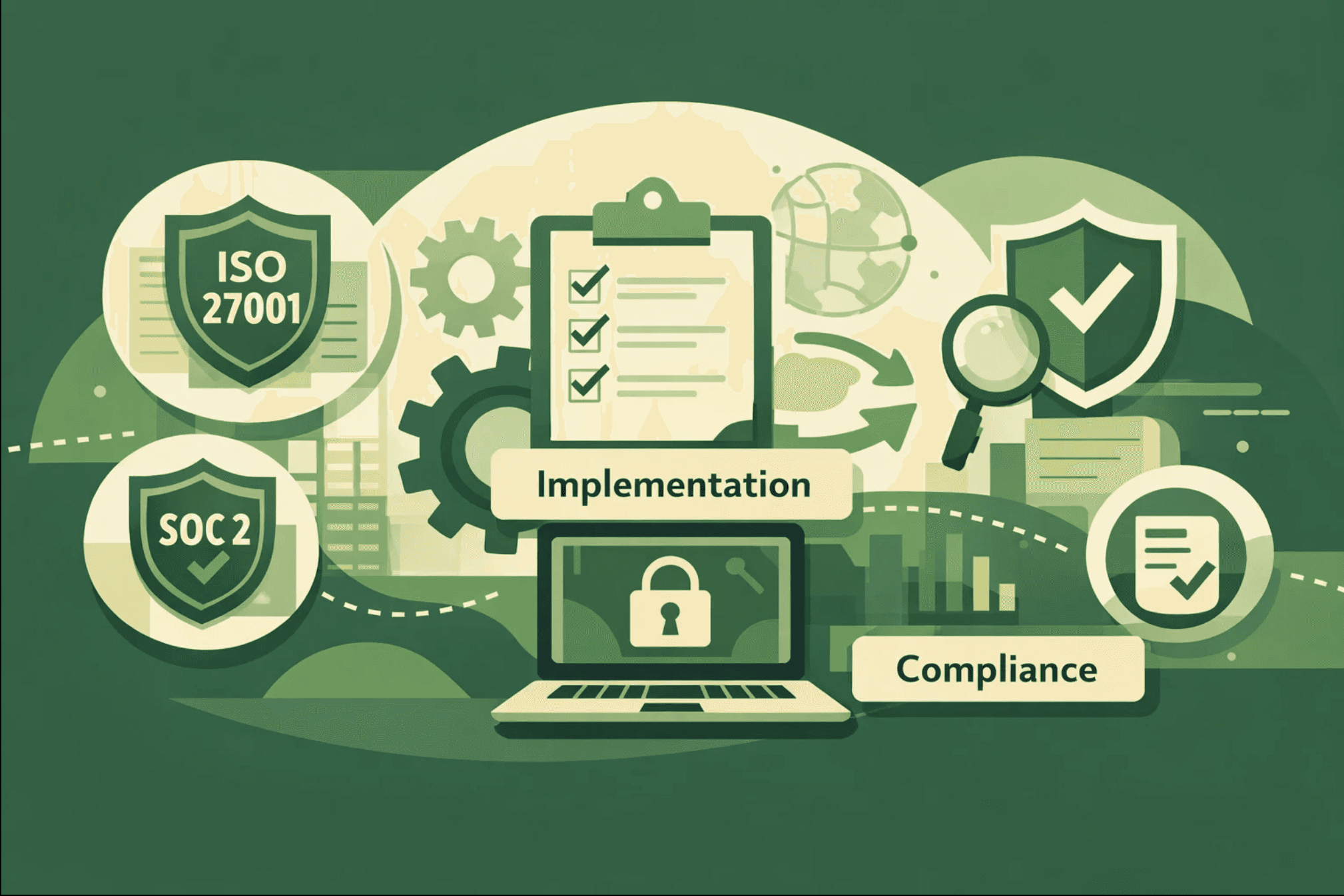
Your enterprise prospects are asking more challenging security questions. European customers want proof of a systematic approach to information security. Partners in regulated industries need internationally recognized certifications.
While SOC 2 tells customers "we secure your data," ISO 27001 certification proves you've built a management system that not only protects information but continuously improves over time. It's the difference between demonstrating controls and proving you have a formal, auditable security program.
For SaaS companies pursuing enterprise deals, understanding ISO 27001 requirements is no longer optional. The good news? If you're already working on SOC 2, you're 60-70% of the way to ISO 27001 certification.
This guide breaks down the 2025 ISO 27001 requirements, shows precisely how they map to SOC 2 controls, and provides a practical roadmap for achieving certification without duplicating compliance work.
What is ISO 27001? Understanding the Gold Standard
ISO 27001 is the internationally recognized standard for Information Security Management Systems (ISMS). Published by the International Organization for Standardization, it provides a systematic approach to managing sensitive information and ensuring its confidentiality, integrity, and availability.
How ISO 27001 Differs from SOC 2
SOC 2 focuses on demonstrating that specific controls are designed and operating effectively through an external audit. It's flexible, allowing organizations to design controls as they see fit.
ISO 27001 requires organizations to establish a formal ISMS—a comprehensive, documented framework for managing information security risks. It's prescriptive about what the management system must include and how you continuously improve it. Read our full analysis on the Key Differences Between ISO 27001 vs. SOC 2.
Key distinction: SOC 2 proves controls work. ISO 27001 proves you have a systematic, continuously improving security management program.
Why Organizations Pursue ISO 27001
International credibility - Recognized globally, essential for European and multinational customers
Regulatory alignment - Many regulations (GDPR, NIS2, financial services) explicitly reference ISO 27001
Competitive advantage - Differentiates in RFP processes where it's often required
Enterprise sales - Large organizations trust the rigorous third-party certification process
Risk management - Forces systematic thinking about information security risks
The Three Core ISO 27001 Requirements
Requirement 1: Build an Information Security Management System
The ISMS is your security program's foundation, defining how your organization:
Identifies and assesses risks systematically
Implements appropriate controls based on risk profile
Monitors progress through metrics and reviews
Continuously improves security posture
In practice: You need documented policies, defined processes, assigned responsibilities, and evidence that your security program operates consistently.
Requirement 2: Complete a Formal Risk Assessment
ISO 27001 doesn't prescribe which risks matter—you decide based on business context. However, you must:
Document your risk assessment methodology
Identify information assets and their value
Identify realistic threats and vulnerabilities
Assess the likelihood and potential impact
Create risk treatment plans
Maintain an active risk register
Critical insight: Your risk assessment must drive control selection. Auditors verify that implemented controls actually address identified risks.
Requirement 3: Implement Applicable Controls
ISO 27001:2022 includes 93 security controls organized into four categories. Your responsibility:
Select controls relevant to your risks
Create a Statement of Applicability (SoA) justifying selections
Document implementation details
Collect evidence proving effectiveness
You don't need all 93 controls selected based on risk assessment, but must justify every inclusion and exclusion.
Understanding ISO 27001 Structure: Clauses 4-10
Clause 4: Context of the Organization
Requirements: Understand your organization's purpose, stakeholders, and security requirements.
Deliverables: Documented services, protected information, affected stakeholders, and ISMS scope boundaries.
Clause 5: Leadership and Commitment
Requirements: Executive leadership must actively support the ISMS.
Deliverables: Leadership approval, resource allocation, assigned roles, established policies, and aligned security objectives.
Clause 6: Planning
Requirements: Systematic planning for addressing risks and opportunities.
Deliverables: Risk assessment, treatment plans, security objectives, and Statement of Applicability.
Clause 7: Support
Requirements: Resources, competence, awareness, communication, and documentation.
Deliverables: Adequate resources, training programs, documented procedures, and communication plans.
Clause 8: Operation
Requirements: Running your security processes daily.
Deliverables: Change management, incident response, access control, backups, secure development, and vendor risk management with supporting evidence.
Clause 9: Performance Evaluation
Requirements: Measuring, monitoring, and evaluating ISMS effectiveness.
Deliverables: Regular monitoring, internal audits, management reviews, and security metrics analysis.
Clause 10: Improvement
Requirements: Continuous improvement based on findings.
Deliverables: Tracked nonconformities, corrective actions, updated controls, and evolved ISMS.
ISO 27001 Requirements vs SOC 2: Complete Mapping
Governance and Management
ISO 27001 | SOC 2 | Overlap |
Clauses 4-6 (ISMS) | CC1 (Control Environment) | 70% |
Policies | CC1.2, CC1.3 | 80% |
Roles | CC1.2 | 90% |
Key difference: ISO 27001 mandates formal management reviews and internal audits.
Risk Assessment
ISO 27001 | SOC 2 | Overlap |
Clause 6.1.2 | CC3.1-CC3.4 | 85% |
Treatment plans | CC3.3 | 80% |
Risk register | CC3.2 | 90% |
Efficiency: Your ISO 27001 risk assessment directly satisfies SOC 2 CC3 requirements.
Access Control
ISO 27001 | SOC 2 | Overlap |
User access | CC6.1, CC6.2 | 95% |
MFA | CC6.1 | 100% |
RBAC | CC6.2 | 95% |
Reviews | CC6.3 | 90% |
Implementation: Nearly identical. Implement once, satisfy both frameworks.
Monitoring and Logging
ISO 27001 | SOC 2 | Overlap |
Security logging | CC7.2 | 95% |
Monitoring | CC7.2 | 90% |
Retention | CC7.2 | 100% |
Detection | CC7.2 | 85% |
Incident Response
ISO 27001 | SOC 2 | Overlap |
Planning | CC7.3 | 90% |
Detection | CC7.3 | 95% |
Procedures | CC7.3 | 90% |
Review | CC7.4 | 85% |
Change Management
ISO 27001 | SOC 2 | Overlap |
Change control | CC8.1 | 95% |
Configuration | CC8.1 | 90% |
Testing | CC8.1 | 85% |
Approvals | CC8.1 | 100% |
Evidence Requirements for ISO 27001 Certification
Governance Evidence
Information Security Policy
Risk assessment reports
Statement of Applicability
Internal audit reports
Management review minutes
Security objectives documentation
People Evidence
Training completion records
Background check procedures
Onboarding checklists
Offboarding access removal logs
NDA acknowledgments
Physical Security Evidence
Badge access logs
Visitor logs
Server room procedures
Equipment disposal records
Technical Security Evidence
MFA configurations
Log retention settings
SIEM documentation
Vulnerability scan results
Backup test results
Code review approvals
Encryption documentation
Network diagrams
Operational Evidence
Change management tickets
Incident response postmortems
Quarterly access reviews
Disaster recovery test results
Common Implementation Challenges
Challenge 1: Outdated Risk Assessments
Solution: Use structured methodology, identify assets systematically, document realistic threats, rate consistently, review quarterly, and track treatment progress.
Challenge 2: Missing Internal Audits
Solution: Schedule audits 6 months before certification, cover entire ISMS scope, document findings thoroughly, track corrective actions, and present results in management reviews.
Challenge 3: Inconsistent Vendor Reviews
Solution: Classify vendors by risk, define review frequency, track schedules centrally, collect updated documentation, document all reviews, and monitor vendor incidents.
Challenge 4: Inadequate Change Documentation
Solution: Standardize approval workflows, require documented PR reviews, capture deployment evidence automatically, link changes to tickets, and maintain change logs.
Challenge 5: Undocumented Incidents
Solution: Create standardized reporting forms, use dedicated channels, maintain timestamped tickets, write postmortems for all incidents, conduct annual tabletops, and document improvements.
Implementation Roadmap
Phase 1: Foundation (Months 1-2)
Define scope, create initial ISO 27001 documentation, establish governance, and assign roles.
Phase 2: Risk Assessment (Month 3)
Document methodology, create asset inventory, identify threats, assess impact, develop treatment plans, and create Statement of Applicability.
Phase 3: Control Implementation (Months 4-7)
Priority 1: Access management, logging, incident response, backups
Priority 2: Vendor risk, change management, training, physical security, vulnerability management
Phase 4: Documentation (Month 8)
Finalize policies, document procedures, establish evidence collection, create templates, and set up a central repository.
Phase 5: Internal Audit (Month 9)
Conduct a comprehensive audit, document findings, implement corrective actions, and verify effectiveness.
Phase 6: Management Review (Month 10)
Present performance to leadership, review findings, assess objectives, identify improvements, and document decisions.
Phase 7: Certification (Months 11-12)
Stage 1: Documentation review and readiness confirmation
Stage 2: Implementation assessment, interviews, evidence review, and control testing
Outcome: 3-year certificate with annual surveillance audits
Combined ISO 27001 + SOC 2 Strategy
Step 1: SOC 2 Type 1 (3-6 months) for fast control proof
Step 2: Build ISO 27001 ISMS on top (3-6 months) with 60-70% controls reused
Step 3: SOC 2 Type 2 in parallel (6-12 months) for operating effectiveness
Step 4: ISO 27001 certification (2-3 months) for international recognition
Total timeline: 12-18 months to both certifications with significant resource efficiency.
Conclusion
ISO 27001 certification demonstrates systematic, continuous improvement in information security beyond basic compliance.
Organizations approaching ISO 27001 as an opportunity to strengthen security, rather than merely checking boxes, gain the most value. The ISMS framework promotes systematic thinking that benefits your business, regardless of your certification status.
Modern compliance platforms automate control mapping, evidence collection, and documentation management, transforming months of work into weeks while ensuring continuous audit-readiness.
Ready for Your Compliance?
Simplify your path to ISO 27001 and SOC 2 certification. Book a free DSALTA demo today to see how automation can accelerate your audit and maintain continuous compliance.

Explore more SOC 2 articles
Stop losing deals to compliance.
Get compliant. Keep building.
Join 100s of startups who got audit-ready in days, not months.