Governance, Risk, and Compliance (GRC) —
How to Run Audits Smoothly: Evidence, Gaps & Fixes
Turn chaotic audits into structured, predictable workflows. Learn how evidence sampling, gap tracking, and remediation planning become effortless with DSALTA.
Deepika
Audit Preparation & Management
Share this article


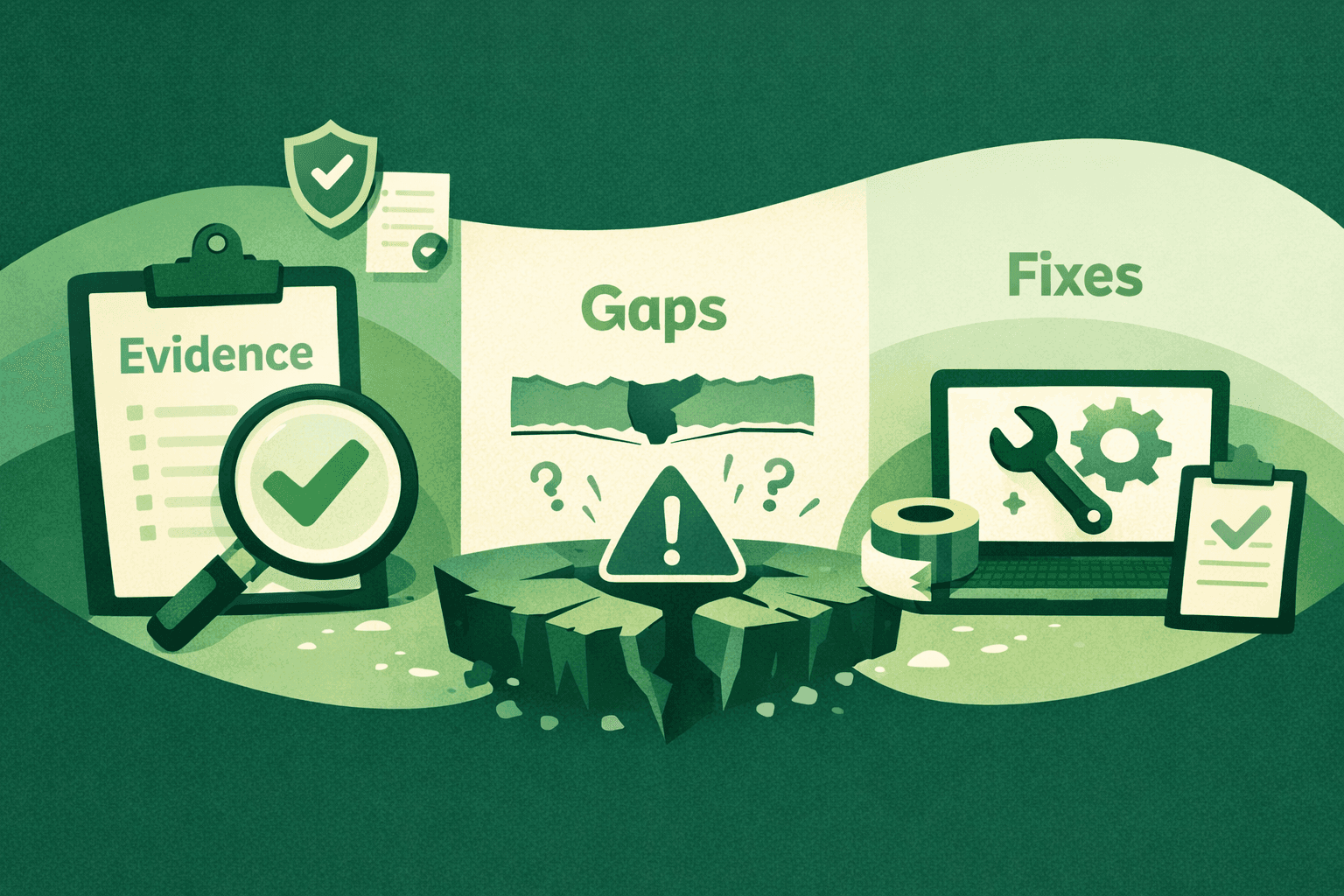
Compliance Audits Without Chaos: Evidence Sampling, Gap Tracking, and Remediation Plans
Compliance audits often feel chaotic because evidence lives in different tools, policies become outdated, and no one has a single view of what’s complete versus missing. Teams scramble to gather screenshots, logs, and access reports while auditors wait — increasing pressure, errors, and findings. To avoid this scramble, organizations must focus on continuous monitoring and readiness, as detailed in our guide to SOC 2 Compliance in 2025
Most chaos comes from three issues:
Decentralized evidence spread across email, Slack, SaaS tools, and spreadsheets.
Undefined ownership where the control owners aren’t clear or responsibilities overlap. Achieving clarity on roles is key, a topic explored in SOC 2 Best Practices 2025: Cadences, Roles & Evidence.
Reactive preparation instead of continuous monitoring and readiness.
Organizations that centralize controls and automate evidence collection report smoother audits and fewer last-minute blockers.
A calm audit is a prepared audit — chaos disappears when evidence is centralized and up to date.
What Is Evidence Sampling, and Why Does It Matter?
Evidence sampling is the method auditors use to test a subset of your controls rather than reviewing all of them. Instead of collecting hundreds of files, you provide targeted samples, such as onboarding records, change tickets, access logs, or security alerts.
How Evidence Sampling Works
Auditors define categories such as access, incidents, vendor reviews, backups, etc.
You supply samples: e.g., 10 onboarding files, the last 3 change requests, and the last quarter of logs.
Auditors validate accuracy: verifying that samples match your stated policies.
Automated platforms streamline the process by creating pre-built folders for each sample type, automatically pulling data, and organizing it for auditor review.
Evidence sampling only works when your systems can instantly produce accurate proof—not when you're manually digging.
How Do You Track and Remediate Gaps Efficiently?
Gap tracking identifies where controls fail, evidence is missing, or policies don’t match reality. Without a structured workflow, these gaps become recurring audit findings that erode trust and delay certification. This is why a unified approach, as the one discussed in Mastering Multi-Framework Compliance in 2025, is crucial for catching overlaps and failures.
A Modern Gap Tracking Approach
Identify: Detect missing controls, outdated policies, or failed tests.
Assign: Route each gap to a specific owner with severity and due dates.
Document: Capture context, comments, attachments, and risk justification.
Resolve: Implement fixes, update controls, and attach remediation proof.
Teams using automated gap tracking resolve findings 3× faster than those using spreadsheets because ownership, reminders, and evidence updates happen in real time.
Gaps shrink quickly when ownership is clear and remediation tasks live inside the same workflow as controls.
How Should Remediation Plans Be Structured?
A strong remediation plan prevents issues from resurfacing. The best teams don’t just “fix the issue” — they fix the underlying workflow or system. Addressing these systemic issues often involves adopting a framework-driven approach, similar to using Pre-Integrated Policies & Frameworks for Instant Compliance.
Effective Remediation Plan Structure
Define the issue: What control or policy failed?
Assess impact: What risk does it create?
Root cause: Misconfiguration? Human error? Outdated process?
Corrective action: Immediate steps to fix the issue.
Preventive action: Process or automation that prevents recurrence.
Evidence of completion: Proof that the new process works.
Platforms with audit automation make this seamless by linking remediation tasks to controls, automatically generating evidence, and updating readiness dashboards.
Remediation succeeds when fixes address root causes — not just symptoms.
How Does Audit Automation Transform the Entire Process?
Audit automation replaces manual checklists and scattered files with an always-ready compliance engine. Instead of preparing once a year, teams stay continuously audit-ready. This level of sophistication is increasingly driven by technologies such as those mentioned in How Autonomous Compliance Agents Are Revolutionizing Vendor Risk.
Automation in Action
Evidence sampling automation: AI gathers logs, configuration snapshots, and change records.
Gap detection: Alerts when controls drift or evidence becomes outdated.
Remediation workflow: Integrated task assignment and tracking.
Audit exports: One-click packets containing all required samples.
Organizations adopting automation reduce prep time by 50–70% and report fewer findings year over year.
Automation turns compliance from a scramble into a predictable, repeatable workflow.
The Bottom Line
Compliance audits don’t need to create chaos. With structured evidence sampling, automated gap tracking, and clear remediation plans, teams stay ahead of issues rather than react to them. Audit automation amplifies this, giving organizations continuous visibility into their compliance posture.
Eliminate audit chaos — automate evidence collection and gap remediation with DSALTA’s AI compliance agent.
Book a DSALTA demo to see how automation simplifies evidence sampling and audit readiness.
Explore more GRC articles
Stop losing deals to compliance.
Get compliant. Keep building.
Join 100s of startups who got audit-ready in days, not months.