Governance, Risk, and Compliance (GRC) —
Unlocking Trust Center ROI: Security as a Revenue Driver in 2025
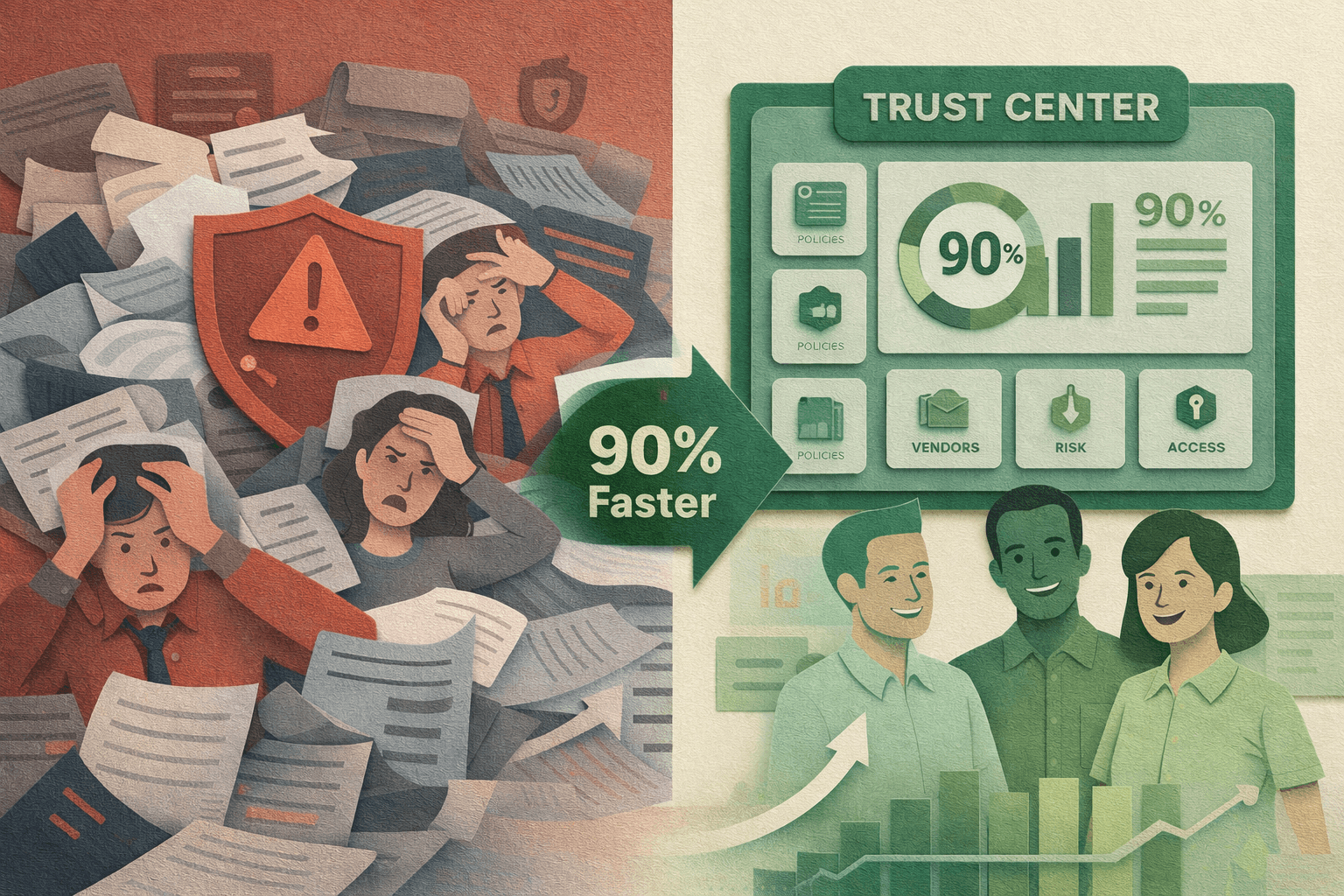
Trust centers accelerate sales by 90% and reduce questionnaire volume to zero. Learn how to measure trust center ROI and turn security into revenue growth.
Dogan Akbulut
Trust & Security Communication
Share this article


Unlocking Trust Center ROI in 2025
Something changed in 2025. Security teams stopped defending their budgets and started showing up to revenue meetings. The difference? Trust centers.
We watched hundreds of companies flip the script this year. Security went from "the team that slows down deals" to "the team that closes them faster." Not through clever positioning or better PowerPoints, but through actual numbers that CFOs and revenue leaders care about.
If you spent 2025 answering the same security questions over and over, watching deals stall at the security review stage, or trying to prove your team's value beyond "we didn't get breached," this retrospective is for you. Because the companies that figured out trust centers didn't just save time—they made security a competitive advantage that shows up in closed-won revenue.
Let's talk about what actually worked.
Why 2025 Was the Year Security Finally Got Credit
For years, security lived in a weird limbo. Everyone agreed it was important. Nobody could quantify exactly how important.
Then enterprise sales cycles got longer. Security reviews became the norm, not the exception. And suddenly, every B2B SaaS company realized the same thing: our security team is either a dealmaker or a deal-breaker, and right now they're breaking more than they're making.
The wake-up call came in hard numbers. Companies without compliance certifications reported that 43% of their deals got delayed or lost entirely because they couldn't answer security questions fast enough. Think about that. Nearly half of your pipeline, just... waiting. Or worse, going to a competitor who could move faster.
Meanwhile, the security teams stuck in the middle were drowning. One CISO told us her team was spending 300+ hours per month on security questionnaires alone. That's nearly two full-time employees just copy-pasting the same answers into slightly different spreadsheets.
Something had to break. And in 2025, it did.
The Trust Center Turning Point
Trust centers weren't new in 2025. Companies like Slack and Dropbox had been using them for years. But this was the year they went from "nice to have" to "table stakes for enterprise sales."
The catalyst? A perfect storm of three things:
First, buyers got tired of waiting. Enterprise procurement teams started explicitly asking for trust centers during initial conversations. If you didn't have one, you weren't serious about security. Simple as that.
Second, sales teams revolted. When your AEs are begging you to "just put the SOC 2 report somewhere they can grab it themselves," you know the old process is broken. Sales leadership started measuring security review time as a deal velocity metric, and the numbers were brutal.
Third—and this is the big one—companies that implemented trust centers started sharing their results. Not fluffy case studies. Real data. And the data was impossible to ignore.
What the Data Actually Showed
Let's get specific, because this is where it gets interesting.
Sales cycle compression: Companies with trust centers saw their security review portion of the sales cycle drop by 70-90%. What used to take 3-4 weeks of back-and-forth emails became a 2-day self-serve process. One VP of Sales we talked to said their average deal cycle dropped from 127 days to 89 days after launching their trust center. That's not a rounding error.
Questionnaire volume collapse: This was the most dramatic change. Security teams that implemented trust centers with good self-serve documentation saw their incoming questionnaire volume drop by 85-95%. Not because fewer people were asking questions, but because they were finding answers themselves. The questions that did come in were actually interesting—edge cases, specific technical requirements—not "can you send me your SOC 2 report?"
Win rate improvement: Here's where it got really interesting for revenue teams. Several companies tracked win rates for deals that went through their trust center versus deals that went through manual security reviews. The trust center deals won 20-35% more often. Why? Because by the time prospects got to final negotiations, they'd already validated your security posture. No last-minute surprises, no final objections.
Time savings that actually mattered: The average security team saved 200-400 hours per quarter by moving to a trust center. But the real win wasn't the hours—it was what they did with them. Teams reinvested that time into proactive security improvements, threat modeling, and actually building better products. You know, the work they were hired to do.
How Companies Actually Measure ROI
This was the tricky part. Security ROI has always been hard to calculate because you're measuring things that didn't happen (breaches, incidents, compliance failures). But trust centers gave security teams something they'd never had before: a direct line to revenue.
The most successful teams tracked four metrics:
Revenue influenced: This became the north star. Companies integrated their trust center with Salesforce or HubSpot and tagged every opportunity that accessed it. Then they tracked which deals closed. The average? About 30-40% of closed-won revenue in the enterprise segment touched the trust center at some point in the sales cycle. That's a number you can take to a board meeting.
Deal velocity by stage: Smart teams didn't just look at overall sales cycle length. They tracked how long deals spent in security review specifically. Trust centers cut that stage from an average of 18 days down to 3-5 days. When you multiply that across 50-100 enterprise deals per year, you're talking about months of aggregate time saved.
Cost per security review: One company calculated they were spending $450 in labor costs per manual security review (considering sales time, security time, and legal review time). Their trust center costs $12,000 per year to maintain. They did the math: after 27 reviews, they were ROI-positive. They closed that many deals in the first quarter.
Sales team satisfaction: This one's squishy, but it matters. Sales teams that could point prospects to a trust center reported way less frustration. Internal Slack messages went from "need the SOC 2 report ASAP" to "check out our trust center." Less friction, better collaboration, fewer urgent requests that derail everyone's day.
The Free vs. Paid Platform Question
Here's where things got practical. Once companies decided they needed a trust center, they hit a fork in the road: build it themselves, use a free platform, or pay for enterprise software.
The paid platforms (some charging $15,000-$30,000+ per year) offered fancy features: AI-powered questionnaire automation, advanced analytics, and white-glove setup. For some companies, especially those with complex compliance requirements or massive deal volumes, these made sense.
But a lot of mid-market and growth-stage companies looked at those prices and thought, "We're trying to prove ROI here, not blow our budget before we see results." That's where free trust centers came in.
The smart move we saw in 2025? Start free, prove the value, upgrade if you need to. Companies that launched with a basic free trust center and tracked their metrics had a much easier time justifying paid tools later. They could walk into budget meetings with actual data: "Our free trust center influenced $2.3M in revenue last quarter. Here's what we could do with more features."
DSALTA's free trust center became popular this year precisely because of this. Security teams could launch something in an afternoon, connect it to their existing compliance automation, and start tracking results immediately. No procurement cycle, no vendor evaluation, just prove the concept and scale from there. See pricing and features.
What Didn't Work (And What We Learned)
Not every trust center implementation succeeded. The failures taught us as much as the wins.
Static PDF dumps failed: Some companies just threw up a page with downloadable compliance reports and called it a trust center. Buyers hated it. They wanted searchable content, clear explanations, and the ability to find specific information fast. A 60-page SOC 2 report isn't helpful if I need to know "how do you handle data encryption?" in the next 30 minutes.
Gating everything backfired: A few companies got paranoid and locked every piece of information behind NDAs and access request forms. Great for security theater, terrible for sales velocity. Buyers would just move on to vendors who were more transparent. The companies that succeeded found the balance: public information for general security posture, gated access for detailed reports.
Set-it-and-forget-it didn't cut it: Trust centers need maintenance. Compliance reports expire. Policies update. Contact information changes. The trust centers that gathered dust became liabilities. Prospects would find outdated information and wonder what else wasn't being maintained. Successful teams treated their trust center like a product—regular updates, user feedback, continuous improvement.
Ignoring analytics was a missed opportunity: Some companies launched trust centers but never looked at the data. Which documents were prospects actually viewing? What questions weren't being answered? Where were people dropping off? The teams that paid attention to these signals continuously improved their content and saw better results over time.
Looking Ahead: What This Means for 2026
As we close out 2025, trust centers have gone from innovation to expectation. If you're selling to enterprise buyers in 2026 without one, you're starting every deal at a disadvantage.
But the evolution isn't over. Here's what's coming:
Real-time compliance status: The next generation of trust centers won't just host static reports. They'll show live compliance dashboards. "We completed our SOC 2 Type II audit 47 days ago. Our last penetration test was 12 days ago. All controls are currently passing." That level of transparency builds trust in a way PDFs never will. Learn more about continuous compliance monitoring.
AI-powered Q&A: Instead of prospects digging through documents, they'll ask questions in natural language and get instant, accurate answers pulled from your compliance documentation. This is already starting to happen, and it's going to accelerate.
Integration with procurement tools: Trust centers will plug directly into vendor risk management platforms. When a prospect's security team runs an automated assessment, your trust center will feed them the information they need without any manual work on either side.
Industry-specific trust frameworks: We'll see trust centers customized for specific industries—healthcare, fintech, government contractors—with pre-built content that addresses sector-specific compliance requirements.
Making the Business Case (Because Someone's Going to Ask)
If you're trying to get approval for a trust center initiative in 2026, here's the pitch that's been working:
The problem: Security reviews are the longest stage in our enterprise sales cycle. We're answering the same questions repeatedly. Deals are stalling or lost because prospects can't validate our security posture fast enough.
The solution: A trust center that lets prospects self-serve security information, backed by automated compliance monitoring that keeps everything current.
The metrics we'll track:
Days spent in security review (before and after)
Number of manual questionnaires received
Percentage of opportunities that access the trust center
Revenue influenced by the trust center
Win rate for deals that use the trust center vs. those that don't
The ask: [For free platforms] Two weeks of implementation time and agreement to maintain it quarterly. [For paid platforms] $X annual budget with a 6-month evaluation period to prove ROI.
The payoff: Based on what we've seen in 2025, we can expect a 70-90% reduction in security review time, an 85%+ reduction in manual questionnaire work, and a measurable impact on deal velocity. If we influence just 20% of our enterprise revenue, this pays for itself many times over.
Conclusion: Security as a Growth Engine
The companies that thrived in 2025 didn't just survive security reviews—they used them as sales accelerators. They proved that security, when presented right, becomes a competitive differentiator.
Trust centers made this possible. Not because they're magical, but because they solve a real problem that was costing companies real money and real deals.
As we head into 2026, the question isn't "should we have a trust center?" anymore. It's "How good is our trust center compared to our competitors'?" Because buyers are comparing. And they're choosing vendors who make it easy to validate security, not vendors who make it feel like pulling teeth.
Your security team already does great work. A trust center just helps everyone else see it. And when they can see it clearly, they buy faster, with more confidence, and tell other people about it.
That's not just good security. That's good business.
Ready to turn your security program into a revenue driver? Explore DSALTA's free trust center and start tracking the metrics that matter—deal velocity, revenue influenced, and the hours you're giving back to your team.
Frequently Asked Questions
How long does it actually take to see ROI from a trust center?
Most companies start seeing results within the first month. You'll notice reduced questionnaire volume almost immediately—usually within the first few deals that access it. Deal velocity improvements show up in the next quarter's pipeline analysis. Full ROI (considering implementation time and costs) typically happens within 6-9 months for mid-market companies. If you're doing high deal volumes, it can be as fast as 3 months.
What's the difference between a free trust center and a $20K/year platform?
Free platforms give you the core functionality: a place to host compliance docs, share security information, and track basic analytics. Paid platforms add advanced features like AI-powered questionnaire automation, deeper CRM integration, sophisticated access controls, and white-glove setup services. Start free to prove the concept and track your metrics. Upgrade when your deal volume or complexity justifies the investment.
How do you track revenue influenced by a trust center?
The most common method is integrating your trust center with your CRM (Salesforce, HubSpot, etc.). Tag every opportunity that accesses the trust center, then track which ones close. You can also survey your sales team quarterly to ask which deals specifically benefited from having self-serve security documentation. The key is setting up tracking from day one, not trying to prove ROI retroactively.
What documents should actually go in a trust center?
Start with the essentials everyone asks for: SOC 2 report (if you have one), ISO 27001 certificate, penetration test summaries, security white papers, and your key policies (data processing, incident response, privacy policy). Make some information public (security overview, certifications list, contact info) and gate sensitive documents (detailed audit reports) behind access requests or NDAs. Add to it based on what questions you keep getting.
Won't giving away security information make us vulnerable?
This comes up every time. The reality is that the information in your trust center (compliance frameworks you follow, certifications you hold, general security practices) isn't secret. Attackers aren't reading SOC 2 reports to plan attacks. What you're sharing is assurance information that helps buyers make decisions, not technical details that create vulnerabilities. You can—and should—keep sensitive technical documentation private. But general security posture information should be accessible.

Explore more GRC articles
Stop losing deals to compliance.
Get compliant. Keep building.
Join 100s of startups who got audit-ready in days, not months.