ISO 27001 —
ISO 27001 vs SOC 2 Penetration Testing: Do You Need Both?
Compare ISO 27001 and SOC 2 pen test requirements. Learn when enterprises expect both, what auditors check, and how to avoid duplicate efforts.
Dogan Akbulut
ISO 27001 Implementation & Certification
Share this article


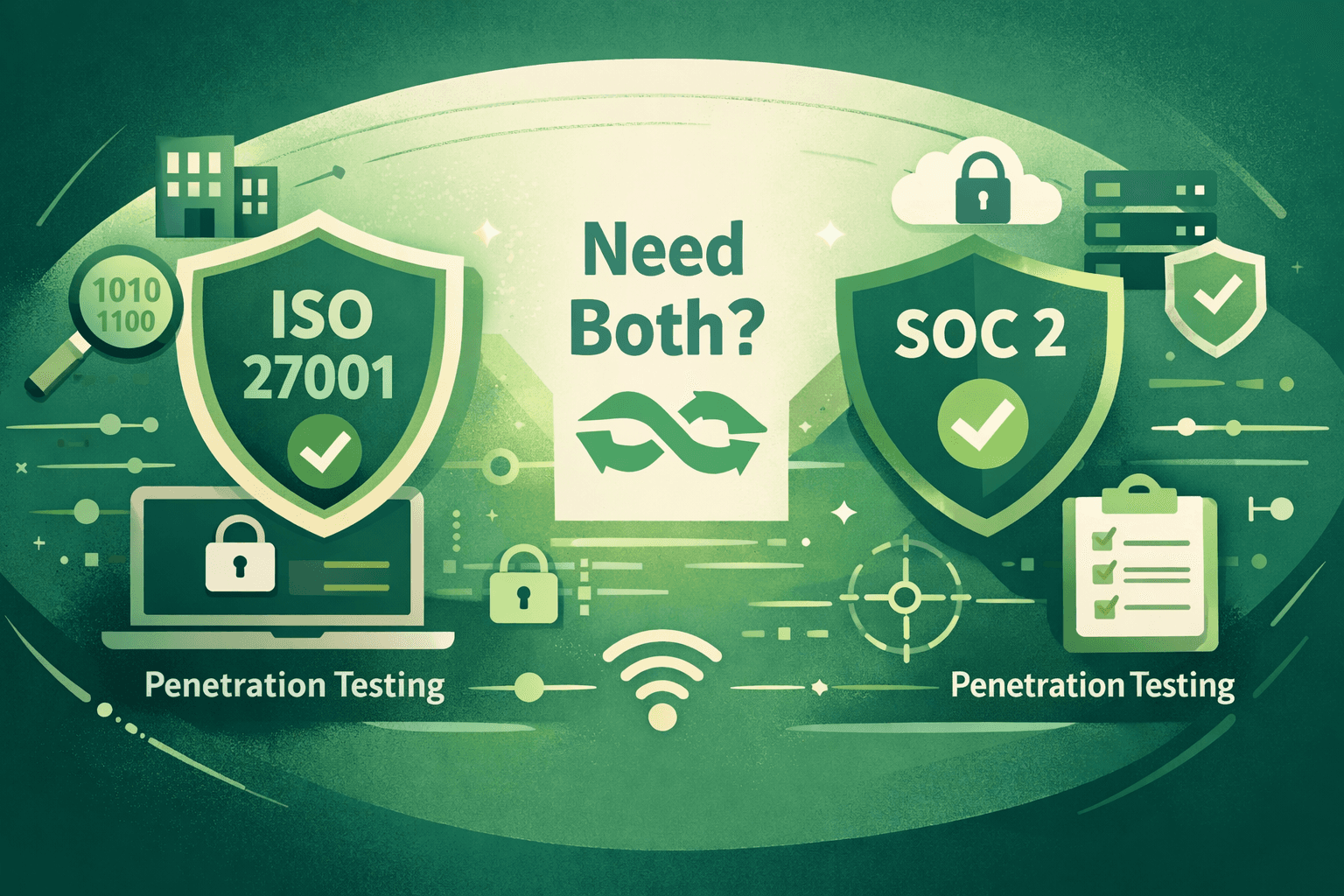
Yes — most enterprise buyers now expect both ISO 27001 and SOC 2 Type II when closing security-sensitive deals. But their penetration testing requirements differ fundamentally: SOC 2 treats pen testing as evidence of control effectiveness, while ISO 27001 treats it as a risk-treatment mechanism. Understanding that distinction saves time, money, and audit cycles.
Table of Contents
What Is Penetration Testing in a Compliance Context?
How SOC 2 Treats Penetration Testing (CC4.1 Explained)
How ISO 27001 Treats Penetration Testing (Annex A Deep Dive)
Key Differences: Outcomes-Based vs. Risk-Based
When Enterprise Buyers Expect Both
How to Run a Unified Pen Test Program
Common Mistakes CISOs Make When Doing Both
What DSALTA Recommends for Multi-Framework Startups
FAQ
What Is Penetration Testing in a Compliance Context?
Penetration testing, the practice of simulating real-world cyberattacks against your systems, means something different depending on which compliance framework your enterprise buyer cares about.
For a startup founder pitching to a Fortune 500 CISO, or a security architect closing a government contract, the question is no longer "do we do pen testing?" The real question is: "Does our pen testing program satisfy ISO 27001 and SOC 2 simultaneously — and can we prove it?"
Getting this wrong doesn't just cause an audit to fail. It kills enterprise deals. Understanding which framework your buyers prioritize can determine your sales velocity and deal closure rates.
According to the 2024 Verizon Data Breach Investigations Report, over 68% of breaches involved a human element or misconfigured controls, the exact territory that penetration testing is designed to expose. Yet most compliance teams treat pen testing as a checkbox rather than a living program, and this gap is exactly what enterprise security reviewers are trained to find.
This post breaks down the mechanics of each framework's pen testing expectations, where they overlap, where they conflict, and what a unified strategy for multi-framework compliance looks like.
How SOC 2 Treats Penetration Testing (CC4.1 Explained)
SOC 2 Is Outcomes-Based, Not Prescriptive
SOC 2 — governed by the AICPA Trust Services Criteria — does not explicitly mandate penetration testing as a named control. This surprises many first-time compliance leads. What SOC 2 does require, under CC4.1 (Common Criteria 4.1), is that organizations demonstrate they evaluate and communicate information security risks to relevant stakeholders.
Under the broader CC4.x series (Risk Assessment and Monitoring):
CC4.1 requires the entity to select, develop, and perform ongoing and/or separate evaluations to ascertain whether controls are present and functioning.
CC7.1 addresses the identification and monitoring of system vulnerabilities.
CC9.2 requires the entity to assess and manage risks from vendors and business partners.
Penetration testing typically surfaces as the primary evidence an auditor accepts for CC4.1. Your Type II SOC 2 report will explicitly document whether you conduct regular external and internal penetration tests, their scope, frequency, and whether findings are tracked to remediation.
What SOC 2 Auditors Actually Look For
When a SOC 2 auditor reviews your pen testing program, they are evaluating:
Scope adequacy — Does the scope cover systems in scope for the SOC 2 audit (production environment, data stores, APIs)?
Frequency — Annual is the industry minimum; many enterprise buyers now require semi-annual or quarterly, especially after significant system changes. Startups preparing for their first audit benefit from comprehensive SOC 2 readiness preparation that addresses pen testing alongside other control requirements.
Qualified testers — Is the test conducted by a qualified third party, or is it purely internal?
Remediation tracking — Are findings linked to a formal remediation workflow with timestamps?
Management response — Does leadership review and formally accept the residual risk associated with any unresolved findings?
Critically, SOC 2 auditors are validating the effectiveness of controls. A pen test finding that was identified, prioritized, and closed strengthens your report. A finding left open with no management response is a qualified opinion risk.
Long-Tail Keyword Insight: "SOC 2 pen test requirements frequency."
The most common question on this topic is: how often do you need a pen test for SOC 2? The AICPA does not specify frequency. However, enterprise buyers — particularly those in financial services, healthcare, and government — now routinely require annual pen tests as a minimum, with clauses that require retests following material infrastructure changes. If your SOC 2 report covers a 12-month period without a pen test during that window, expect a finding.
How ISO 27001 Treats Penetration Testing (Annex A Deep Dive)
ISO 27001 Is Risk-Based, Not Evidence-Based
ISO 27001:2022 takes a fundamentally different philosophical approach. Rather than specifying outcomes that controls must achieve, it requires organizations to build a systematic Information Security Management System (ISMS) grounded in risk assessment and treatment. Organizations implementing an ISO 27001 ISMS from scratch should understand how penetration testing integrates into their broader risk framework.
Penetration testing in ISO 27001 appears explicitly in Annex A Control 8.8 — Management of Technical Vulnerabilities, and is strongly implied in:
A.8.7 — Protection against malware
A.5.36 — Compliance with policies, rules, and standards for information security
A.8.9 — Configuration management
Clause 9.1 — Monitoring, measurement, analysis, and evaluation
Clause 9.3 — Management review
Annex A 8.8: What It Actually Requires
Control 8.8 of ISO 27001:2022 states that organizations shall obtain timely information about the technical vulnerabilities of the information systems they use, evaluate their exposure to such vulnerabilities, and take appropriate measures.
In practice, a well-scoped ISO 27001 ISMS will use penetration testing as one mechanism within a vulnerability management process that includes:
Asset inventory and classification (A.5.9, A.5.10)
Regular vulnerability scanning
Penetration testing for high-risk systems or after a significant change
Patch management and hardening
Formal risk treatment decisions are documented in the Risk Treatment Plan (RTP)
The Internal Audit Dimension
Here is where ISO 27001 diverges most sharply from SOC 2: internal audit.
Under Clause 9.2, ISO 27001 requires you to conduct internal audits at planned intervals to determine whether the ISMS conforms to requirements and is effectively implemented. Pen test findings feed directly into this audit cycle. Your internal auditors will review whether:
Technical vulnerabilities identified through pen tests were added to the risk register
Risk treatment decisions were formally documented and approved
Residual risks were accepted at the appropriate level of management authority
Corrective actions were tracked and verified for effectiveness
This means an ISO 27001 pen test isn't just a technical exercise — it generates management system artifacts that reside within your ISMS and are reviewed during Stage 2 certification and surveillance audits.
What ISO 27001 Certification Auditors Look For
An accredited ISO 27001 certification body (CB) auditor will examine:
Risk assessment methodology — Is technical penetration testing incorporated as a risk identification input?
Scope alignment — Does the pen test scope align with your Statement of Applicability (SoA) and ISMS boundary?
Risk treatment documentation — Are pen test findings treated as risks with documented treatment decisions?
Corrective action records — Are nonconformities from pen tests linked to formal corrective actions (Clause 10.2)?
Management review input — Were pen test results presented to and reviewed by top management (Clause 9.3)?
Key Differences: Outcomes-Based vs. Risk-Based
Understanding the philosophical divide between SOC 2 and ISO 27001 on penetration testing is the most important concept in this entire post.
Dimension | SOC 2 (CC4.1) | ISO 27001 (Annex A 8.8) |
|---|---|---|
Approach | Outcomes-based | Risk-based |
Pen test mandate | Implied evidence for control effectiveness | Explicit vulnerability management control |
Frequency standard | Not specified (annual is market norm) | Not specified (risk-driven) |
Primary artifact | Auditor's report + evidence package | Risk register + corrective action records |
Internal audit role | Not required for pen test specifically | Pen test findings feed Clause 9.2 audit cycle |
Management involvement | Management response to findings | Formal risk acceptance at the management level |
Regulatory linkage | AICPA Trust Services Criteria | ISO/IEC 27001:2022 standard |
Certification body | Licensed CPA firm | Accredited CB (BSI, DNV, Bureau Veritas, etc.) |
The practical implication: your pen test report can serve both frameworks, but the downstream workflow it triggers must be different for each. SOC 2 needs evidence packaging. ISO 27001 requires updates to the risk register and management review documentation.
When Enterprise Buyers Expect Both
The Multi-Framework Compliance Reality for B2B SaaS
If you are a Series A or Series B SaaS company selling to an enterprise, you have almost certainly encountered this scenario: a prospect's security review team sends a vendor questionnaire that asks for both your SOC 2 Type II report and your ISO 27001 certificate.
This is no longer unusual. It is the new baseline expectation for several buyer segments:
Financial Services Buyers Banks, insurance companies, and asset managers operating under DORA (EU Digital Operational Resilience Act), FFIEC guidance, or internal third-party risk management (TPRM) frameworks now routinely require both. ISO 27001 satisfies their international risk management requirements; SOC 2 satisfies their US-based internal audit teams.
Healthcare and Life Sciences Buyers Organizations subject to HIPAA, plus those with international operations, increasingly require ISO 27001 for global sites and SOC 2 for US-based data processing. Pen testing expectations cascade into both.
Government and Public Sector Buyers FedRAMP, CMMC, and IRAP (Australia) all have penetration testing requirements that map to both frameworks. A strong SOC 2 + ISO 27001 posture dramatically accelerates these procurement cycles.
Global Enterprise Procurement Teams Large multinational buyers — particularly those headquartered in the EU, UK, or APAC — will expect ISO 27001 as table stakes. US enterprise buyers add SOC 2. Startups closing deals in both markets quickly discover they need both.
The Procurement Trigger: Security Review Questionnaires
Enterprise security review questionnaires (SRQs), standardized assessments such as SIG (Standardized Information Gathering) and CAIQ (Consensus Assessments Initiative Questionnaire), all include pen testing questions that reference both frameworks. These assessments are part of mature third-party risk management frameworks that holistically evaluate vendor security posture.
How to Run a Unified Pen Test Program
Step 1: Align the Scope to Both the ISMS Boundary and the SOC 2 System Description
Your pen test scope document should reference both your ISO 27001 ISMS boundary (typically defined in your ISMS scope statement under Clause 4.3) and your SOC 2 system description. Map every in-scope asset, application, API, and network segment to both.
This single step eliminates the most common duplication: running two separate pen tests, one with each framework's scope.
Step 2: Use a Qualified Third-Party Tester
For SOC 2, third-party testing is not technically required but strongly preferred by auditors and by enterprise buyers reviewing your Type II report. For ISO 27001, Clause 7.2 requires competence — a third-party tester with recognized credentials (OSCP, CREST, CEH) meets this requirement.
Use one qualified external firm for both. Ensure the engagement letter explicitly references both compliance contexts.
Step 3: Structure the Report for Dual Use
Request that your pen testing firm deliver a report with the following sections explicitly documented:
Executive summary (for management review — ISO 27001 Clause 9.3)
Scope and methodology (for SOC 2 auditor evidence package)
Findings with CVSS scores (for risk register updates — ISO 27001 A.8.8)
Remediation recommendations (for corrective action tracking — ISO 27001 Clause 10.2)
Retesting results (for SOC 2 remediation evidence and ISO 27001 corrective action closure)
Step 4: Trigger the Correct Downstream Workflow for Each Framework
For SOC 2:
Upload the report to your evidence management platform
Link findings to the relevant Trust Services Criteria (CC4.1, CC7.1)
Document management responses for each finding
Track remediation with timestamps for the audit window
For ISO 27001:
Add identified risks to your risk register with inherent risk ratings
Document risk treatment decisions for each finding (accept, mitigate, transfer, avoid)
Issue formal corrective actions for critical and high-severity findings
Include the pen test summary in your next management review agenda
Update your internal audit schedule if findings indicate gaps in Annex A controls
Step 5: Synchronize Timelines
Run your annual pen test 60–90 days before your SOC 2 audit period ends and well before your ISO 27001 surveillance audit. This gives you:
Time to remediate critical findings before the audit window closes
Retest evidence showing remediations were effective
Updated risk register inputs for management review
A complete corrective action trail for both auditors
Common Mistakes CISOs Make When Doing Both
Mistake 1: Running Two Separate Pen Tests
Many organizations run one pen test for SOC 2 and a separate one for ISO 27001. This is unnecessary, expensive, and creates inconsistent findings across frameworks. One unified engagement serves both — if scoped and documented correctly.
Mistake 2: Treating Pen Test Findings as IT Tickets, Not Risks
For ISO 27001, a pen test finding that goes straight into a Jira ticket without a corresponding risk register entry fails the audit. Every finding must be evaluated as a risk, treated in accordance with your risk treatment methodology, and formally accepted or mitigated by management.
Mistake 3: Ignoring Internal Audit Integration
CISOs often run penetration tests and internal audits in parallel, without integration. Under ISO 27001, your internal audit program (Clause 9.2) should explicitly review whether your pen test program is operating effectively. This means internal auditors should check the adequacy of scope, frequency, finding quality, and remediation tracking — not just verify that a pen test happened.
Mistake 4: Forgetting Vendor and Third-Party Scope
SOC 2 CC9.2 and ISO 27001 A.5.19–A.5.22 (Supplier Relationships) both require attention to third-party risk. Enterprise buyers increasingly expect that your pen tests include critical third-party integrations or that you have a vendor pen test attestation program. If your production environment includes SaaS dependencies or third-party APIs that handle in-scope data, consider whether they should be included in your pen test scope. Many organizations are now automating vendor security assessments to maintain continuous visibility into third-party risks.
Mistake 5: Not Documenting Residual Risk Acceptance
Both frameworks require documented management acceptance of residual risk. For findings that are acknowledged but not immediately remediated (due to business priority or technical constraints), you need a formal risk acceptance record signed by an appropriate level of management. Undocumented residual risk is one of the most common audit findings in multi-framework programs.
What DSALTA Recommends for Multi-Framework Startups
At DSALTA, we work with founders and security teams to navigate the operational complexity of achieving and maintaining both SOC 2 Type II and ISO 27001 certifications simultaneously. Our AI-powered compliance platform is built specifically for this challenge — eliminating duplicate work, automating evidence collection, and mapping controls across frameworks in real time.
For a startup preparing for its first enterprise deal that requires both certifications, we recommend:
Start with a unified control framework. Before commissioning your first pen test, map your controls to both SOC 2 Trust Services Criteria and ISO 27001 Annex A. DSALTA's platform does this automatically, surfacing the controls where a single pen test satisfies both requirements versus where additional evidence is needed.
Build your risk register before the pen test. Treat pen testing as a continuous program, not an annual event. Enterprise buyers — especially in financial services and healthcare — are moving toward quarterly vulnerability assessments with annual full-scope pen tests. AI-powered compliance automation makes continuous monitoring scalable and cost-effective for growing teams.
Treat pen testing as a continuous program, not an annual event. Enterprise buyers — especially in financial services and healthcare — are moving toward quarterly vulnerability assessments with annual full-scope pen tests. DSALTA's platform tracks this cadence, alerts you when tests are due, and auto-populates evidence to the correct control owners.
Use your pen test results to accelerate deals. A well-documented, dual-mapped pen test program with clear remediation evidence is one of the most persuasive artifacts in an enterprise security review. DSALTA clients regularly use their compliance posture as a competitive differentiator — closing deals faster because their security documentation tells a coherent, auditor-ready story.
Frequently Asked Questions
Does SOC 2 require penetration testing?
SOC 2 does not explicitly mandate penetration testing. However, penetration testing is the most commonly accepted evidence for satisfying CC4.1 (ongoing monitoring and evaluation of controls) and CC7.1 (vulnerability identification). Enterprise buyers and SOC 2 auditors expect to see annual third-party pen tests in your Type II report.
Does ISO 27001 require penetration testing?
ISO 27001:2022 Annex A Control 8.8 explicitly addresses management of technical vulnerabilities, and penetration testing is one of the primary mechanisms used to satisfy this control. Certification auditors will expect evidence that your organization identifies and assesses technical vulnerabilities systematically — pen testing is the industry-standard method for doing so.
Can one penetration test satisfy both SOC 2 and ISO 27001?
Yes — if scoped correctly and followed by the appropriate downstream documentation. The pen test engagement itself can be a single exercise. What differs is the workflow that follows: SOC 2 requires evidence packaging and management responses; ISO 27001 requires risk register updates, formal corrective actions, and integration of management reviews.
How often should we run penetration tests for multi-framework compliance?
Annually is the minimum standard for most enterprise buyers. Many financial services and healthcare buyers now expect semi-annual or post-significant infrastructure changes tests. DSALTA recommends annual full-scope external pen tests with quarterly internal vulnerability scanning as a baseline multi-framework program.
What credentials should our pen testing firm have?
For both SOC 2 and ISO 27001 compliance contexts, look for firms with testers holding OSCP (Offensive Security Certified Professional), CREST accreditation, or equivalent certifications. For ISO 27001, Clause 7.2 requires you to document the competence of those performing security activities—vendor credentials meet this requirement.
When do enterprise buyers require both frameworks simultaneously?
Global enterprise buyers, particularly in financial services, healthcare, life sciences, and government/public sector, frequently require both during procurement. If you are selling into multiple geographies (US, EU, UK, or APAC), multi-framework compliance is effectively a market-entry requirement for the mid-market and enterprise segments.
Conclusion: One Program, Two Frameworks, Zero Deal Blockers
The question "Do you really need both ISO 27001 and SOC 2 penetration testing for enterprise deals?" has a clear answer: you need one well-designed pen test program that satisfies both, not two separate programs, not two separate tests, and definitely not two years of parallel audit preparation.
The distinction that matters is philosophical: SOC 2 asks "did your controls work?" and uses pen test evidence to answer that question. ISO 27001 asks, "Do you understand your risks and manage them systematically?" and uses penetration testing findings to feed into that process.
A CISO or security architect who understands this difference doesn't just pass audits more efficiently. They build a compliance posture that enterprise buyers trust, security reviewers approve faster, and founders can scale on.
DSALTA's AI compliance platform is built for exactly this — helping growing companies run unified, multi-framework security programs that turn compliance into a growth accelerator, not a bottleneck.
Ready to align your ISO 27001 and SOC 2 pen test programs? [Book a free compliance gap assessment with DSALTA →]
Explore more ISO 27001 articles
ISO 27001 Implementation & Certification
Stop losing deals to compliance.
Get compliant. Keep building.
Join 100s of startups who got audit-ready in days, not months.