HIPAA —
How to Prove Technical Safeguards for PHI in AI‑Powered SaaS Platforms
Learn how healthtech SaaS teams align HIPAA safeguards with SOC 2 Security controls and use AI to manage PHI evidence and reduce compliance risk.
Jon Ozdoruk
HIPAA Compliance Essentials
Share this article


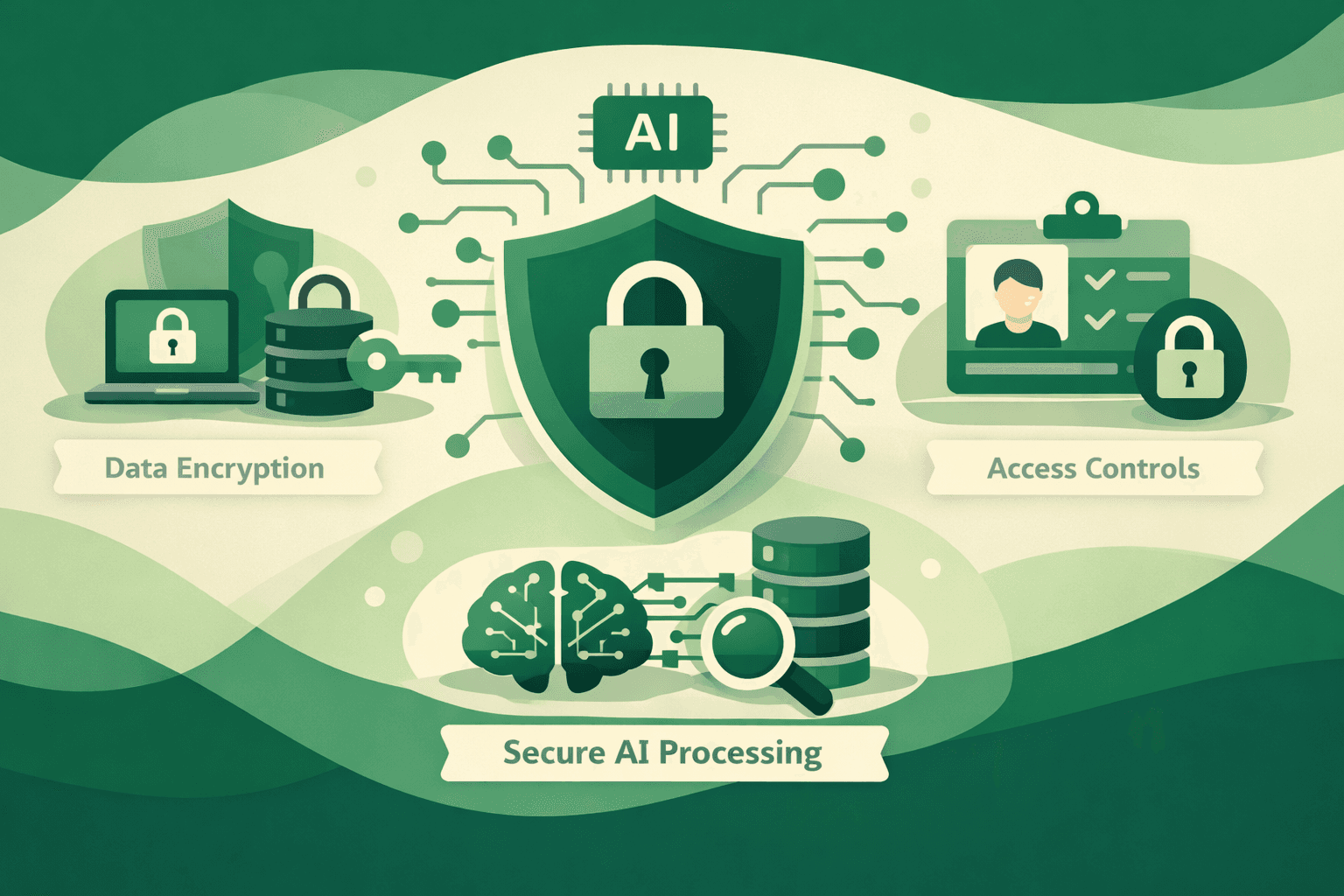
SOC 2 and HIPAA Are Not the Same, But They Can Work Together
If you're building a healthcare SaaS platform that processes Protected Health Information (PHI), you're likely staring down two compliance requirements at once: HIPAA technical safeguards and a SOC 2 Type II audit. The instinct many healthtech founders have is to treat them as one project. That instinct is partially right — but partially dangerous.
SOC 2 does not equal HIPAA compliance. HIPAA does not automatically satisfy your SOC 2 auditor. But when mapped correctly, the two frameworks share significant technical overlap — and that overlap is where your engineering and security teams can work smarter, not harder.
This blog breaks down exactly where HIPAA and SOC 2 intersect at the technical control layer, where they diverge, and — critically — how AI workloads introduce entirely new evidence requirements and risk posture changes that most compliance checklists haven't yet caught up with.
Why This Matters More for AI-Powered SaaS Platforms
Traditional HIPAA guidance was written for EHRs and billing systems. It assumed PHI moved in predictable, structured paths: from intake form → database → access-controlled view.
AI-powered SaaS breaks that model entirely. When you introduce large language models (LLMs), inference pipelines, retrieval-augmented generation (RAG), or ML model training into a healthtech product, PHI no longer moves in a straight line. It:
Gets embedded into vector databases
Surfaces in prompt context windows
Flows through third-party model APIs (e.g., OpenAI, Anthropic, Google Vertex)
Appears in training datasets that may persist for years
Gets logged in inference logs that a few teams audit
This creates a fundamentally different risk posture — one that your SOC 2 auditor and your HIPAA privacy officer both need to understand, but that requires new technical evidence to prove.
The Four Technical Safeguard Domains And How SOC 2 Maps to Each
The HIPAA Security Rule (45 CFR § 164.312) defines four categories of technical safeguards. Here's how each maps to the SOC 2 Trust Services Criteria (TSC) and how AI workloads change each one.
1. Access Control (HIPAA § 164.312(a)) → SOC 2 CC6.1, CC6.2, CC6.3
What HIPAA requires: Unique user identification, emergency access procedures, automatic logoff, and encryption/decryption mechanisms.
What SOC 2 requires: Logical access controls, role-based permissions, multi-factor authentication, and periodic access reviews.
The overlap: Both frameworks want you to prove that only authorized individuals can access PHI — and that you have evidence of how, when, and by whom that access occurred.
What AI changes:
Who is "accessing" PHI when an LLM retrieves it from a vector store? The model has no user identity.
RAG pipelines that query PHI databases at inference time may bypass traditional RBAC controls entirely.
Third-party model APIs often process data through opaque internal pipelines with no audit trail for you.
What to document for your audit:
Service account controls for AI pipeline components
Data minimization controls on what PHI enters the prompt context
Contractual and technical controls on third-party AI vendor data handling (model API BAAs)
Evidence that PHI is not persisted in model API logs or used for model training
2. Audit Controls (HIPAA § 164.312(b)) → SOC 2 CC7.2, CC7.3
What HIPAA requires: Hardware, software, and procedural mechanisms that record and examine activity in systems containing PHI.
What SOC 2 requires: Anomaly detection, log management, incident detection, and response procedures.
The overlap: Both frameworks want immutable, queryable logs — and evidence that someone is reviewing them.
What AI changes:
Inference logs from LLM calls may contain raw PHI in prompt or completion fields
These logs are often stored by default in third-party systems (e.g., LangSmith, Helicone, OpenAI's logging layer)
Standard SIEM tooling may not parse inference logs natively. For guidance on structuring these controls, see our continuous compliance monitoring guide.
Model outputs themselves may need an audit — not just inputs
What to document for your audit:
Centralized log aggregation that includes inference pipeline logs
Masking or redaction of PHI before sending to external log management tools
Alerting rules for anomalous PHI access patterns in AI pipelines
Demonstrated log review cadence (weekly minimum for SOC 2 Type II evidence)
3. Integrity Controls (HIPAA § 164.312(c)) → SOC 2 CC6.1, PI1
What HIPAA requires: Mechanisms to ensure PHI is not improperly altered or destroyed — including transmission integrity.
What SOC 2 requires: Data integrity monitoring across processing activities; change management controls.
The overlap: Both want evidence that PHI is the same when it comes out as when it went in — and that any modification is intentional, authorized, and logged.
What AI changes:
LLMs can generate PHI-like content (hallucinations) that may be mistaken for real patient data
Fine-tuned models may "remember" PHI from training and reproduce it in unrelated contexts
Vector embeddings are lossy representations — proving that PHI wasn't altered in semantic transformation is a novel challenge
AI-generated clinical notes or summaries in PHI systems require additional integrity verification layers
What to document for your audit:
Checksum or hash verification for PHI at rest and in transit
Controls around AI-generated content insertion into PHI systems (human-in-the-loop review)
Evidence that training datasets containing PHI are version-controlled and immutable post-use
De-identification verification for any PHI used in model development
4. Transmission Security (HIPAA § 164.312(e)) → SOC 2 CC6.7
What HIPAA requires: Technical security measures to guard against unauthorized access to PHI in transit — including encryption in transmission.
What SOC 2 requires: Encryption of data in transit using current standards; protection against unauthorized interception.
The overlap: Both frameworks require TLS 1.2+ (minimum) for any PHI in transit — and evidence of enforcement.
What AI changes:
PHI may transit to model inference endpoints over the public internet (even through enterprise API contracts)
Streaming responses (used in many AI chat interfaces) require end-to-end encryption of the stream
Webhook callbacks, batch inference jobs, and async processing pipelines all create new PHI transmission paths that may not be covered in your original architecture diagram
What to document for your audit:
Network diagrams that include all AI pipeline data flows, explicitly annotated with PHI classification
Certificate management evidence for model API connections
Vendor security review documentation for each third-party AI component that touches PHI
Evidence that streaming interfaces enforce TLS and do not cache PHI client-side
Where HIPAA and SOC 2 Diverge (And Why It Matters)
Understanding the gaps is just as important as understanding the overlaps. Here are three critical divergence points:
1. Business Associate Agreements (BAAs) are HIPAA-specific. SOC 2 has no equivalent concept. Your AI vendors — including model API providers — must sign a BAA if PHI flows to them. A SOC 2 report from a vendor does not replace a BAA. Many AI vendors offer BAAs only under enterprise contracts; validate this before architecting any AI pipeline that handles PHI.
2. SOC 2 auditors evaluate design AND operating effectiveness. HIPAA enforcement is complaint-driven and focused on minimum necessary standards. SOC 2 Type II auditors test whether your controls actually worked over a 6–12 month observation window. This means your AI safeguards need to be consistently applied, logged, and demonstrable — not just documented in a policy.
3. HIPAA requires a formal Risk Analysis (45 CFR § 164.308(a)(1)). SOC 2 CC3 requires risk assessments, but HIPAA's standard is more prescriptive. AI workloads significantly expand your HIPAA risk surface — and many organizations fail audits not because their controls are weak, but because their risk analysis doesn't reflect their actual AI architecture.
Building Your Evidence Package: A Practical Checklist for AI SaaS Teams
For healthtech product and security teams preparing for a combined HIPAA + SOC 2 audit, here's what your evidence package needs to demonstrate specifically for AI components:
Access & Identity
Service account inventory for all AI pipeline components with PHI access
Documented least-privilege policy for model inference roles
BAA inventory covering all third-party AI vendors with PHI access
MFA enforcement across all human access points to PHI systems
Logging & Monitoring
Inference log retention policy (minimum 6 years for HIPAA)
PHI masking/redaction in logs sent to external SIEM or observability tools
Documented anomaly detection rules for the AI pipeline PHI access
Evidence of periodic log review with reviewer sign-off
Data Integrity & Handling
De-identification standard applied to any PHI used in AI model training or fine-tuning
Human review gates for AI-generated content inserted into PHI records
Data flow diagrams updated to reflect all AI pipeline components.For a complete framework evidence checklist, reference our SOC 2 audit evidence guide.
Vendor security assessments for each AI component touching PHI
Transmission & Encryption
TLS enforcement on all model API connections with cipher suite documentation
Network segmentation evidence for AI inference infrastructure
Encryption at rest for vector databases and embedding stores containing PHI
The Risk Posture Shift: What AI Actually Changes About Your Threat Model
Traditional PHI threat models focus on perimeter breaches, insider threats, and ransomware. AI workloads require updated risk assessment frameworks, adding several categories your security team may not have formally assessed:
Model inversion attacks — adversarial prompts designed to extract memorized PHI from fine-tuned models.
Prompt injection — malicious inputs in user-generated data that redirect AI behavior, potentially causing PHI exfiltration or unauthorized modifications.
Supply chain risk — your AI vendor's security posture is now part of your risk surface. A breach at a model API provider could expose PHI from your inference logs.
Training data leakage — PHI used in model development may surface in model outputs for unrelated users if de-identification was insufficient.
These aren't hypothetical. Each represents a documented attack vector in production AI systems — and none of them appear in legacy HIPAA risk analysis templates. Your risk analysis needs to be updated to reflect them.
How DSALTA Helps AI SaaS Platforms Navigate HIPAA + SOC 2
At DSALTA, we specialize in AI compliance for healthtech companies building fast and can't afford to get it wrong. Our approach maps your actual AI architecture — including LLM pipelines, vector stores, and third-party model integrations — to both HIPAA technical safeguard requirements and SOC 2 Trust Services Criteria.
We help you build an evidence package that satisfies auditors, generate policies that reflect how your product actually works (not a generic template), and assess the AI-specific risks that most compliance consultants haven't yet built frameworks for.
If your team is preparing for a SOC 2 Type II audit, handling PHI in an AI-powered product, or responding to enterprise security questionnaires, we can help you prove what your controls actually do.
Frequently Asked Questions
Does a SOC 2 report satisfy HIPAA compliance? No. SOC 2 and HIPAA are separate frameworks with different legal bases. SOC 2 demonstrates security controls to customers; HIPAA compliance is a legal obligation under federal law for covered entities and business associates. A SOC 2 report can support your HIPAA security posture, but does not replace a HIPAA risk analysis, BAA management program, or breach notification procedures.
Do AI model APIs like OpenAI or Anthropic require a BAA? Yes — if PHI flows through their APIs, a BAA is required under HIPAA. Many AI vendors offer BAAs only on enterprise-tier contracts. Always verify BAA availability before routing PHI through any third-party AI service.
How long must PHI-related audit logs be retained under HIPAA? HIPAA requires documentation and records to be retained for a minimum of six years from the date of creation or the date it was last in effect, whichever is later. This applies to audit logs for systems containing PHI.
What makes AI workloads different when collecting SOC 2 evidence? AI workloads introduce new data flows (inference logs, vector databases, embedding pipelines) that traditional SOC 2 evidence templates don't cover. Learn more in our guide on AI-powered compliance automation. Auditors increasingly expect security teams to demonstrate controls over these components explicitly — including third-party AI vendor risk management, PHI masking in inference logs, and access controls for AI service accounts.
Explore more HIPAA articles
Stop losing deals to compliance.
Get compliant. Keep building.
Join 100s of startups who got audit-ready in days, not months.